Showing posts with label Panteg. Show all posts

Monday, November 1, 2010

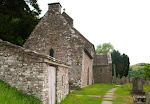
Llanfihangel Pontymoile-St Michael in the 'Circle of Heaven' Cilcoegan.

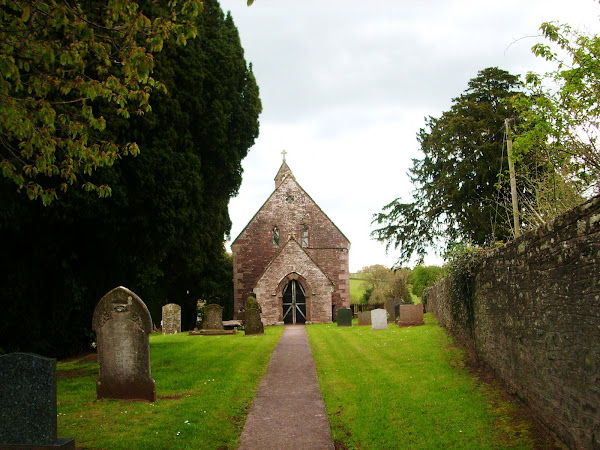
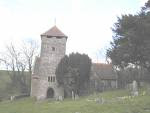
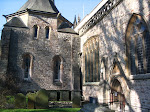
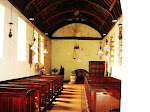
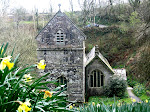
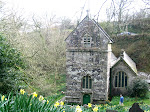
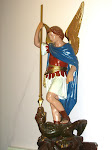
The Reverend Jennifer Mole showed me round the small but pretty Church of Llanfihangel Pontymoile this week. The second part of its name-the Bridge of Moile is easy to see, a llan is awhat it always was a Cambro- British Monastery and ‘Mihangel’ the name of the beloved and fierce defender of the Lord, St Michael. This was not its original name which was Cilgoegan. So who was this lost saint, who was despatched upon the arrival of the more powerful St Michael, which did not happen until Tudor times, after Henry VIII dispute with Rome and the founding and reorganising of his own church                              

St Michael was a popular dedication in Monmouthshire and often associated with mountains. J Darrell Evans , who wrote the guide book for the church writes' there were so many dedications for this defender of the heavenly hosts in this unstable borderland, they were each given another name to distinguish them'. The nearest village was Pontymoile, more than a mile away, and this name predominated by the seventeenth century.
It was all part of the manor of Cilgoegan, stretched between Cae Brest, the river and the Clarewaun brook and part of the lordship of Usk.
In the ‘Taxatio’ of Pope Nicholas in 1254 it appeared the church of Kilgoigen in his inventory of the churches in England and Wales. When the churches were taken by the king, in the sixteenth century they referred to Kylegoygane annexed to the parish of Panteg. This always seems to have been a small chapel and quite poor. Both Panteg (originally Llandeverguir? Given in the sixth century to St Cybi by the petty king Edlogan after the famous miracle) and Llanmyhangel are given in the charters as belonging for nearly five hundred years to the Priory of St Mary at Usk. Interestingly, neither church appears as having any  assets at all in Henry VIII officials of additions of the land and possessions, including trusts and offerings made by the faithful which he  took for himself.

       
The parish name seems to have appeared as Llanfihangel Pontymoile on the first published map of Monmouthshire by Christopher Saxon in 1577.By this time ‘llan’ had come to mean church, but it was not exactly this, as we know it was an early British monastary, and as its name suggests, this was perhaps originally a hermitage. (‘Cil’ is Welsh for Latin ‘Cella’ or cell-a hermit’s cell)so St Coegen may have originally been a hermit. However, extensive searches have not revealed such a saint, so Coegan may have simply been humble hermit, living in this little chapel in the grove. There is no doubt that the church was rebuilt in stone after the conquest and served the Christians living around it at a time when most people lived on the land and worked it. Yet the plague perhaps (1315-1317) caused many such small agrarian communities to be wiped out, and the churches attached to them never recovered their former numbers. This seems always to have been a small chapel in a grove, and  though dedicated to St Michael, it seems likely that the British term CEUGANT  suggested the dwelling, the realm of the Druid God, and may have been kept by the Christian hermit living there. Druidic lore was always an oral traditions, whose rites were not even written down until the seventeenth century. In the absence of any important founder, the cell of this hermitage probably existed on the site of an older  and deserted Druid grove and the name stuck for some time. In the  Priory at Usk ,it was simply called Llanmyhangel-obviously the name it was known by from its take over by the Benedictine nuns.
There is also a possible link to Coygan(!) from ceredigion, who was a leader at a hill fort there and it is always possible that this grove was the place where he spent lent away from the world in penance as so many of the saints of this period did. In the absence of any firm sources, however, this is speculation as I can find no other references and this practice of Lenten retreat was common at the time.

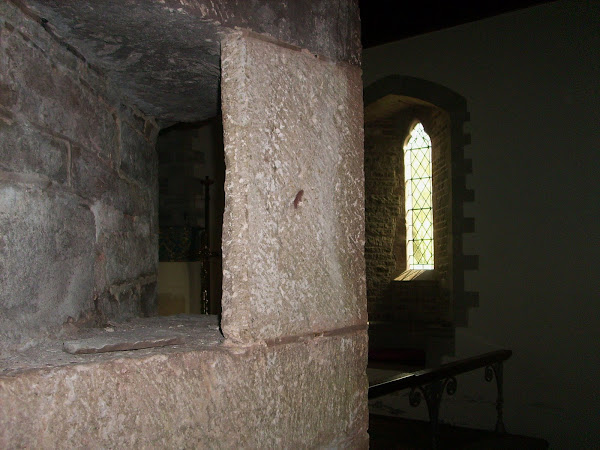
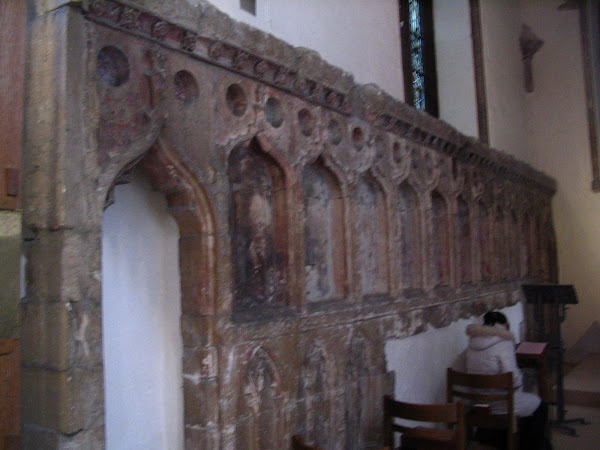
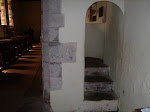
The rood loft was removed from the church after the Reformation, which would have contained a picture of the Doom and the great Crucifix, under which the Faithful would come to confess their sins to the priest sitting there in persona Christi.Nowadays if you approach the pulpit through the Vestry , there is a narrow door through which the person preaching has to approach. This was the door which originally led to the rood loft.

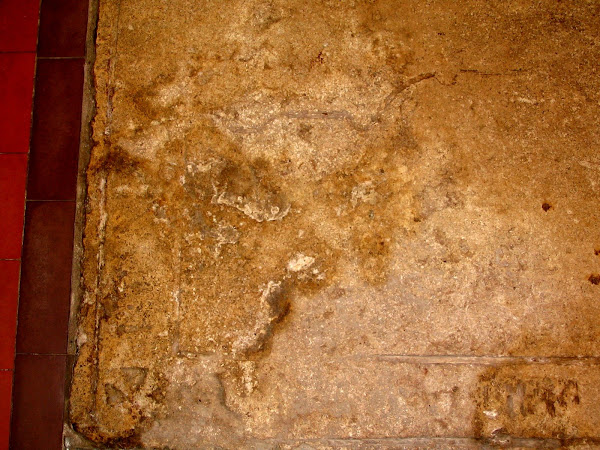
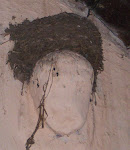
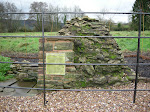
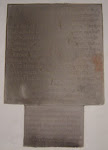
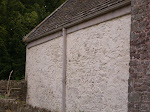
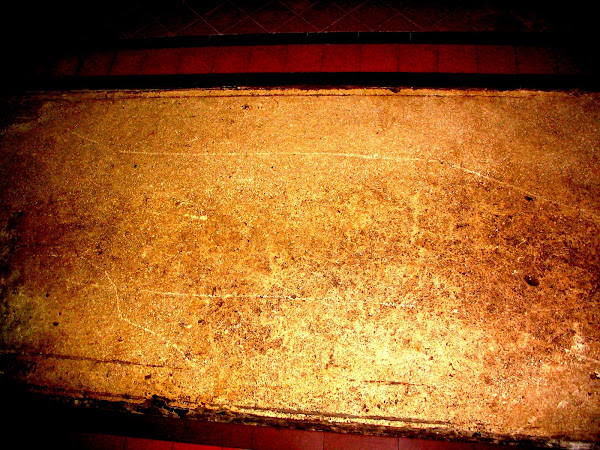
On the south wall of the Church is a very old memorial stone tablet (pictured above) with an inscription in 18th century lettering. ‘Here lieth ye body of Thomas Iones of Glascoed who departed this life in the 14th Day of September. Ano Dom 1713 .Aged 41 years’.


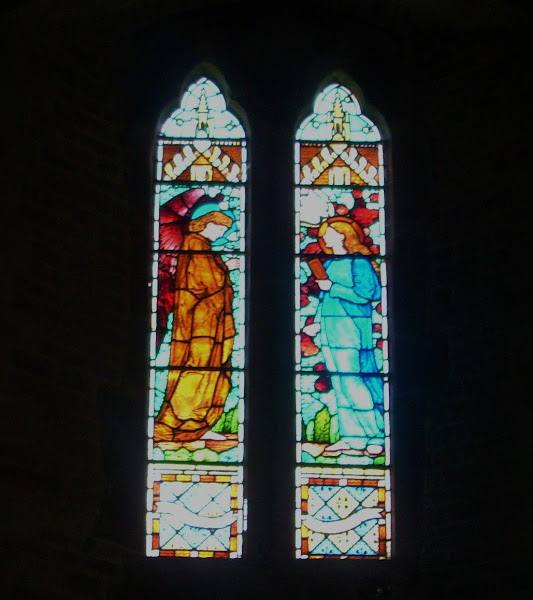
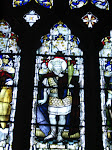
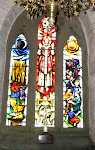
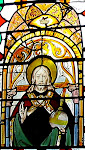
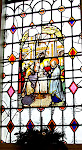
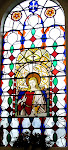
The Wakinshaw Windows are of later date and depict the Holy family in one panel and Christ reading the Scriptures(!) in the other. Walkinshaw funded the Free Press of MMonmouthshire newspaper and the windows are probably to remind people of the fact he was a newspaper man. There is another beautiful window in memory of his son Alexander James, who died at only nine years of age- something beautiful for what must have been a terrible family tragedy.
.
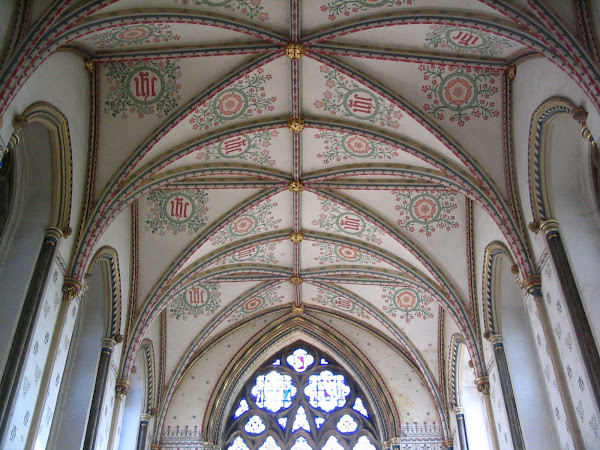
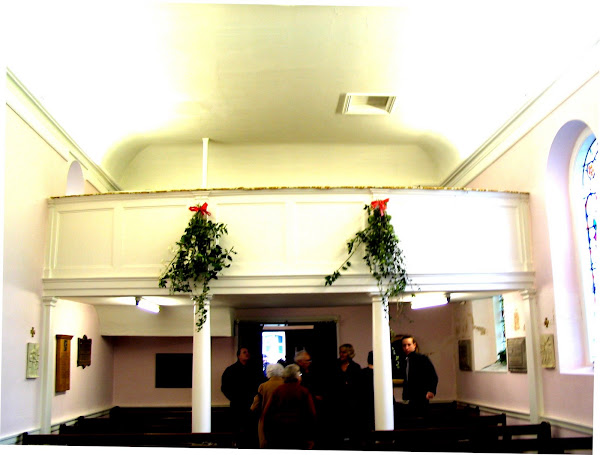
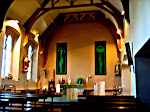
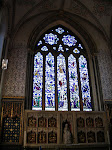
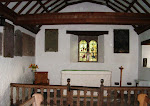
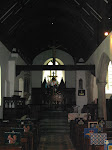
The ceilings show much wear and tear and flaking plaster which is a shame. It is a very small country church with only `11 regular churchgoers who cannot afford the repairs. The church  has put out an appeal for help for the £8,000 it will take to deal with the roof and stop it collapsing.

 It is a Norman style barrel roof with small; gold rose bosses.the present ceiling comes from the eighteenth century. The whole structure remained intact when in 1924 the church roof slipped off, the crash giving rise to the rumour that an earthquake had happened.

Thefts and an appeal for the twenty first century. 

Sadly the church has to be kept locked because of the large number of artefacts which have been stolen. The vicar tells me lead has recently been stolen from the roof of Panteg Church as well and this little church of Heaven, needs £8,000 to repair the ancient roof with only 11 older parishioners. It is a Grade II listed building. There are only 420 people living in the parish.
Prayers please,  especially at this time. If this amount can be raised, there is a possibility it can be matched.
The Church in Wales website has details of this little church at Pontymoile which is attached to the Church at Panteg if you can help.

Wednesday, May 6, 2009

Church of the Virgin at Panteg-a gift, St Cybi, the Miracle and the Well.

Apologies for he darkness of the pictures below. I took them in the evening and they are not as bright as I would have liked.


Scholars , such as W Rees who compiled the ‘Lives of the British Saints’ have placed the first reference to Panteg in the ‘Life of St Cybi’ where its early name was Llandaverguir., where the Blessed St Cybi himself left a small hand coloured bell. He left there to go to Menevia, city of St David and stayed there for three days.

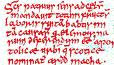
Deinde Ethelic tribuit in perpetuo Sancto Kepio duas ecclesias, quarum una lankepi vocatur, altera autem Landaverguir , et ibi dimisit Kepius parvum digiti sui cimbalum varium. Tunc Sanctus Kepius benedicens Etherlic regem, egressus est inde ad vcivitatem Meneu Sancti David, et ibi moratus tribus diebus et tribus noctibus.Vita Sancti Kebii

The Church of St Cybi (same saint as St Cuby in Cornwall) is well known, but the parish of Panteg has an unknown patron (apart from the dedication to the Blessed Virgin, which was common to all churches )and is adjoining the parish of St Cybi and also of the land of the chieftain Ethelic.(who gave his name to Edlogan (Edelgynion) the Scholar A.r.Rees suggests the likely site to be the church parish next to St Cybi’s, that at Panteg. Llan is clear, but Da verguir -could point to an early tradition of the Saints name. Spellings were not standardised at this time, and mixtures of Welsh and Latin not uncommon as the Church at Pater Ishow's shows at Patrishow.Furthermore all services were held in Latin, and lay people instructed in the meaning of the Mass.Then there is Gwentian dialect as well, which altered spelling, so it is there to consider.

The Legend, the Miracle and the Holy well

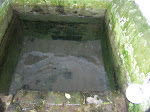
We are told that when Cybi his monks and his soul friend, St Cyngar (of Llangefni)came to a small church where the church of Llangibby is now, he stopped travelling for a while with his companions , he laid a cloth on the floor and spread his tent. The Chieftain Ethelic saw them and sent a man down to find out what they were doing, and after finding out the man told Ethelic told him they were monks. Ethelic was furious and went to eject them from his land, but as he rode off in a temper he was thrown from his horse, and his horse immediately died, and worse , as a sign, Ethelic and all his men were struck blind. Then Ethelic prostrated himself on his face and gave his body and soul to God and to his servant St Cybi and he and all his men had their sight restored. Then St Cybi was given two extant Churches, the fair Church on the fair land Llandaverguir /Panteg and St Cybi, where a spring had sprung up on the site where Ethelic had prostrated himself before God. There follows the information that Cybi went from Panteg to St Davids (in Pembrokeshire) for three days and then sailed to Ireland.

Very Early catholic Catechesis?

This account by Iolo gives us more information still. That there were Church buildings here of some description from before the date of the visit of Cybi and his monks and the great miracle. This was probably the result of the missionary efforts of St Medwin (Medw of Michaelston le Fedw. Comments by Gildas and Tertullian attest to the fact that South Wales was Christianised from the very earliest times. (See the new scholarship:St Lucius of Britain by David J Knight.(2009)

St Cybi of Llan-gybi-Some biographical details
Cybi was one of the great Cornish saints, the son of St Selevan of St Levan in Cornwall. Selevan is a Welsh / Cornish version of ‘Solomon’. St Cybi(nicknamed ‘The Tawny one’ also has a holy well at Duloe .He was born near Tregony , or Callington(now called ‘St Cuby’) but claims are made for Duloe near Looe, of whose church he is the original patron. He studied the Christian faith avidly in youth and at the age of 27 he made a pilgrimage to see Pope Symmachus at Rome, who was made a saint, because of his support, financial and spiritual for the northern Italians, who were being constantly attacked by Germanic tribes, and the amount of aid he sent with Christian brothers who took food and clothing to the African tribes, who were also being attacked and killed by Pagan tribes of Germania at the time. Following this Cybi visited the Patriarch Helliah I (494-516) at Jerusalem, an amazing journey at that time, yet many saints travelled to these places from this time onward. A surprising number of people went to Rome and Jerusalem at this time and we know later, under the Laws of Hywel Dda,in the Gwentian code, a criminal could remove a death sentence for a terrible crime and return to the community, if he made a pilgrimage to Rome and confessed it there. It must have been a huge undertaking, but it was Welsh Law. Cybi however, received more teaching and scholarship and then went on to visit Hellian, in the last century before it was overrun by Persian tribes.
Upon his return to his native Cerniw (Cornwall) Cybi began his Christian evangelisation in earnest. he made his ‘Martyrdoms’ constantly putting himself in the hands of God, travelling from Cornwall in his case. He travelled from one monastic settlement to another, baptising and creating new monasteries. Under the laws of ancient British hospitality, each llan was in duty bound to provide food and accommodation for such travellers, free of charge. From the moment he walked into a village with his coloured bell, rung to announce his arrival, (the arrival of a holy man) he would begin to tell people about the amazing plan of Salvation of God and the sacrifice of Christ. In Cybi’s case, he travelled from Cornwall to Wales and Ireland.
He established the Church at St Cybi (Llan-cybi-Llangibby) and has been called one of the MAKERS OF CHRISTIAN WALES. He established his largest monastery at Holyhead (Caer-Cybi—Caergybi)where he was Abbot.

Llandavergui llan da vergui (The Church of the Virgin? (Da Verga)/ Panteg

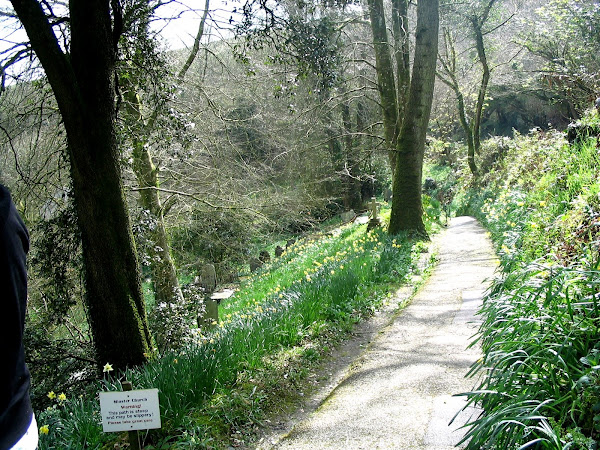
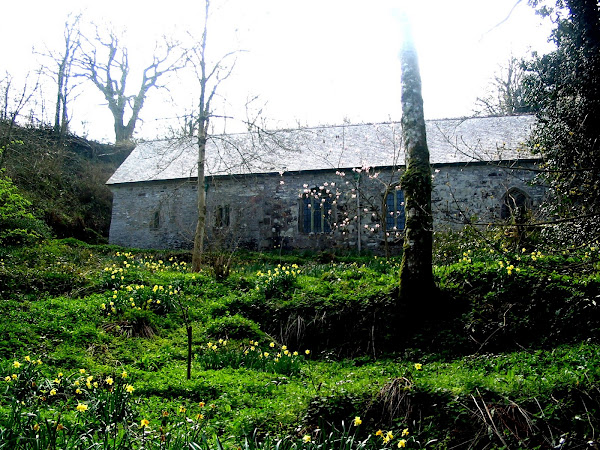
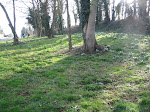
Panteg, or as shown on older maps Panteague, means "Fair Hollow". I found the church at the end of a long lane off the main road through the village of New Inn, and found it with part of its Welsh form of the Circular churchyard, which was the border of the place which was holy and separated it from outside world. It really is a beautiful place.

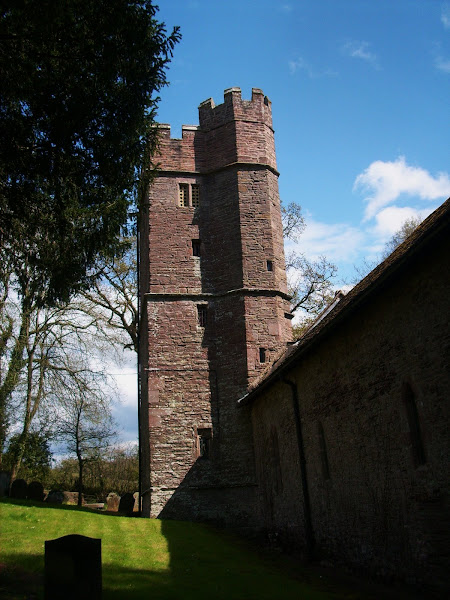
We presume it continued as a small Welsh Church, possibly built in stone in Saxon times .The next mention comes in the ‘Taxatio’ of the Pope Nicholas n 1254. This little church was considered too poor to pay tax to Rome , as it was rural (and still remains so today)It was dedicated to the Blessed Virgin and in Welsh would have been Llanvair under the Normans. The Normans will have extensively rebuilt the church and later, in the fifteenth century, a large square tower was built, possibly a defensive action at that time , to protect the people and goods against the constant onslaughts of Owain Glyndwr, who had attacked many religious establishments in the County, which they considered the property of the hated Norman usurpers. Goldcliff Benedictine Priory had been sacked as indeed had Llandaff itself, Llanthony and many other places. Weapons and food would have been placed in the tower.

The monk, Adam of Usk was the distinguished Parish Priest here for a while in later Mediaeval times.

Panteg Church changes

In the troubled times of the 16th century, it became an Anglican Church. TheRood screen was removed along with any works of art and statues.

Catholic Worship in Penal times

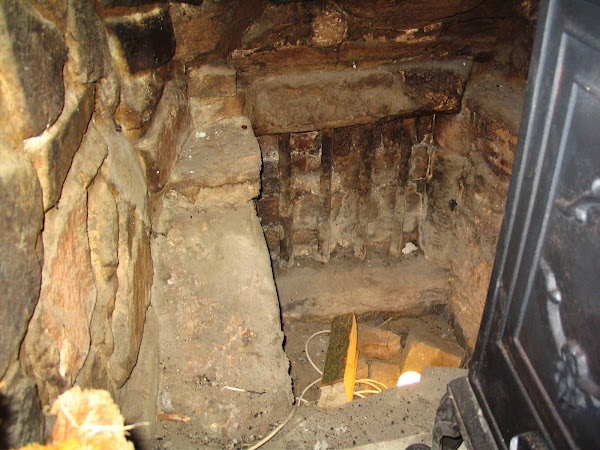
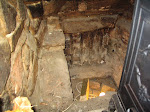
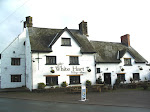
Catholic Mass continued to be provided from this time onwards at the Llangibby Public House, the White Hart Inn while the local priests had to keep a very low profile and people kept watch. There is still a priest’s hiding place in the Pub.(see photos at the bottom of this blog) This became the Mass Centre for the area.

The Church given to St Cuby became known as St Mary’s Parish Church.
St Mary's, which has been greatly rebuilt and refurbished in the ensuing 450 years and and comprises a western tower, a nave, chancel, south porch, north aisle to the nave, a clergy vestry and choir vestry. There are 3 bells in the tower - all hung for full-circle ringing and there is no better sound as you approach for Sunday Service or a wedding, than to hear the bells ringing out as you walk through the beautiful old churchyard.

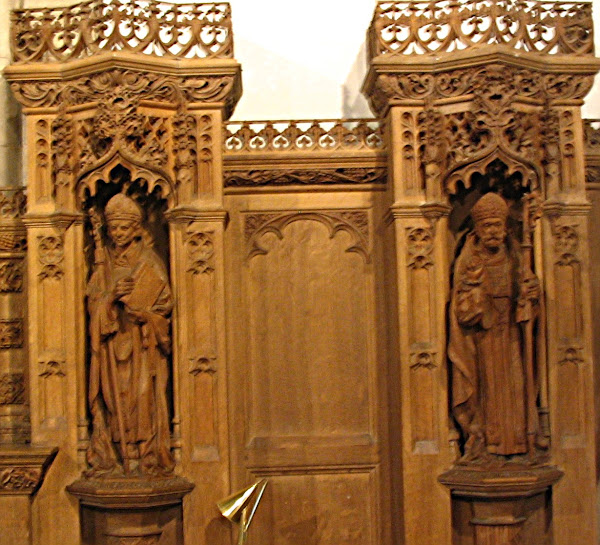
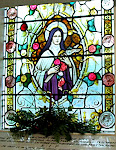
Inside, the walls are plastered, with a timber frame roof and there is an arcade of octagonal piers to the north aisle (a most unusual feature). There are plain wooden pews seating just over 200 people, a stone font with wooden cover, a wooden altar rail and pulpit all dating from the Victorian era of mid to late 1800s. A wooden choir screen was added in 1935 whilst the organ chamber was built around 1879. There are stained glass windows to the north aisle with a painted tryptych screen alter below a wonderful east window designed / made by O'Connor and Taylor. The enlargement of the church was completed in 1876 and one more bell added. In 1935 the Chancel screen was added to the Church.

Tithe Barn
There is a tithe barn nearby , it was probably a grange belonging to Usk or Abergavenny Priory-more more research needs to be done. The Tithe Barn became a school in the nineteenth century . A Reverend James confirmed a great many people in the church. He and his wife built the school at Pontymoile as well during the 14 years he was there as clergyman, with his wife. He was greatly esteemed andd the great stained glass window was erected as a tribute to his memory by his friends.

Disestablishment of the Anglican Church 1920

Changes to the governance of the Church came in 1920 with the Disestablishment of the Anglican Church in Wales (before we had been part of the Church of England). The Diocese of Monmouth was newly formed and Panteg became one of its parishes.
Throughout its history, St Mary's has seen many changes and welcomed many people to worship. There have been many changes through all sorts of trials and tribulations, through financial crises and the development from a strictly rural area to that on the fringe of an industrial new town of Cwmbran. In its quiet and tranquil surroundings it remains loved and cherished by its congregation. I experienced some of that welcome when I arrived to take photographs during an evening when two friendly ladies were polishing every pew of the church and we had a warm conversation, while someone outside was mowing the lawn and tending the grounds.
The site has continued since the second century as a place of the worship of Christ and that is a survival story.