


Wednesday, April 23, 2008

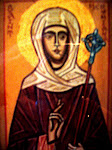
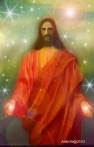
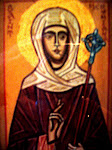
Saint Tydfil (Tudfal) of Merthyr Tydfil,daughter of Brychan, Mother of Teilo


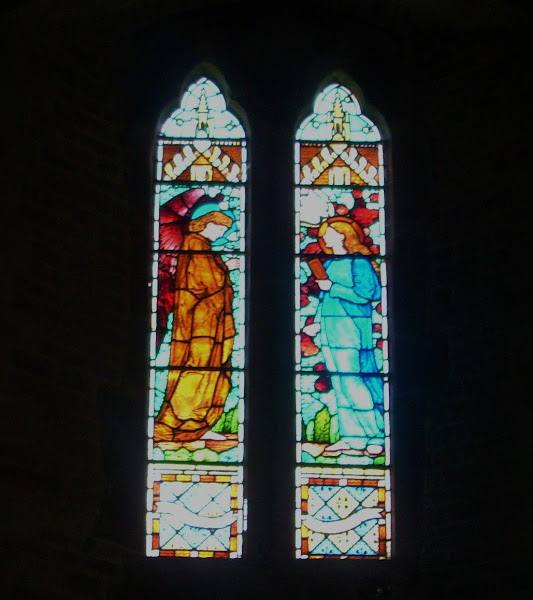
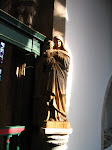
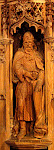
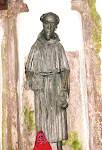
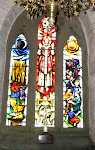
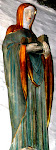
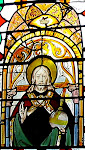
Tydfil and Teilo at Llandaff Cathedral
Above the Martyrdom of Saint Tydfil

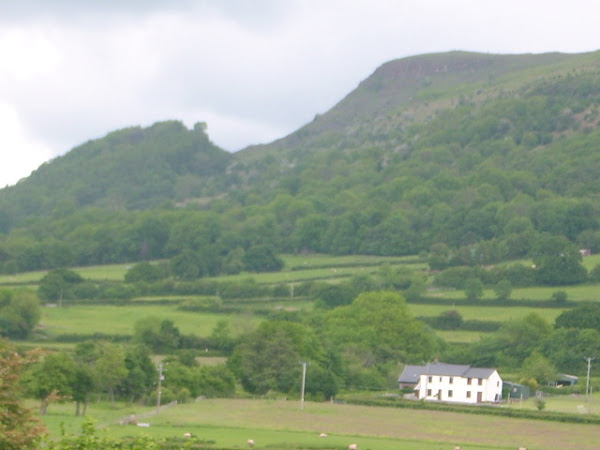
Yesterday I put up a podcast about two South Welsh saints. We have already mentioned a daughter of Brychan Byrcheiniog whose name was Gwladys, who married Gwynlliw (st Woolos) and became a religieuse. and gave birth to another great Welsh Saint-St Cadog (Cattwg)the Wise. Brychan had many daughters Most were married to chieftains and petty chieftains. Gwynlliw’s son Bugi had married his cousin Goleu who gave birth to yet another great Welsh Saint-St Beuno who figures in the story of St Winifride.Tydfil was also married to a chieftain in West Wales in what is now Pembrokeshire. When her husband died or was killed she returned and embraced a life of chastity. Her father , Brychan received a plot of her fathers land at the foothills of the Brecon Beacons, where the land was fair and fertile. She probably planted an orchard-or had one planted for her, had her own small hut and a tiny church built at the centre of hier little Island of land. The women grew their own food and herbs and they prayed the Prayers of the Hours every day dedicating themselves to the service of the small community round about, offering their services as healers, herbalists giving remedies, growing lavender and buying or even growing sheaves of corn to crush it to meal and bake bread.Some of the men would fish too. It was unlikely Brychan would leave his daughters to fend for themselves. They would probably have had a weekly visit from a priest from her father’s court to administer the sacraments and say Mass.

The role of the Priest was important in these times in a court. The Priest would take care of oaths and legalities and be responsible for the care of the relics and church property as oaths were always sworn over the relics. If you want to know more about this and the other Laws ofHywel Dda lstn to thePodcast on Relics and St Teilos Skull-a very interesting story about how St Teilo’s skull ended up agoing around the world!

Life in an Early Welsh Convent


Tydfil and her women as many nuns in the centuries to come would offer theirexpertise in helping women with childbirth when their confinements came. They devoted themselves to feeding the hungry, clothing the naked and caring for the sick and the other works of mercy.The Catechism of the Catholic Church says :’The fruits of Charity are joy, peace and mercy; charity demands beneficence and fraternal correction, it is benevolence; it fosters reciprocity (inspires the same generosity and love in those to whom it is given) and remains disinterested and generous. It is Friendship and Communion. Love is itself the communion of all our works. There is the goal, thatis why we run towards it, and once we reach it, in it we shall find rest.’Para 1829.

Work and Mission

Mary was their Patroness, the Mother of Mercy and their inspiration to follow the teachings of Christ, as Mary always points to her son. They would have learned to card and spin wool, weave and knit again with a few male servants to did the harder aspects of animal husbandry. We know St Maches, Gwynlliw’s daughter had worked as a shepherdess. Tydfil was greatly loved locally by all, and made strangers welcome. She tried to live out the vocations to which she had been called in the same was as Mother Teresa and her nuns, and the large number of Franciscan and other sisters and brothers around the refugee camps in Zimbabwe, giving Hope to those for whom life is hard and so the church goes on.


Tudfal and Teilo

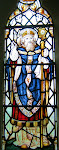
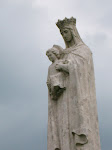
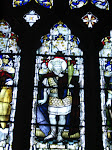
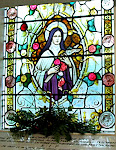
Tydfil seemed to love the secure life she had and gained great joy working for the Kingdom of Heaven.The stained glass window shows Tyfil with the child Teilo, who may even have been brought up with his mother at her monastery for a while until he was sent away to school at Ty Gwyn. We can only assume, Teilo having been born at Llandeilo in West Wales, that her husband died, and there were other children to succeed him.. They may even have continued a Roman custom that when children had been born and grown up, a married woman, supported financially by her husband had freedom to go and follow her religious vocation, as Roman ex wives had become successful farmers and business women. With the help of some of Brychan’s servants who came to help them build their strong church and walls, they built a small settlement, probably from wood or mud and wattles, and became a Christian centre, offering Mass to local people, who perhaps had no priest.

Anglo-Saxon Raiding Bands

This was, however during 400-600AD and before the routing of the Saxons by Meurig and Tewdrig at Tintern. (Meurig had been named after St Maurice the Roman Commander who with his whole legion had been martyred for their faith. Many places in Europe too were named for him-eg Saint Moritz. Tewdrig was named for the King Bishop Theoderick (also of the Eastern Catholic Church)who popularised the fate of the Legion. It shows that the Welsh Church was very much part of the Universal Church at that time.)


Fall of Glevum (Gloucester) gave access to Wales

Ceowulf the Saxon had taken Glevum (Gloucester) but did a deal with the Angles who had settled in Mercia. They were just beginning forays into Wales. King Arthwys had stemmed the tide at the Battle of Mons Badonis (Mount Badon) near Bath before his death but the tide of Saxons entering the Country was strong. The Saxon threat was not the only one. Irish raiding parties were rife, moving up from Swansea and the coast up the heads of the valleys track, in search of lucrative 'llans' to raid, young healthy people for slaves as well as gold or silver.
St Tudfal gains a Martyr's Crown

Tydfil chose as her home, the Taff River valley, sparsely populated by Celt farmers and their families. She became known for her compassion and her healing skills as she undertook to nurse the sick: human and animal.

She established an early British monastic community, leading a small band of men and women. She built a "llan" or enclosure around a small wattle and daub church according to common practice.

Her home included a hospice, outhouses and a scriptorium. There she lived quietly, bringing hope and support to the people of the Taff valley.

In his old age, King Brychan decided to visit his children one last time. He took with him his son Rhun Dremrudd, his grandson Nefydd and Nefydd's own son, along with servants and warriors.

They visited his third daughter, Tanglwstl, at her religious community at Hafod Tanglwstl, what is now known as the village of Aberfan, south of Merthyr Tydfil. Brychan wanted to linger with his daughters a little longer, so he sent most of his warriors and Nefydd on ahead, along the homeward journey. The king went on to Tydfil's home while Rhun and Nefydd's son were still at Hafod Tanglwstl.

So the party was spread out along the Taff Valley; a distance of about seven miles and all uphill.

Wales at this time was suffering from raids from the Irish, free to roam around now that the Romans had long gone. Some had even settled at South Radnorshire, near Brychan's kingdom. Perhaps the news of the king's absence had reached the Irish settlement and they decided to take advantage of the king's vulnerability. In retrospect, Brychan would appear to have made a very foolish decision in allowing his party to split up. But he must have known that, being so old, he was unlikely to ever see Tanglwstl and Tydfil again.

Rhun Dremrudd was attacked by an Irish raiding party, a mile from Hafod Tanglwstl and he died defending a bridge over the river at what is now the village of Troedyrhiw (the bridge is still called Pont Rhun). The bridge gave the Irish free access to the King's party and Rhun Dremrudd put up a good fight. The Irish then split into two groups: one devastated the Hafod Tanglwstl community and the other pursued the king.

The king and his followers were robbed of their jewellery, money and clothes. Servants and family; they were all cut down. While the others ran and fought and panicked, Tydfil knelt and calmly prayed, before she too was brutally slain.

Then the Irish retreated over the Aberdare mountain. By then, Nefydd and his warriors caught up with them and avenged the deaths of his family at "Irishman's Hill". Then they returned to bury their dead.

Tydfil was buried within the church she founded, amongst the people for which she had cared

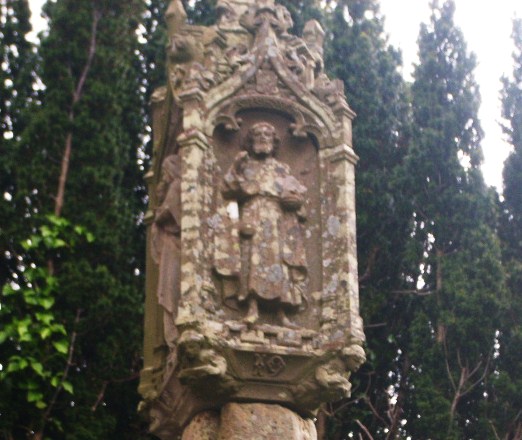
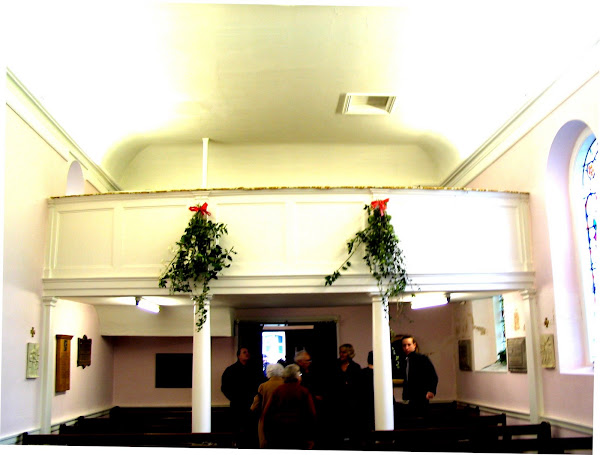
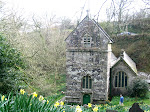
A Celtic Cross was put up in a clearing near the Taff which became a meeting place for the people of the valley. In the 13th century the cross and wattle and daub church Normans replaced the old church to a stone church dedicated to Saint Tydfil the Martyr, which was itself replaced in 1807, and rebuilt again in 1894. The church still stands, at its place by the River Taff and is one of the first things the tourist sees as she enters the town centre from the south side.

In recent times we have seen such cruelty ourselves, or heard of it. It is unlikely Tydfil was as young and beautiful as in the portrayal of her Martyrdom in the stained glass window, yet such a sacrifice for God made her beautiful in the sight of many. She was brave and fearless and merciful.

Stained Glass at Llandaff, and Corporation of Merthyr Tydfil. 'Mertyr means 'Martyr'

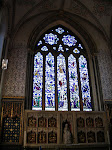
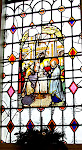
The picture of this martyrdom is contained at Llandaff Cathedral, where you can see her just before she was beheaded. She met her death bravely offering no resistance. She was not a women the Saxons would have liked or understood. These Angles were puzzled by what religious women were and may have feared them or even offered them to their many gods. The Welsh word for ‘Martyr’ is Merthyr and Merthyr Tydfil means ‘The Martyr Tydfil’to this day, she remains on the crest of the town of Merthyr Tydfil.She was buried on the site where the Church of St Tydfil now stands. The Catholic church and Priory re established in the nineteenth century was also dedicated to this remarkable woman.

Conclusions

Merthyr Tydfil is not a beautiful town today. It was not planned and developed during the industrial revolution into an important coal mining town and further disfigured by ugly council estates in the 1960s. The Coal Mine owners the Crawshay family were closely connected with the town and eventually funded an important concert Brass Band, famous throughout South Wales. The collapse of the mining industry has brought difficult adjustments but the town is proud of its martyr princess.The views are wonderful and to drive slightly north into Brecon brings you through the most amazing countryside and solitude, similar to that St Tydfil would have enjoyed. She gave Birth to one of the greatest Welsh Saints, Teilo who founded the College at Llandaff following his trip to the Patriarch of Jerusalem and being consecrated Bishop by him, and so she enriched the Catholic and Christian life of the whole of Wales.

Tuesday, April 22, 2008

The Saddest Story-Surely the Devil at work?

Yesterday Bridgend claimed another suicide victim, who hanged himself after he had gone out for the evening drinking with his friends. It was said that he smiled all the time and worked in a shop. His friends were shocked as he was always cheerful and had given no sign of wanting to end it all. His friend Chris said “He had everything to live for and was always so cheerful’.He had even just passed his driving test and was very popular.

He was found hanged in a lane at the back of a friend’s house on the Bettws estate at 7.30am 20th April. He had had a row with some of his friends the previous evening.

His parents Tracey and Byron Rees with two other children were completely shocked and upset and being comforted by their two their children.A large number of flowers have been found at the base of a tree where he was found. His devastated girlfriend Charlotte left a tribute, as did many of his
Friends like Some said he was not the sort of person to do this.
Like many of the victims, Sean had a page on networking site Bebo. He wrote: “I live for the nights I’ll never remember with the friends I’ll never forget.” A local councillor said they were so worried why people are still dying as they could not find answers.
There was talk about an evil person on the internet targeting yo0ung people and suggesting ways to end it. I think it is quite conceivable that there is something diabolic going on in Bridgend, something which actually takes over the bodies of young healthy people, possibly who are made emotionally unstable by some circumstance or event. I understand from priests who specialise in this kind of work that this is possible, and can take people over to destroy themselves and, incidentally parents and families. This I believe is a spiritual sickness. Father Euteneuer who is a Catholic Priest and exorcist said that whilst people to whom this happens are rare- and the church would always want to check if there was another reason for this first- that the numbers of possessions by spirits is rising.

Secularism has created a vacuum in man’s thirst for the infinite. Many schools have taken away the hope of the resurrection by removing all Christian spiritual content from the timetable and substituted a lot of facts about other religions and atheism, they have removed stability and security and hope for life after death. The educators and politicians think they are being clever. If you think there is nothing else-what is the point, even if you are on to a good thing. You are not even encouraged to get married and get stability that way. Even music and beauty and art such as we have heard and seen recently on the Pope’s visit to America, when do such children get much of this in school, where even music is pop music, art is not the great spiritual art. There is nothing to move them.

I would like to have that estate spiritually cleansed. I would like to see people begin to talk again and join in community activities-particularly young people. We bring them up like princes and princesses and they find as adults that life is hard and heartbreaking at times.They need grit and a will to survive Those who have been given the firm foundations of Christian Faith Hope and Love, who engage with their families, and who have a good grip of life, a healthy curiosity and spirit will cope far better. When you have such words written on your Bebo web site, you have to ask what is there in his soul. Do some have too much leisure, or are we not inspiring the young to create music and art to the glory of God, are we not encouraging them to take and interest in things of the spirit and self sacrificing love for others? Looking outwards can heal the hurt within yourself. Or is it that for some there is no priest to talk things over with, no one to talk about those deep things of the soul, that most don’t want to hear about or even understand. God loves all who have died. They were all precious to him. Shaun must have carried beneath that ever smiling face a deep and searing emptiness as so many do today. I will pray for him, his parents and the life he never had. May his soul and all the faithful Departed of Bridgend Rest in Peace.Mary, pray for us all.
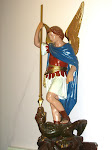
St Michael protect them with your fiery sword.

Monday, April 21, 2008

St. Brynach (born around AD 500)An Inspirational Saint fromthe Holy Land


-----------------------------------------------------------------------------------------------------------------

We have already learned about the Saintly St Gwladys of Newport, and later will learn about her sister,the martyr StTegfedd. It is also claimed that another sister was the famous St Tydfil. All were the children of Brychan Brycheiniog of Brecon, whom I had mentioned before several times. He seems an enigmatic figure. Even Bugi, son of Gwynlliw married a daughter of Brychan. Moreover Tegfedd seems to have been the mother of St Teilo, of Llandaff.

Gwladys was the mother of Gwynlliw. These ‘holy matrons’ seem to have been splendid examples of God’s female saints. Women who also give birth to great saints, carrying on God’s Creative purpose) and brought them up in holiness observing the sacraments, teaching holy scripture, and in widowhood have devoted themselves to the religious life. It is true that a child’s first catechist is his mother. It was Gwladys and Cadoc who brought Gwynlliw to God . (Even in earlier times we have heard about Holy Materiana or Queen Madryn of Gwent as she was who went with her son Cedwyn or Ceidio to Minster, Boscastle and Tintagel in Cornwall. When they stand before the Creator at Judgement, they could truly claim their reward. These were holy Queens and Princesses of Gwent and Brecon.

Question is, why did King Brychan have so many daughters all of them strong Christians? In these days, of course, such Kings would have large families, adding strength and prestige to the line and sadly the number of young women dying in childhood meant there would have been a number of wives during the lifetime of a chieftain. Brychan (after whom Brecon is named) would have had several wives in his lifetime, and it is also believed by scholars that some daughters were actually grand daughters.Brychan is believed to have been descended from the line of Joseph of Arimathea, according to British records.

Brynach was very influenced by his Confessor, St Brynach.He is known as Brynach the Irishman (Brynach Wyddal) however this may not have been his country of origin. The Vita Sancti Bernaci ‘Elegit sibi Dominus virum de filiis Israel juxta cor suum, Bernaci nominee, venustia ornatum moribus, tiulisque virtutum insignibus virtutum insignibus excellentem..’so we may take this at face value and claim he was a Jewish Christian and someone of means. He was from a wealthy background.He may have been the son of a worthy merchant in Jerusalem perhaps.The Vita goes on ‘not considering the country of his nativity to be his own, he was anxious to remove of it to acquire one of himself by travelling to another country. According to the teaching of Christ, and following his example , he expected by relinquishing all his wealth, all things would be given to him.. He went to a ship and trusted in God and travelled to many countries sowing the seeds of the teaching of Christ. There, burning with desire for God , he spread the Word.’

There follows an account of how he slew a beast which was terrorising the countryside around Rome, where he had made a pilgrimage. He escaped from it, but then ‘by the sole power of prayer’ he was . He became very well known, so decided to leave Rome and sail somewhere else, wishing to remain humble and anonymous. It goes on.’Then, performing a long journey , and wherever he came,giving an example of goodness to be imitated by all, and travelling towards the western parts of the world, he came to Lesser Britain’. In the Welsh (Romanised Celt) Prydain (Brudd-eyen) was the name for Britain. Prydain Fawr (Greater Britain=Great Britain) and Prydain Fach (Lesser or Little Britain=Eire) He spent a great deal of time in a healing ministry in Ireland which probably accounts for his nickname Brynach the Irishman!(Brynach Wyddel) Sick persons came from all over and others came to hear his preach the gospel for the good offices of the soul. But again , he became very famous and by way of Brittany (Armorica) where he travelled first, he came to Wales. Legend says he was floating on a stone (probably his portable altar) He arrived at Milford .Unfortunately he had to fight off the amorous advances of a daughter of a local chieftain.She tried to seduce him and gave him and gave him an aphrodisiac of Wolfbane to drink, but it did not work because he refused it.She then tried everything to be rid of him and sent thugs. They stabbed him, but God moved others to protect him. The would be murderers were attacked by insects, possibly bees and died a horrible lingering death. Brynach went to a nearby well, washed his wound clean and washed off the blood and this is the origin of the Red Fountain now St Brynach’s Well, which became famous for its healing properties. It became called ‘Fons Rubens’
At Cilymaellwyd he was not received well and was forced to shelter under a grey stone. Eventually he built himself a small hermitage at Llanfyrnach in Pembrokeshire.

He first travelled north-east to Llanboidy (Carmarthenshire) where he was denied lodgings by the locals and slept in a cow-shed. At Fishguard ,too, he liberated the place of demons who cried out at night and gave ‘horrid howlings’.He then established his foundation at Never, called the Grove of the Ancient Church. His followers set about building the monastery but every morning everything they had done was undone. God told Brynach not to stay there and gave , precise directions to Clechre (Clether)where he was helped by a local Christian Chieftain. This Chieftain, Clether, was so impressed by Brynach and his rhetoric that he gave up his throne in order to retire to Cerniw (Cornwall) as a Christian hermitBrynach did this but embarked on a course of denying himself almost everything fasting watching, praying doing without. Brynach travelled all over South Wales and came to the court of King Brychan who was very impressed by the sanctitity of the holy man from so far away. Brynach and Brychan became friends and the whole family of Brychan came under his spell and became lifted to heavenly ideas. Brychan remained at the court of Brecon for some time, no doubt establishing a foundation. Before continuing his travels.

David Hunt Nash in his website ‘Early British Kingdom’ writes
During his life at Nevern, he often moved around somewhat South Wales, founding churches as he went, including Llanfrynach in Brycheiniog and Llanfrynach and Penllin in Morgannwg. He became a great friend of St. Dewi who often visited him at Nevern. Once, Dewi arrived carrying a heavy highly-decorated stone cross-head. He was taking it to Llanddewi Brefi as a memorial to his achievements at the Synod held there in AD 545. However, Brynach persuaded Dewi to give it to him instead. He had an equally finely carved shaft made and mounted the cross on the top, installing it on the south side of Nevern Abbey Church. (The version there today is said to be a 10th century replacement).

Eventually, St. Brynach left Wales to try his luck in Dumnonia(Devon and Cornwall). He lived as a hermit at Braunton (North Devon) and it was there that he died on 7th January (according to his West Country adherents) and was buried in his church there.
In Wales, however, his feast day is 7th April perhaps because this was traditionally the day on which the first cuckoo in the country is said to sing every year from the top of St. Brynach's famous cross in Nevern churchyard.
A 13ft high, 10th-11th century patterned Celtic cross (in the churchyard) is one of the finest Mediaeval high crosses in the country and the Vitalani Stone is notable for its 6th century Ogham inscription. Nevern was also on an important pilgrimage route to St. David's and the Pilgrims Cross can still be seen cut into the rock and was said to be the place for prayer of passing pilgrims..'(David Hunt Nash, Early British Kingdoms)

So while we have left Gwent for a short time here, we have seen the witness of a great and holy Jewish Christian Saint who had such an enormous influence on the whole of Wales, and particularly in our Holy Newport Saint Gwladys, who converted her bandit husband Gwynlliw , gave birth to Cadoc. So the great teachings of Christ worked on in Wales and elsewhere through the centuries.

From the Prayer for the saints of the Isles (adapted from Orthodox Troparion)

‘With what beauty or hymn shall we praise the divinely wise of the Isles, the splendour and adornment of the Church of Christ, the crown of the priesthood, the rule of piety, the never-drying wellsprings of divine healing, the outpouring of the gifts of the Spirit, the streams of manifold wonders which gladden the Isles and all those who seek God. For whose sake the All-Merciful Christ has cast down the uprisings of the enemy.: Let the earth make glad and the heavens rejoice, in praising your toils and struggles, your spiritual courage and purity of mind, O Venerable Ones, for you were not overcome by the laws of nature. O holy company and divine assembly, you are truly the strength of our Isles.
O blessed kings and queens, divinely-wise princes and princesses, who shine forth with loving-kindness and are resplendent with virtues: You enlighten all the faithful, driving away the darkness of the demons. Wherefore we honour you as partakers of never-fading grace and unashamed preservers of your inheritance, O right wondrous ones.
+Glory Be to the Father, the Son and the Holy Ghost as it was in the Beginning is now and ever shall be, World without end. Amen.

Friday, April 18, 2008

Praise to the Lord of Heaven and to the Trinity

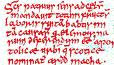
From The Black Book of Camarthen
Below: The Priory of St Mary Magdalene, Goldcliff (site)dedicated to Our Lady.The white Benedictines from the Abbey of Bec in Normandy prayed here to the God of Heaven.


1 Be it mine to praise Him,
Who is great in praises:
Him as Ruler I adore,
For He has increased the fruit
Of His charity!

2God has guarded us
God has made us
God will save us
God is our Hope
Worthy and perfect--
So beautiful His destiny.

3 We are O and A’d of Him,
Who is in the highest heaven
King of Trinity:
God was sorely tried,
When He was entering
Into suffering and pain

4.God has come!
Though He was imprisoned
In His gentleness
Sovereign most blessed
He shall make us free
For the Judgement Day!

5 He shall bring us to the Feast,
In His mildness
And His lowliness:
In His Paradise,
Holy shall we dwell
From sin's penalty.

6.We have no health
But in his agony
And the five wounds
Unsparing His grief
In human defence was
When He took our flesh

7 To God we were lost,
Except for the ransom
By a blameless decree:
From the blood-stained rood
Streamed forth Salvation
To the wide universe!
Mighty Shepherd
Never shall the merit
Of Christ decay. Amen

Thursday, April 17, 2008

St Peter Visits America - Further updates on Madeleine


The Pope celebrated his 81st birthday with a speech from the South Lawn of the White House, insisting that religion had forged "the soul of the nation" and should continue to be a "precious source of insight" to Americans today.

That speech marked the beginning of the Pope's first visit to the United States, a five-day tour of Washington DC and New York.

The Pope said "God Bless America!" adding that he had come "as a friend, a preacher of the Gospel and one with great respect for this vast pluralistic society".
He said that the country's quest for freedom was linked "to a moral order based on the dominion of God, the Creator".

I have, as you see, been watching the continuous streaming of live coverage via EWTN website after seeing tiny snippets on TV. In fact you would have hardly known thousands were lining the streets in America. His historic visit was eclipsed by endless coverage of ----wait for it----Gordon Brown and his self induced credit crunch. Disgusted I saw a bit more of the visit on CNN and then finally was told by Father Roderick on the Daily Breakfast podcast that it was available all day on EWTN. God praise Mother Angelica and EWTN! Anyway click video. Difficult for anyone to get an idea of the scale of this as he has been virtually airbrushed from the news coverage.

Madeleine McCann

It seems that the PJ have asked for a reconstruction of the events of last year on May 3rd to try to desperately solve the mystery. They have listened in as British Police have questioned the nine friends at the Tapas bar that night. One wonder, however what new news they have to be able to confidently claim they can solve the mystery and whether, if the kidnapping of Madeleine was in revenge for something, whether anyone in the party was righting some wrong they believe has been done them and is holding her in a place of safety while they turn the knife, whether returning to Portugal for the parents may be a big opportunity to further torture the parents or even take them in to custody as they seem to have been made arguidos or official suspects on the flimsiest of evidence, so how much more flimsy evidence would there have to be for arrests? It is a risky business. One of the Portuguese police chiefs said that their interviews had left them without a clue and they were clutching at anyting.
I wondered whether police had gone into the relationships of both parents before their marriage. Were there any disappointed and aggrieved disappointed former girlfriends or boyfriends. Who donated the eggs for Kates DNA? Might there be a link there? Did someone want Gerry's research? The questions abound. The fact they are Catholics means there could have been some conflicts of interest between his research ,which may have been lucrative for someone, which he may have witheld in respect of his religious views. There are really so many avenues here that should be explored. Whoever is responsible, it is a wicked act, and this little baby should be returned to her parents forthwith.

Haut de la Garenne

A rather grisly new find at the Haut de la Garenne Home in Jersey. A man came forward and had seen two large holes like pits at the rear of the home. He had asked the people in charrge what they were for and he was told told to mind his own business. The police excavated one o the pits two days ago and found it to have been filled with lime at some stage. Quantities of lime remained at the bottom . The police have no idea what the purpose was and why they were filled with lime-I think I can guess-can't you? If anyone does not believe in the power of the devil to possess people already steeped in evil- just look at this place. God bless all those who suffered and bring them to Glory with OUr Lord.


The Pope criticises American Bishops for their handling of scandals

The Pope last night criticised American church leaders for their handling of sex abuse scandals but said that an increasingly secular society needed to shoulder some of the blame, but that the paedophile scandal must never happen again.But he said,
"What does it mean to speak of child protection when pornography and violence can be viewed in so many homes through media widely available today?" he asked at a prayer service attended by hundreds of US bishops.

He agreed with Cardinal Francis George of Chicago, president of the US Conference of Catholic Bishops, that the church had dealt with child abuse "very badly".It must never happen again and he was ashamed that some priests of the church were involved in it. (The Church has now instituted child protection officers,and procedures making sure any future problems will be dealt with quickly and effectively by the police-Editor)He said it was up to the Bishops to now heal the rifts and pain caused by the scandal and protect young people. He said that the majority of the clergy in America do well in evangelisation, and it was important that they should be a shield and always protect vulnerable young people under their care. Further children should grow up with a healthy attitude to sex, with the dignity of the human person and the gospel of life. Pornography and violence can be seen in every home and all have their part to play in this revolution of overturning these immoral perversions. Moral values must be taught so that life can flourish. They must address sexual acbuse also in the values of sexual mores.There must be a determined collective response. There has been shame and loss of trust-this brings you close to the crucifix in the pain of Christ in these sins. Jesus is present in the midst of suffering and walk along the path of hope.He hopes for a holier priesthood and this terrible time will bring a period of purification and turning darkness into light. All is being made new in the Light of Christ of Hope.The Bishops would have to lead by example. You must inspire priests to rededicate themselves in holiness, we all need to experience the joy of a Christ centred life, immersing ourselves in prayer. This sustains the life of the whole community. Time spent in prayer is important, the Rosary releases and consecrates us to Christ. The Liturgy of the Hours sanctifies every day and keeps us Christ centred. His healing must be brought to the Faithful.Open yourselves up to the power to the spirit in prayer.He dedicated the people of America to the Immaculate Mary.He wished them peace and joy in the Risen Lord.

Wednesday, April 16, 2008

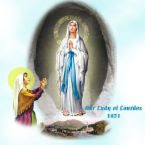
Happy Bernadette's Day! New Grotto at Tredegar


Saint Bernadette,was born Marie-Bernarde Soubirous (January 7, 1844 –, She was a miller's daughter from the town of Lourdes in southern France.
From February 11 to July 16, 1858, she reported eighteen apparitions of "a Lady." And reported to her astonished family that the lady had said she was the ‘Immaculate Conception’ a concept she could not have understood, as her Confirmation had even been held back because of her simple mind. The ‘Lady’ appeared on what was the site of the rubbish dump in Lourdes. Bernadette was told to dig for a holy spring at the sight, initially she made her self very dirty with digging with her hands in obedience to the ‘Lady’s’ instructions. As people turned away, thinking her a simpleton, the spring began to flow, and she was believed. Pilgrims started to appear at the town immediately and have been coming ever since.

Despite initial scepticism from the Catholic Church, these claims were eventually declared to be true revelation after an investigation by the Church. After her death,( April 16, 1879)Bernadette's body remained incorruptible,(see photo above) and the shrine at Lourdes went on to become a major site for pilgrimage, and attracts millions of Catholic pilgrims each year. On December 8, 1933 she was canonized as a saint by the Catholic Church; her Feast Day is celebrated on April 16. On this Feast Day of Bernadette we have her anniversary and the Pope has asked people to visit Lourdes if they can.Special spiritual rewards are available from visiting the Grotto and contemplating the message of Mary. We are asked to keep our hearts and eyes fixed to the divine promise of Jesus and on Faith and Hope in our heavenly future.

Because people are sceptical about visions and apparitions, I include today an abridged version of Ellen Wilson Fielding’s article from ‘This Rock’ (abridged) available from www.Catholic.com.

‘As the Church enters the third millenium, there is much talk of dreams and visions, and what to make of them. We have the persistent phenomenon of Medjugorje, with its continuing messages to some of the seers. Stories of other apparitions and supernatural happenings, like oil or tear giving statues, abound, as do dark warnings of apocalypse. Many Catholics seem to be joining with their Protestant brethren in foretelling a time of tribulation, with consistent details like three days of darkness and a chastisement followed by an era of peace. Even the television and radio programmes abound with calamities-if we do nothing there will be dire consequences concerning the environment, floods, chaos and playing on fear exudes a sense of doom and gloom . There is a ‘crisis’ here and ‘Crisis’ there. However much we are ‘warned’ on the basis of scientists’ conclusions, and take sensible precautions in our role of the planet’s custodians, and recycle and make sensible choices to cut down on waste, there is no need for doom. This is evil trying to spread its dark negtivity, and rob people of the joy of the life they lead.

Getting back to visions, such emotional sightings of spiritual revelation (some no doubt genuine, others not) have been stirring for a few decades now, and some wise religious guides have weighed in with more cautionary material.

One of these is Fr. Benedict Groeschel of the Franciscan Friars of the Renewal in New York. A psychologist as well as a spiritual writer, his warm and humorous way of conveying truth has made him a favourite author, lecturer, and guest on EWTN. Because of his psychological training, Groeschel is especially thought provoking (and convincing) on one topic that never was covered in parochial school when the nuns told the stories of Fatima or Lourdes. That is the subject of human experience—and how all of it, even experience of divine messages in dreams, locution, visions, and the like, passes through the limited and individualized medium of a finite, faulty human being.

God must allow for that, as he allows for our ignorance or the way we are prone to distort good impulses, sudden "inspirations," or private interpretations of the God inspired gospel. Even when God or his Blessed Mother specially illumines a humble, holy persons such as Bernadette to bear a special message to us, allowance is made for some natural refracting of the rays of divine light, so to speak, as it passes through the finite human mind..

In fact, evidence of God and our Lady taking account of these human frailties run all through approved apparitions; our Lady, for example, tailors not only her language but her dress and appearance to suit her audience. What will her seers expect, and what would too greatly rock them off balance, setting off greater fear and anxiety? A middle path between the customary and the shockingly alien is most usual.

The Portuguese peasant children of Fatima saw a lady in white (a color which would be far beyond the efforts of poor peasants to keep that way) as befitted the Queen of Heaven. Bernadette’s lady began to speak in French but moved smoothly into the Pyrenees patois more familiar to her listener. She carried a rosary and asked Bernadette to recite it, but did not herself recite the Aves, since she herself is addressed by that prayer.
In these and many other details (hair and eye color, wording, etc.), supernatural visions vary according to their audience. To unimaginative nineteenth-century atheists, this would be an argument against believing in any of them: Obviously, they would argue, pious women and children were imagining our Lady in terms of their time and space bound spirituality.

Almighty God and Mary’s indulgence of our expectations and limitations inspires this supernatural courtesy. Even with such accommodations, those who witness visions are filled with fear (the fear of the Lord) as well as love and exaltation. They usually shrink from attempting to touch the visitor from heaven.

So the heavenly visitors accommodate details to our human state. But in the matter of the messages themselves, there are also variations in how we human beings receive them, and what we make of them, and how we subtly though unintentionally distort the emphases and implications here and there.

Further complicating the matter, we have the difference between our notions of time and God’s ("See, I come quickly," he says at the close of Revelation, in what for us poor mortals must seem something of an exaggeration. As for the descriptive colour and imagery of the apparitions, some of that derives from the stock of images already stored in the human mind. God mostly works with the materials already present in us. In our own day, for example, cataclysmic images are likely to take the shape of mushroom clouds or comets colliding with the earth. This is not to say that predicted cataclysms won’t someday take reality in that form, but they are not bound to do so simply because the prophecy is clothed in that imagery.

Too many Catholics drawn to rumours of apparitions treat them like codes to be cracked, poring over each word, as if it is a puzzle. They argue endlessly about what this or that means or when such and such is likely to take place. Far more admirable and spiritually healthy was my mother’s reaction to unexplainable spiritual occurrences like the incorruptible bodies of certain saints. "Isn’t that amazing?" she would ask, filled with a kind of wondering gratitude to God for his willingness to think up such astounding demonstrations of his love.

Most apparitions ask people to pray and repent and how sin and spiritual deafness can affect our chance of going to live with God and live with him in eternity. We should ,however, understand that the underlying purpose and motivation for these warnings is the same as that for healing miracles or for the great miracle of God coming to the World in the form of a man. It is love—God’s loving care for us and his Blessed Mother’s love, ever fruitful, because once long ago she, a young human girl, bravely consented to bear the fruit of the Holy Spirit. We are now begged to be bearers of that love and of the Good News to one another, so that we will short circuit the destructive effects of hatred, indifference, and resentment. Visions and apparitions and weeping statues and all other sensory manifestations of spiritual reality are misinterpreted or misrepresented or misappropriated unless they rouse in us greater wonder, gratitude, and assurance of God’s never failing love for us his wayward people.

Grotto of the Shrine of OUr Lady of Lourdes at Tredegar in MonmouthshireOpened February 11. Diolch i DDuw.

In Monmouthshire we are privileged to have had a new grotto opened by Emeritus Bishop Daniel Mullins of Menevia.He celebrated Mass at Tredegar in the East Monmouthshire valley Church at Tredegar, an area which would have originally belonged to the monks at Bassaleg in the 13thcentury

This was done to mark the 150th anniversary of the apparitions of the Blessed Virgin to St Bernadette in the nineteenth century. The bishop began by finishing the newly constructed Lourdes grotto by cementing a large piece ofthe original grotto sent by the Lourdes Sanctuary authorities.

The Catholic Herold reported that at the end of Mass that throughout the coming year of the Lourdes celebrations Pope Benedict XI would impart his apostolic blessing on condition that pilgrims prayed for the Pope and the sick before the newly erected grotto at Tredegar. The Papal blessing would be hung prominently in the Church.

The Mass was concelebrated by Canon Edmund Mullins who had been director of the Welsh National Pilgrimage to Lourdes for 30 years.The Bishop, a fluent Welsh speaker, preached to the congregation, many of whom had to be content to listen while standing outside the Church porch. such were the numbers.

Confessions were heard throughout the celebrations which ended with a torchlight procession. It co-incided with the Torchlight procession at Lourdes. The Congregation sang the Lourdes Hymn with great hwyl and fervour.

The procession was led by the wheelchairs, the sick and normally housebound of Tredegar parish, who received the sacrament of the sick from Bishop Mullins.

The 150 Anniversary celebrations ended at the grotto with prayers for Pope Benedict XVI's intentions.

The Parish Priest Father Gareth Jones thanked the Bishop and the Canon Mullins for their presence and told the people to visit the grotto regularly and obtain the Apostolic Blessing, as well as praying for the sick and frail.

Prayer for Our Lady, Mary Mother of God

O rosy dawn, that proclaims the happy day of Salvation
To you O Virgin your people ask your prayers in the shades of
the night
The torrent that engulfs all who are drawn into the whirlpool
Rests calmly, as over its softened wave the ark of God is borne

While earth is parched with scorching heat, you alone are
covered with dew
And dew spread around you on earth as we look at you, the
untouched art

The serpent lifts his head and vomits up his poison and evil
But you, O Mother crush his proud inflated head as we read.
O loving Mother ,pray for your children,we beg you pray for us
Protect us in our battle with hell, you who were the means to
bear Our Saviour.

O Jesu born of the Virgin bright,all Glory to thee forever!
With Father Son and Holy Ghost All Glory be to the end of Time.

histis nuncia in noctis umbra plebs tua , Te Virgo supplex
invocat....
The Apparitions of Lourdes