Showing posts with label Brychan Brycheiniog's Daughters.and granddaughters. Show all posts

Wednesday, October 6, 2010

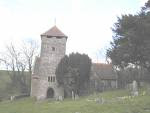
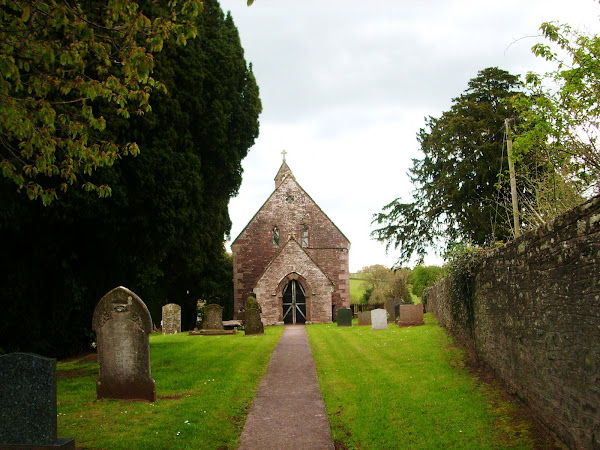
ST CLYDAWG THE MARTYR AND HIS CHURCH TODAY

POSTCODE
HR2 ONY
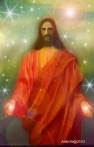
Brychan Brycheiniog, the famous king of Irish ancestry, married into the community of Garth Madrun or Talgarth, where a number of settlers had lived for some centuries, granted land by Cunebelinus. Brychan’s children and grand children were famed saints of Wales and Cornwall, who were of the line of Brychan Brycheiniog, his line being one of the ‘Three Holiest in Wales’.

St Cladawg-eldest son.
St CLYDAWG-FEAST DAY November 3

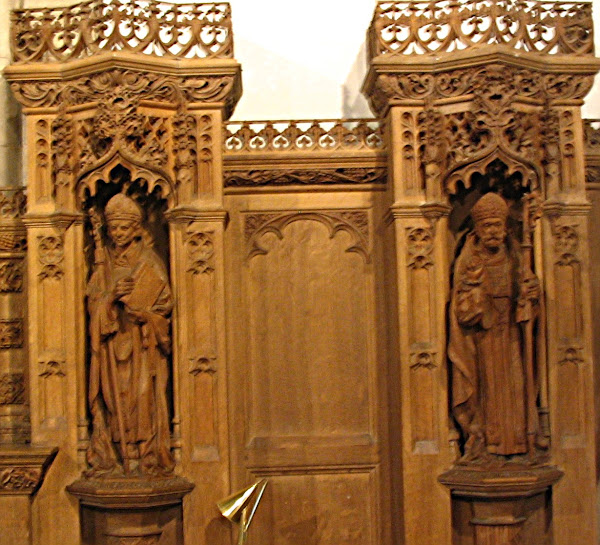
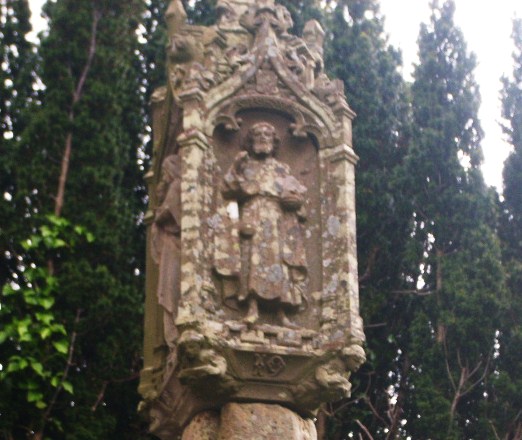
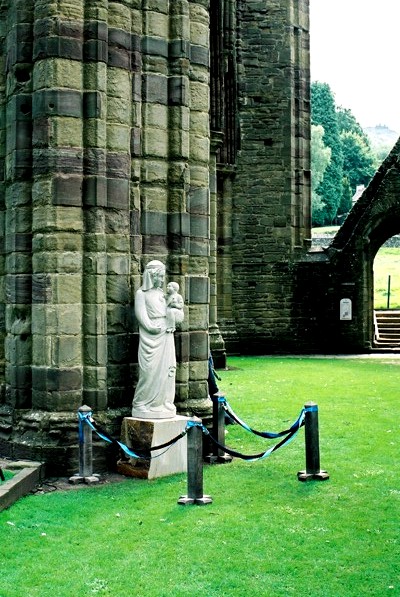
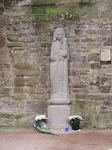
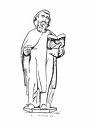
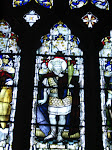
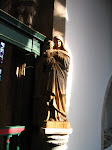
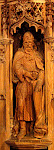
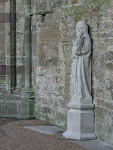
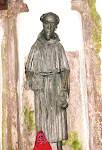
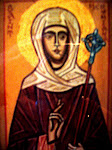
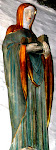
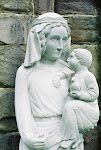
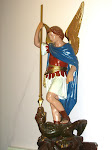
< This picture of a statue in Cil Pedic's Church (Kilpeck) could be (British tonsure) St Clydawg, except he is not depicted with a crown-but does have a martyr's palm. It may also ,of course be St Pedic.Whether in statues of this period a crown may have been shown is another matter>
ECCLESIA DE SANCTO CLADOCO

(In the Welsh Primers of 1546, 1618, 1633, Cotton Manuscripts , Welsh Almanacks . Alwydd Paradwys gives the date as August 19. Also other sources favour this date.)

The story of St Clydog was first written down from the oral tradition of the Bards in the twelfth century in the Book of Llandaf. His life story is also told by John of Tynemouth in the thirteenth century, which was a transcript of the Liber.

Clydog was the son of Clydwyn, who was a son of Brychan. Clydwyn was himself a saint from the Cognatio de Brychan. It is stated that he ‘invaded the whole of South Wales or ‘conquered Deheubarth,’ and that he was the father of Clydog and Dedyw and both of them ruled here. There was also a daughter ,St Perdita, that has been ascribed to him. It is probably not true that he conquered the whole of South Wales. All the genealogical lists make him son of Brychan, but also that he may have been King of Ceredigion and Dyfed Clydwyn also had a daughter, aside from his two sons, named Gwledyr. He shares a feast day with his father St Clydwyn. A place called ‘Cruc Cletwyn’ (his mound’) is mentioned in the Talley Abbey Charter of 1331.Hid aunt was St Clydai the Virgin. Was married three times to Prawst(1), Ribrawst(2) and Roistri (3) and his other brothers were Arthen,Papay,St Cynon (of Abercynon near Penrhys),Dingat (of Llandingat (Dingestow),Pasgen, St Cynlefr the Martyr,(Merthyr Gynlefr), St Berwen (llan in Cornwall)Cydoc or Iddog (Llan in Britanny-Ton Ridoch)The Sepulchre of Brychan was on the island called Ynys Brychan and is near the Isle of Man. Another source (Cott manuscript) says Brychan had thirteen sons and twenty four daughters!

He was King here in Ewyas (partly in Monmouthshire and partly in Herefordshire-the old Welsh  Kingdom of Ergyng) He was one of the king-saints, ruling with justice, peacefully and with holiness.His early formation as a Catholic priest was at Llancarfan under the glorious Saint Cadoc, son of St Woolos(Gwynlliw) of Newport. He and his brother studied theology and philosophy, Latin and Greek there and were ordained. Cadoc himself was a prince. They spent a great deal of time there and worked with him in Cadoc’s own foundations in Monmouthshire and Glamorgan.

On his return to Ewias, acertain woman, the daughter of a nobleman, fell in love with him and would marry no one else. One of Clydog’s nobles, a Saxon, his eye having fallen upon the woman, decided she should be his and no one else’s. The following day whilst the holy and noble King, after having attended the Mass, went out hunting and whilst taking aim at a stag, was shot and killed by his erstwhile friend. The body was placed on a cart and driven towards a river, where there was a ford. This is the bridge area at the stream below the present church, where the water is very shallow. The river Monnow, which also flows through Monmouth, was a barrier and the yoke carrying the cart broke and the oxen would not be driven further. There the great king died and was buried. A great fire was seen to be burning over the grave that night and the Bishop (probably Teilo) ordered that there be built a Martyrum or Martyr’s Chapel over the place of his grave. His sorrowing people, who had loved their wise and saintly king did so. This is Caer Gledog, now in England (Loegr) Probably nearby Longtown was meant by this , where there was an ancient British Camp. (Caer)The Book of Llandaff (Cardiff area) affords proof that Brychan’s rule extended into this area.

There was a further story that two men who had been at loggerheads for a long time vowed upon the tomb of St Clydog to be reconciled. On their way back from the church ,one turned on the other and treacherously murdered him, but immediately afterwards, stricken by a guilty conscience, he fell upon his spear and died miserably.
 In Welsh, the scene of St Clydog’s martyrdom, (as a Christian King by an evil traitor) allowed the people to acclaim him a saint, which was granted at Llandaff by the Bishop-possibly St Teilo. )was known as MERTHYR CLYDAWG or Merthyr Clydawg –his Martyrium, a chapel in which the body of a martyred saint is interred by his grieving brother,Dedyw (who ruled after him, and also founded a llan at Llan-detty at Bwlch in Powys. His church is in Ewias where he was killed by pagan Saxons.Following the martyrdom of the Blessed Clydog, the hermits Llibio,(Cleebeeo)Gwrfan (goorvan)and Cynfar (Kunvarr) were the first inhabitants and cultivators of the place after the martyrdom of St Clydawg the Martyr. So famous was he, that a people were named after him, including a eleventh or twelfth century Bishop of Llandaff.
In later times, Clodock was called ‘Hundred’.The notorious Henry VIII extirped Wales in 1535 and so Clodock was forcibly taken into England. The parish remained as part of the new Anglican See of Llandaff until 1858 when it was taken over by Hereford. However, this always was Welsh Wales as everyone spoke Welsh here until the beginning of the nineteenth century.

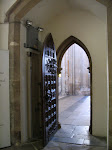
St Clydawg’s church, emulating the spirit of ‘mercy’ for fugitives contained a sanctuary ring which a ‘criminal’ could grasp to ask for refuge ,so Clodock church was chartered as a 'place of refuge' for those escaping from their enemies.The door itself could also be secured with an oak bar. The criminal could remain for forty days, and would have to be provided with food by the congregation .After that time, he would have had to ‘abjure the realm’, that is walk directly to the coast and take the first available boat abroad and never come back. Alternatively, he could give himself up for trial, and with luck, after forty days, those investigating the crime may have come to a different conclusion.
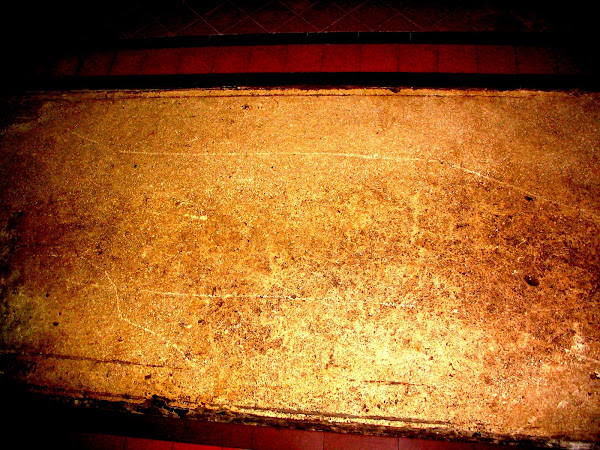
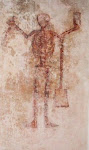
 The Welsh Border runs alongside the mountain and there was much rivalry between the Border people, hence the strong solid door dating from around the l5th century. The church is full of history, with faded wall paintings, coats of arms and a Decalogue. It has a memorial stone which is thought to date from around AD 750-850, 'To the dear wife of Guinndo, a resident of this place. In fact there are more memorials to local people than images of the saints and angels of God.Much would have been lost in the restorations.

 Because Saint Clydawg was a Martyr, many came to pray at his tomb, pilgrims arrived at this remote place on his feast day, November 3rd.Masses would be said over the tomb. However, it is possible the feast day changed in Norman times, or even earlier. The pilgrims’ season is normally from May to October, because summer weather brings more pilgrims as winter weather would make these pilgrimages more difficult, as snow and bad weather often make the areas impassable. The upkeep of a church is very expensive and the Bishop may have introduced a proxy date for the saint for the convenience of the common good of the faithful, with a local feast celebrated on the November date, when the elderly and disabled would not be so cold. This would have been the local bishop’s prerogative.
Alwydd Paradwys was a Catholic source, and the date may have come from an later Martyrology in Rome. It was the miracles which drew the pilgrims, asking for the saint’s help with prayers. People always needed miracles and prolific celebrations may have happened on both dates. There seem to have been many miracles at St Clydawg's before the
reformation ceased.
The Englishman Whytford gives on November 3rd however:
‘In England ye feest of saynte Clitauke a martyr, a kynges son of strayte justyce, a lover of peace, and of pure chastite, and of a stryte and perfyte lyfe ye was cruelly slayne by a fals tratour at whose deth were showed many miracles and at his tombe after many moo’
St Clydog should be represented holding a sword in one hand and a lily in the other and crowned as a prince,in Norman times.

The Twelfth century church had the following boundary from the Book of Llandaff:
Merthyr Clitauc-‘Clodock’ Its boundary is the sone in the Waun Fraith on the cecin,North end of Hetterall (at yr Haul-to the sun) Hills, along it to Rhiw Gwrw, to the stone on the Cecin of the allt, along the Cecin on the edge of the Brec. Black mountain upwards as far as the stones opposite to Nant Trinant , the Turnant , along it, downwards as far as into the Olchon , along it, the Olchon, downwards as far as Ynys Alarun at its top end , to the Maen Tyllog to the crug to the Monnow , across the Monnow to Aber Nant Cwm Cinreith, the nant throught its length as far as the Mynys Ferfun (anglicised later to Money farthing-trans ‘Fersun’s Hill’)along the Mynys Ferfun to the Loch of Fer un, along the mountain to the source of the Hilin, along the Hilin as far as the Monnow. Along the Monnow downwards as far as Aber Ffynon Bist, along Ffynon Bist as far as its source, From its source to the Cecin straight upwards making for the Waun Fraith (Wine vryth)on the Cecin on the Mountain, as far as the stone where the boundary began.'


 It was served by The Abbey of John the Baptist at Llanthony, who were its patrons. Its dedication was to St Clodock. In Rome, in the Taxatio of Pope Nicholas where Clydag is referred to in various Latin forms ST CLEODICUS ST CLYDOG ST CLODOCH ST CLADOCUS( as in evidence of 1517). It was valued in the taxation at the enormous sum of £20, so must have been quite a rich church.It is given as being the Diocese of St David. Since the whole area was overrun by Saxons around 600AD it is likely the Saxons, when they became Christianised, improved the church and it was this church which was rebuilt in Norman times and became attached to the nearby Priory of Augustinian Canons in nearby Llanthony.

 This was part of the work of the Norman de Lacey family, who built the castle at Longtown on the rruins of the British Caer (Camp). He appointed a secular priest to serve Longtown in the first instance, but after that the Canons at Llanthony, which he founded with Bishop Ervistus, became responsible for serving the church and village, and there would have been a place of accommodation for visiting priests, possibly even in the Church house adjacent to the church, where a more modern house now stands. There may have been, however more ancient Llan buildings available. The Tithes from the church were, therefore given to Llanthony and the canons or black monks were priests here for two hundred years.

 My Visit 5th October 2010


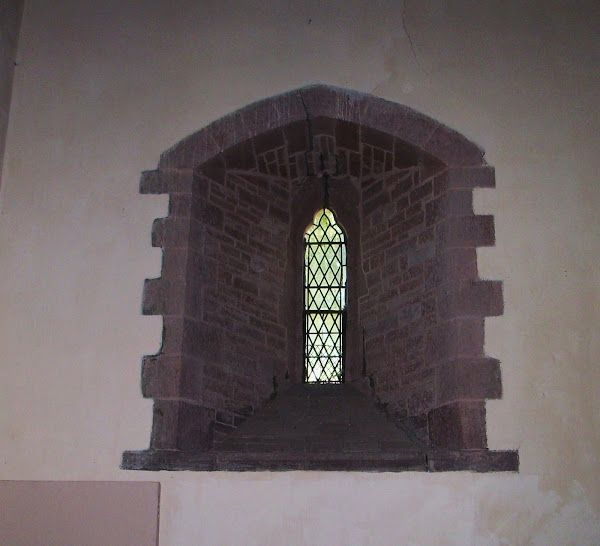
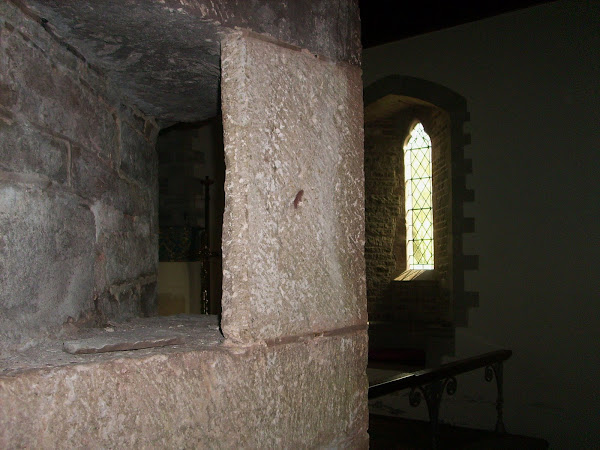
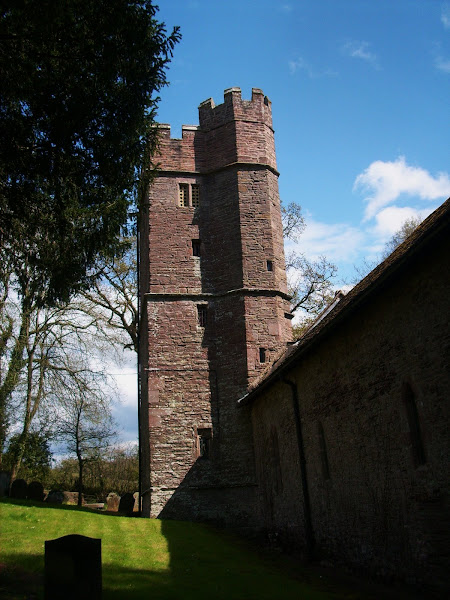
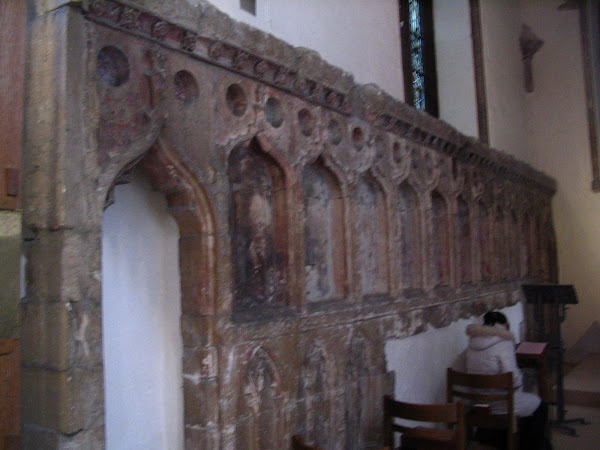
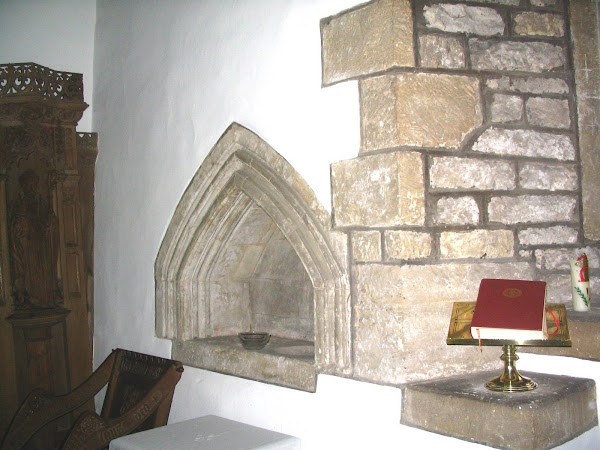
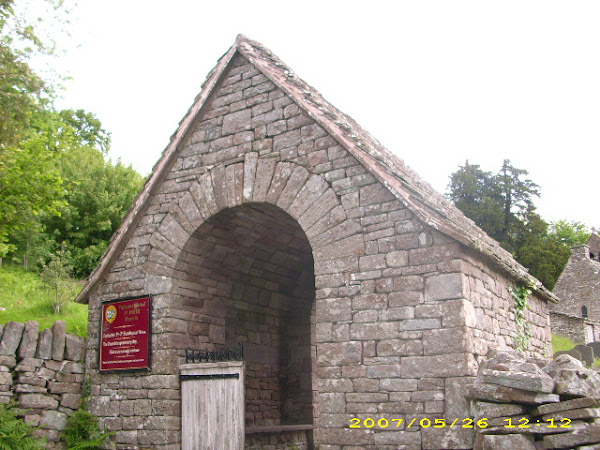
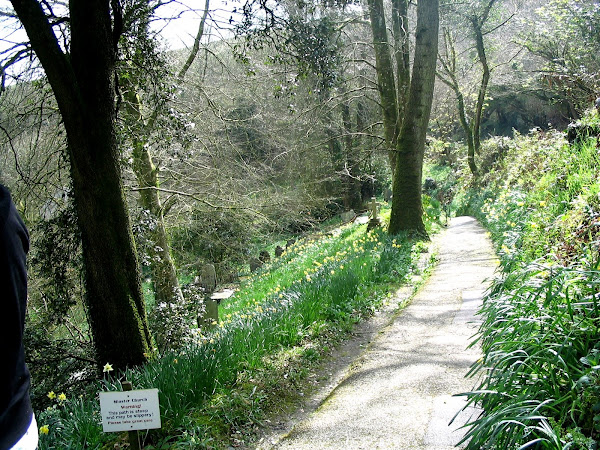
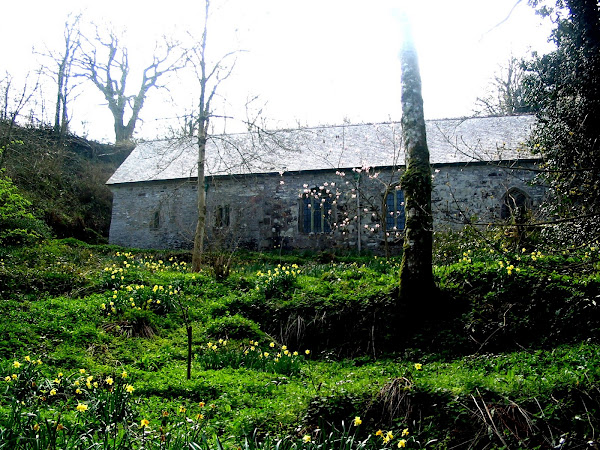
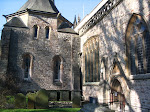
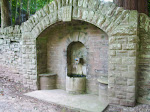
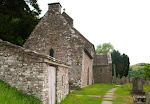
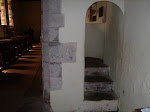
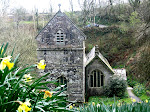
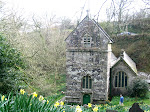
No one could imagine a lovelier setting for the church and it is quite clear this was a wonderful part of Clydawg’s kingdom.The mountains all around looking down on it and a fast flowing stream and holy well on the south bank of the river.A Norman tower looks down and a tri partite structure shows. The chancel area in the front was probably the original Welsh/Saxon site and then the nave and tower added in Norman times. Interestingly there is an arched recess in the chancel.


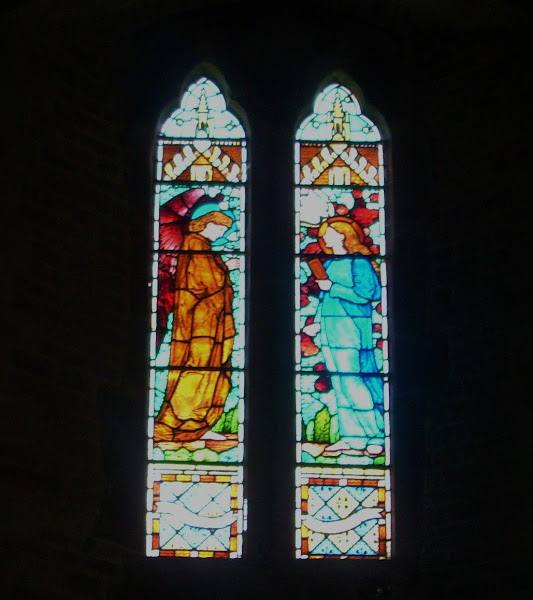
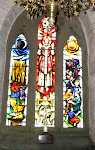
One splash of colour, a beautiful stained glass window!

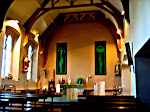
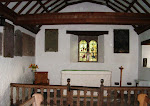
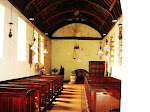
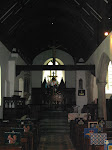
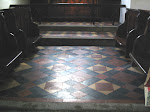
 When I entered the church, I was, I have to say, that in spite of the awe inspiring scale and height of this church of pilgrimage, it seemed totally devoid of the colour and charm of a Norman Church. Little pictures peeped out like an enchanting cherub over the pulpit and part of an annunciation(oh please let it be restored!), even a coloured fresco of the Blessed Virgin,in the window splay near the pulpit but for me, the building seemed dominated by its dark brown boxed pews , oak choir stalls and an absolutely enormous three decker pulpit and sounding board, which made it ‘feel’ more like a Non conformist chapel, the altar being a simple wooden table. One wonders, as in so many churches, whether the original Norman altar complete with consecration crosses may be interred under the present table dated about 1650, in the height of the Cromwellian period, with Laudian rails and Housel bench, part of the changes ordered by the Anglican Archbishop Laud. The table is surrounded with rails, allowing the Communicants to gather around it. Some of the choir stalls are beautifully carved with flowers and dragons, but the overall effect quite cold with its brown and white.
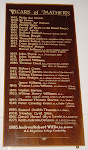
 There was another restoration in the twentieth century and when the Anglican Revd F.G.Llewellyn arrived in 1916, he found the church virtually a ruin and he raised money to repair and restore the fabric of the church, which was vitally important for its survival.


The font is still that of the old Catholic church and dates from 1290, made of hand cut stone,but quite small, standing on a shaft as big as the bowl.


The priest’s door is still there on the South Wall. Known as the ‘monks’ door’it would have been used by them when they said Mass or came in for the daily office. The oak door is oak studded and dates from a much later date. As in Orthodox churches today, there would have been a rood screen or loft (which were torn down during the sixteenth century)and so the priests would have entered the sanctuary (where the Blessed Sacrament was held in the Tabernacle) and they believed this area was holy and only the ordained could enter. Likewise, no sanctuary lights to show Christ present at all times.


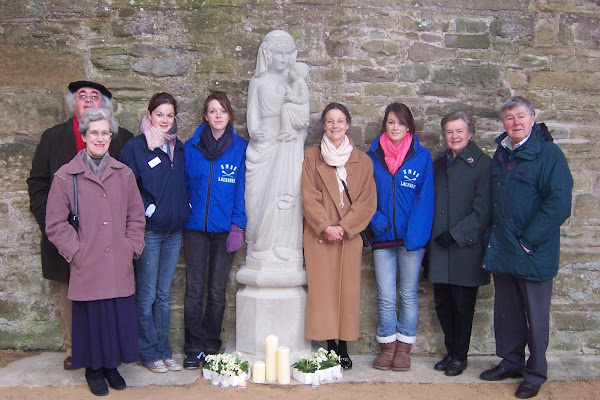
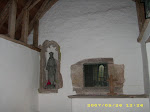
 The two plinths at the south side of the arch are empty. It is sad to think of the hatred which smashed the statue of the Blessed Virgin Mary, whom the angel so honoured. She is missing, along with a representation , no doubt of St Clydawg the martyr, similar to those in nearby Kilpeck Church.
In 1645 Scots pillaged the valley and stole the communion plate, since the earliest now there was dated to 1695, so must have been made for the seventeenth century restoration. There are three chests made out of a single log in which records were kept. That of St Peter’s in Longtown (now a private house) was probably the place of the third chest’s origin.
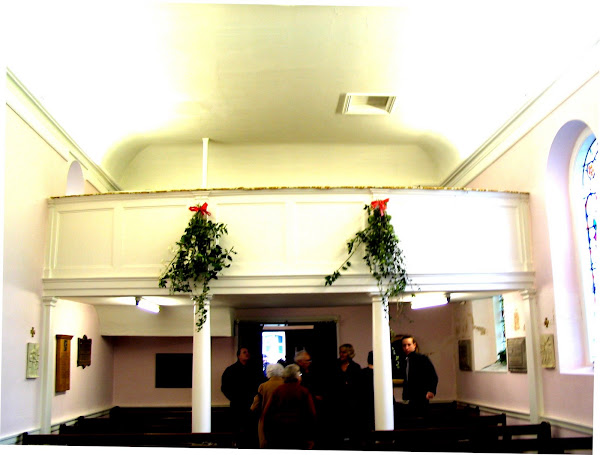
  The Gallery was built in 1700 to house the village orchestra and choir and is large, with a music stand, seats for musicians and the choir benches are raked so those behind could see. The large scale of the church is obviously due to its pilgrim status in Mediaeval times, and it now looks a very different church from that appreciated by the pilgrims.
 The joyful colours of heaven seemed to be gone from the church in the brown and white. I know villagers would have grown up and love their church, but coming from Wales, it looked more like a chapel. It is going to be interesting how the present congregation will refurbish the church to hand on to the next generation. I hope there will be more colour, having seen St Teilo’s wall paintings at St Ffagans in the Welsh Heritage Museum, you can see how beautiful these churches would have been in the fifteenth century. Only my opinion though, as it is clearly a well loved and cared for church.


.


Thursday, November 6, 2008

ST CLETHER--AND A PRESENCE!!!!3


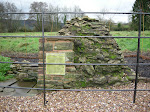
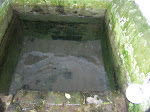
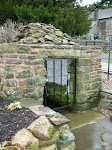
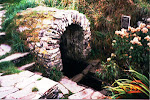
St Clether was one of the twenty our children of Brychan, along with Finbarr who also worked in Cornwall.This monastery was only a short way away from his sister';s at St Keyne.The hamlet where this was still situated is well worth a visit. The parish church itself was built in Norman times and the Vicarage obviously built after the Church was used by the Anglicans in the 16th century. The ancient well was rebuilt and repaired in Norman times and the well carefully conserved.

Firstly we went to visit the Norman age built church which leads over the fields for half a mile. St Clether is South of Bodmin.We drove up on a windy day, and there was much of interest in the church, which had had a refurbishment recently, and the piscina and stoup had been removed at some time. The area where St Clether had lived and worked among the people , healing, praying and clothing the naked, feeding the hungry was set well apart from the church, which is nearer the small road leading through the village. Clether seems to have established his monastic cell here on the river Inny. It is north of Altarnan, though not accessible through very wet weather as the road floods. It can be reached from the main Bodmin-Liskeard road, however.

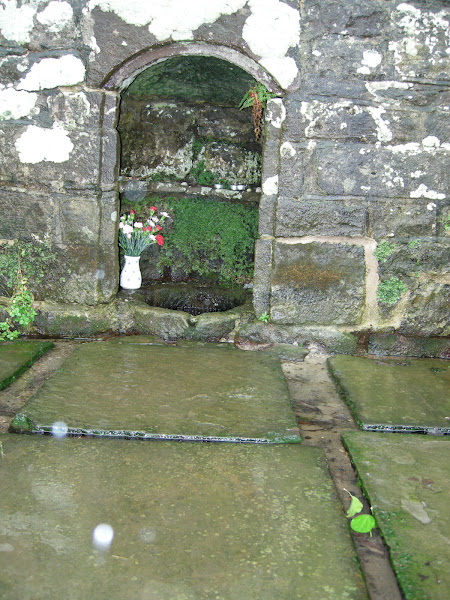
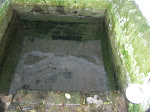
The parish church is mediaeval, but very few original features remain and it has more in keeping with the 18th century charming rectory over the road.The Well at St Clether has a chapel, however which is more ancient than the church. It needs money at the moment for repairs, so anything you can send would help. St Clether designed his chapel well, so that the water from the well flowed beneath the altar of the church. At some point he went to live and died at St Cleer (possibly in old age and infirmity) and his relics were put beneath the altar over the running spring.
St Clether's Feast Day is on November 4th.

The well would have been sought for healing by many people and as the Normans did not demolish it and put up a church elsewhere, it was probably far more colourful in those early years, with wall paintings and such.Candles are available for lighting at St Clether's well, to ask for St Clether's help in prayer to the Father for healing.

A STRANGE OCCURANCE

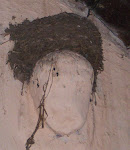
The distance to get to the well, clearly marked by oak markers was too great a distance and I sent my husband to photograph the well and chapel. My knee has an injury at the moment. He returned quite excited. He had photographed the well and chapel and had snapped the inside of the chapel the minute he walked in. With his naked eye he could see nothing at all, yet on the digital camera screen he saw a white shape. Now he is sceptical of many things but the white shape, as you can see above was clearly visible, apparently 'fleeing' into the stones. Five seconds later he snapped again and it had gone. If you look carefully, you can see plainly that the window is lower than the white shape. He said he was not afraid, so perhaps the camera recorded an angel guarding the place,we did not know. But it would be great to hear any explanations?

The Well itself is slightly higher than the chuch, through which the spring flows.
It was certainly worth a visit and needs repair money so if you have a spare fiver...

Will post more on St Clethers when I have time.

MADELEINE MCCANN

There has been no informatin on here whereabouts, yet I absolutely have a hunch she will be found one day soon and will continue to pray for her and her family.

FACEBOOK

There is a Mary in Monmouth Page on Facebook .

LLANFAIR DISCOED CHURCH

Following the recent blog on this church and its connection to Lady Margaret Pole, Countess of Salisbury and her son Cardinal Reginald Pole, both martyred for the Faith in Tudor times, I was contacted by some descendants of the Pole Family in Hampshire and we have become friends.They are still Catholic and help with the National Catholic Library in Farnborough. So that has been a blessing for me.

Tuesday, November 4, 2008

St George of England, Brychan Brycheiniog's family and that Heavenly Stained Glass

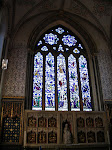
Brychan, with all his children in his lap! and the St George Window in the West Wall showing incidents from his life and Martyrdom.In the final picture there are many such panels, all equally wonderful depicting the laity praying for the intercession of the saints. It seems to the left of the present altar, there may have been a Grave sepulchre, where the crucifix may have been kept during the Holy Week for the Tenebrae services.The Place seems to be in a traditional place for it.


_____________________________________________________

BRYCHAN BRYCHEINIOG

The King of Brecon, one of the holiest 3 families in Wales, decended , according to Welsh annals from the family of Joseph of Arimathea and the family members of the Virgin Mary, who had been granted land at Garthmadrun (now Talgarth) according to Welsh sources.Joseph was a tin merchant and had accompanied the Empoeror Vespasian on his many trips to Britannia. They returned, sent by St Peter, travelling to Gaul with St Philip, who sent them on to Britannia. There was considerable antipathy to the families of anyone connected with Jesus at this time, and so it is likely that they came with Joseph. Interestingly, whilst the holy men desiring hermitage had gone to land given by Archiviragus, brother of Caractacus and King of the Demetiae, known as Ynys Witrin (The Island of Glass) or Glastonbury. Joseph's extended family lived at Talgarth and married into the local royal family(of Irish extraction!), but in the early years the genealogy shows many Jewish names.Parishaw in the Black Mountains for example is from Pater Ishow (Issui in Welsh) Or Father Esau, believed to be from that family.Perhaps Issey, daughter of Brychan was also from the female form of the name, and commemorated at nearby St Issey on the way to Padstow.

Brychan was the father of numerous holy children, although it is felt these may have been grandchildren as well, Amongst these children are many of the Cornish and Welsh Saints. We have seen how St Paul inspired chastity in women and how many Christian women, for the first time saw that they need not marry and could not be forced to-many undergoing hideous tortures for the faith, like St Thekla for example, Paul’s disciple, who was tortured for not marrying a man chosen by her parents.

Many followed her example . St Winifred of Wales is one such example as are the saints all over the church, St Lucy,St Perpetua. Our own St Tecla of Gwent on her tiny island near what is now the old Severn Bridge was another.
Unusual in Brychan’s court, was that he encouraged his children to set up llans all over the district. Under his advisor St Brynach, a priest who had arrived via Ireland from the Holy Land, his children were carefully brought up as Christians.

He had numerous children (many of whom we have already heard of here on this site) In the true manner of Old British saints, however ,they wandered around from place to place (white martyrdom-to where God would lead them) until they found their ‘green martyrdom’sanctified the area of their ‘llan’ and settled there.

Brychan’s children in Cornwall included

ADWEN(Advent) CLETHER,KEW,OUDICEUS(Euddogwy, her brother and nephew of Teilo) ENDELIENTA ,
(St Endellion)ISSEY (St Issey)KERIA (Egloskerry)CEYNA (St Keyne) MABENA, (St Mabyn) MINVER (St Minver)MORWENNA,TEATH, and of course some sons, FINBAR and OUDICEUS.Others we have heard of in Wales are Tydfil, Tegwedd and St Gwladys in Newport. It is wonderful to see this stained glass window paying tribute to this holy King.I have written about Brychan before.

Donors of the Windows

The different windows were donations from local families . Borlase, Martyn, Motton, Callaway and Tubbe families.

Unique Mediaeval St George Window

Twelve scenes in the west window of the north aisle describe the life of St. George. They depict the Eastern Church’s recorded martyrdom accounts as a Christian Roman soldier born in Palestine this window is of unique interest as incidents are not found elsewhere nowadays. St George was always shown holding the flag of the Paschal Sacrifice , the red blood on the pure white flag, representing the Lamb of God. In grasping this flag, he was himself taking the Martyrdom for the sake of Christ.The dragon he fought was probably a metaphor for the enemies of Christ. The flag accepted by the Crusaders, who spread a legend of his fighting a dragon as many of then had to as so many of whom died in droves trying to protect the Christian pilgrims to the Holy Places. St George was their inspiration
The Paschal Flag became the English Flag.

It is worth pointing out that St Piran is the patron saint of Cornwall, but had long been administered from England since Norman times and later Wales too became annexed to England and the Welsh language to be 'extirped'

George was born to a Christian noble family during the late third century around AD 275 and AD 285, in Lydia Palestine. His father Geronzio was a Roman army official from Cappodocia and his mother from Palestine. They were both Christians and from noble families of Anici (can not be defeated), so by this the child was raised with Christian beliefs. They decided to call him George meaning "worker of the land".
George offered himself as a soldier to Diocletian, who accepted him as Geronzio had been one of his finest soldiers and by his late 20s, George was a Tribune and stationed at Nicomaedia.

In the year AD 302, Diocletian (influenced by Galerius) issued an edict that every Christian in the army should be arrested and every soldier offer sacrifice to the Roman gods.
George objected and with the courage of his Faith approached the Emperor and tore up the edict. Diocletian was upset, not wanting lose his best Tribune and son of his best official, Geronzio. George loudly renounced the Emperor's edict, and in front his fellow soldiers and Tribunes he claimed himself to be a Christian and declared his worship of Jesus Christ. Diocletian tried to make George change his mind, even offering gifts of land, money and slaves if he made the sacrifice to the Pagan gods. The Emperor made many offers, but George would not accept.
Having made this edict, Diocletian was left with no choice but to have the saint executed for his refusal. Before the execution George gave his wealth to the poor and prepared himself. After many torture sessions,(which included being lacerated on a wheel of swords, he was miraculously resuscitated three times, George was indeed, as shown in the window of St Neot, executed by decapitation before Nicomedia's city wall, on April 23, 303AD, the same year as St Julius and St Aaron)of Caerleon) and St Alban (of Verulamium)died.
. A witness of his suffering convinced Empress Alexandra and Athanasius, a pagan priest, to become Christians as well, and so they joined George in martyrdom. His body was returned to Lydda for burial, where Christians soon came to honour him as a martyr there in Palestine.So not a legend , but a real Martyr and Protector of England.

Back to the St Neot Windows

The guide to the church building states
‘The finest and least restored window, the Creation Window, is at the east end of the south aisle and is full of delightful things representing the Creation (including the newly created bird flying off the tip of His finger), the Fall, Cain and Abel and lastly Noah politely doffing his cap to God as he receives his instructions, while the first window in the south aisle represents the story of the Flood and Noah’

Underneath are the laity imploring ‘Ora Pro nobis’ from kneeling figures dressed in 15th century or so costumes. Only two parish churches in Britain have complete sets of stained glass designed for them –one at Fair ford in Goucester and here at St Neots.The earliest three windows are from 1480 and the last around 1539, which must have been at the date of the taking of church property to form the new ‘Church of England’ by Henry VIII.
It appears the remoteness of the church spared it from the army of Oliver Cromwell who usually destroyed stained glass if they could.

The New Glazing

In 2004, Richard Grylls, the present patron, engaged Arthur Bradley to replace the frosted window at the west end of the church, which obscured the belfry, with a new etched glass screen. The new window contains etchings of a dove, mirroring the dove over the baptismal font, together with fruits of the vine, and wheat from the fields, as well as a porcupine – a symbol from the Grylls family crest, and denoting both plenty and realisation of hopes. A beautiful addition to a fabulous Church.

In the Churchyard

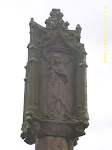
Here in the churchyard was a lantern cross which appears to have had the figure of St Neot on one of the panels and possibly the Blessed Virgin, though truth to tell it shows more signs of weathering than the one I saw at Patrishaw in Gwent, in a lot better state of repair. Nevertheless this cross had been put up again, traditionally a place where visiting preachers or Newsgivers would stand whike addressing the local population.

The Mills as the source of local industry

Travelling along we went past a number of Mills which formed the earliest occupations of the local people-The Trago Mills retail outlet is a development of one of those mills, probably a money spinner in Mediaeval times!


Autumn Colours

The autumn colours were vibrant and startling and trees and woodland inviting in the summy monets but menacing in the dark gloomy moments. St Neots was situated in the area of Warleggan which was evocative of the Poldark TV series.

Return

As we returned to Tintagel, we passed Dozmary Pool, lying undramaticall in the Moor. This was where the legend of the 'arm in white samite'appeared to the earlier 'King Arthur' in Arthurian Legend. I ave written about Arthrwys, the real 'Dux Bellorum' before, but here is where local tradition places the legend. We also passed by the temple Church, home of the Templars until their cruel suppression.Was ever a more unjust punishment, by evil Philip the Fair of France? This Church is dedicated to St Catherine a popular Mediaeval saint, who died broken on a wheel, the rather sick nameing of a corresponing firework 'The Catherine Wheel' on bonfire night.

This A30 is also the site of 'Jamaica Inn', unfortunately nowhere near the sea, but there was also the Daphne du Maurier exhibition and a restaurant and inn with standard food.Frenchman's Creek is not far way and Cornwall was also the Cornish setting for the novel 'Rebecca'.

All in all, a most interesting day.

Wednesday, June 11, 2008

Some insights into the Holy Grail, St Peter and the Family of Brychan

_


St Joseph of Arimathea by Pietro Perugino


-

Brychan'Brycheiniog,holiest family in Wales

-----------------

In 71AD: Joseph "Ha-Rama-Theo", the desposynic prince, one of Jesus’ kinsmen (Mt. 13:55), was given an estate in Britain by the British King Arvcviragus (brother of Caractacus) that comprised 160 acres of land [= “one hide”] surrounding an old hill-fort as his residence, which estate was raised in status to a kingdom, Garthmadrun, by the Roman Emperor Maximus in AD 383. What makes this more credible is that Joseph accompanied the Roman Emperor Vespasian during his British campaign, and was given an estate in Britain by the British King Archiviragus, which came to be called "Garthmadrun", and, his descendants are called in the Welsh "Triads" one of the "three holy families" of Britain.

Joseph was a successful dealer in tin and spent a great deal of time in Cornwall, importing it) Whilst leaving with this kinsmen and women, he would have had this property available after Christ’s Crucifixion, Resurrection and Ascension, and probably left a colony at Garthmadrun. Joseph was Mary’s Uncle and so it is reasonable to suppose the family could be ancestors of some of our Welsh saints, particularly Gwynlliw and Cadoc, David and Padarn as well as Cybi.Then there is Madrun (Materiana)of Gwent and Cornwall, and Ishow (Welsh for Esau)

Did twelve hermits go off and found Glastonbury?


William of Malmesbury writing in mediaeval times, did write that Joseph and his family arrived via Wales to found the Kingdom in Britain at the behest of St Philip and St Peter. Joseph had provided the tomb for our Lord after the Crucifixion. They would have arrived with wives and family and extended family and probably left these under the protection of some elders at Garthmadrun while they went on to found Glastonbury. If they came to Wales, they probably arrived at Caerleon, the flourishing Roman fort at this time, right next to Caractacus’ hill fort, which gave Romans such a problem later on.


What is true is that this family of Joseph was particularly revered, because of its links with Mary’s family. In the genealogies there are many Jewish names, and in the lives of the Saints for example.Gwynlliw (and hence Cadoc) is meant to have some of the blood of the kinsmen of Christ according to Cybi’s pedigree, who lists Fallach, son of Eugien son of Erddolen, Avillad, Amlech,Belim, Anna-the cousin of the Virgin Mary.

When I first red this, I smiled. It seemed the holy monks of the eleventh century wanted to give a glorious pedigree to Wales’ greatest saints. Then I discovered the chronologies of these kings. Records show Joseph did die in Britain.The cluster of Jewish names in the Welsh records might lend credence to this, although it has always been held in legend.

In fact there is even a source that Christ’s Apostle Simon the Zealot was martyred in Britannia in 74AD, but I am trying to trace this at the moment.

St David and St Patrick in Glastonbury

St Patrick visited Glastonbury (Ynys Witrin) and set up a ‘llan’ there as the original twelve had remained hermits and Patrick was newly trained and ordained. Interestingly St Patrick was the Son of Sucatus, also of this line of Joseph of Arimathea.He set up the foundation again, according to the developing church. He was also a literate man, and wrote Latin, whereby we have some texts from this period. St David also arrived there later.
St David died at St David’s but Patrick may have been buried at Glastonbury. Obviously the place where the first Church in Britain had been built was sacred and remained so. So where did all the other disciples go? They probably did go to Talgarth (Garthmadrun) . Joseph’s direct line became extinct in the male-line in AD 481, and his family was replaced in official Welsh records by the descent-line of Joseph of Arimathea.

St Gwladys of Newport (glass from St Woolos Cathdral)

__________________________________________


Here is a family tree I found for Brychan

02. Jasna "Piliste" [his nickname refers to his place of origin in "Palestine"], son, bro of Josue El-Harami
03. Sarclotus, son
04. Emanuel "Erise", son
05. Enciede (Encride) "Ere", son
06. Othrac, son
07. Maxime, son
08. Llebryn (Luibuirne), son
09. Kornodd (Cornuithe), son
10. Mouric, son

11. Ottaviano, son
12. Marchudd, son
383 AD 13. Gwrthryw, 1st King of Garthmadrun (383), son, bro of Oidisse (Odissus), father of Photaighe (Potitus), father of Calpinn (Calpurnius), father of Succat[us],

( aka Saint Patrick, Apostle of Ireland 457-493)

14. Gwraldeg (Gwroldeg), son
15A Morfydd (Morvitha), dau, heiress & co-ruler
15B Teithfall (Teichfallt; Teithwalch ; Taith[w]al) (Tudwal), husband, co-ruler
16. Teuduric (Teithrin), son
17A Marchell, dau, heiress & co-ruler
17B Anllach, husband, co-ruler
Yr 481: Brychan, 1st King of Brecon [Brycheiniog; Brecknockshire]
son of Prince Anllach of Galloway [whose mother was an Irish princess] and Marchell of Garthmadrun, its heiress; succeeded his grandfather as King of Garthmadrun but re-named the kingdom after himself as Brycheiniog, also called Brecon.


The Holy Grail


The early history of the Grail is intimately connected with the story of Joseph of Arimathea. When he is cast into prison by the Jews, Christ appears to him and gives him the vessel, through which he is miraculously sustained for forty-two years, until liberated by Vespasian. The Grail is then brought to the West, to Britain, either by Joseph and Josephes, his son (Grand St. Graal), or by Alain one of his kin (Robert de Boron). Peredur locates it, achieves the quest; and after the death of its keeper the Grail vanishes.

It was conceived as the most precious relic,the cup which had contained the life blood of the Lord Jesus. Of course it was held to have miraculous powers (probably the vision of the Kingdom of Heaven, only given to the pure in heart, which Peredur was meant to be)
The legend was that The angels who remained neutral during the rebellion of Lucifer were its first guardians; then it was entrusted to Joseph who brought it to Britain-Glastonbury, and possibly-the Abbot Collen brought it to Castell Dinas Bran for safekeeping, rather than let it fall into Saxon hands.

-

This is a wooden chalice such as it may have appeared, but is of more modern date.

Wolfram von Eschenbach calls this mons salvationis or silvaticus (Munsalwaesche in Middle High German)and this would definitely fit the bill at Castell Dinas Bran, an old Iron Age Hill fort in a remote area of Wales, well protected and later fortified even more.

The Grace of God meant that ancient Britain was converted to the Christian Faith and the family’s input very strengthening to Christianity in Wales particularly, which for many years was spared the rampages of the Saxons of the pagan type-though later they became exemplary Christians.
There are, in the stories some Celtic cultural emblems and symbols as you would expect in a tradition not written down until much later. The Catholic encyclopaedia says of it, that the Catholic Church at the time had nothing to say about Joseph’s arrival in Britain. The story is, after all contained not in Apostolic written material, but the apocraphal Gospel of Nicodemus which was popular in Britain in the 12th century. The Church had an uphill struggle in maintaining the consistant biblical teaching of the Apostolic times .


The Catholic Church had decided on the books of the Bible and what sould be included was only what was in the experience of Jesus twelve apostles themselves, see Catechism of the Catholic Church (paperback from Amazon)

Why the Church did not Comment on the Grail stories

So the Church has not endorsed this as part of the canon of the Bible and it is not 100% reliable, but remains a source of tales and legend. We know more facts now now. That there was a first century mud and wattle church at Glastonbury for instance, as I believe St Patrick alluded to it. The monks at Glastonbury had revered it, and bewailed the fact it had been burnt down.

Blessed Sacrament- a holy relic to be revered

The religious element in the story is fundamental. We read how Joseph, whom the Jews had imprisoned, is miraculously fed by Christ Himself (the Holy Blood). The food vessel can be explained in the holy consecrated bread, later to be a wafer which gives the Body and Blood to the Faithful .Joseph escapes sails for Wales by St Peter and Philip from Jerusalem. Joseph had been there before we believe with Vespasian and had dealt in tin in Cornwall and Wales and had land there. Legend has it St Patrick was buried at Glastonbury and so was Arthwr and Gwenhwyfar his wife, his tombstone being discovered there in the twelfth century.


Saint Collen of Glastonbury is relocated with the brothers to Llan-Gollen because of Civil War and Saxon Threat.


In 519 AD, under the military leader, Arthur’s protection, the community of the descendents of Joseph were relocated from Garthmadrun north to a more secure place, namely Castell Dinas Bran in North Wales at Llangollen. Interestingly St Collen, who was their pastor and Bishop was also Abbot of Glastonbury, itself threatened by Caelin at this time, the Saxon Prince.

Many British kings seemed unable to get their act together and possibly Arthur (the real one, not the lengendary one!) thought they would be more secure here. Joseph and his descendents were known as ‘Grail Kings’ in Wales’ and Cadoc himself was one of the Guardians.


Unity in the Church upon St Peter whom Christ appointed to be the custodian of his Church.


Why it is not mentioned or commented on by the Church in the interests of Unity.
It is plausible that the Grail too-if Joseph had it- was removed for safekeeping during this troubled time and then kept in a secret place in Wales near Llan-gollen by Guardians responsible for its safety. No clerical authors mention it. Unfortunately all the fantastical and magical tales which had been woven around it had sensationalised it contained unchristian symbols and symbolic magic of which the church could not approve.
Druids connected it with the ‘Cauldren of Anwyn’ the amazing source of all visions. Yet Lewis Spence, in his book ‘The Mysteries of Britain’ goes on to say:that later members of the bardic classes were mostly Christians, who had accepted the Body and Blood of Christ as the highest development of Druidism, giving the worthy believer direct access to heaven, just as the Cauldron of Anwyn would give them visions of heaven.

The Central Message of the Kingdom must not be obscured.

In my book, actually achieving heaven by the receiving into your body of the Body of Christ and becoming an adopted son or daughter of God himself and an heir to paradise was more satisfying and something which made life worthwhile. The Druids themselves had always believed in an Otherworld after death, so Christ’s promise was an extension of that, and included all the strength of family life of the ancient Britons, (the ‘llans’ or ‘clans’-families as the building blocks of the Mystical Body of Christ) The important thing for the Church was the building of the Body of Christ, by its members, joined together by the Mass, the celebration of the Body and Blood of Christ and establishment of the Kingdom of Heaven on earth.
The holy cup was undoubtedly a treasured relic of the church and subject of veneration, however.
The issue of Unity-would this create a gulf between Rome and its British arm?

The importance of Peter among the Apostles and to Christ as the leader of the Church.

There was an issue of the importance of the Unity of the Church, which was founded on St Peter, not St Joseph of Arimathea, who had, in obedience, been sent to Britain by St Philip and Peter. In the interests of unity these amazing hair raising stories should not detract from the even more amazing supernatural central truth , the growth of the Kingdom of Heaven in the Body of Christ growing upon the efforts of St Peter and the Church Christ founded upon him .
Among the Twelve Apostles, Peter became conspicuous.

Though of irresolute character, he clings with the greatest fidelity, firmness of faith, and inward love to the Saviour; rash alike in word and act, he is full of zeal and enthusiasm, though he is endearingly human and easily scared, sometimes bewildered. The more prominent the Apostles become in the Bible narrative, the more conspicuous Peters appear as the first among them. In the list of the Twelve on the occasion of their solemn call to the Apostolate, not only does Peter stand always at their head, but the surname Petrus given him by Christ is especially emphasized (Matthew 10:2): "Duodecim autem Apostolorum nomina haec: Primus Simon qui dicitur Petrus. . ."; Mark 3:14-16:
Jesus said 'You are Peter and upon this Rock I will build my Church and the gates of Hell shall not prevail against it.
What did Jesus say?

Jesus asked his apostles : "Whom do men say that the Son of man is?" The Apostles answered: "Some John the Baptist, and other some Elijah, and others Jeremiah, or one of the prophets". Jesus said to them: "But whom do you say that I am?" Simon said: "Thou art Christ, the Son of the living God".

And Jesus replied: "Blessed art thou, Simon Bar-Jona: because flesh and blood hath not revealed it to thee, but my Father who is in heaven. And I say to thee: That thou art Peter [Kipha, a rock], and upon this rock [Kipha] I will build my church [ekklesian], and the gates of hell shall not prevail against it. And I will give to thee the keys of the Kingdom of Heaven. And whatsoever thou shalt bind upon earth, it shall be bound also in heaven: and whatsoever thou shalt loose on earth, it shall be loosed also in heaven". Then he commanded his disciples, that they should tell no one that he was Jesus the Christ (Matthew 16:13-20; Mark 8:27-30; Luke 9:18-21).

Peter-Simon's new name , was Petros-The Rock

By the word "rock" Jesus cannot have meant himself, but Peter, as is so much more apparent in Aramaic. He wishes to make Peter the head of the whole community of those who believed in Him as the true Messiah; that through this foundation (Peter) the Kingdom of Christ would be unconquerable; that the spiritual guidance of the faithful was placed in the hands of Peter, as the special representative of Christ.
This meaning becomes clearer when we remember that the words "bind" and "loose" are not metaphorical, but Jewish legal terms. It is also clear that the position of Peter among the other Apostles and in the Christian community was the basis for the Kingdom of God on earth, that is, the Church of Christ. Peter was personally installed as Head of the Apostles by Christ Himself. This foundation created for the Church by its Founder could not disappear with the person of Peter, but was intended to continue and did continue (as actual history shows) in the primacy of the Church and its bishops to Benedict today.

______________________________

This was why in the early days the Grail is not commented upon by Church writers. Unity was the most important thing of all to the church. There was no internet, no telephone, no satellites. It was important the Faithful should focus on the Truth of the real message of the Kingdom. The original teaching of Christ had to reach through the centuries intact.


Extract from Peter’s First Letter to early Christians


As Peter writes his instructions in his first letter to the churches, Bishops and Priests,

+From Peter,
Apostle of Jesus Christ ,
to all those aliens (means ‘temporary citizens of the world)living among gentiles of Pontus, Galatia, Capadocia,Asia and Bithynia, who have been chosen, by the foresight of the father, to be made holy by the Spirit, obedient to Jesus Christ and sprinkled by his blood. Grace and peace be yours in abundance.

I urge the presbyters among you (priests)as a fellow Presbyter and witness of the sufferings of Christ, and as one who is to have a share of the glory to be revealed, give a shepherd’s care to the flock of God that is entrusted to you, watch over it, not simply as a duty , but gladly as God wants, not for sordid money, but because you are eager to do it

Do not ‘lord it’ over the group in your charge, but be an example to the flock .When the Chief Shepherd appears, you will be given the unfading crown of Glory’.In the same way, younger people,be subject to the elders. Humility towards one another must be the garment you all wear constantly, because God opposes the proud but accords his favour to the humble. (*Compare here the words of the Virgin:’he has brought down the mighty from their seat and has exalted the humble and meek’(Magnificat-St Luke 2) Bow down now, then before the power of God, so that he may raise you up in good time.

Unload your burdens on to him, since he is concerned about you. Keep sober and alert, because your enemy is the devil and on the prowl on earth like a roaring lion , looking or something to devour. Stand up to him, strong in faith and in the knowledge it is the same kind of suffering that the community of brothers throughout the world is undergoing. You will have to suffer only for a little while. The God of all grace who called you to eternal glory in Christ will retore you, he will confirm, strengthen and support you, his power lasts forever and ever. Amen
I write these words to you to encourage you and attest that this is the true grace of God. Stand firm in it!

Greet each other with the kiss of Peace.
Pax to you all who are in Christ.
Peter


The Grail and its amazing stories is a precious holy relic, which held the blood of Christ. But we, who drink the precious Blood in the Eucharist have it whenever we partake of it. It is present to us now, today. That is AMAZING!