









































 ____________________________________________________________________________
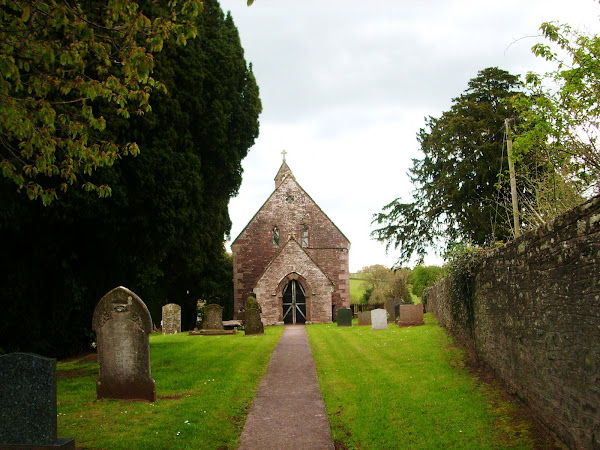
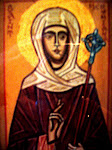
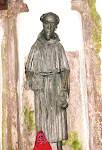
ST FAGAN AND ST TEILO
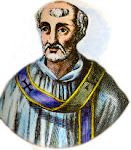
Pope (c. 174-189). The Liber Pontificalis says that he was a native of Nicopolis, Greece. From his contemporary Hegesippus we learn that he was a deacon of the Roman Church under Pope Anicetus (c. 154-164), and evidently remained so under St. Soter, the following pope, whom he succeeded about 174. While the condition of Christians under Marcus Aurelius was distressing in various parts of the empire, the persecution in Rome itself does not seem to have been violent. De Rossi, it is true, dates the martyrdom of St. Cecilia towards the end of this emperor's reign; this date, however, is by no means certain. During the reign of Commodus (180-192) the Christians enjoyed a practically unbroken peace, although the martyrdom of St. Appollonius at Rome took place at the time (180-185). The Montanist movement, that originated in Asia Minor, made its way to Rome and Gaul in the second half of the second century, more particularly about the reign of Eleutherius; its peculiar nature made it difficult to take from the outset a decisive stand against it (see MONTANISTS). During the violent persecution at Lyons, in 177, local confessors wrote from their prison concerning the new movement to the Asiatic and Phrygian brethren, also to Pope Eleutherius. The bearer of their letter to the pope was the presbyter Irenæus, soon afterwards Bishop of Lyons. Eventually the Pope took a stand and declared against Montanists, Gnostics and others.
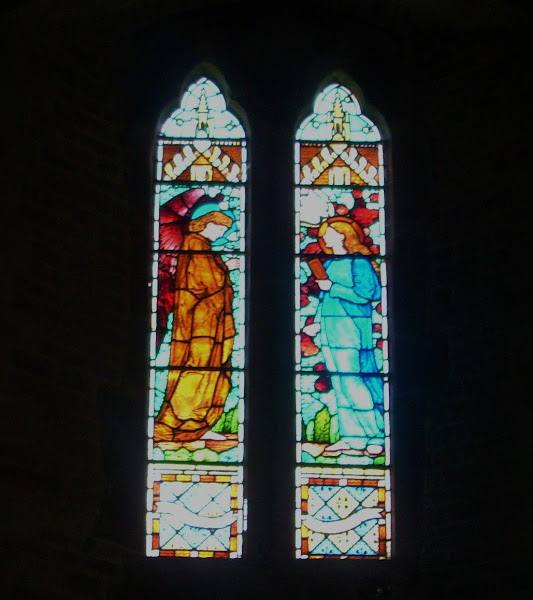
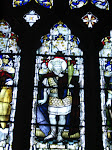
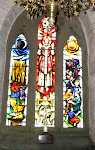
The ninth-century "Historia Brittonum" sees Lucius as a translation of the Celtic name Llever Maur (Great Light), says that the envoys of Lucius were Fagan and Wervan, and tells us that with this king all the other island kings (reguli Britanniæ) were baptized (Hist. Brittonum, xviii). Thirteenth-century chronicles add other details. The "Liber Landavensis", for example (ed. Rees, 26, 65), makes known the names of Elfan and Medwy,(a stained glass window at Llandaff Cathedral dedicated to Elfan and I posted last year about St Medw, a physician, whose church at MICHAELSTONE Y F(m)EDW was built inside a Roman fort near Newport-tying it to the S Wales area) the envoys sent by Lucius to the pope, and transfers the king's dominions to Wales. "Liber Pontificalis" is authority for the statement that Eleutherius died 24 May, and was buried on the Vatican Hill (in Vaticano) near the body of St. Peter. His feast is celebrated 26 May.
Southamption University Press is publishing a new book in May, Called 'King Lucius of Britain'. Recent research by a recent scholar and archeologist, who argues that Lucius was the first Christian King of Britain and deserves far greater recognition. He is not to be confused with Sankt Luzius of Chur who was a completely different saint and martyr. Our King Lucius was Llefer Mawr who has a tomb in St Mary de Lode in Gloucester.
http://www.soton.ac.uk/mediacentre/news/2008/may/08_84.shtml">
Amazon UK Link
http://www.amazon.co.uk/gp/offer-listing/0752445723/ref=sr_1_olp_1?ie=UTF8&s=gateway&qid=1240902118&sr=8-1
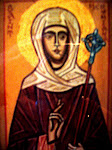
So Saint Fagan was a Roman missionary , who came to Britain and porbably baptised. with Elfyn and Medw the chieftains and nobility of Britain.This is also affirmation, that when Julius and Aaron and Alban were persecuted there was already a thriving Christian Church in Caerleon-whether it was Bede's 300 persons we cannot know, but we are certain it was in the 2nd century not the third when the persecution happened, which ties in with the Julian Julianus stone in Tredunnock, which has been authenticated as second century.
Fagan set up in the Cardiff area and founded his church there, and his small monastery of the Romano-Celtic type, which attracted other Christians, although nothing like a big monastery of the later type. He was a missionary, and possibly the centre of his mission the very fields on which he Museum of Welsh Life is situated. In common with St Julius Julianus, he gives his name to a whole area of the town of Cardiff, which is a good indication of a solid presence connected to the land itself. Elfyn and Medw also set up their centres, and it is possible the unnamed Amphilabus (the 'cloaked one') and Bishop of the Silures who initially escaped the persecution, and fled to Alban actually trained and studied under one of these saints. He later became a martyr, being stoned to death at Verulanium (Now St Albans) Plainly his influence was wide, if details about him are scanty, in a curious way his name lives on, not only in the Great Communion of Saints, but also in the name of the Museum of Welsh Life.
ST TEILO's CHURCH, TAL-Y-BONT
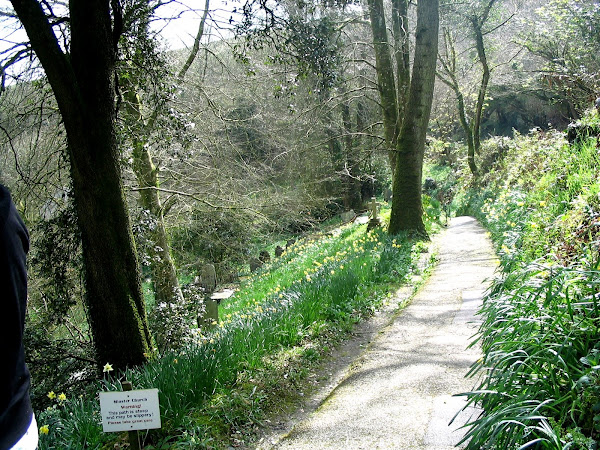
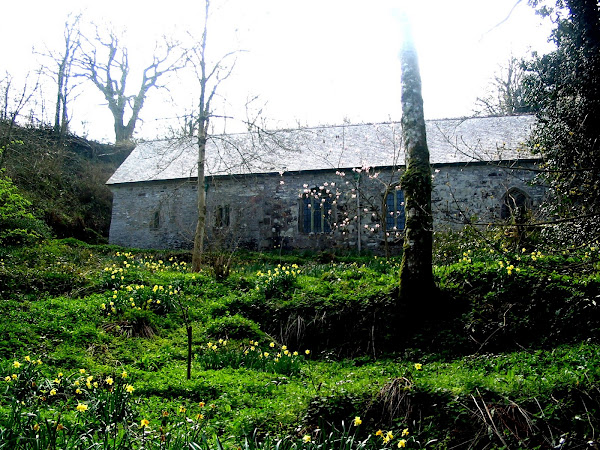
The Museum of Welsh Life (Amgueddfa Werin Cymru) lies just outside Cardiff, in a beautiful setting near the River Taff. I wrote all about St Teilo in a previous post last year, and about the colourful transition of his relic all around the world.If you look at the boxes on the LHS, you can scroll down to all the archives from last year, and I believe it was in an April or June page.There is also a Podcast on Mary in Monmouthshirelink to all the programmes in the left hand side boxes)
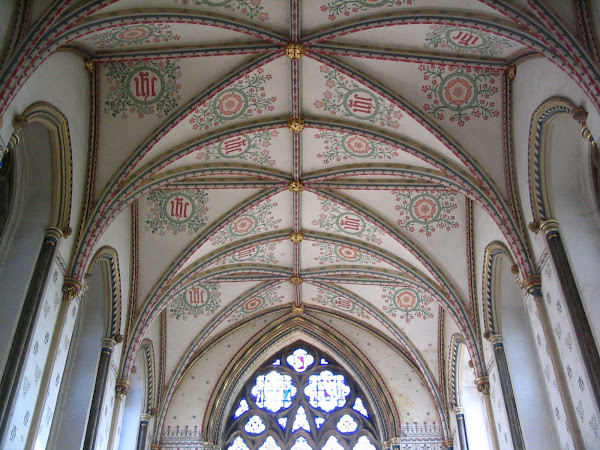
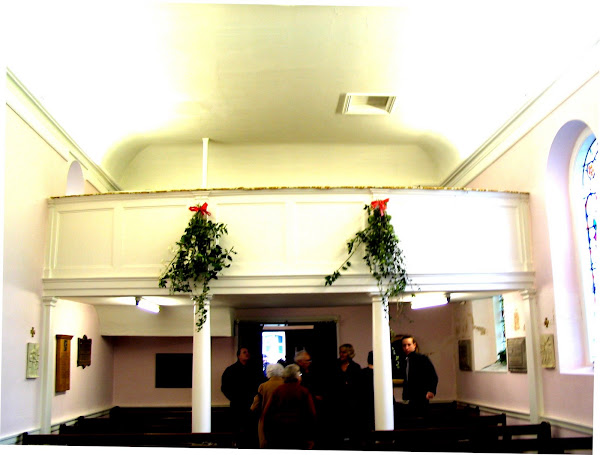
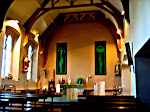
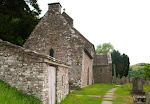
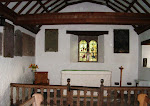
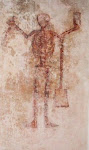
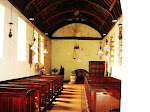
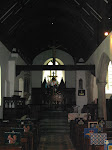
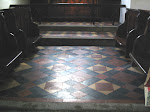
In 1508, Michaelangelo was painting the ceiling of the Sistine Chapel. Ten years later, another craftsman was painting the walls of another church, Llandeilo (the Llan or holy place of St Teilo)at tal y bont. We will never know his name, but what he did has been re-erected and repainted from exact copies as it has been reproduced exactly as it would have been in the 1520's before the time of trial when all such lovely things were limewashed, which in fact preserved them over centuries, as the Welsh were unhappy about the wrecking of the beauty of the churches. All the surviving original materials have been used in the complete reconstruction of the churc and its oil paintings, and missing items have been researched by experts. Floor tiles and glass , altar furnishings and furniture have been meticulously re-created. A new, hand-carved rood screen was made and decorated. The Painting of the Doom over the Rood the most amazing as it the shock of seeing a church so brightly coloured and beautiful with paintings, and devoid of pews.The result is breathtaking. The Custodian said to me, that a woman had said to him, that if churches looked like this today they would be full, as just to gaze upon it was a vision of heaven.
St Teilos
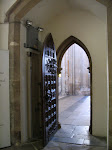
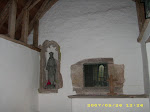
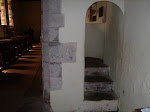
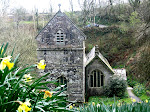
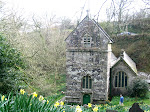
St Teilos was originally built on the banks of the River Llwchwr near Pontardulais. (The Old CHurch on the Marsh)as it was fondly called on its original site.The full translation of the Welsh name is 'The Holy place of Teilo by the crossing point of the River) There is no longer a bridge, but the church was at one time on one of the main routes through Wales, possibly for pilgrims on their way to St David's.Travellers entered the church to pray for safe passage accross the tidal waters of the River Llwchwr (TH-oo-thoor approx pron). A painting of St Christopher was always the first thing seen in a Mediaeval Church-associated with safe travel and pilgrimage. To die after seeing an image of Christopher was associated with immediate take up into heaven. Here at Talybont, is no exception. He is photographed through the door above.The Church was a central part of Mediaeval life and one of the only large meeting places available to the community.Eisteddfods, sports and festivals and fairs took place in the graveyard!
The church's rich decoration was a vision of heaven, acting as an audio visual backdrop for the Sarum Latin Mass, celebrated there on Sundays. Further visual stimulus was provided by symbols, images and messages, all woven into the theme.
There was indeed an earlier clas or Llan established here from the sixth century, and indeed the present church (now rebuilt and restored at St Fagans) dates back to the twelfth and thirteenth centuries, as does the font. During the Fourteenth century, two chapels were built on to the church, creating a cruciform or cross shaped plan.It then formed an aisle during the fourteenth and fifteenth century. 1500-1540 it was again repainted with scenes from the Passion cycle together with popular saints, St Thomas Becket,St James and inevitably Margaret of Antioch, and finally the porch was built.It was completely stripped during the time of the 'reformation' and everything whitewashed. It ceased to function as a parish church in 1852 when a new St Teilo's parish church was built in nearby Pontardulais. The old church remained in use for burials and swerview but in 1073 these ceased and the church ell into decay. The roof tiles were stolen leaving the structure exposed and compromised and in 1982 the anglican Church in Wales offered the building to St Fagans for reconstruction.It had been in use for 800 years by Catholics and Anglicans.
At St Fagans a new bell was also cast by Taylor, Eayre and Smith, Bell founders of Loughborough.(cast Great Paul at St Pauls Cathedral)1881. The bell here is obviously more modest but uses all the ancient techniques and used as a model the 15th century bell at Llantwit Major (see previous blog).It has a prayer in Latin around the crown like so many mediaeval bells
SANCTE TELIAUE ORA PRO NOBIS(St Teilo pray for us)
CARVINGS
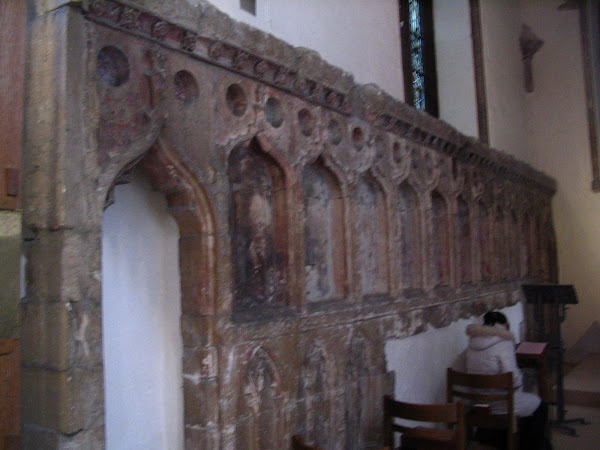
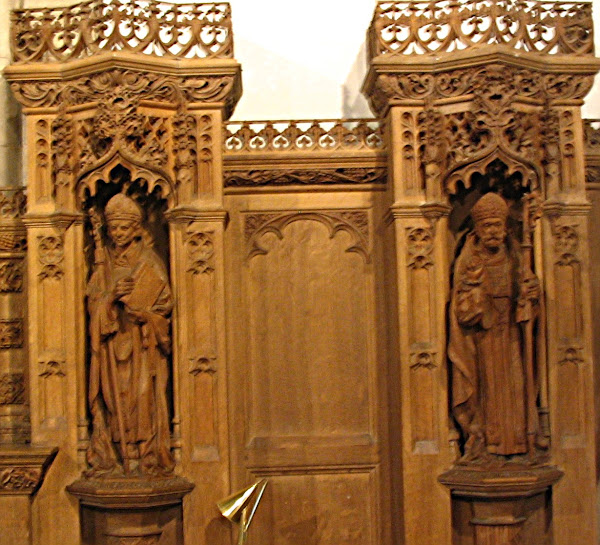
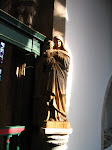
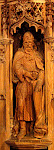
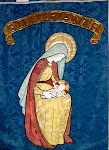
The Rood screen used to screen off the Sanctuary-the holiest part of the church, where the Blessed Sacrament was kept, and where the oly Sacrifice of the Mass is offered from the nave, where the ordinary people sat. The nave (meaning ship) provides the image of the protected people of God, in the ark of Noah, travelling to heaven. An image of Doom was provided above, but also the righteous climbing to heaven with Peter, and the Crucifix reminding the people of the Triumph of the Cross. Also there were the Blessed Mother, Our Lady, Mary, and Christ's favourite disciple John , representing the church. John was to look after Mary and Mary was now to be his mother.Very few of the rood figures remain because of the wholesale destruction during the 'reformation'and St Fagans is lucky to have two in the Collections in the Oriel Gallery no 1.
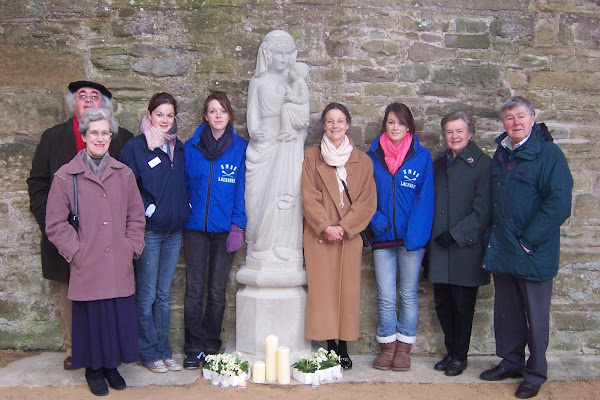
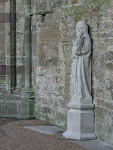
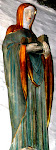
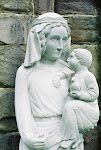
Master Carver Emyr Hughes carved the new figures of Our Lady and St Teilo from originals in Brittany.
There are many such remnants of rood screens found in various Churches around Monmouth, the most splendid (although no longer coloured) being at Llangwn Uchaf near Usk. this one is breathtaking. Again this was another original Old Welsh monastic settlement and I blogged about it in the summer of last year.A full booklet with the complete history and pictures of the reconstruction of St Teilos is available from the folk musieum. Entrance to the museum is FREE and car parking £2.50
This is a link for the Welsh Catholic History Society in Cardiff, who are at this time updating their website and when it is up again, you will be able to find out about the special Sarum Mass recreated for the opening of the Church at St Fagans. Currently there are no plans to license it for marriages and baptisms, but demand may eventually lead to that.
http://www.soton.ac.uk/mediacentre/news/2008/may/08_84.shtml">">