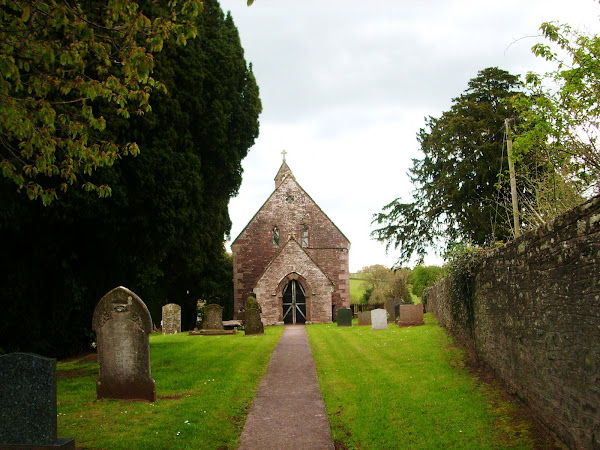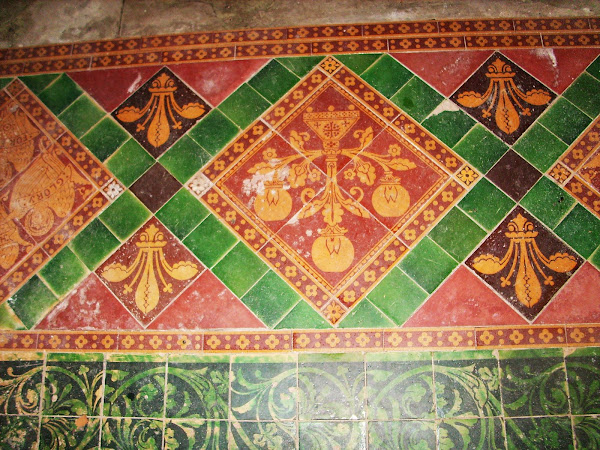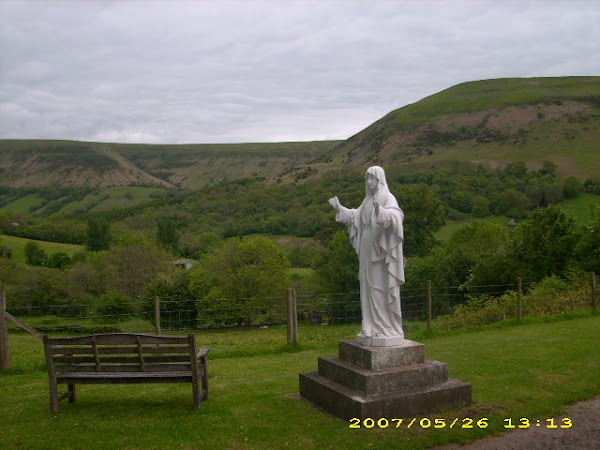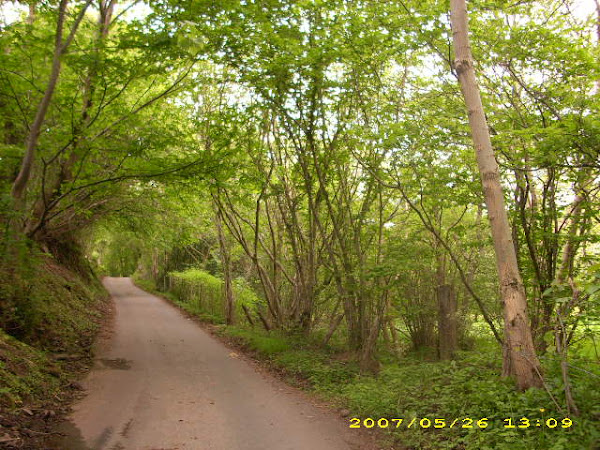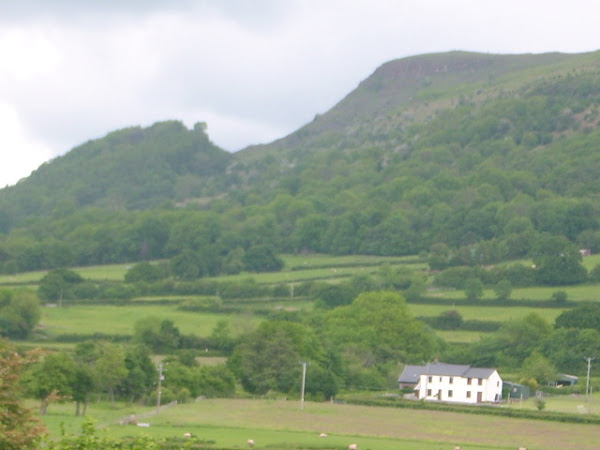








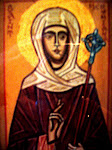

































Last Friday, I visited the ancient Church at Llantilio Crossenny.St Teilo is linked inextricably with Gwent. He seems to have had a close association with Llanarth, by climbing the Skyrrid and invoking, with all his monks the strength of Almighty God with St Michael to protect the Monastery from the Saxons (The Skyrrid or 'Holy Mountain' being Englished to 'St Michael;s Mount.
We have his close attachment to King Meurig, son of King (St)Tewdrig who established and funded Llandaff and, incidentally, saw to it for hundreds of years in the future that the then=pagan Saxons did not penetrate the Forest of Dean and Wychavon into Wales. Meurig was named after the Martyr St Maurice and Tewdrig is the welsh version of Theoderick the Bishop of the ancient church.So there is also the link with Mathern, near Chepstow, where Tewdrig died. These stories are all told from the Book of Llandaff (Liber Landaviensis) on the Mary in Monmouth podcasts. There is even an account of the consecration of Llandaff Cathedral, with Teilo and his nephew Oudocceus or 'Docco' after which monasteries were named at Llandogo near Tintern and in Cornwall.
Llantilio Crossenny is fairly near (South West of Monmouth) and I remember it well from its summer festival and its concert at Christmas. My first singing teacher lived in the village at Treadam and I was called upon as a girl singer to sing there a few times, in the days where the composer Mansel Thomas played the cello. It was afterwards at the Christmas concert we all gathered in the local hostelry with a lemonade and sat by the log fire, exhilerated by the occasion and performances.It was strange to make the pilgrimage back after thirty years, and my child remembrances actually had played me false. It was a much larger and more ancient church than I remembered.
The other mention of Llantilio was in Hansard for 1679. The then vicar of Llantilio is mentioned as having testified that only forty people attended his church, most of his flocl disappearing to the Gunter House in Abergavenny and its secret attic chapel and entrance, with the 'mark of the Jesuits' (oh dear!)on the wall. This was Vicar Greenhaigh at the trial of the most blessed Martyr, Father St David Lewis , the Father of the Poor, loved by Catholic and Protestant and hung for being a priest by a grieving population. This was all in the tide of the Titus Oates hoax and the fear of the landed gentry of having their property newly aquired from the church reposessed, if ever the Catholic Church recovered from persecution. When we reach that persecution segment in our county's history, I hope to publish more about it then, but just now wish to return to Teilo because of the name Llan-tilio is an English corruption of Llan-deilo and the Crossenny part from the Latin Crucis and Welsh version of that, the cross being the Cross of King Iddon, the successor to Meurig.
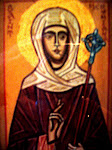
In 550 AD King Iddon asked Teilo, at his Monastery in Llanarth to pray for him, as Saxons were again making raids into the area. Teilo came North, raised a Cross on the pre-Christian mound and King Iddon repelled them.In return, Iddon granted Teilo the mound to build his holy church and monastery (llan)the dedication probably being to St Teilo and the Blessed Virgin Mary as every monastery was in those days. The customary rituals would have gone on, the clearing of the area, forty days of prayer and fasting on the site, then the final dedication of the church and llan. We know the monks and brothers and sisters did a Liturgy of the Hours,much longer than ours today. Later Teilo became Bishop of Llandaff.
Llantilio Crossenny , therefore means the ;Holy Place of Teilo at Iddon's Cross.
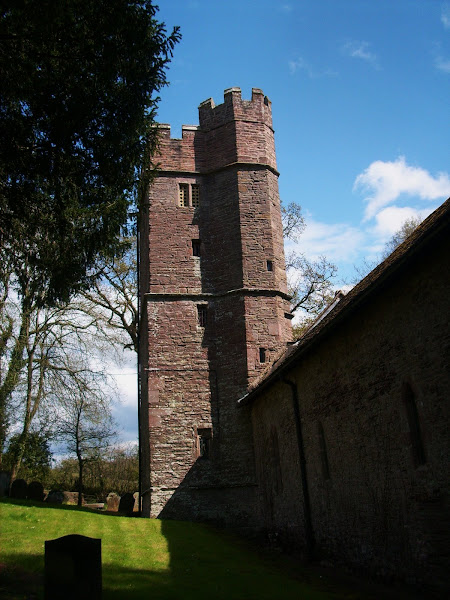
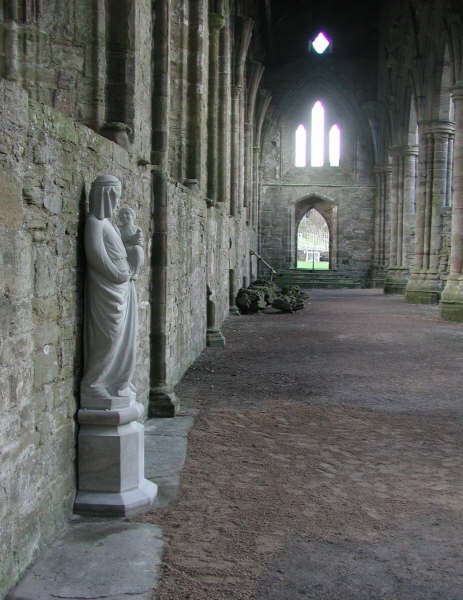
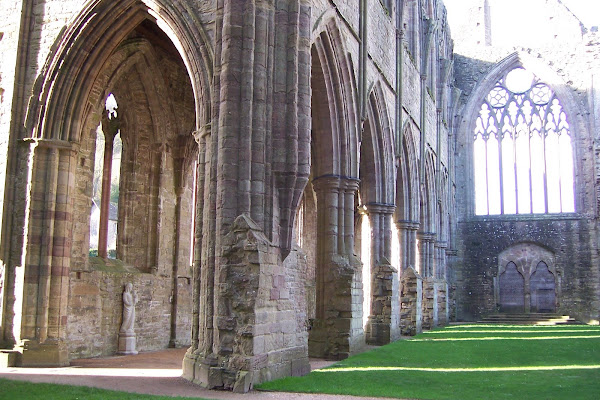
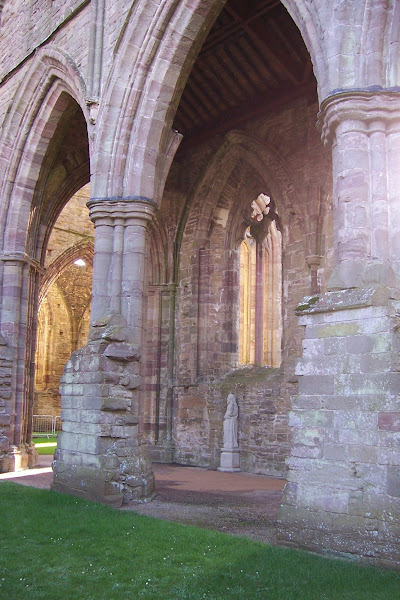
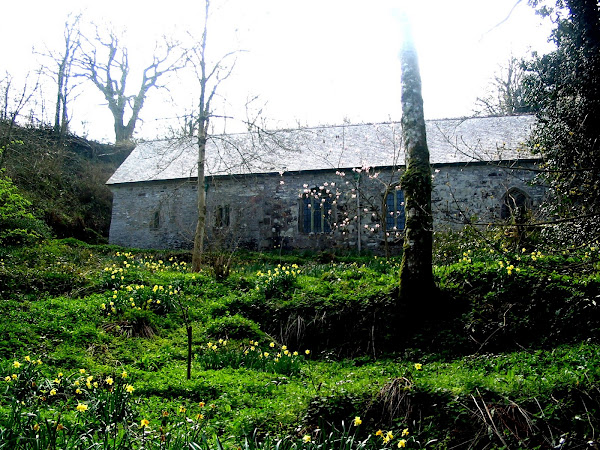
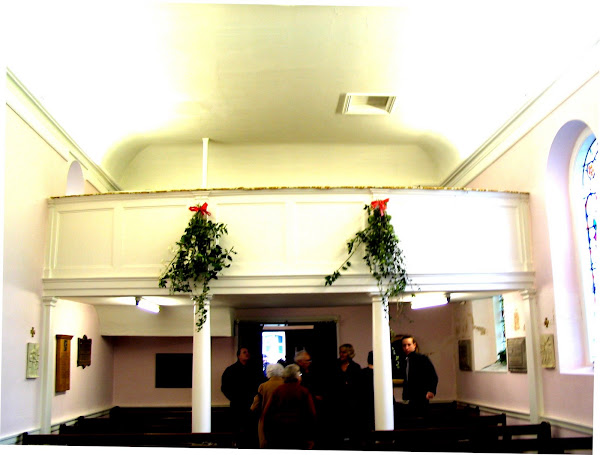
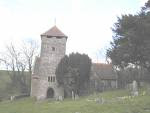
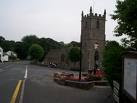
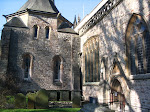
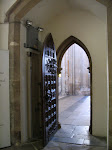
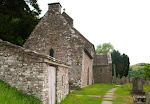
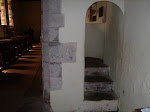
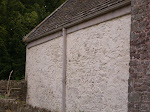
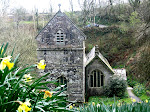
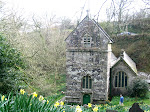
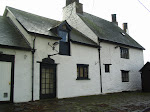
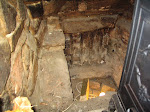
The Guide Book to this interesting church tells us that a grant of 3 modil of land(27 acres)was granted by King Iddon to St Teilo in 550 AD which came to the Church at Llandaff and is mentioned in ecclesiastical documents of 1119,1128 and 1291 AD.This was a lot of land and would have included land for animal husbandry and crop growing to support the community. Also the first church would have been made of wood or mud and wattles as we have noticed elsewhere. When the Normans arrived in the eleventh century and set about reorganising the churches, and establishing them as local defence structures and places where weapons could be kept in the face of attacks, espeically by Welsh princes, the buildings were replaced in stone by the 12th or 13 centuries. This is the result below. The staircase leading to the upper tower room has disappeared, leaving the door, quite high up in the Wall.There was a central gothic (early English) tower in the centre , some sixty feet high. It originally had a parapet, as shown by the gargoyles and probably a flat lead roof or one in the form of a low pyramid covered with stone tiles.More details after the pictures below..


 ________________________________________________________
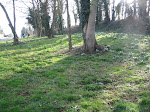
You can probably see from one of the last pictures the tell tale circular feature of the Llan.]
The Chancel
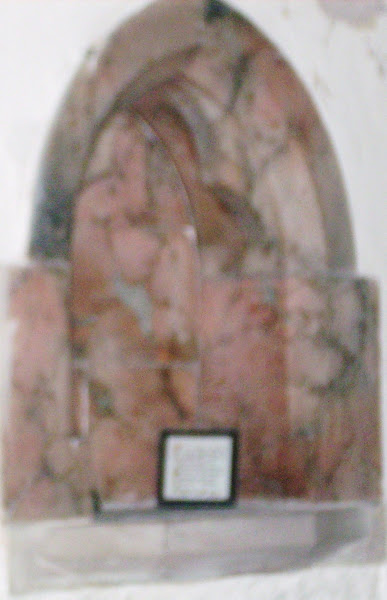
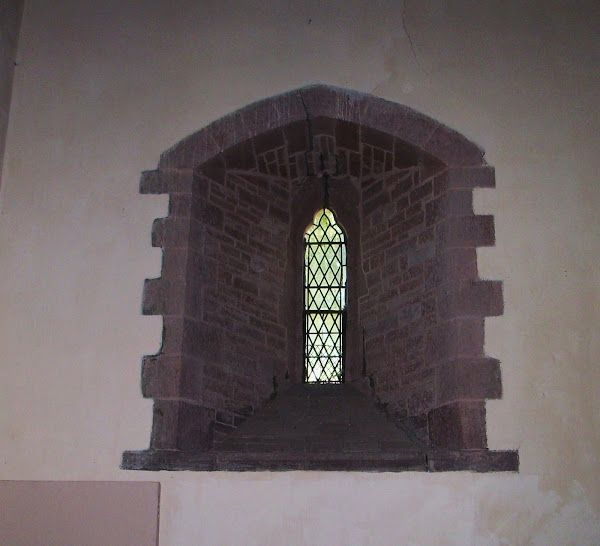
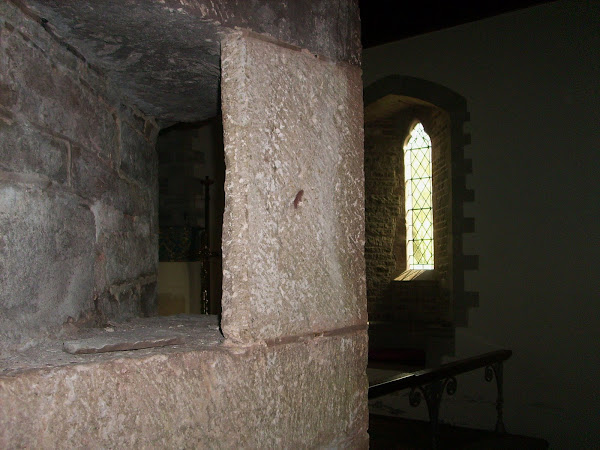
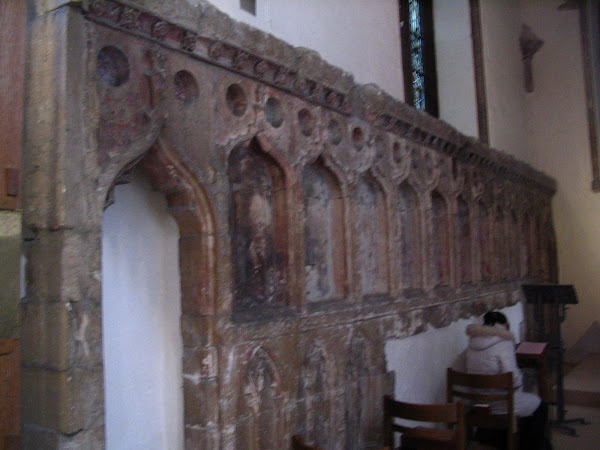
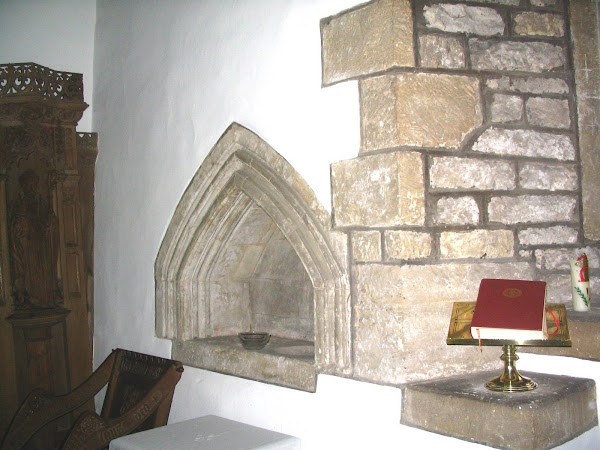
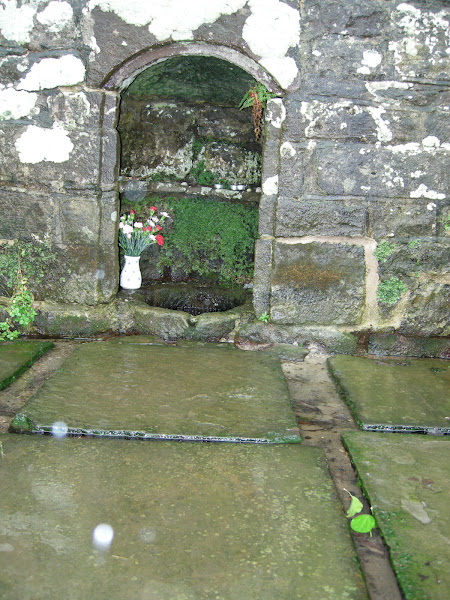
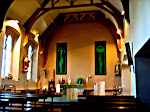
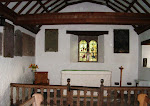
This was rebuilt in the fourteenth century in the 'decorated style' and there is still (see above) the decorated piscina, where the priest poured to earth the washing water of the chalice and patten, used at Mass. In fact, there are various arches on the North wall, leading into what would have been the Lady Chapel according to the guide book, but I would have thought the Lady Chapel, in common wit Catholic practice would have been to the left of the altar, and the right hand chapel holding the Blessed Sacrament, so that Christ, as it were was on the right hand side of God, if you faced the people from the altar and our Lady on the left hand side. I may not be right about this, and perhaps it does not matter but I observe this is usually the case. In Abbey Churches, Lady Chapels are often separate, behind the High Altar.On the South wall is the priests door,and another door gave access to a priests room. In common practice was, that when monks from the priory at Monmouth came occarionally to say Mass they would then be accommodated in this room as happened at Caerwent. The writer of the huide book also mentions the window facing down toards the altar, and it was possibly where a watch was kept on pilgims coming to pray before the relics, presumably of St Teilo-though clearly not his skull which seems to have had its own adventures, and is now once again in Llandaff Cathedral.
Welsh Reverence of Relics
A marked feature of the religious life of the old Cymry is in the respect and reverence given to relics- creiriau
In the relion and in the legal system of the tribe they play an indispensable part. Nawdd y Creiriau is frequently mentioned in old documents-it means the protection afforded to relics.When a beloved person dies it is quite usual for us to keep a remembrance-I kept an old brown jacket and driving license from my father. My house has reminders of him all over. It is a fond remembrance and assurance he is still there. In these early times people felt like that about beloved saints. After many years of their daath, often their bones would be retrieved and a bone placed under a Catholic altar, because in the Book of Revelations the Martyrs poured out at the end of time from under the altar mentioned there. According to teaching, the holiness and holy spirit had permeated every part of the Saint's body and that by praying in its proximity, there would be spiritual benefits of healing or special grace or religious insight or nearness to God, which was what the saint was now enjoying. Of course this was always going to be open to claims of abuse, that people used relics as 'lucky charms' but this was clearly not the case.Gerald the Welshman recalls the reverence of the Welsh for the relics. Swearing on the relics was the regular mode of procedure in the law courts of the tribe (Venedotian Code of Hywel Dda book 2 cap 10)
The litigant had to swear at the church where his sacramental bread and Holy Water shall be 'bara offeren ay dwyfar swyn'
In the Book of Llandaff there are many references to the custom of swearing on the relics of St Teilo. (Liber Landaviensis pp115)
Even at the time of the Annexation of Wales, the repsect paid to relics is illustrated by a letter of Edward I written about 1281 It refers to the relics of St Asaph the pupil of St Kentigern (Mungo) the original founder of the see.The King proposed that the relics be transferred from the Cathedral to Rhuddlan for the sake of safety.There are even stories of communities fighting over relics, for ecample those of st Beuno, uncle of St Winifred.(Gwenfrewi)There are also records of relics being carried into battle as late as Owain Glyndwr.Many relics were smuggled away and hidden during the times of persecution in the 16, 17 centuries and guarded by Guardians.
Easter Sepulchre
This refers to the custom during the Tenebrae.It held a large crucifix for veneration on Good Friday afternoon mass and then this would be placed in a large tomb on the north wall of the chancel or Sanctuary and a vigil kept until the light entered the Chuch at Midnight on Easter Eve. I had photos of a wooden Sepulcher at St Sannon's Church in Bedwellty. Then I noticed one in St Neot;s Church but minus the stone carved chest. I think there would have been one here too. This church was obviously important and linked with the Cathedral-it is also quite large for a country church and I really feel it would have had a stonw chest Easter Sepulchre, bow removed (when Anglicans took it over in the 16th century perhaps. Looking again at the Bedwellty pictures will give you an idea of the kind of carvings and inscriptions which would have been upon it.
Floor Slabs
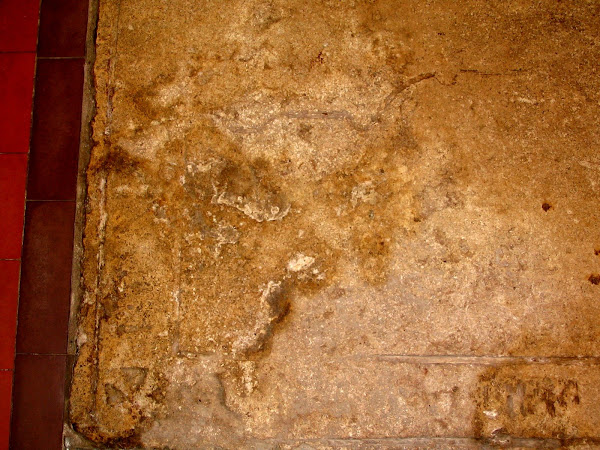
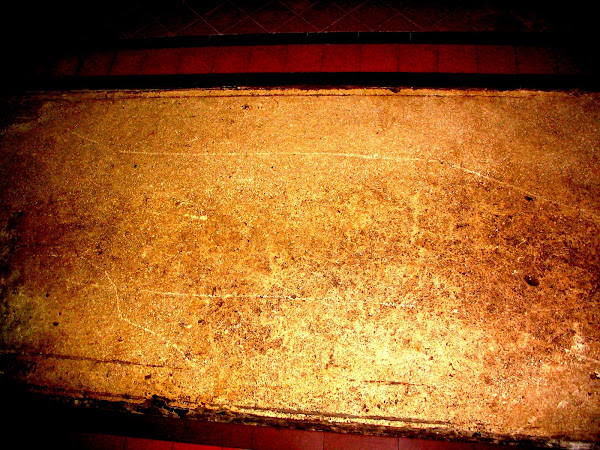
There are several interesting stone slabs on the floor from various families who lived in the area subsequetly abd worshipped there in late Tudor times.
Ringing Chamber
There are eight bells in all but they are from 1709 and so not Mediaeval. Their frame rests on four large timber supports, all careved from one oak tree.They are sixty feet high and stand on four blocks of stone, one at each corner of the tower. This extra support was put in at the time the bells were put in, and the spire is also a later addition.Original bells came from Gloucester (Adrian Ruddhall)(tenor weighs 10 cwts and 23llbs (520kgs)The White Chapel Bell Foundry of London chipped in in 1978 and another two added. The present tenor weighs 4cwts and 2 qts nd 4 lb (230kgs) and is tuned in D major.
Rood Screen was torn down
Originally the steps leading to the ringing chamber also led to a rood screen, containing a Crucifix and a statue of St Maru and St John.
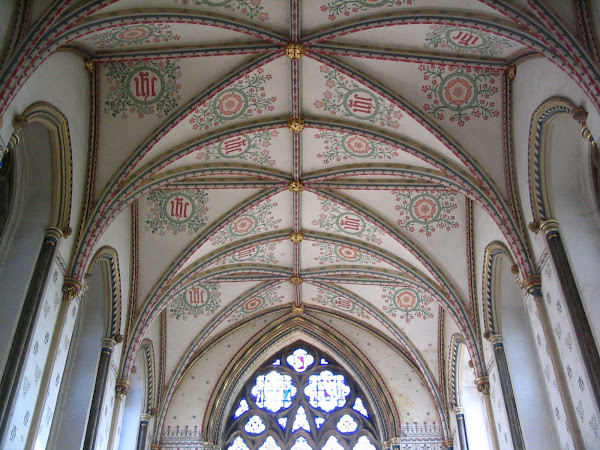
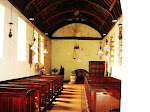
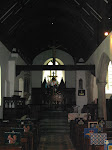
The Navewould originally in the stone building been in the Early English style and lower than at present.It was raised in the 14th century in a perpendicular style. It was raised on its slender colums when a clerestory was added adding more light higher up. These high arches contrast with the lower, Early English tower arch,
Saxon or Norman Font
This is found in the North aisle. It was rescued from the churchyard in the nineteenth century, probably at the time of the Oxford Movement and brought back into the Church.
Agincourt
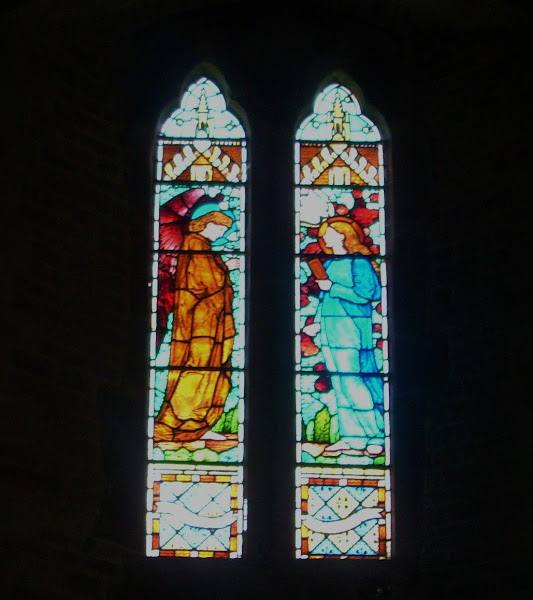
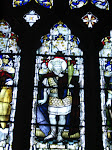
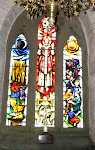
The most easterly window on the north wall has glass from Llantilio Court. The leftshows the inscription and coat of arms of Sir David Gam, Knighted by King Henry V, when Sir David was mortally wounded at the Battle of Agincourt.Sir David lived at Hengwrt, a nearby manor demolished in 1459. He is purported to be Shakespeare's Fluellen in Henry V but the dates are says te guide book inconsistent.
The right side of the Window is dedicated to Sir William Herbert, also connected with Llantilio and one of the family of the glorious defenders of the Catholic Faith in future centuries.The original entrance would have been through the south porch and its stoup (next to font) but now the entran e is through a west door
Ladye Chapel
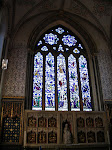
The guide book says the North transept became the Lady Chapel in the fourteenth century, perhaps because during the middle ages, the virgin mother gained greater status and perhaps the smaller chapel was not large enough.At the same time the original window was removed and replaced by the larger perpendicular window, which had four lights. This is now filled with glass by Mrs Morgan Clifford in memory of her husband and son.
Edward V (one of the murdered princes in the tower) or Edward II (1302-27)
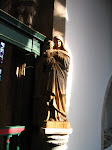
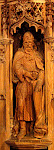
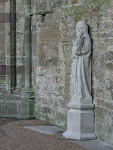
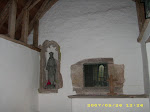
ON either side of the altar table in this chapel-in which there is no representation of Mary today,are two corbels or brackets meant to hold statues. They could be of either of the two kings above as the hairstyles are indicative of these periods.
CIL-LLWCH
There is a strong article, which I will deal with in later blogs, by Fred Hndo's visit to this manor and its attick chapel. The family were strong and loyal recusant Catholics and held regular Masses at their house, Cil-llwch Manor, which still esists and is mentioned also in Hansard of 1679 at the Trial of Father David Lewis
Te lucis ante terminum
Cyn tywyll nos , O Arglwydd Nef Before dark night, O Lord of Heaven
 dyfal lef o’r galon With earnest cry from the heart
Erchwn arnat, Geidwad cu, We beg of you, dear Saviour
I’n Cadw rhag peryglon…. To keep us from all danger….
Dewi Nant Bran Father David Powell
Where did Catholics Worship in Monmouthshire/Gwent?
This cannot be an exhaustive list but is representative only…..
1.Cil llwch _Killough Manor had a secret chapel-(The Powell Family) Father Andrewes
was the priest they kept/ Killough, it is now marked on OS maps with its Welsh spelling.
It lies West of Llantilio Crossenny
Fred Hando describes a Priest hole at Cillwch. llwch referrs to running water, cil is a secret place, (The secluded place by the brook.)
There is a secret (though not very secret in the light of the information today!) chapel in the house where people gathered for Mass. The Vicar of Llantilio Crosseny testified to the House of Commons Enquiry that he had seen Father Thomas Andrews at ‘Killouch’ and had seen him say Mass there.He had also seen Father Thomas at William Davies’ House in Bettws Newydd as well.
The less lucky Faithful went to the church of St Michael at the top of the Skirrid, or Holy Mountain, where they prayed the Rosary or celebrated Mass when there was a priest. The Priest who said Mass here too was Father Andrews, a Jesuit, who did his priestly duties well and managed to escape martyrdom.The burial of Catholics during these terrible times was always distressing, as they had to be buried at the dead of night,though presumably, since they owned the living, the priest buried them in what had originally been their parish church, with the Vicar turning the other way. The Powell family, perhaps including Father Powell were buried in this church.
Green Man
There is a green man in the church symbol of death and Rebirth of Our Lod Jesus, adapted from an earlier figure of pagan worship of death and rebirth.There are two squints allowing the occupants of the Ladye Chapel to see through to the altar for the elevation of the Host before the consecration at Mass. Further testimony to the existance of an Easter Sepulchre.The guide book mentions that there may have been an anchorite in the church as well.
Churchyard
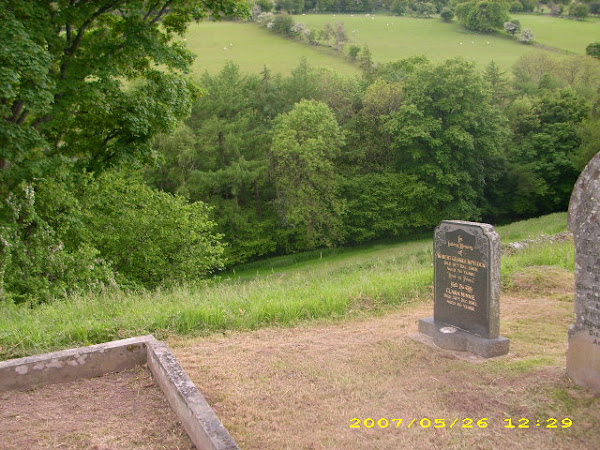
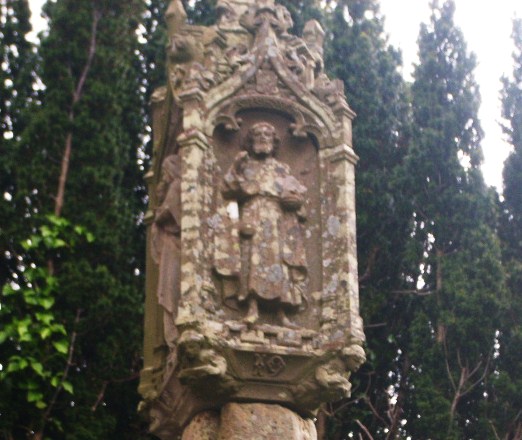
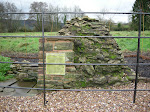
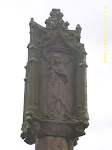
This contains the remains of an ancient preaching cross now carrying a simple wood cross , since the original stone one must hav ebecaome dangerous and was dismantled.This cross is a memorial to those who died in the two world wars.
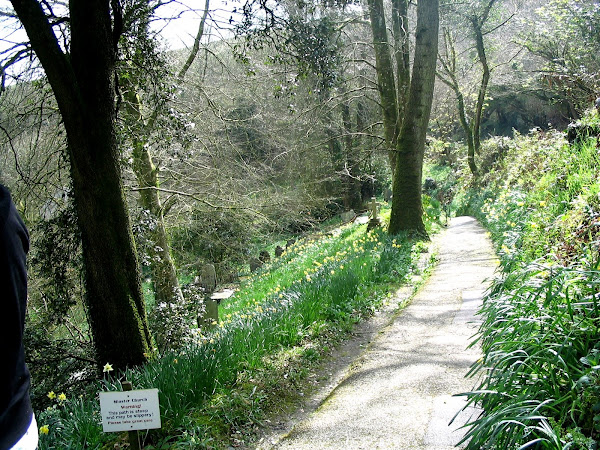
The Churchyard is also curcular establishing its claim to be an early Christian llan.
When I had gone around the church , I said a Rosary for many intentions and especially for our recusant priests, As I went on I felt colder and colder and was relieved to walk into the open sair as it was sunny outside!