


Showing posts with label Mass. Show all posts

Monday, June 30, 2008

The famous Welsh Croesnawdd-Cross of Protection and other relics


St Beuno's body was coveted by three communities, Clynnog, Nevin and Bardsey (Ynys Enlli-(Unnuss enthlee)The name 'Ynys yr Arch in the parish of Clynnog is suposd to preserve a thrilling incident in the course of this memorable controversy. The Legend ran that as the saint's body was being carried to burial, the porcession halted at this spot, while a sharp contention arose about its ultimate destination. Such was the posture of affairs when the dispute was solved to everyone's satisfation. The hearers having fallen asleep awoke to find three coffins resembling each other in every respect. Clynnog secured the true one ! (Celtic Britain and the Pilgrim Movement p 34) However, the sma etale is told of St Teilo you will remember.
Usually the saint would be buried and then at some point disinterred and if the body has decayed various bones were taken in special rituals and shared out amongst the churches.These were not worshipped in anyway, just venerated, bringing the saint closer to the people worshipping God.

The CroesnawddThe Famous Welsh Cross ofProtection

This holy cross , which was said to contain a portion of the True Cross was adorned with gold and precious stones and was always solomnly borne before the Prince of Wales as a palladuim of eternal salvation. After the death of the last native Prince of Wales, Llewellyn the Great, this precious relic was tken by Edward I to Westminster, after which it disappeared and no trace can be found.
-------

The Relics of St David

In the Black Book of St David's(14th century) we read that a certain class of tenants in time of war'are bound to follow the Lord Bishop with the shrine of the Blessed David and with the relics; and entries in the Black Bookshow the great veneration paid to the relics of the great Saint Dewi.

Swearing an agreement

One of the oldest of Welsh legal terms, cynghrair -ie a covenant or agreement made on oath-means an agreement sworn over a relic (crair)

Felindre the name for a Welsh Slave Village

One passage from the Dimetian code pf the Welsh Laws is of exceptional interest as an illustration of the steady influence of the church on the side of freedom and progress. It must be pointed out, that there was in the Welsh tribes, a class of serfs, or villeins as the Saxons would call them, probably the descendents of the conquered Iberians.(Celts living in Spain and Portugal) These men lived in separate hamlets on the borders of the tribal settlements.

The word Felindre is a very common place-name in some parts of Wales even to the present day and is a survival of the old serf village-(dre-f or Tre-) is the name for a serf-slave)

Law of Serfdom and Slavery

THe passage referred to deals with the class of persons wose privileges increase in one day, and among them is the serf-slave or villein:

The first, is where a church is consecrated in a serf village, any man of that village who might be a serf in the morning becomes on that night a free man.

A second passage in the same Code of Dyfed gives it a slightly different form:
If a church be built within a serf village (taeogtref)and there be a priest offering Mass in it,and it be a burying place, such a 'tref' is free from thenceforward.

Sacrament of Confirmation

'At the end of seven years, he-the young tribesman- is to swear for his acts, for then he shall come under the hand of his Confessor, and shall take the duty of God unto himslef(Book 2 Laws of Hywel Dda-Venedotian Code)

Devout Catholic Orthodoxy of the Welsh People in Mediaeval Times

The greatest literary figure in Mediaeval Wales is Gerald the Welshman, Giralds Cambrensis-the 'father of popular literature'as Green the historian calls him. He was a most voluminous writer, and in spite of his vanity and failings as a historical critic. his works are of the greatest value for the light they throw on the religious condition of the area known as Wales.

His writings are so well known that we need not linger over his testimony. Both in his Welsh Itinary and Description of Wales he speaks very highly of the orthodoxy and devout nature of the Welsh peoples., though he is candid and outspoken about some of their failings too. In Ad 1188 he accompanied Bishop Baldwin on his crusading tour of Wales, the outstanding feature of which was that the English Archbishop celebrated Mass each of the four Welsh Cathedrals. His experience during this memorable tour enabled Gerald to see Wales and Welsh life and customs from the inside. In fact his Itinary may be justly considered the first comprehensive account of the religious condition of the Old Cymry (Welsh).

Abbot John of Whitland (Ty Gwyn ar Daf) and Abbot Seisyllt of Strata Florida (Cistercian monasteries in West Wales-Menevia)accompanied the Archbishop and all his party as guides and interpreters. Gerald speaks very highly of the religious faith and devotion of the Welsh people and of their profound reverence for the church and the priesthood.

HE refers to many points of similarity as regards ecclesiastical customs between the Welsh and Irish of that period-eg. repect for croziers, torques, trumpets and books and the use of saints bells as relics.'Nothing', he says 'contrary to the true Faith is to be found among the natives'. It is said that some parts of the ancient doctrines are retained here. They give the first piece broken off from every loaf of bread to the poor; they sit down to dinner by three to a dish in honour of the Trinity.

With stretched out arms and bowed head, they ask a blessing of every monk or priest, or of any person wearing a religious habit. But they desire above all other nations the Bishop's Confirmation and chrism, by which the Grace of the Spirit is given. They give a tenth of all their property , either when they marry or go on pilgrimage, or when, by the counsel of the Church, they are persuaded to amend their lives . But of all the pilgrimages they prefer to go to Rome, where they pay the most fervent veneration to the Apostolic See.'

We observe that they show a greater respect than other nations to churches and ecclesiastical persons; to the relics of the saints, bells, holy gospels and the Cross , which they devoutly revere; and hence their churches enjoy more than common tranquillity.


Pilgrimages to Rome

We know from the writings of contemporary bards and other sources that pilgrimages to Rome were immensely popular among the Welsh people. (Brut y Tywysogion 12,40,44, 364)In fact, on the occasion of Gerald's second visit to Rome to plead for the Welsh independence of St David's in Menevia, there were crods of pilgrims from Wales in the Holy City-'multi peregrini de Wallia'-who came forward with patriotic eagerness , prepared to hear testimony in his favour. (This was for a separate Archbishop for Wales)

The Welsh bards are our witnesses that Rome exerted an extraordinary fascination for the Welsh mind. A pilgrimage to Rome was a must for every Welsh saint and found a way into his life story.

Cynddelw- a patriotic and distinguished Welsh bard-speaks enthusiastically of the sights of Rome:

Caer Rhufain, ryfedd olygawdd!
Caer uchaf uchel ei defawd!

I will write later about pilgrimages and about Gerald the welshman and his trip through Monmouthshire. He called in at Llanthony, Abergavenny, Usk Caerleon and Newport before going on to Cardiff.

Arrest of Ulrich Schultz known as Oliver Shanti

The arrest of this man on Saturday, brought to a close a seven year search for this German Paedophile on the run in Portugal and undetected in 7 years with a £3,000 bounty on his head because of allegations of more than 1000 crimese also seems to be connected with a business site for adoption of orphans from Kazakstan. German police arrested him in Lisbon on Saturday and all are hoping that this will be the close os a possibly child trafficking. He also may possibly know of the whereabouts of Madeleine Mc Cann and other Portuguese missing Chidren-like Yeremi Vargas.Let's hope this is a breakthrough!

Thursday, March 20, 2008

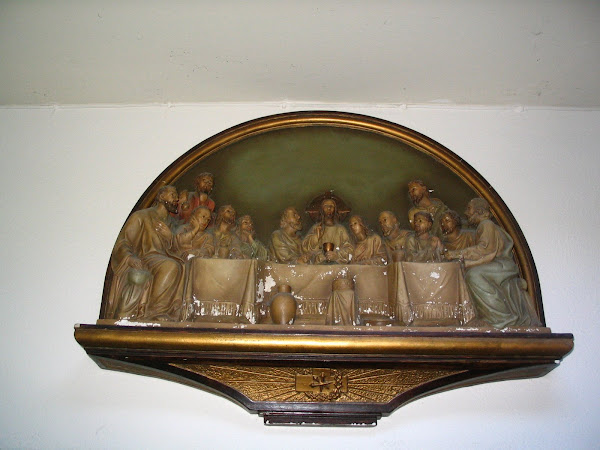
HOLY THURSDAY:THE TRIDUUM,The Mystery Begins


I have a new Commandment to give you,that you are to Love one another; that your love for one another is to be like the love I have borne you.
Blessed are they who pass through life's journey unstained , who follow the law of the Lord.

MANDATUM NOVUM DO VOBIS:UT DILIGATIS INVICEM SICUT BEATI IMMACULATI IN VIA;QUI AMBULANT IN LEGE DOMINI.

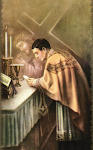
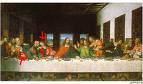
The theme of today's mystery is the love of the Lord Jesus Christ in the institution of the Holy Eucharist, the sacrifice on the cross and the lasting reality of his being with us in the Eucharist at every Mass 'even to the end of Time'.It is a memorial for thePriesthood and love of one person to another and the humility of the washing of the Apostles' feet by himself.

Have Christians always believed that the bread and the wine on the altar is changed from the Bread and Wine we see into the actual body and blood of Christ?

If you want a serious answer, read on with an open mind and no preconceptions. The answer is yes, until the sixteenth century.Let's look at what Jesus himself actually said: (John 6:26+)


In all truth I tell you, you are looking for me,not because you have seen the signs,but because you had all the bread you wanted to eat. Do not work for food that goes bad, but work for food that endures to eternal life,which the Son of Man will give you,on him, the Father God himslef has set his seal.

Then they said to him,What must we do if we are to carry out God's work?Jesus said:'This is carrying out God's work, you must believe in the one he has sent.So they said, what sign will you do, the sight which will make us believe in you?What work will you do?Our fathers ate manna (food God sent to feed the people when they were starving in the story of the Red Sea and Moses in OT)in the desert, as scripture says:He gave them Bread from Heaven to eat.

Jesus answered: In all truth I tell you,It was not Moses who gave you the bread from heaven, it is my Father who gives you the bread from heaven,the true bread for the bread of God s the Bread that comes down from heaven and gives life to the world.


'Sir' they said 'give us your bread always'.

I am the Bread of Life
No one who comes to me will ever hunger
no one who believes in me will everthirst
But as I have told you
You can see me and still you will not believe
Everyone the Father gives me will come to me
I will certainly not reject anyone who comes to me
Because I have come from heaven, not to do my own Will
but to do the Will of Him who sent me
Now the Will of Him who sent me is that I should lose othing
of all He has given to me, but that I should raise it up on the Last Day
It is myFather's will
That whoever sees the Son and believes in Him
should have eternal Life
And that I should raise that person up on the Last Day.

Meanwhile the Jews complained about him, because he had said'I am the Bread that has come down from Heaven' They were saying surely this is Jesus, Son of Joseph whom we all know and whose family we know. How can he say 'I have come down from Heaven?'

(Ed :Jesus goes on to affirm what he has already said John:6:44-48)

Then:
Your fathers ate manna in the desert and they are dead.
But this is the Bread that comes down from Heaven.
so that a person may eat it and not die
I am the living bread which has come down from Heaven.
Anyone who eats this Bread will live forever.
and the bread I shall give
is my flesh, the life of the world.

Then the Jews argued among themselves, How can this man give us his flesh to eat?

Jesus said (this time substituting the Greek word for 'eat' with the word to'gnaw' and 'chew')

In all truth I tell you,
If you do not eat the flesh of the Son of Man
and drink his blood,
You have no Life in you.

Anyone who does eat my flesh and drink my blood will have eternal Life
(Live forever with God)
and I shall raise that person up on the last day

For my flesh is real food
And my blood is real drink
Whosoever eats my flesh and drinks my blood lives in me,
And I live in that person.


As the Living Father sent me and I draw Life from the Father
so whoever eats me will draw life from me
This is the bread which has come down from Heaven
it is not like the bread our ancetors ate.
They are dead, but anyone who eats this bread will live forever.

This is what e taught in the Synagogue in Capernaum. After hearing it many of his followers said,'This is intolerable language! How can anyone accept this? Jesus was aware they were complaining and said'Does this bother you?' What if you should see te Son of Man ascend to where he was before?

It is the Spirit that gives Life, the flesh has nothing to offer* The words I have spoken to you are spirit and they are life.

(*St. Augustine explains this , “It is the Spirit who gives life, the flesh profits nothing” [Jn 6: 63]. The problem with their understanding is that they were thinking of flesh as when it is cut up in a meat market or cut from a corpse and not when it is animated by the spirit. To say that the “flesh profits nothing” he says, is the equivalent of saying “knowledge puffs one up.” )

Jesus goes on :
'But there are some of you who do not believe. For Jesus knew from the outset who did not believe and would betray him. He went on.'That is why I told you that no one wcould come to me except by this gift of the Father'. After this, many of the disciples went away and did not follow him any more.'(They were appalled as they thought he was talking about cannibalism)

'Jesus then turned to Peter his follower and said 'What about you? do you want to go away too?' Peter said 'Lord to whom shall we go? You have the message of Eternal Life and we believe and have come to know, that you are the Holy One of God. Jesus replied to them 'Did I not choose the twelve of you? Yet one of you is a Devil.' He meant Judas, Son of Simon Iscariot, since this was the man of the Twelve who would betray Him.

The Twelve Apostles Jesus picked were his chosen, those to explain him to the people and do his Mission after he died.

*the word Apostle in Greek is Episkopoi which means “bishop or overseer”

What did the people who were fed to the Lions, and martyred in horrible cruel ways think about the Eucharist?


The people trained by Saints Peter and Paul and John, the Apostle were given the full insights into the teaching of Christ, long before the Bible as we know it was formulated and confirmed.It was the Early Church that Compiled the Bible from the accounts of people who were alive at the time of Christ and could give witness.

One of the oldest Christian documents in existence is the Didache, also known as the Teaching of the Twelve Apostles, which was written between 50-150 A.D. and was used to instruct new Christians or catechumens. It says:

In regard to the Eucharist--you shall give thanks thus: First, in regard to the cup: --We give you thanks, our Father, for the holy vine of David your son, which you made known to us through Jesus your son [who was a descendant of David]. Glory be to you forever. In regard to the broken bread [the bread is broken at every Mass]: --We give you thanks, our Father, for the life and knowledge you have made known to us through Jesus your Son. Glory be to you forever. At this the broken bread was scattered on the mountains, but brought together was made one, so gather your Church from the ends of the earth into your kingdom. For yours is the glory and the power through Jesus Christ forever. Let no one eat or drink of this Eucharist with you except those who have been baptized in the name of the Lord; for it was in reference to this that the Lord said, 'Do not give that which is holy to dogs.'(See below in what the Welsh and Irish Teachers say about this)

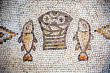
If you are in any doubt that Jesus has enough of his 'flesh' to go round from generation to generation till the Second Coming, this passage in John 6 is preceeded by the Miracle of the Loaves and Fish. Just think what relevence this is coming before this passage about the Eucharist.Panis Angelicus-Bread of the Angels.

St. Ignatius of Antioch, the third *Bishop of Antioch, who provided the first written evidence that the Church called itself “catholic’ [meaning “universal”] referred to the Eucharist [Body and Blood of Jesus received in Communion at the Holy Sacrifice of the Mass] in the following terms in his letter to the Ephesians written before 110 A.D. when he was on his way to Rome to be martyred for his faith:
Come together in common, one and all without exception in charity, in one faith and in one Jesus Christ, who is of the race of David according to the flesh, the son of man, and the Son of God, so that with undivided mind you may obey the bishop and the priests, and break one Bread which is the medicine of immortality and the antidote against death, enabling us to live forever in Jesus Christ.

Ignatius, also wrote in the letter to the Smyrnaeans
Take note of those who hold heterodox opinions on the grace of Jesus Christ which has come to us, and see how contrary their opinions are to the mind of God . . . They abstain from the Eucharist and from prayer because they do not confess that the Eucharist is the flesh of our Savior, Jesus Christ, flesh which suffered for our sins and which the Father, in his goodness, raised up again. They who deny the gift of God are perishing in their own disputes.


St Augustine, one of the earliest writers in the Church writes:

... I promised you who have been baptized a sermon in which I would explain the sacrament of the Lord’s table, which you now behold and which you became partakers of last night. You should understand what you have received, what you will receive, indeed what you should receive daily. The bread you see on the altar and that has been sanctified by the word of God is the Body of Christ. Through these things the Lord Christ wished to entrust to us his Body and his Blood which he shed for us unto the remission of sins. If you receive them well, you are that which you receive. The Apostle says, ‘One bread and we, the many, are one body.’ [1 Cor 10: 17]

St. Augustine also makes it clear that Christ was holding his own flesh in his own hands when, entrusting us to his own Body, [for] he said: ‘This is my Body”[Mt. 26:26; Mk 14:22; Lk 22:19; 1 Cor 11:24]. Indeed he was carrying his own Body in his own hands.”


http://www.catholicfaithandreason.org/fathersoneucharist2b.htm For more writings of the earliest Christians.

Early Welsh beliefs-Gildas

If is interesting in looking at the sins that Gildas writes down that it is quite clear that the ancient Church in Wales held identical beliefs, being, as it were in full Communion with Rome.

The word 'Host' is the consecrated Bread, Body of Christ, called after 'Hostias'=Sacrifice-Latin)

'From Gildas' Penitentials:

If a monk vomits the Host during the day from an overful stomach, he shall not presume to take his supper, and iff illness is not the cause, he shall expunge his offence with seven special asts, but if illness is the cause,rather than gluttony, then with four special fasts.

If anyone loses a host through carelessness, leaving it to be consumed by wild animals and birds, he shall do penance for three forty day periods.'

He who allows the Host to fall to the groundthrough carelessness, shall go without supper.

Then the Penitentials of Cummean

If by some accident someone negligently loses the Host, leaving it for animals and birds to devour, if it is at all excusable ,he shall still do penance for three fourty day periods, if not, ofr a year.

He who knowingly gives the Host to someone who is excommunicate shall do penance for forty days. (Soneone not conirmed in the Church's faith)

He who allows the Host to fall to the ground through carelessness shall do a special fast.

Further:
If someone lets a mouse eat it = 40 days fasting
Loss of the Host =Twenty days
Loss of the receptacle of the Host=:three forty day periods in the year.
Dropping the wine on the altar accidentally=7 days penance
spilling a lot of wine on the altar=seven days fasting
Dropping on the straw on the floor=7 days penance
Spilling the wine from the chalice at end of Mass=40 days penance.
Vomiting the Host =20 days penance if it goes into fire,if not 40 days. If dogs eat it 100 days.If the cause is illness, he shall sing 100 psalms

there are two more pages in 'Celtic Spirituality' (by Oliver Davies-available from ama zon )declaring sins connecedwith the Host, the Bread of Heaven as Christ called it himself)It was quite clear the seriousness with which they regarded the Host or the Lords supper and how they looked after it during and after Mass in direct obedience to the words of Christ.


There are always those who will walk away from this Truth , like the Jews who left appalled, unable to see with the eyes of faith-understand. The Bread and the Wine on the altar are not a reenactment of the Crucifixion over and over every time, but truly a visitation to that one time, when we stand at the foot of the Cross with Mary and the Apostle John.

Well who could show love better than that? Who can face the Eucharist and deny the teachings of Christ? And bear in mind there are many more references from the people who were made into human torches and fed to the lions. They all believed in the Body and Blood of Christ in the Eucharist-literally.I am glad I came to understand this.

Madeleine McCann

How good that at last Gerry and Kate McCann have had this tremendous injustice takn from their shoulders. They are now able to focus on getting their child home and employing new directives. It is the opinion of many people , psychics and otherwise, that those who hold Madeleine are actually known to the family, and it has been some kind of punishment or grudge. If it is and you who have her are reading this, Give her back to her parents now. You have done much damage, hurting a little child.Give her back. She is not yours and remember there is Divine Justice.

Haut de la Garenne goes on

Because there is little yet to go on until all the investigations are complete, the Sun newspaper is making wild and unsubstantiated claims against a well known personality, whose own background has been spotless.They will never learn and I hope the person in question sues the newspaper concerned. We have a right to know facts, not spurious allegations against people (like the McCann's were) who then haveto start defending themselves against something entirely without foundation, which gives them and their families enormous grief, just so they can sell their newspapers.