

































































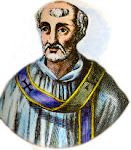


Angles or Angels?
The story goes that Pope Gregory was walking in the market place in Rome and saw three small children with blond hair and blue eyes being sold as slaves. He asked where they came from and was told the Land of the Angles (Angle-Land-Aeng-land) He said 'Not Angels but Angels' and decided to send Augustine to evangelise them, as such beautiful children needed the beautiful religion. He knew about the disobedience of the native church in refusing to convert them to the faith, but also realised perhaps better than they, that there could be no peace until they had embraced the Faith as their predecessors in England had done. The native church was indignant and resolute. Their brothers and sisters had been driven out and murdered in a callous way and made slaves by these heathern invaders, and they were probably too frightened to encourage them. INdeed their princes were still fighting to keep them out of Wales, even though there is evidence that some Saxons did settle peaceably in Monmouthshire.Gregory did know that Bertha,Queen of Kent was a Christian, however and her husband was the Bretwalda or King of Kings of the English and the Christian Queen gave Gregory the best hope of evangelising the Anglo Saxon Kingdoms. A very reluctant Augustine (he had heard what the Anglo Saxons were like too and probably did not expect to survive the mission!) arrived in Kent and was warmly received by the King and Queen.
King Aethelbert and Queen Bertha of Kent allow Augustine to build an Abbey at Canterbury
King Aethelbert saw quickly the unifying aspect of Christianity and his whole court was baptised and from its headquearters in Canterbury the missionaries went out to evangelise the other Angles and Saxons and baptise them.
There were problems as Augustine arrived with the original British church. They had become used to the Julian Calendar and because of the inaccuracy of dealing with dates and months in this way, the Pope Gregory, to whom all the authority of Christ had been given as regards the church, decided there should be a more straightforward system, so the months would not become askew. This led to a dispute about the date of Easter, which I will speak about again. There was another matter of discipline, although nothing was forced at this stage, which was the matter of priestly celibacy.
The old Romano British Church was needing modernising as the universal church evolved under obedience to Peter, who was given the power of binding and loosing on earth,and who was given the power to forgive sins in Christ's name. (from the Bible)
The monastic settlements admitted married clergy-indeed St Peter himself was married and had to suffer the sadness of seeing his wife and daughter Petronella carried off to be martyred. This was nothing to do with women’s role but what the church needed at this time was growth, and that meant children. There had been so many persecutions of Christians (and remains so to this day) it was felt better to have a priesthood able to travel without encumbrance and also a priesthood who understood the virtue of purity and virginity. They would dedicate their whole lives to God. Indeed the Apostles themselves urged even married couples to abstain from sex when their children had been born, and we see again and again the pattern –as in Gwladys and Gwynlliw parting for separate organisations when their child bearing was done. Children would be given to the church and some held back to be rulers and monarchs and fight to administer and defend the kingdoms they inhabited. All the great saints of the ancient British church were celibate as Virginity was greatly prized and essential for the descendants of the Apostles.Further to this the Irish in particular had kept the old Druid Practice of a one year trial marriage , during which they could live together and have children, and confirming it a year later, which was against Christian teaching of marriage -one man and woman. This was irregular, but as Christ's teaching on marriage was even stricter than that of Moses, it had ti be phased out. After all if the marriage did not work out, what then? The approach of Augustine without soldiers and so forth was light but he did ask obedience to Christian teaching, but some leaders were not to be reasoned with.
Augustine finds resistance to the Anglo Saxon Evangelisation and the attempts by the Pope to establish the Gregorian Calendar and hence date of Easter.
When Augustine arrived, there was resistance to the modernising Pope. He was one of the few Popes known as ‘The Great’. Gregory had great love for the Angles, seeing a small group of blonde children in the market place in Rome, when he was told they were Angles, he said ‘Not Angles but Angels’, and resolved to send Augustine. He reformed and standardised ecclesiastical chants. (Gregorian Chant), because he realised that the church needed to celebrate Easter together throughout the world. The European world celebrated Easter at one time and the British church at another.
Eventually a painful decision was made and the Anglo Saxons merged with the Romanised Celts in Britain and from this beginning, the Anglo Saxons began to grow their own saints and benefited us greatly as the Anglo Saxon monks, taught be Augustine began to write down the stories and history of the English Church as well as recording the stories of the martyrdom of Julius and Aaron and Alban or example. The Venerable St Bede of Jarrow for example wrote a whole history of the Church. For all the historians groaning at inaccuracies of his dates etc, I would say time was of little importance to them, in the context of God’s time. The elaborate way they described martyrdom and death surrounded by angels etc was consistent with the beautiful Christian view of this ‘going home rejoicing as a supernatural event’
Abbess Hilda, The Synod at Whitby
The story of the Great Synod or meeting held at Whitby to ecide all these questions actually is an interesting one in itself and I will tell it at another time, as well as another story of Whitby Abbey.Suffice it to say, that the representatives from Rome reminded the representatives of the native British churches of the importance of Unity and to remain outward looking and take their full part in the evangelisation of the Kingdoms. There was naturally still resentment as the Romano British churches resisted change, but gradually changes happened, although nothing was done to force this, although some attempts to reason with some of the dissenters were marred with violence from the British side. Gregory was right, however. When Christianity was firmly established , things did settle down, though there was still some friction at the borders, it put an end to Saxons lotting churches and attacking monks.Indeed the Saxon monks became outstanding Christians and three generations gave their loives to going back and evangelising in the lands they had originally come from! One such monk was Wynfrith of Crediton.
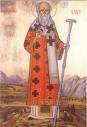
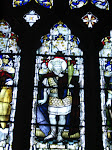
Wynfryth of Crediton (St Boniface)
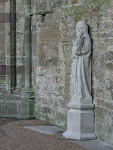
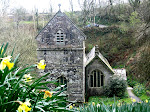
The Saxon Wynfrith or Boniface as he was to become was born at Cred’s Town (Crediton)in Wessex around 680AD. In the meantime a new church and monastery in the modern style had been built and he went to the monastery school at Exeter for the first part of his life. Then he entered the Benedictine house at Nurseling near Southampton(then called Hamwic). He was born of a fine family and his father allowed him to enter the church reluctantly. He soon attracted his own students by his brain and by his holy and virtuous life. King Ine of Wessex sent Boniface to head a delegation to the Archbishop of Canterbury. When the Abbot died the young monks begged him to take over but he felt the pull of the missionary to go and evangelise amongst the Saxons in the continent and went to London. He was really quick and clever, but humble and wise and so when the Abbot died, he was offered the job. He ,however, felt himself called to the life of a missionary. 716AD is the time he set off for the Netherlands and Friesland (low German part of North Germany) These German tribes were not easily convinced. They held to their ancient deities:
Sun-Sunday
Moon-Monday
Tiu Tuesday
Woden Wednesday
Thor Thursday
Freya Friday
From which we get our weekday names even today. They were not interested in peace or Commandments.
The Angles and Saxons
The Angles, Saxons and Jutes, themselves contained various peoples and tribes and were still trying to organise themselves into kingdoms. The King of a particular area would rule with is ‘Witan’ or a number of Earls, who themselves were local leaders of the tribes. The small Celtic settlements they had taken over became ‘Minsters’. These minsters were often secular establishments , where trade could happen, but after the mission of Augustine, many of the older churches which were not stone, were rebuilt in stone. So it was that the original stone church at Crediton came into being, the Celtic peoples having fled. So it became a church, but not a monastery, as we see that Boniface or Wynfrith went to school in Exeter and then Nursling to become a monk and study for the priesthood. There were strains from the start, since, although kings had been received into this church London was the City of Trade or Emporium for all those kingdoms. Mercia, Essex, Wessex and Kent. So there was quite a lot of sortng out to do to bind these tribes into one.
The European Background –Mission to the Frisians
Western Europe was a patchwork of rival power centres, mainly Christian but with pagan outposts like Frisia. North of the alps was the Merovingian dynasty under Clovis, who established it in Gaul. Clovis became Christian and became a member of the church as a present to his wife,after her prayers brought about a victory when they had been attacked by an alemannic tribe and were expecting defeat. He called upon God and was victorious. A strange coincidence brought about a mission to the Frisians.
The lands of the Merovingians were divided into an Eastern side called Austrasia and a Western side called Neustria.The Kings were challenged by their ministers and powerful dukes of Thuringia and Bavaria and in the early 660s the Austrasian minister deposed his king a child called Dagobert II , had him tonsured as a monk and sent off to Ireland. Fifteen years of politics later, one of all these factions were looking for a puppet King asked Northumbria’s Prince Bishop, Wilfrid for help. The great man complied. He had the Irish contacts and his years in Lyon had introduced him to the ways of the people.. He equipped the monk with a magnificent entourage and arranged for him to return to the Merovingian throne in 676AD.
Wilfrid makes enemies
The Western Merovingian faction took a very dim view of this. Dagobert had an unquestioned right to his own throne, but they were not happy.Two years later he decided to go to Rome again and did not want to go via Quentovic (France) and took a more easterly route by way of Frisia. Now Frisia was the area inhabited today by Holland and the area of Friesland around the coast of Northern Germany, roughly as far as the beginning of Denmark. Quite by chance, and fortunately for the church, so began one of the great historical events of the Saxon mission to the Frisian peoples. When his onward mission to Rome was held up by delays, he talked extensively to the king of the Frisians and was received in a friendly way. He was lucky, because his arrival co-incided with a bumper fishing season, which they chalked up to the arrival of the holy man. It seems thousands were converted to the faith but this first conversion was a hollow one, and soon the fishing declined and then the throne passed to a fierce pagan called Radbod.
Prayer +In the Name of the Father, and of the Son and of the Holy Spirit.Amen+
O Lord, let St. Boniface intercede for us, that we may firmly adhere to the faith he taught, and for which he shed his blood, and fearlessly profess it in our works. Amen
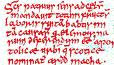
Fæder ure
Our Father
þu þe eart on heofonum;
Who art in heaven
Si þin nama gehalgod
Hallowed be thy name
to becume þin rice
Thy kingdom come
gewurþe ðin willa
Thy Will be done
on eorðan swa swa on heofonum
On earth as it is in heaven
urne gedæghwamlican hlaf syle us todæg
Give us this day our daily bread
and forgyf us ure gyltas swa
and forgive us our trespasses
swa we forgyfað urum gyltendum
as we forgive those that trespass against us
and ne gelæd þu us on costnunge
And lead us not into temptation
ac alys us of yfele soþlice.
And deliver us from evil
Amen
Pater noster, qui es in caelis,
sanctificetur nomen tuum.
Adveniat regnum tuum.
Fiat voluntas tua, sicut in caelo et in terra.
Panem nostrum quotidianum da nobis hodie,
et dimitte nobis debita nostra,
sicut et nos dimittimus debitoribus nostris.#
Et ne nos inducas in tentationem:
sed libera nos a malo. Amen
Madeleine McCann
All has indeed gone quite on the Madeleine front. We continue to pray for her safe return. In fact the whole case has been a puzzle, with many things not adding up and involvements or governments and His Holiness, major world millionaires and involvemtns of Scotland Yard. This is clearly no ordinary case. Madeleine was always a high profile child and not a 'normal' victim as she had very powerful friends and connections indeed. I hope that the silence means now the Gerry and Kate are following up all the leads and she will be found very soon and the mystery solved. No one would be happier than me!
Haut de la Garenne
Not much new news except that sniffer dogs have now shown an interest in the courtyard at the centre of the complex, near the boys dormitory. Police are to search here next.
MONMOUTHSHIRE
I was terribly sad to learn of the suicde of a couple wo had married many years ago and in old age had been told that having different needs, they could not go to the same care home. Whilst the Social Services at Abergavenny aid it would be against their human rights for this to happen, in fact my own in laws were told the same thing and after my mother in law went into a home where she could be cared for around the clock my stepfather died, even though we had offered him a home with us. The only blessing-if it ever could be was that my mother in law could not take it in and was telling people he had run off with another woman. It is a sad state of affairs that such centres are free in Scotland but English and Welsh have to pay, and also that social services are able to make such judgments and delineate between homes so that if someone has this degree of care they cannot go to this place. There have, in any case been many such stories in the news recently. Had my mother in law not needed round the clock nursing this could have been managed differently, but she is very happy there and has a lot of friends.
God bless that couple and make us all aware that the care of elderly people, who have lived well, maintained a marriage and not been a burden to anybody should have to go through such torment in later life. We should be actively seeking to create homes where married couples can continue to live together in as normal a way as possible until they pass on. Lives well lived, should not end in this way.