
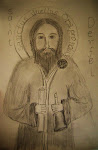







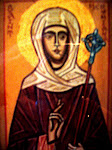







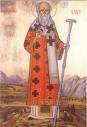












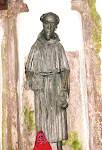







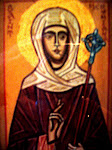






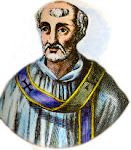


St Dubricius or Dyfrig (born in Madely near Hereford) was the great Abbot, who founded monasteries at Hentland, Moccas and of course was Archbishop of Caerleon, when it was the chief centre of theBritish diocese incorporating Wales.What we know is that Dyfrig, who was sent by the Synod at Llandewi Brefi to get St David to come and defend the church’s teaching against Pelagius the Culdee, reformed the College at Caerleon (the Romans had left it very run down)and filled it with young men going out to be missionaries in the diocese and it was St Tysoi who was one of his students. He was under the personal tutelage of St Dyfrig .However the main monastery by the time of Tysoi was the great monastery of Llancarfan,(founded by Cyngen in 447AD after the visit of the Bishop St Germanus when he first came over to preach against the Pelagian heresy of the Culdee Morgan-Pelagius’ real name.) which is probably where Tysoi was formed and ordained,because St Dubricius (Dyfrig) was its principal before St Cadoc.
In fact he is named as a clerical witness to a grant to the Llancarfan monastery in the time when an Abbot Paul was in charge.
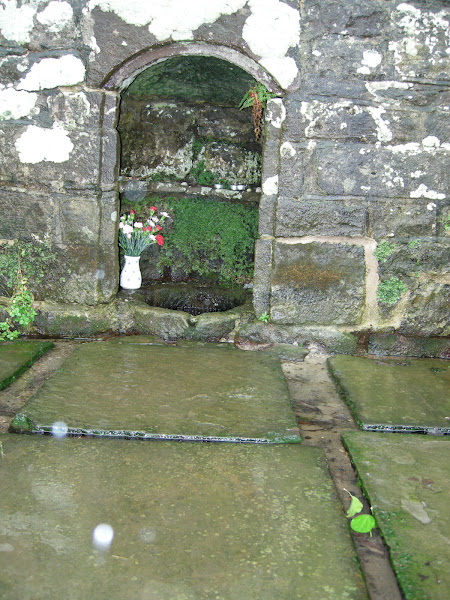
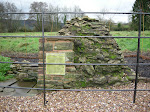
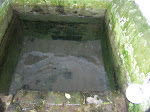
This Llan would have been founded as all the others. Tysoi and a group of followers would have been sent out on the white Martyrdom, came to this beautiful valley to preach the gospel, cleared the ground, and so established their heavenly circle, built their church in the centre, their accommodation buildings around it,(at first of mud and wattles or wood -then later of stone) and near water or a holy well for use and for baptisms.Before doing so they would have sanctified the ground by prayer and fasting for forty days and nights and they would have established farms around it to support it.
It would then occssionally receive a visit from the Bishop who would consecrate it, then the bretheren would establish their ‘Opus Dei’ their daily work of God , with an early and much lengthier Office of Hours, the psalms often accompanied on the harp. This was the pattern in so many places. Bishops travelled from place to place preaching and strengthening the faith, announcing their way by means of a bell and the visits of the bishops provided unity for the faith. Indeed St Cadoc himself –of the same vintage as Tysoi it would seem made seven trips to Rome in the time of seven popes! It would seem travel was not quite so arduous as at first appeared. Possibly a King’s son, such as Cadoc (he also ruled as King) was able to afford transport.
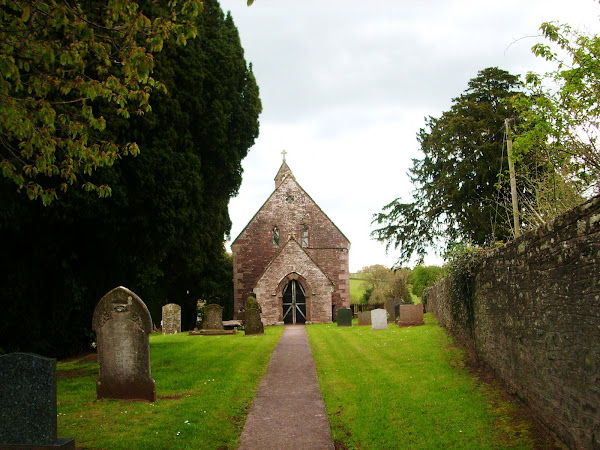
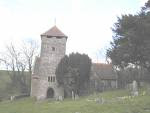
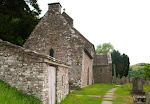
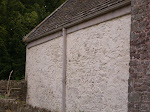
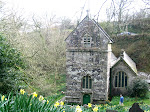
Evidence for Llansoy’s monastic origin is strong-the churchyard is curved, roughly in a circular shape and the llan area enclosed by earth banking, which you can see from outside the church yard on the south and south west side. So life continued for hundreds of years until the Saxon raids and the frequent driving out of the Welsh Christians (they were called ‘Welisc’ by the Saxons which means ‘Romanised Britons’-as they were thoroughly Romanised and in Communion with Rome)and we can guess that the original monks and Christian Community had to flee inland and West, or as so many did to Armorica or Brittany in France. At some point ,when the Saxons received Christ at the work of the holy Saint Gregory (and St Augustine of Canterbury) the Welsh Church had been in existence for hundreds of years and after the wholesale slaughter and putting to flight of the British Christians in what is now England and the lowlands of Gwent, it is understandable that they feared the Saxons and did not wish to embrace them at first.
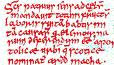
Tysoi’s church was eventually given into the new diocese of Llandaff by Conhage or Conhae in the time of Bishop Berthwyn of Llandaff. It is described as
‘PODUM SANCTE TISOI,PUPIL OF ST DUBRICIUS, which formerly belonged to St Dubricius’ and was ,it seems willed to Llandaff on the death of St Dubricius, after he was buried at Bardsey. (p187-Book of Llandaff)
The name is later spelt Landissoy or Llandesoy when it was ‘Englished’.It is today spelt Llansoy , in which the term of honour ‘Ty’(the House of) has been dropped. No dedication is given of the Church, but there is no doubt as to its patron.Other than this, not much is known of Tysoi personally, but as he was the clerical witness to the Land Grant to the Abbot Paul, he must have been an important person in the Church hierarchy.
The Norman Conquest
After the Norman Conquest (in 1066),in the late 11th century, Llansoy was reorganised as a church belonging to the Lordship of Usk, one of the Marcher lordships created on the border country between England and Wales to consolidate Norman gains in Wales. I have written about this before and how the Normans cunning and endlish in fighting between the Welsh Princes meant that the Normans were able to take over the land. It is likely that the monastery contained no more monks, or that any that were there were sent to other places, one retained there as priest, but the lack of records off this seems to indicate it was a working church for that village and already administered by a priest.The Marcher lords were powerful, put in place (in this case USK Castle) to keep them busy fighting the Welsh and not the royal family. Indeed they had virtual independence from the crown. They were abolished by Henry VIII no less in 1536, when compounding his seizure of all the Church’s properties and setting himself up as its head) he also annexed Wales into England, determined to stamp out the Welsh language and officially deciding that Wales had ceased to exist. He felt he could so this as he had some Welsh blood.
The Earls of Pembroke,held the lands for two hundred years , then passed to Viscount Windsor and bought in the 1760’s by Henry, fifth Duke of Beaufort.The Duke was the patron of the Church until it was given in 1902 back to the diocese of Llandaff as part of the Disestablishment of the Welsh Church.
Anglican Parish of Llansoy
The boundaries have not changed much since the earliest times. It remains a quiet rural parish and is bounded on the North by the Olway and the South by the Pill brooks.The main road through runs from Chepstow to Raglan , on the route once used by the ‘Fusileer’ the coach that ran from Bristol to Brecon in the 1830’s. In an effort to improve the road, a turnpike was built to extract tolls from travellers, the middle house at the three on the north side of the road was the toll house.
St Thomas Day in the area
Thomas Watkins, Anglican vicar of Llanarth distributed St Thomas Day alms (just before Christmas) to eighteen poor people of the parishes of Llanarth, (st Teilo’s monastery)Llansoy and Clytha.They had to be churchgoers and of impeccable reputation in order to qualify.There was, after the removal of the safety net of the monasteries considerable problems over poor laws and which poor belonged to which parishes. (the word ‘dole’ came from the monasteries who would dole free food out to any who came to the monastery ‘dole window’. Records show the monasteries often kept whole villages alive during the time of famine. There were always ale houses in the village.
Parish Priests of Llansoy
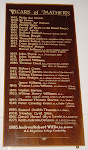
Father Nicholas (de Bagethorp) seemingly a Norman priest was the first priest recorded at Llansoy by Sir Joseph Bradney.He resigned in 1347. We have evidence for another priest’s name Father Philip (Sir Philip ap Howel-a Welsh name)in July 1431. He was named in a transaction of land involving three parties. 1473 was Father Edward (Sir Edward ap Sienkyn) another Welsh name, who in that year witnessed a deed relating to land in the parishes of Llansoy and Llangwm.
These are the only names of parish priests that survive before the church became Anglican.
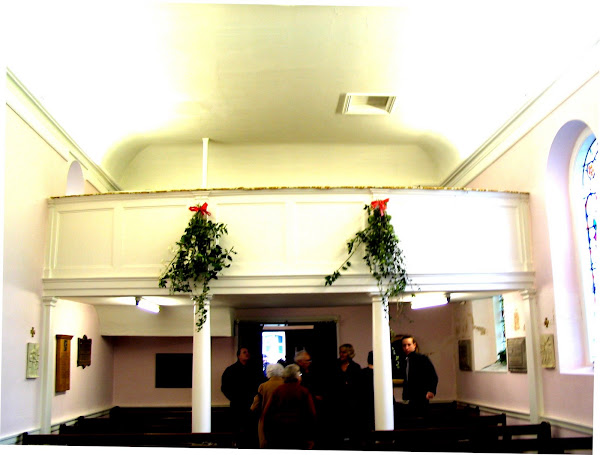
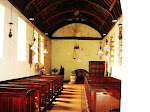
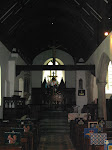
Inside the Church
Original Church door, the Holy Rood and its destruction at the time of Henry VIII
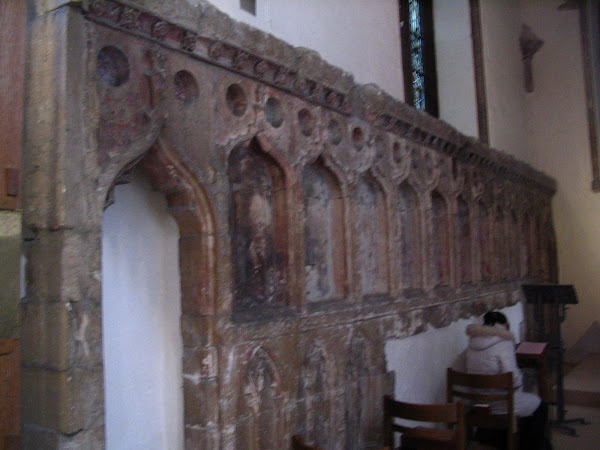
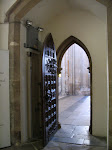
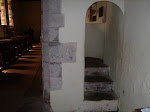
Of the earliest date is the door between the tower and the nave , of 13th 14th century date.In the 15th or 16th century a rood screen was added and a rood loft and stairs leading to the loft. A picture of the doom would have been painted on a tympanum above it , a large cross and a Crucifux of wood and Mother Mary and St John on each side of it. The rood was important, reminding Christians that paradise was lost when the Tree of Knowledge of Good and Evil was plundered of fruit by Eve and given to Adam, and Christ, who was the fruit, handing on the wooden cross made his sacrifice to become the Tree of Life, in which those who believe and do his Will regain paradise upon death) The ‘Holy Tree’ in fact as the Good Friday liturgy gives.
The South wall of the nave had to be reconstructed for this to happen.The ‘Holy Rood’ is the Crucifix and ‘Holyrood House’ in Edinburgh named after this-probably attached to the ;Church of the Holy Rood.
During orders of Elizabeth I ,In 1547 on orders of the agents of Henry VIII and in 1561 on the orders of Elizabeth his daughter, all rood screens were ripped out of churches and whilst nearby Llangwm and several other chuches miraculously survived, St Tysoi’s church was not so fortunate.Remarkable because the Puritans in the 16th century went round desecrating churches as well. Since these rood screens were very expensive, carved by craftsmen with donations from parishioners, there must have been great unhappiness at removal of something so beautiful for a plain space. Rood screens often contained pictures of saints and inspirational pictures from the Bible for a people who could not read and they must have felt bereft, a reason why so many complied and went to Church to avoid heavy fines on Catholics , did not take Communion and then attended covert masses in houses of the local aristocracy, to whom the organisation of the Catholic mission passed.
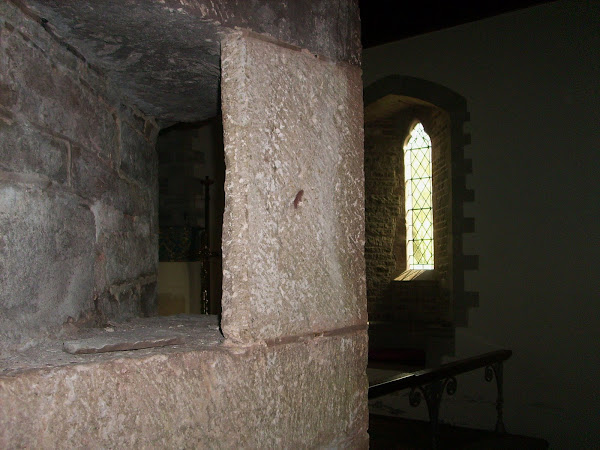
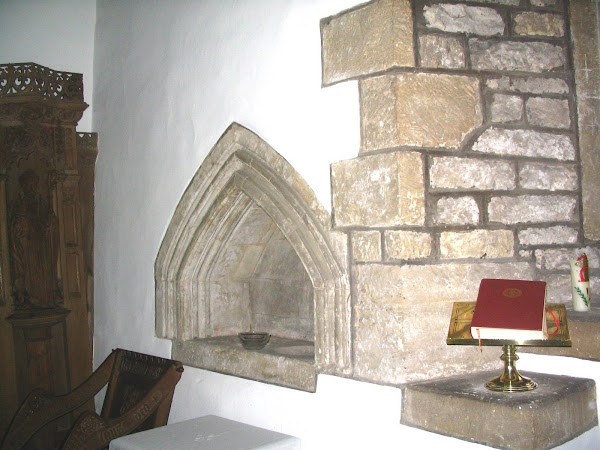
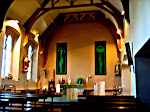
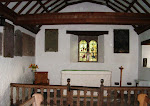
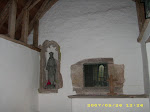
The priest’s door is still there on the south wall of the chancel/sanctuary, and provided the father with his own door into the ‘holy of holies’ –mediaeval in date and the piscina also survives, where the priest washed his hands and poured away the washings of the vessels of the Blessed Sacrament after the Mass-straight into the earth as Canon Law required.This is in the south wall next to the altar of course.
The later tower and font
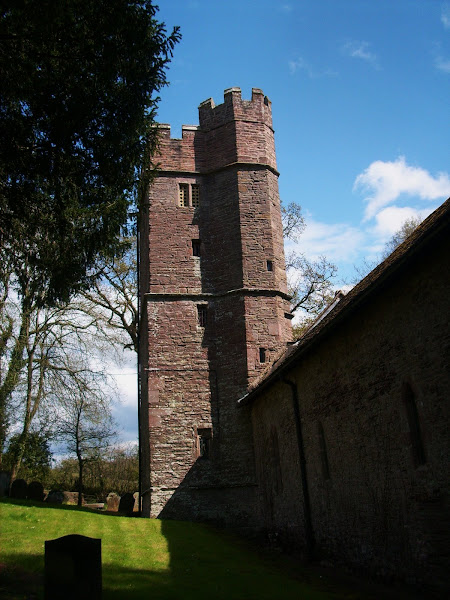
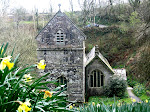
The present tower was erected by the Anglican parish by 1770s.The Church was restored in 1857-had seating for only 51 people.The original font had been thrown out at some time in the 16 or 17th centuries and a new one carved of Portland stone, octagonal in character and a square base. Has a heavy octagonal oak cover and an elaborate iron work decoration and ring.
Stained Glass Windows and Brass Cross
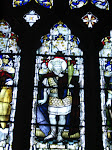
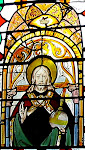
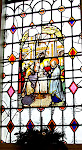
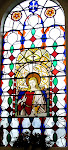
These were thoughtfully provided by the vicars and their families who served the parish. There are two windows (lights ) on the North wall of the Nave-one shows the Parable of the Sower was in memory of a Churchwarden,John Cale, and the other Alfred Pritchard’s window shows Christ of the Revalation holding the Lamb in his left hand and priestly staff in his right hand.
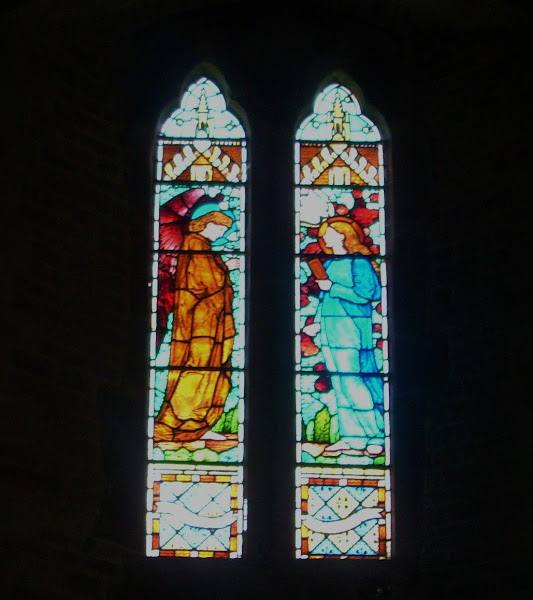
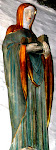
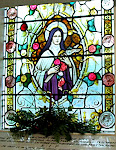
In the South Wall there is a beautiful stained glass window depicting the Holy Mother Mary on the right and St Peter on the left, this was given by the children of Rector William Jones who died in 1914.
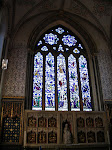
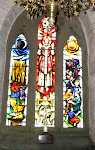
In the south wall of the nave is more stained glass which is quite modern but interesting and commemorates the life of another Rector William Jones (died 1938) and his wife and has an inscription chosen by their daughter because of the relevance to country folk.
‘While the earth remaineth, seed time and harvest, and cold and heat, and summer and winter, and day and night shall not cease’
(Genesis 8:22) In the window’s centre light the earth is portrayed, a cruciform star rises from it. Blue is used to represent night cold and winter. Red symmbolises day, heat and summer. The sun shines in the red light of the sindow while the moon appears on a background of blue. There is also a dove, symbol of peace, flying over the waters of the flood. A rainbow arches through all three lights of the window, in the artist’s words’uniting all’ The window was dedicated by Dr Rowan Williams, Anglican Bishop of Monmouth 30.9.1988.
The big brass cross at the altar was dedicated by another Rector’s family –that of Rector Evan Thomas.There is a metal box in the church which used to contain parish rrecords, until they were all sent to the national library at Aberystwyth and facsimiles given back to the parish. After 1733 legal documents ceased being written in Latin.
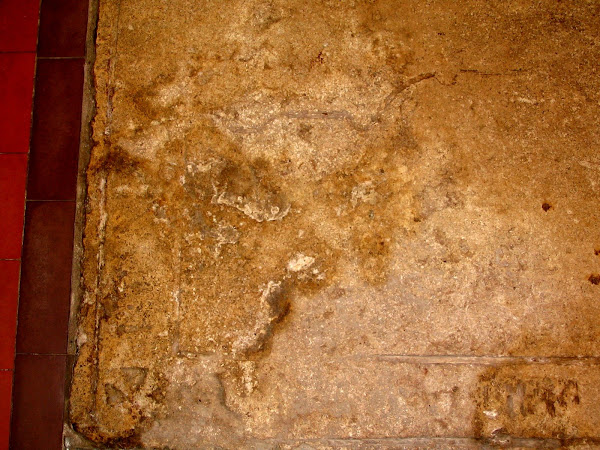
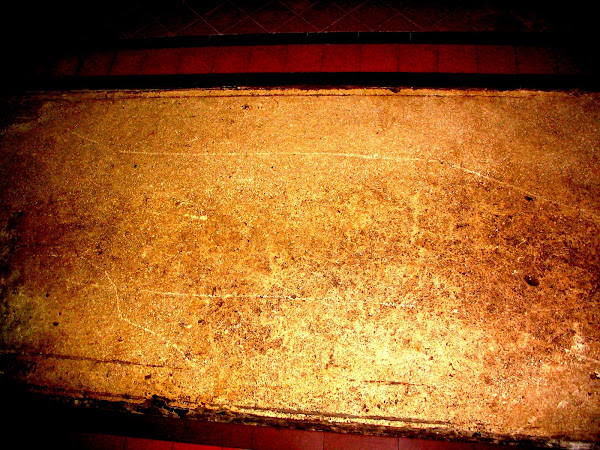
There were always people buried under the nave of the churches, but the inscribed stones above are of later date-the earliest from 1689.
Churchyard
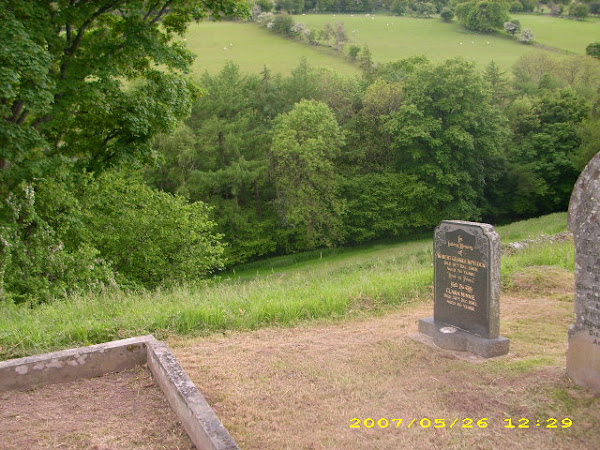
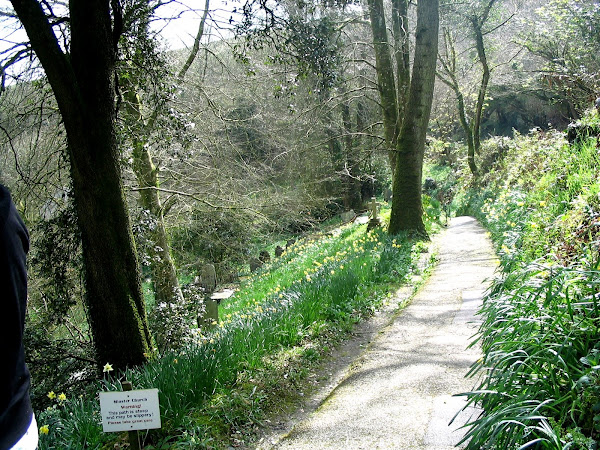
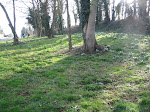
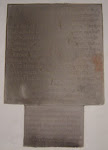
The Churchyard is dominated by a huge yew tree growing out of a low mound-trunk measures 28 feet. From Celtic times yews have been a symbol of religious life-in the area of heaven in St Tysoi’s llan.There is also a very interesting memorial tablet, which is above.
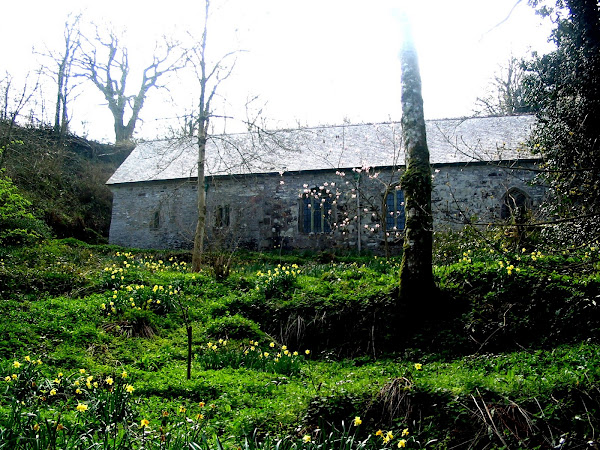
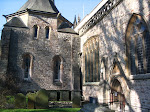
All in all the character of St Tysoi’s llan has remained unaltered. You can still imagine it functioning as a small llan and it is still surrounded by some houses, land occupied by the first monastic community.
Thank you to Annette M Burton for her (much more detailed and excellent) guide book obtained from the church entitled ‘With the Lord’s Assistance-A Brief History of the Parish and Church of Llansoy’, which has given me much information.