



Showing posts with label Augustinians Greyfriars at Usk. Show all posts

Wednesday, January 5, 2011

PREACHING THE CRUSADES IN GWENT!-Part TWO-PATRISHOW, USK, CAERLEON, NEWPORT

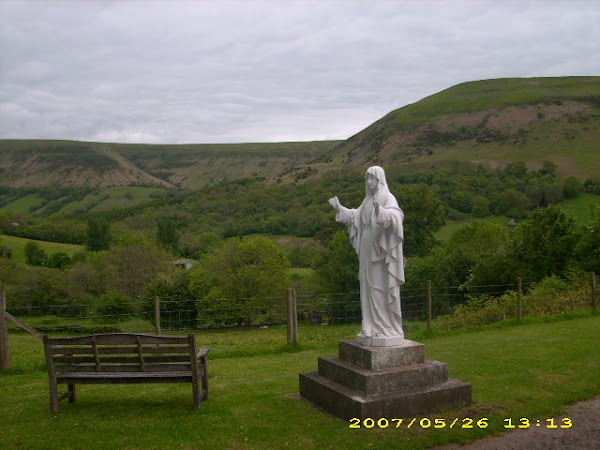
PATRISHOW
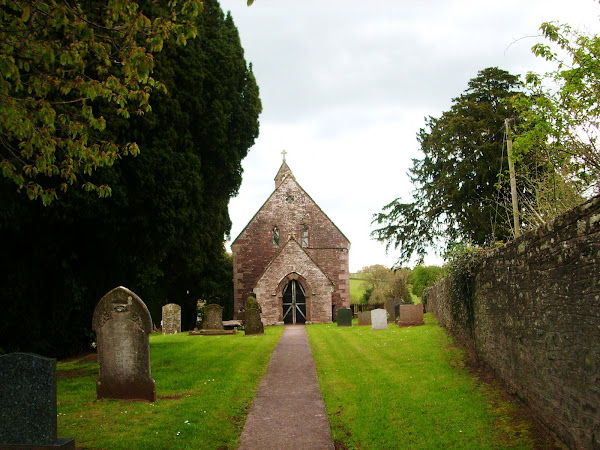
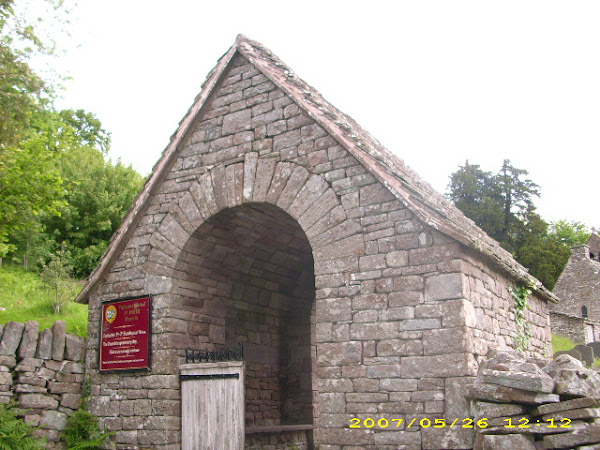
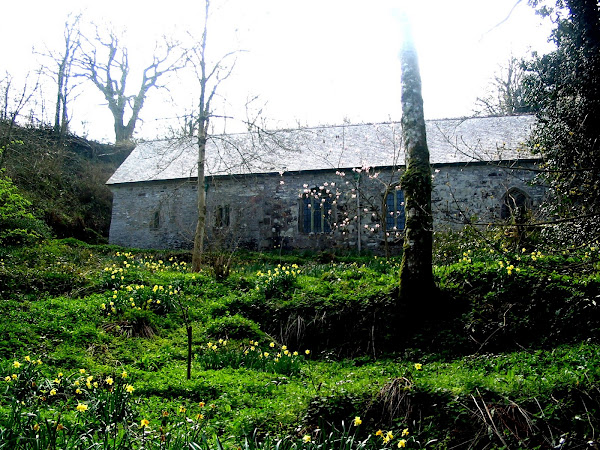
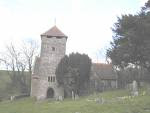
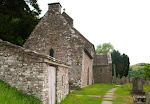
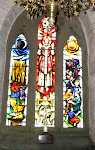
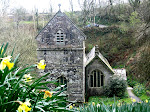
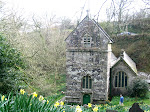
After leaving Llanthony, Archbishop Baldwin and Prior Gerald made their way, along with their recruits to the next port of call. This was the highly popular pilgrimage site and healing well at Patrishow. Here St Issui the Martyr had met his end tending to a homeless stranger. You can search this blog to find the rest of the story. The bridge over the stream still is said to  contain a small cross incised by the visitors of 1188

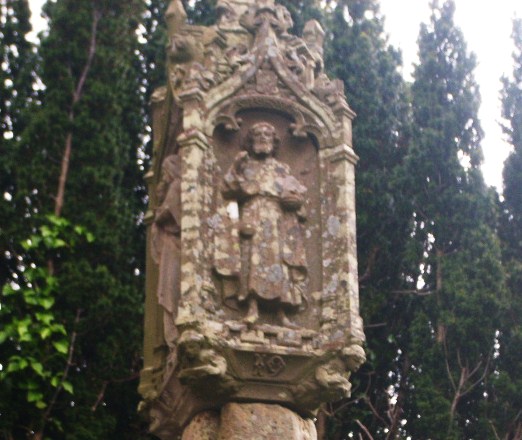
 St Issui (Welsh for Esau) off the family of Brychan, rapidly gained a growing entourage of pilgrims visiting the Martyr's grave. By Norman times, a stone building had been erected, and in addition the martyr's hovel transformed into a room adjoining, and other buildings. The Bishop of Hereford had declared Issui a saint, so it became popular. Here , under the powerful lantern cross Baldwin preached the sermon.
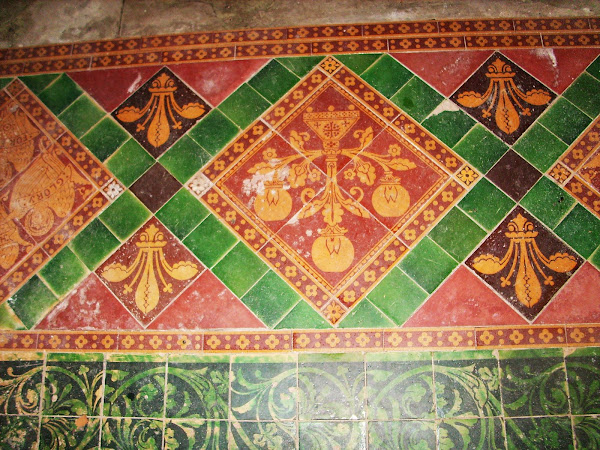
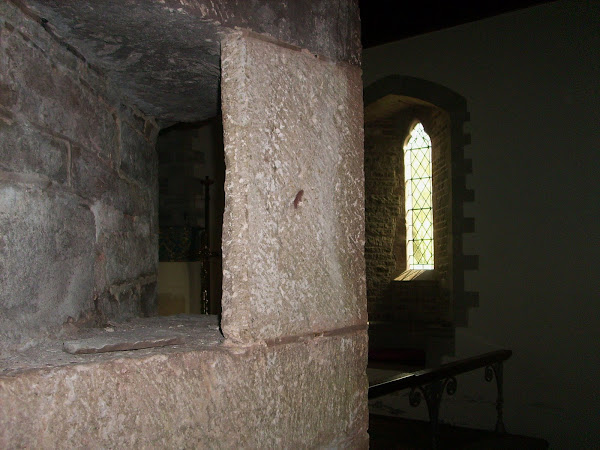
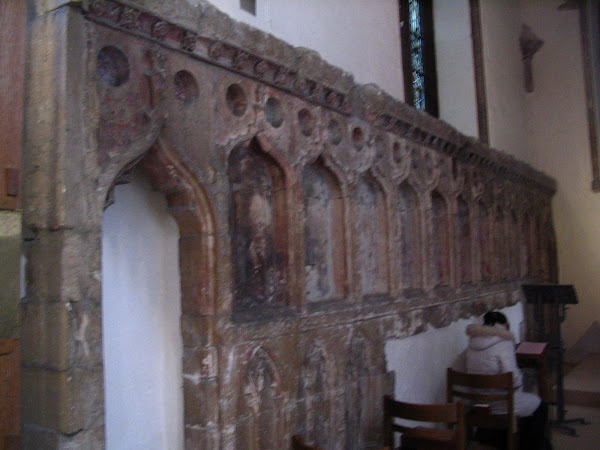
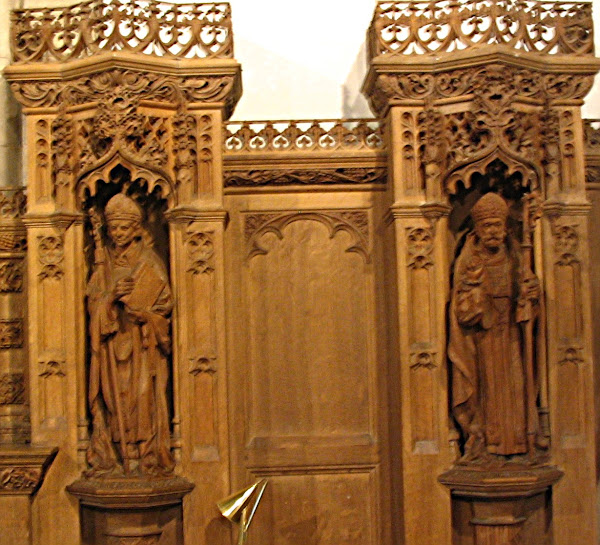
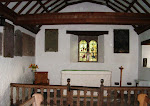
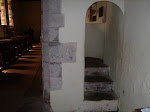
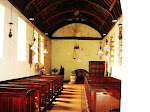
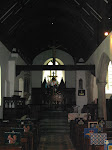
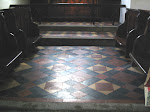
Beautiful Mediaeval Rood Screen still there
  Asking the saint for his intercession in order for the local people to find the bravery to come forward, incense wafting around the Archbishop, people began to come forward, embracing the Cross held by Gerald. An indulgence was attached to the pilgrimage. All those who were without sin, had attended confession and Mass on that day were entitled to a full uindulgence of all their mortal sins if they went on the Pilgrimage. In addition, perhaps, villeins, who would be only to happy to take the chance of a new life away from the drudgery they endured working on the farm.

Pilgrims in the Church at Patrishow
Gerald and Baldwin preached at the foot of this cross

ABERGAVENNY

Preaching Cross near Priory, Abergavenny

We are told the meeting was held at the castle, but the Square was not far away and probably orginally held the old Preaching cross before its destruction by the Protestant authorities.


USK/ Wsg


From Abergavenny, Archbishop Baldwin and his retinue passed by on his way to Newport by way of Usk and Caerleon.’ At the castle at Usk , a multitude of people , influenced by the archbishop ‘s sermons and by the good and worth Bishop of Llandaff were signed with the cross. It is remarkable’ Gerald continues that ‘many of the most notorious murderers, thieves and robbers of the neighbourhood were here converted, to the astonishment of the spectators!’.


CAERLEON
Archbishop Baldwin at Caerleon

 At Caerleon, we may have expected the Crusade preachers would have met with a tremendous reception. Gerald however, seems to have forgotten their mission in his eagerness to describe the ancient city.His comments can be seen in Chapter One. ‘Caerleon Means The City Of Legions, Caer, In The British Language, Signifying A City Or Camp, For There The Roman Legions, Sent Into This Island, Were Accustomed To Winter, And From This Circumstance It was styled The City Of Legions

This city was of undoubted antiquity, and handsomely built of masonry, with courses of bricks, by the Romans.

Many vestiges of its former splendour may yet be seen; immense palaces, formerly ornamented with gilded roofs, in imitation of Roman magnificence, inasmuch as they were first raised by the Roman princes, and embellished with splendid buildings; a tower of prodigious size, remarkable hot baths, relics of temples, and theatres, all inclosed within fine walls, parts of which remain standing. You will find on all sides, both within and without the circuit of the walls, subterraneous buildings, aqueducts, underground passages; and what I think worthy of notice, stoves contrived with wonderful art, to transmit the heat insensibly through narrow tubes passing up the side walls.

Julius and Aaron, after suffering martyrdom, were buried in this city, and had each a church dedicated to him. After Albanus and Amphibalus, they were esteemed the chief protomartyrs of Britannia Major. In ancient times there were three fine churches in this city: one dedicated to Julius the martyr, graced with a choir of nuns; another to Aaron, his associate, and ennobled with an order of canons; and the third distinguished as the metropolitan of Wales. Amphibalus, the instructor of Albanus in the true faith, was born in this place. This city is well situated on the River Usk, navigable to the sea, and adorned with woods and meadows.

The Roman ambassadors here received their audience at the court of the great king Arthur; and here also, the archbishop Dubricius (Dyfrig) ceded his honours to David of Menevia, the metropolitan see being translated from this place to Menevia, according to the prophecy of Merlin Ambrosius.

"Menevia pallio urbis Legionum induetur." "Menevia shall be invested with the pall of the city of Legions."

Not far hence is a rocky eminence, impending over the Severn, called by the English Gouldcliffe or golden rock, because from the reflections of the sun's rays it assumes a bright golden colour:

"Nec mihi de facili fieri persuasio posset, Quod frustra tantum dederit natura nito rem Saxis, quodque suo fuerit flos hic sine fructu."

NOVUS BURGO-(NEWPORT) (Newboth/Casnewydd)

Leaving Caerleon, the party passed on to Newport where they spent the night. The enthusiasm for the Crusade was aroused by their indignation at the peril of the Church in the Holy Land. The archbishop arrived in Newport followed by all the recruits from Usk and Caerleon, many of whom were known personally to the Newport people. So the crowd were very excited. At the ale houses, the castle entrance of the Motte and Bailey Castle and anywhere where people could gather together interested men discussed the topic of the day. Among those converts, whose enthusiasm for the cause had brought them into town, a crowd of anxious listeners assembled, eager to obtain any information which they could give. Silently they listened to the accounts given by the archbishop of the witnesses to the sack of Jerusalem and the Archbishop’s dignified bearing and authority.

The following morning there was a scene of extraordinary commotion at an early hour. People from the outlying districts made their way into town, and an immense crowd gathered around the castle ,long before the Archbishop was expected to address the assembly. This is not the present castle.

At last the procession came forth . The Archbishop was attended by William de Salso Marisco , Bishop of Llandaff, Alexander, Archdeacon of Bangor, the learned Gerald and many of the clergy of the neighbourhood. The Chief Normans of the district held places of importance, side by side with many of the native nobility. Behind the archbishop the soldiers of the party were drawn up.

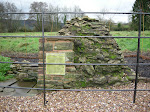
Gerald does not tell us, whether the archbishop preached to the assembly from the castle green, from the churchyard or from the cross, the remains of which can be seen built into the wall at the corner of Havelock Street and Stow Hill. However the exact spot where the sermon was preached is not important .The eloquence of the archbishops preaching roused a great enthusiasm in the listeners and many Newport men enrolled in the Crusades to make the holy places accessible to pilgrims again.
Cardiff
The party then passed out of Gwent to Cardiff, where they spent the night at the Castle before continuing on their journey.

Gerald’s View of the Quality of the Welsh men as fighters and bowmen.
Gerald gives a full account of the Welsh and their habits. They were, he said, light and active, hardy rather than strong and entirely bred up in the use of arms.
They lived on the herbs and the product of their hunting and paid no attention to commerce, shipping or manufactures. Their love of hunting was so great that in times of peace, the young men went out early and did not return until late. Going into the deep forests of Wentwood for example, they learned to endure fatigue and acquired the act of fighting by accustoming themselves to the use of weapons.

Their chief activity was the defence of their country and their liberty, for which they fought, underwent hardships and willingly sacrificed their lives. When the trumpet sounded the alarm, or the warning beacon burst into flames, the husbandman rushed eagerly from his plough as the courtier from the court. Though unarmed they dared to attack an armed foe; through on foot, they defied cavalry and by their activity and courage generally proved victorious.

The men of Gwent were more accustomed to war, more famous for valour, and more expert in archery than those of any other parts of Wales. Their bows were not made of horn or yew, but fashioned from elm , unpolished and rude, but stout’ Giraldus Cambrensis/Gerald the Welshman 1188.


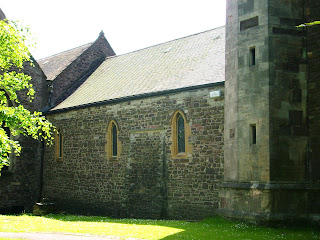


1. Many thanks to the Library Museum and Art Gallery, Newport for getting out the head of the original preaching cross . Gerald and Baldwin would have preached beneath this very cross.

2. Newport have included a new Replica of the original cross for the High Street.

3. The base of the Original Cross is in St Woolos (Gwynlliw's) Churchyard, and its original stite was half way up Stow Hill.

4. The Chapel that Gwynlliw built or Our Lady is still part of the St Woolos(now) Anglican Cathedral.

Friday, August 28, 2009

Sunday's (30th) Pilgrimage at USK and Martyr St David Lewis


St David Lewis, SJ Priest M (RM)

He was born at Abergavenny, Monmouthshire, Wales, in 1616; He died at Usk, August 27, 1679; beatified in 1929; He was canonized in 1970 by Pope Paul VI as one of the Forty Martyrs of England and Wales. David was the son of a Protestant school master and a Catholic mother. Amazingly enough, he was the only one of the nine siblings to have been raised as a Protestant--but that did not last for long. After studying law at the Middle Temple in London, he accompanied a nobleman's son to the Continent as his tutor. While visiting Paris, David was converted to Catholicism.

By 1638, he was studying for the priesthood at the English college in Rome. Two years after his ordination in 1642, he joined the Jesuits, who sent him to the English mission for a short time, then recalled him to Rome to serve as the spiritual director for the English college.

'CHARLES BAKER' his alias and the CWM

In 1648, David was sent to Wales, where he used the alias Charles Baker and a farmhouse at Cwm (Monnow Valley) in southern Wales as his headquarters for the next 31 years. This same inconspicuous building was the College of Saint Francis Xavier, the centre for Jesuit missionary activities in western England and Wales. When the persecution of Catholics was unleashed by the liar Titus Oates' fictitious Plot, David escaped Cwm but was betrayed by a servant and captured at Llanfihangel Llantarnam, preparing for Mass betrayed by six disgruntled parishioners, who had been intimidated. Llantarnam was a former Cistercian House and a centre for recusant Catholics. It is now occupied by the Sisters of St Joseph of Annecy and remains as a monstery.

Following a two-month imprisonment at Monmouth, he was tried at Usk and then interrogated in London.He returned to Usk and was imprisoned in a former Franciscan house, which had become the gaol. Although no evidence could be found to link him to the conspiracy, he was convicted of being a Catholic priest,to be hanged, drawn, and quartered. The love local people had for him, however, was not confined to Catholics.The hangman disappeared and the blacksmith engaged as executioner was intimidated to disappear. A Protestant held the hand of the 63 year old Father David 'The Father of the Poor'(Tad y Tlodion) as he was known and refused to let him go until he was dead. There being nothing gained from further cruelty, with relief the mayor ordered him to be buried and Father David was taken on a bier and carried with reverence to the priory Church in Monmouth, where his body was found earlier this century as an extension was made to the priory church, a former Benedictine nunnery,whose last superior was Mother Ellen Williams. He was buried with great honour as the local saint in Usk just outside the endtrance to the church and fresh flowers are left there most days.

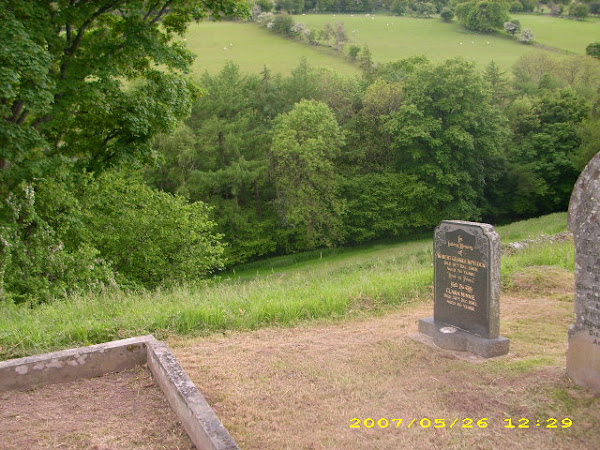
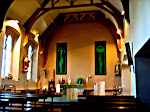
There is a prominent grave stone giving the details of his canonization in Latin and English. The annual, well-attended pilgrimage to Usk, which begins with Mass at St David Lewis and St Francis Xavier, with a processional Rosary to Saint David's grave The Catholic Church was built close to the site of the martyrdom, near the toll house at the poster shown above.


HYMN IN HONOUR OF ST. DAVID LEWIS

(Tune Hyfrydol)
Holy Martyr, David Lewis,
Monmouth Countys glorious Saint.
Father of the Poor they named you,
When you lived and toiled in Gwent.
Priestly work was undertaken,
Danger-fraught from dawn till dusk.
Gladly still you served your people,
Till you died for them at Usk

From your capture at Llantarnam,
Through your time in Monmouth Gaol,
Threats and tortures could not shake you,
For your faith would never fail.
Bravely then you faced the gallows,
Crudely fashioned for your death,
Further torment someone spared you,
Till you drew your latest breath.

Great and glorious David Lewis,
Staunch and steadfast in the strife,
Bless your people here in Monmouth,
Those for whom you gave your life.
Help us to be strong, courageous,
Loyal to our loving God,
To Him then will glory flourish,
In the places you have trod.

Composed by:
Sister Canisius. Llantarnam Abbey


Prayer:

Lord, we thank you for the gift of Saint David Lewis as our local Saint and Martyr. He was faithful to Christ even to the point of accepting martyrdom for His sake. Help us to do all we can to promote devotion to him. Increase our own faith, and by his prayers, grant us the courage to follow his example of love and the grace of conversion for all who seek the truth. This we ask in Jesus' name. Amen.
Saint David Lewis, pray for us.
Saint David Lewis, pray for Wales

TOMORROW's PILGRIMAGE BEGINS AT 3pm at the Catholic Church, St David Lewis and St Francis Xavier, at USK.Pilgrims will, after the Mass-this is the 330th year of the martyrdom, process to the tombstone at the priory church and then there are refreshments for all pilgrims back at the Catholic Church.(30-08-2009) These posts stay a long time and the date varies for different years. The Feast day is 27/08.

Friday, October 24, 2008

Second Milennium in Monmouthshire/Gwent


I have been very busy recently and am off to Cornwall on Sunday and will be visiting various site in Cornwall and will be posting from there. There has been an enormous calamity with my camera, which has not produced very good pictures of late and have now upgraded to a very god one, which is great and I hope to have some good pictures next week.

Same with the podcasting. I work most days and have not the time for frequent podcasting as we are shortly anyway to move into the second Milennium of the Church's Sory in Monmouthshire. Also I am compiling a list of posts which are to be placed in order on a post. If you are interested, can I ask you to cut and paste it into a word document so you can see the huge amount of information on first Milennium Gwent and know what is available.

Our Next Group of posts will look at the various religious foundations in Gwent , which were priories of French Monasteries

Augustinian Foundations)

Llanthony Priory (Near St David's Cell
Austin Friars of Newport

Benedictine Priories

Chepstow Priory
Monmouth Priory
Abergavenny Priory
Goldcliff Priory
Bassaleg Priory
Usk Priory (Benedictine Nunnery)

Then the Cistercian Abbeys

Tintern
Llantarnam
Abbey Dore

Franciscans (Followers of Francis of Assissi

Franciscans were mendicant friars. They landed in England and formed a base at Oxford.Their tenedency was to minister to the poor and a house was established in Cardiff, but they tended to move around and records are scanty. It may also have been that houses were established and then the brothers perhaps died of the plague.
There are two places with a strong tradition of Greyfriars.

Greyfriars near Llangattock Vibon Afel in North Gwent (South west of Monmouth.
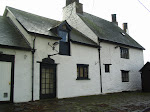
Greyfriars at Usk (where a house was traditionally called Grey Friars

The Usk house became the prison by the bridge and here the house became the town prison, when it ceased to be used as a religious house, and it was here that the 62 year old 'Father of the Poor', blessed Saint David Lewis spent his last days before being martyred in the town.


Carmelites

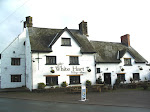
This house in Usk was described in detail by Fred Hando and again there are no documents, except the House was called 'Whitefriars', traditionally the name for Carmelites. There are no official papers that assert this, but the place name (as the name llan)seems to confirm their presence as do the various religious artefacts found in the house. Again all the records for these religious foundations were held at Raglan Castle (Castell Rhaglen) and when General Fayrfax ruined and burned the castle, the records were burned- a grate shame.

The story of these foundations says a great deal about our county's faith. The Benedictines tended to be French at the start of the Norman period. St Woolos, Gwynlliw's shrine (not originally being near a castle-Newport castle was a new one build in the thirteenth century)was given into the care of St Peter's Abbey in Gloucester (now Gloucester Cathedral.

I still have a few more Old Welsh institutions to visit and report on so these will appear from time to time.

I am not primarily a historian but have read some of the great historians of our time, like Madeleine Grey and David Williams and will also work on subjects of popular devotion like the 'Five Wounds' devotion, popular in the Middle Ages. One of the interesting things is that Catholic worship has not altered very much in the past thousand years, except for the Latin Language and the Tridentine Rite of Council of Trent in the Late Mediaeval times. While the 1962 Rite was identical, vatican II also introduced an English version and since last year , the Tridentine Rite has been reestablished as an alternative.

Nevertheless, a fist century Catholic , a fifteenth century Catholic and modern Catholic still attend the same Mass with the same vision of the Revelation. Mass is still the name for our Mission. Monmouthshire people still go on Pilgrimage and may old Pilgrimaes are being reestablished. I have an upcoming podcast about one such group of pilgrims from Pontypool.

So I will spend more time here from now on, but am first off to Cornwall with some more of the immensely popular saints of the first milennium. So see you there!

Facebook

There is a Mary in Monmouth group on Facebook. If you are on this-do join and post what you would like me to put in. Also I am asking for anyone living in SKENFRITH to get me some photos of the Priests Well in Skenfrith. I am not sure if it is the same as St Bridget's Well. I went up there but could not find it!

you can all reach me and post information and photos (I would love this site to be a resource!) at maryinmonmouth@googlemail.com. One of the very lovely things about doing this is how many people from Monmouthshire and Wales throughout the world, Canada, Australia and USA 'drop in' to see familiar places and read up on the history.

The other wonderful thing is to bring out all the Christian history there all around, which many have forgotten about. Also children can see how very ancient the Faith of OUr Fathers is in Gwent.

If you can log on to

ourlady oftintern.co.uk

and join the Friends. Friends of this project to resetablish the Pilgrimages to Tintern by construction of a Pilgrim Centre for all Christians at the Abbey -a new and exciting project.Annual membership is £15 per annum and will bring great fruits spiritually.