Showing posts with label August 15 Pilgrimage 2009. Show all posts

Tuesday, September 1, 2009

Pilgrimage to St David Lewis on his Memorial Day


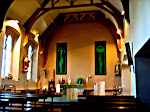
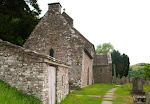
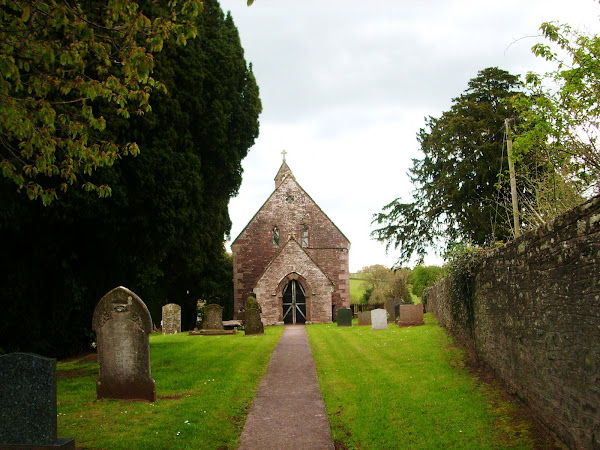
29th August was the Pilgrimage at St Francis Xavier and St David Lewis Church in Usk

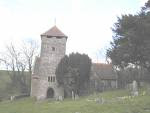
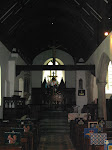
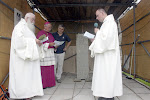
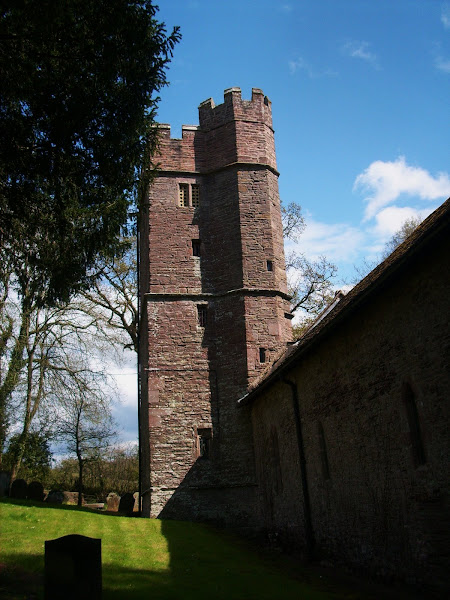
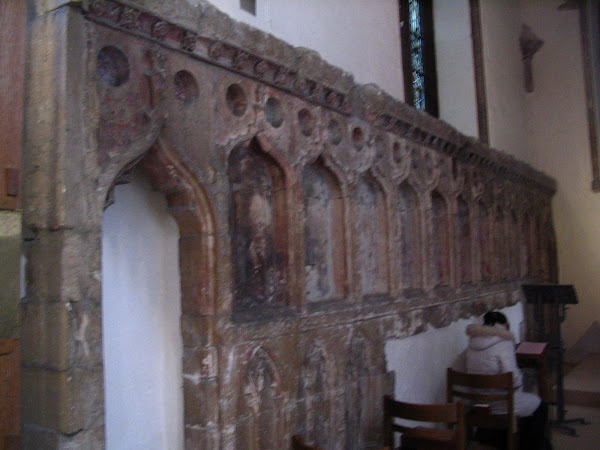
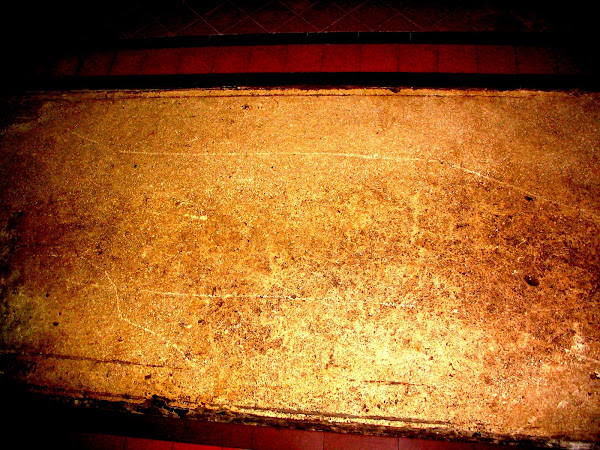
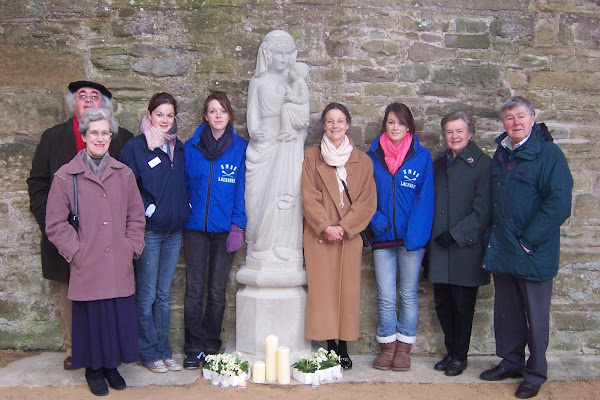
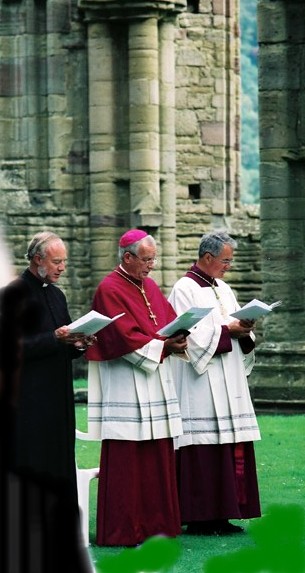
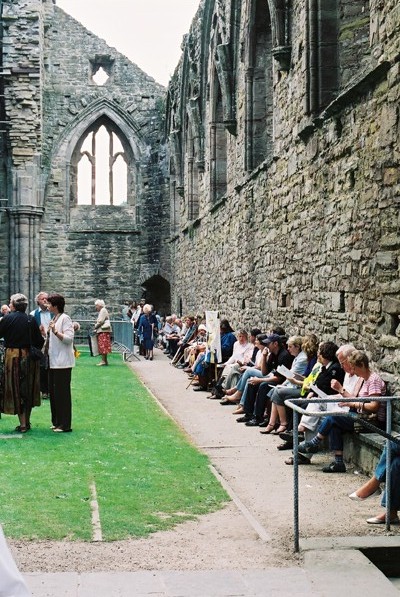
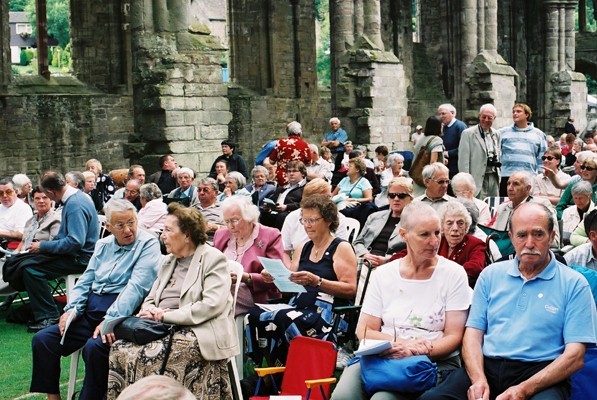
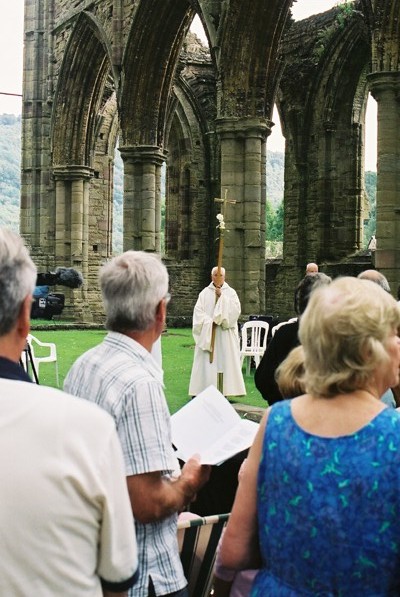
A large number of religious and lay people came. It was a very joyful occasion.The Mass was followed by a walk to the site of the Hanging over the road from the church. After reading the last speech of Fr Lewis, we walked along the streets of Usk to the Priory Church where St David was buried.There we said the Lord's Prayer, a decade of the Rosary and sang the Salve Regina, which sounded wonderful unaccompanied in the still air. Afterwards people venerated the tomb and went in to the Priory to light candles and also tea and cake in the vicarage afterwards.

I think the last speech of Fr David from the scaffold was very moving, about being roud to die for being a Christian. Two protestants had clung onto his hands to make sucre he was dead and could not be given the agony of being drawn and quartered. I shall speak more of this later when I come to penal times, but this is a 'special' of the official pilgrimage day.

It was wonderful to be around his grave in the churchyard, singing the 'SALVE REGINA'. So beautiful!

Friday, August 28, 2009

Sunday's (30th) Pilgrimage at USK and Martyr St David Lewis


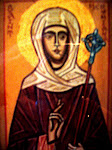
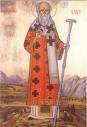
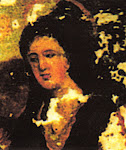
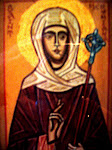
St David Lewis, SJ Priest M (RM)

He was born at Abergavenny, Monmouthshire, Wales, in 1616; He died at Usk, August 27, 1679; beatified in 1929; He was canonized in 1970 by Pope Paul VI as one of the Forty Martyrs of England and Wales. David was the son of a Protestant school master and a Catholic mother. Amazingly enough, he was the only one of the nine siblings to have been raised as a Protestant--but that did not last for long. After studying law at the Middle Temple in London, he accompanied a nobleman's son to the Continent as his tutor. While visiting Paris, David was converted to Catholicism.

By 1638, he was studying for the priesthood at the English college in Rome. Two years after his ordination in 1642, he joined the Jesuits, who sent him to the English mission for a short time, then recalled him to Rome to serve as the spiritual director for the English college.

'CHARLES BAKER' his alias and the CWM

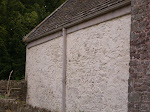
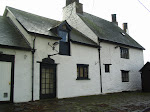
In 1648, David was sent to Wales, where he used the alias Charles Baker and a farmhouse at Cwm (Monnow Valley) in southern Wales as his headquarters for the next 31 years. This same inconspicuous building was the College of Saint Francis Xavier, the centre for Jesuit missionary activities in western England and Wales. When the persecution of Catholics was unleashed by the liar Titus Oates' fictitious Plot, David escaped Cwm but was betrayed by a servant and captured at Llanfihangel Llantarnam, preparing for Mass betrayed by six disgruntled parishioners, who had been intimidated. Llantarnam was a former Cistercian House and a centre for recusant Catholics. It is now occupied by the Sisters of St Joseph of Annecy and remains as a monstery.

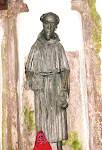
Following a two-month imprisonment at Monmouth, he was tried at Usk and then interrogated in London.He returned to Usk and was imprisoned in a former Franciscan house, which had become the gaol. Although no evidence could be found to link him to the conspiracy, he was convicted of being a Catholic priest,to be hanged, drawn, and quartered. The love local people had for him, however, was not confined to Catholics.The hangman disappeared and the blacksmith engaged as executioner was intimidated to disappear. A Protestant held the hand of the 63 year old Father David 'The Father of the Poor'(Tad y Tlodion) as he was known and refused to let him go until he was dead. There being nothing gained from further cruelty, with relief the mayor ordered him to be buried and Father David was taken on a bier and carried with reverence to the priory Church in Monmouth, where his body was found earlier this century as an extension was made to the priory church, a former Benedictine nunnery,whose last superior was Mother Ellen Williams. He was buried with great honour as the local saint in Usk just outside the endtrance to the church and fresh flowers are left there most days.

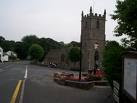
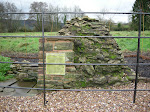
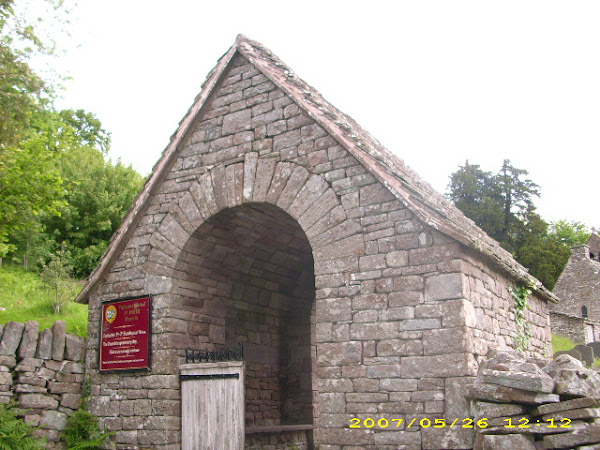
There is a prominent grave stone giving the details of his canonization in Latin and English. The annual, well-attended pilgrimage to Usk, which begins with Mass at St David Lewis and St Francis Xavier, with a processional Rosary to Saint David's grave The Catholic Church was built close to the site of the martyrdom, near the toll house at the poster shown above.


HYMN IN HONOUR OF ST. DAVID LEWIS

(Tune Hyfrydol)
Holy Martyr, David Lewis,
Monmouth Countys glorious Saint.
Father of the Poor they named you,
When you lived and toiled in Gwent.
Priestly work was undertaken,
Danger-fraught from dawn till dusk.
Gladly still you served your people,
Till you died for them at Usk

From your capture at Llantarnam,
Through your time in Monmouth Gaol,
Threats and tortures could not shake you,
For your faith would never fail.
Bravely then you faced the gallows,
Crudely fashioned for your death,
Further torment someone spared you,
Till you drew your latest breath.

Great and glorious David Lewis,
Staunch and steadfast in the strife,
Bless your people here in Monmouth,
Those for whom you gave your life.
Help us to be strong, courageous,
Loyal to our loving God,
To Him then will glory flourish,
In the places you have trod.

Composed by:
Sister Canisius. Llantarnam Abbey


Prayer:

Lord, we thank you for the gift of Saint David Lewis as our local Saint and Martyr. He was faithful to Christ even to the point of accepting martyrdom for His sake. Help us to do all we can to promote devotion to him. Increase our own faith, and by his prayers, grant us the courage to follow his example of love and the grace of conversion for all who seek the truth. This we ask in Jesus' name. Amen.
Saint David Lewis, pray for us.
Saint David Lewis, pray for Wales

TOMORROW's PILGRIMAGE BEGINS AT 3pm at the Catholic Church, St David Lewis and St Francis Xavier, at USK.Pilgrims will, after the Mass-this is the 330th year of the martyrdom, process to the tombstone at the priory church and then there are refreshments for all pilgrims back at the Catholic Church.(30-08-2009) These posts stay a long time and the date varies for different years. The Feast day is 27/08.

Saturday, July 25, 2009

Mair O Aberteifi- Our Lady of the Taper, Assumption Pilgrimage (15 August)EF LATIN MASS


I have been asked to remind everyone living in the UK of this pilgrimage to the Shrine of Our Lady of the Taper in CARDIGAN on the West Wales coast.At 12 Noon Mass will be celebrated in the Extraordinary form(Tridentine) YOU WILL NEED A PACKED LUNCH. Mass, the Great Mission begins at 12 noon.

DIRECTIONS TO THE SHRINE

Our Lady of the Taper,
North Road,
Cardigan
SA43 1LT,
UK
Tel: 01239 612615
Fax: 01239 6159417
E-mail: info@cardigantaper.org
or: Parish@taper2.freeserve.co.uk
Cardigan is in west Wales, 20 miles north of Fishguard. Important in the middle ages, it is now a pleasant market town of 4500 people. Catholics are few, and Mass attendance is only 150 although the parish stretches 30 miles along the coast.
From London take the M4, and then the A48 to Carmarthen, where you find the sign to Cardigan, which is 30 miles distant. If travelling from the north, head for Aberystwyth. Cardigan is 38 miles south on the A487.
The church is on the road running north-south through town. It lies towards the northern end, opposite the rugby field. The shrine chapel and church are open daily from 9:00am.

If you are staying overnight there are several good B and B guest houses nearby in addition to local hotels.

Here is some of the History of this ancient Shrine from their blog
www.ourlady of the Taper.org

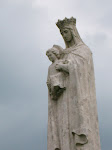
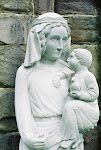
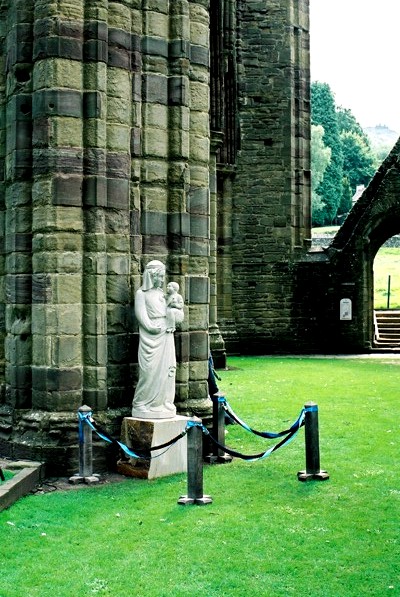
During the middle ages there was a notable pilgrimage in honour of Our Lady in Cardigan. A beautiful legend describes how a statue of Mary was found by the side of the river Teifi, "and her sonne upon her lappe, and the taper bernynge in her hande". It was taken to the parish church but would not remain there, returning three or four times to "the place where now is builded the Church of our Lady", the present St. Mary's church. A chantry priest sang Mass daily in honour of Our Lady for pilgrims who came to pray and leave gifts. They lodged with the Knights Hospitallers of St. John, where the Angel Hotel now stands.

St. Mary's dates from 1158. If it was built to hold the statue then Our Lady of Cardigan is indeed ancient. It resembles an earlier shrine in the city of Arras, which was then in Flanders. Did Flemish merchants, who settled in Cardigan and traded in Welsh wool out of the port, bring the statue back with them?
Outside town, on the old pilgrim track, lie the ruins of a building by a stream. It is called Capel Bach (Little Chapel), and may have been an oratory where travellers prayed before walking the last mile to the shrine. It is the same distance from St. Mary's as Walsingham Slipper Chapel is from the shrine there.

St. Mary's was a priory church of Chertsey Abbey. Benedictine monks cared for it until 1538, when they were expelled and the shrine destroyed.

Devotion to Mary was once universal in Wales. Many places are called Llanfair or Capel Mair (Mary's church, chapel), and dozens of flowers and plants bear her name. No girl was given the name Mair (Mary), as it was reserved for Our Lady.
There was a lesser taper shrine in Haverfordwest. The most notable is at Cagliari in Sardinia, where in 1370 a Catalonian ship foundered offshore, and a statue of Our Lady of the Taper was brought to land. A church was built for it on a headland, and named Santa Maria di Bonaria (of the good air), for people said its presence had cleared the place of a pestilential atmosphere. Spain controlled Cagliari, and its sailors adopted Santa Maria di Bonaria as their shrine.

Ransomer priests cared for it. They were great seafarers, as their vocation was to rescue Christian captives from the Moors. They became chaplains to the Spanish navy, and sailed with Columbus, bringing their devotion with them. They founded a shrine in Cuba. Others, named La Candelaria, are to be found in Tenerife, Guatemala and Rio de Janeiro. Buenos Aires was once called Santa Maria de los Buenos Aires (the Spanish name for the Cagliari shrine).

We do not know how the devotion transferred to Barcelona and Cagliari. In the 1320's and 1330's Catalonian sailors had thronged British waters. Did they come to Cardigan, see the shrine and copy it?

In 1904 Breton monks, in exile near Cardigan, revived the devotion, giving the title Our Lady of Cardigan to their abbey church and also to the little church they opened in town in 1912. They left in 1916, and another generation passed before the name was heard again. More information at:


http://www.ourladyofthetaper.org