Monday, September 21, 2009

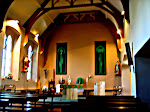
ST DAVID'S METROPOLITAN CATHEDRAL, CARDIFF 22 September


________________________________________________________________________________________________________________________________________________________________
__________________________________________________________________________________________________________________________________________________________________________

Three Themes of the Pilgrimage:

1EVANGELISATION OF WALES AND HEREFORDSHIRE

2DESIRE FOR PERSONAL SANCTIFICATION

3VOCATIONS TO THE PRIESTHOOD

Plenary Indulgence Elderly ,sick and Housebound can gain plenary indulgence -be in a state of grace and detached from sin, receive communion and pray the prayers below. Indulgence to Cardinal Murphy O'Connor for this pilgrimage Rome 28/7/09

Must attend Holy Mass (or at least receive Communion)
Be comletely detached from any sin and attend Reconciliation/Confession
Pray for Pope Benedict's Intentions,Our Father & Creed

Pope Benedict's Intentions

September 2009
General: That the word of God may be better known, welcomed and lived as the source of freedom and joy.

Mission: That Christians in Laos, Cambodia, and Myanmar, who often meet with great difficulties, may not be discourage from announcing the Gospel to their brothers, trusting in the strength of the Holy Spirit.

October 2009
General: That Sunday may be lived as the day on which Christians gather to celebrate the risen Lord, participating in the Eucharist.

Mission: That the entire People of God, to whom Christ entrusted the mandate to go and preach the Gospel to every creature, may eagerly assume their own missionary responsibility and consider it the highest service they can offer humanity.

November 2009
General: That all the men and women in the world, especially those who have responsibilities in the field of politics and economics, may never fail in their commitment to safeguard creation.

Mission: That believers in the different religions, through the testimony of their lives and fraternal dialogue, may clearly demonstrate that the name of God is a bearer of peace.

December 2009
General: That children may be respected and loved and never be the victims of exploitation in its various forms.

Mission: That at Christmas the peoples of the earth may recognize in the Word Incarnate the light which illuminates every man and that the Nations may open their doors to Christ, the Saviour of the world.
.


Tuesday 22nd September 2009

12.45pm: MASS for Vocations to the Priesthood

1.30pm-3.15pm: Exposition of the Blessed Sacrament

3.15pm-3.30pm: Choral Benediction

3.30pm: Solemn Liturgy for the Reception of the Relics

4pm-6pm: Veneration of the Relics

4pm-5.30pm: Sacrament of Reconciliation

5.30pm-6pm: Rosary and Choral Litany

6pm: Mass for Evangelisation

7pm-8.30pm: Veneration of the Relics

7pm-8.30pm: Sequence of Readings and Meditations

8.30pm: Exposition of the Blessed Sacrament

9pm: Solemn Benediction

9.30pm-10.30pm: Veneration of the Relics

10.30pm-11pm: Night Prayer of the Church

11pm-00am: Open Vigil

THE CATHEDRAL WILL BE CLOSED TO THE PUBLIC AT MIDNIGHT

Wednesday 23rd September 2009 (Memoria of St Pius of Pietrelcina)

THE CATHEDRAL WILL OPEN TO THE PUBLIC AT 7AM

8am-8.30am: Office of Readings

9am-11.30am: Sacrament of Reconciliation

9.30am-10am: Mattins of the Church

10am-11.30am: Veneration of the Relics / Particular Activities for visits by schools

12noon-1pm: Mass for Evangelisation - Sanctification

1pm: Solemn Liturgy for the Departure of the Relics


The three bishops of the ecclesiastical province, Archbishop Peter Smith of Cardiff, Bishop Edwin Regan of Wrexham and Bishop Tom Burns of Menevia, will be present throughout the celebrations in the Cathedral. They will be joined by many members of the clergy and representatives of religious congregations including the Carmelite Community of Dolgellau.

We are expecting very large numbers of the lay faithful to be in attendance across both days. With so many people gathering it will be necessary that we all exercise a true spiritual patience as we engage with the various celebrations. We would ask those visiting to cooperate with the stewards at all times.

Tuesday, September 1, 2009

Pilgrimage to St David Lewis on his Memorial Day


29th August was the Pilgrimage at St Francis Xavier and St David Lewis Church in Usk

A large number of religious and lay people came. It was a very joyful occasion.The Mass was followed by a walk to the site of the Hanging over the road from the church. After reading the last speech of Fr Lewis, we walked along the streets of Usk to the Priory Church where St David was buried.There we said the Lord's Prayer, a decade of the Rosary and sang the Salve Regina, which sounded wonderful unaccompanied in the still air. Afterwards people venerated the tomb and went in to the Priory to light candles and also tea and cake in the vicarage afterwards.

I think the last speech of Fr David from the scaffold was very moving, about being roud to die for being a Christian. Two protestants had clung onto his hands to make sucre he was dead and could not be given the agony of being drawn and quartered. I shall speak more of this later when I come to penal times, but this is a 'special' of the official pilgrimage day.

It was wonderful to be around his grave in the churchyard, singing the 'SALVE REGINA'. So beautiful!

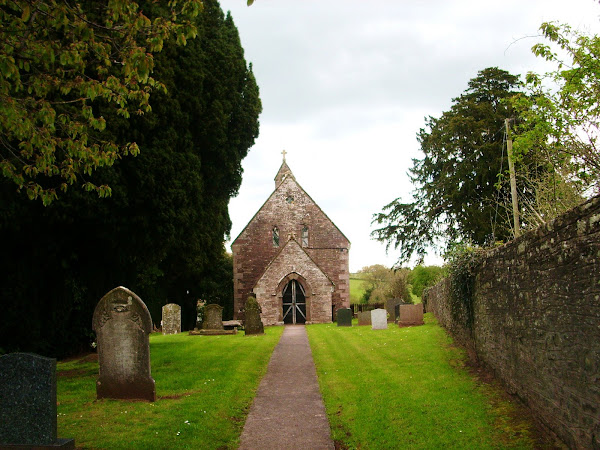
Priory of St Mary Magdalene and St Radegunde, USK


This priory of Benedictine nuns was founded in the early twelfth century, certainly before the death of the founder, Richard (Strongbow) de Clare, Earl of Hertford and Lord of Usk, in 1135. (His family crest appears in some of the floor tiles recovered from the chancel). His son, Gilbert (d.1152), continued the development of the establishment, and Richard Strongbow, 2nd Earl of Pembroke (d. 1176) granted an important charter to the priory, which was confirmed in 1330 by Elizabeth de Burgh.

Saxon Church at Usk (and Llan) before foundation of the Nunnery

The earliest part of the church is earlier than the foundation and the church is mentioned in the foundation charter. The nuns thus took over an existing church and it is possible (by analogy with better-documented communities in England) that there may have been an informal community at Usk before the formal endowment of the priory.
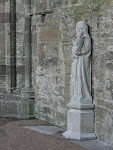
The community was founded by 5 nuns and grew to the usual 13. According to Bruce Venarde, the community was founded by Richard de Clare and his son, Gilbert, according to a document confirming the properties in 1236. Nothing is known of the first century of the nunnery's history; the first documentary mention of the community appears in 1246 when there was an inter-regnum and the community received licence to elect a new prioress. In the following year, 1247, the prioress obtained letters of protection. The only known prioresses are: Joan Lewis, 1491-7; Agnes, 1500-01; Joan Haryman, 1518-29; and Ellen or Eleanor Williams, from a local gentry family, prioress 1529-36.Eleanor Williams’ effigy lies gathering outside the door of the church.There were supposed to have been five Benedictine Nuns, but at certain taimes there were more, sometimes up to fifteen nuns.At the time of the Dissolution there were five.The house was independent with no help from other convents and in 1404, Adam of Usk petitioned the Pope asking for indulgences for alms to support theproperty.

After the Glyndwr risings and the burning of Usk in 1405, there was much rebuilding. The large perpendicular windows were inserted and two porches built and later in the 15th century, the screens were added .The Magnificat was inscribed in gold blacklettering all along the length of it/

1284 Nuns in Financial trouble

Archbishop Peckham visited in 1284 and found the nunnery in a "most desolate state," for primarily economic reasons. Archbishop Peckham visited the community in 1284 and found the nunnery in a "most desolate state," for primarily economic reasons. He recommended better accounting procedures and a senior priest to supervise financial affairs One of his complaints was that the nuns of Usk were wandering outside the confines of the nunnery and staying with layfolk. He ordered that the nuns should not go out of their precinct without suitable companions, nor stay in the houses of layfolk for more than 3 or 4 days. Other criticisms dealt with economic affairs. He suggested the appointment of 2 "provident and discreet" nuns as treasuresses; they were to receive all monies and make all disbursements, and render account of their stewardship to the Prioress and 5 or 6 of the senior nuns at Lent, at Whitsun, and at Michaelmas. The nuns were also to have a "senior priest, circumspect in temporal and spiritual affairs, to be master of all their goods"

Apart from Richard de Clare and his son Gilbert (d. 1152) other patrons were Richard Strongbow, 2nd Earl of Pembroke; Elizabeth de Burgh, countess of the Marches; Edmund Mortimer, 5th Earl of March (d. 1424); and his nephew, Richard Plantagenet, Duke of York (d. 1460). The latter two served as Lords of Usk. All of these patrons/benefactors were prayed for as founders and alms were given for their memory on Shrove Tuesday

Richard Strongbow's Charter

Richard Strongbow granted an important charter to the priory which was confirmed in 1330 by Elizabeth de Burgh. The lawyer and writer, Adam of Usk (c.1360-1440) was also remembered as a protector of the convent. A recovered floor tile with the Mortimer arms on it seems to indicate that the first dateable repair work to S. Mary's Usk was done at the expense of the Mortimer family between either 1368-1381 or 1398-1402.

Adam of Usk's Petition to the Pope 1404

I, the writer of this history, delivered to the pope the
following petition :
"
Holy father, in the town or borough of Usk, in the diocese of Llandaff, is a certain most honourable monastery of a prioress and convent of nuns, under the profession of the order of Saint Benedict, who serve God with the greatest devoutness, which was of old sufficiently endowed with possessions, rents, and other profits ; and in this monastery none but virgins of noble birth were and are wont to be received. But now, owing to the burnings, spoilings, and other misfortunes which have been caused by the wars which raged in those parts, or otherwise, this same monastery hath come to such want that, unless ready help be forthwith found by your Holiness, the sisterhood will be forced to beg for food and clothing, straying through the country, or to stay in the private houses of friends ; whereby it is feared that scandals may belike arise. And, seeing that within the walls of the same monastery there is built a certain chapel in honour of Saint Radegunde, virgin nun, once queen of France, where that they are baptized with water, these three marks are made, partly as a token of gentility, and partly as the completion of their baptism. There are also Jews in the country, and these bear two marks, one on either cheek ; and the Saracens have but one, to wit, on the forehead, extending halfway down the nose." Colonel Yule, in his learned note upon the passage, refers to the early mention by Matthew Paris, under the year 1237, of the practice among the Jacobite Christians of branding their children on the forehead before baptism. It appears also to have been the custom in Abyssinia and other parts of Africa to cauterize the temples of children, to inure them against colds. Ariosto, referring to the emperor of Ethiopia, has :
"Gli e, s'io non piglio errore, in questo loco
Ove al battesmo loro usano il fuoco."

Salt, the traveller, mentions that most of the people of Dixan had a cross branded on the breast, right arm, or forehead ; which he explains as a mark of attachment to the ancient metropolitan church of Axum. And in Marino Sanudo it is stated that "some of the Jacobites and Syrians who had crosses branded on them said this was done for the destruction of the pagans, and out of reverence to the Holy Rood unto the men of that country bear great reverence, and which they ofttimes, and specially at the feasts of Easter and Whitsuntide, are wont to visit ; now therefore, prayeth your Holiness your faithful chaplain and auditor of causes of the sacred palace apostolic, who first drew breath in the same town or borough, and of whose blood are some of the same sisterhood, that, having pity with fatherly compassion on that monastery and prioress and nuns, you will deign graciously to grant to all Christian people who, so often as,
on the second days of the said festivals, for all time to come, they shall visit the same chapel, shall stretch forth the hand of help thereto, some indulgence, as your holiness
shall think fit, with necessary and proper clauses, as inform." And the pope signed it thus " So be it, as it is asked," for five years and as many periods of forty days,
as appeareth in the same chapel.


Monastery is destroyed

The house durig Henry VIII’s period was valued at 69 pounds, 9 shillings, 8 and a halfpenny gross, 55 pounds, 4 shillings, 5d and a halfpenny net in Valor .The only record of the community's possessions come from the period of the Dissolution. The estate at that date consisted of: land in Usk and adjoining parishes; land in Badgworth, Uphatherley and Downhatherley (Glos); the rectories of Usk, Cilgoegan [Llanfihangel Pontymoel], Llanbadoc, Llandenni, Llangyfiw, and Trostrey (Monmouthshire). The community also received tithes in Raglan, Estavarney (Monmouthshire) and had an interest in the rectory of Badgworth (Glos). When the nunnery dissolved, the lead on the roofs was valued at 52 pounds 4 pence; a not very considerable sum .

 Adam of Usk

Adam of Usk made a petition to the Pope on behalf of the community in 1404 and he described the priory as devastated by the after-effects of fighting during the Glyndwr uprising, but no blame could attach to the nuns for this. According to Adam of Usk, the monastery was in such want that unless some remedy was found, the nuns would be "forced to beg for food and clothing by wandering about the country, or to stay in the private houses of their friends; whereby scandal might arise" The chantry chapels in the priory church at Usk belonged to the local community, which shared the church, but the nuns had chapels dedicated to St. Mary Magdalene and St. Radegund of Poitiers within the priory precinct.

Endowments and offerings at these chapels were valued at 4 shillings, 7 pence in Valor Ecclesiasticus but may have included other tithes which were accounted for under the general tithes of Usk. There is also some evidence for pilgrimages to the statue of Mary Magdalene at Usk.
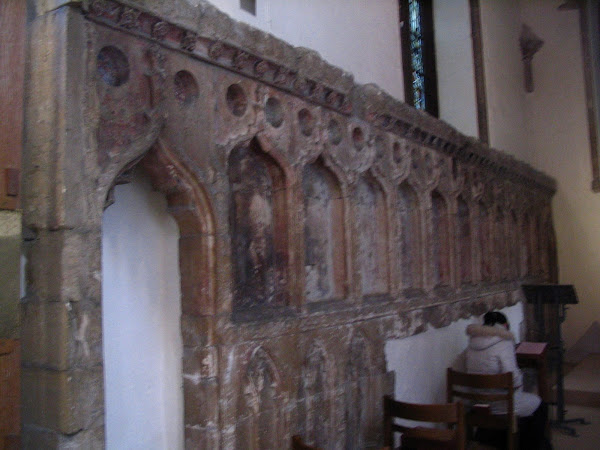
The priory church still has its rood screen, embellished with a carving of the Virgin Mary, and there was another image of Mary in the church before which Adam of Usk wanted to be buried (Bradney 1921, 59). [The present location of the wooden screen extending right across the nave and north aisle may not be its original position.] The rood screed also bears a commemorative brass lauding Adam of Usk in Welsh

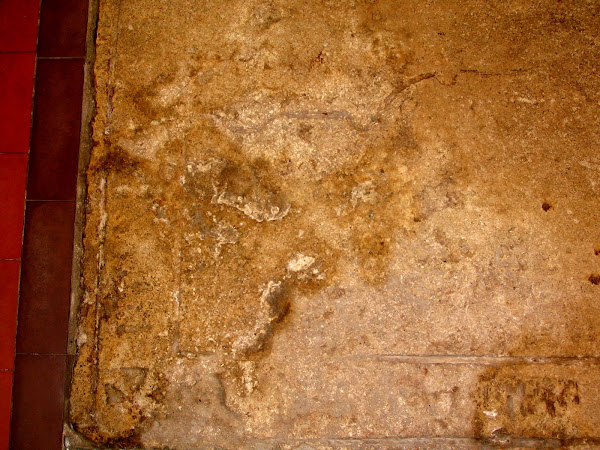
BELOW MOTHER WILLIAMS' EFFIGY TODAY LEFT IN THE GRAVEYARD


_________________________________________________________________________

Last Prioress: Mother Eleanor Williams

In the years immediately before the Dissolution, the then prioress, Eleanor Williams, had some remarkable panelling installed in the conventual buildings, possibly in her own apartments. The cornice is embellished with a frieze of shields decorated with the IHS monogram, the Five Wounds and the Instruments of the Passion, with royal and other armorial bearings including Catherine of Aragon's pomegranates (a brave statement of support in the 1530s). The frieze and the panelling were incorporated into the Priory House but much of the carving was removed in about 1860 to a local mansion, Cefn Tilla (Rickards 1904 has drawings of the frieze).

Catholic Priests the Nuns would have known

1387 Fr John A Philip (resigned 1387)
1387 Fr John Shirfield
1397 Fr Robert Alkebarrow, Chaplain to the Nuns
1429 Fr John Vickers
1512 Fr William Pryce -1535

Chancel Floor

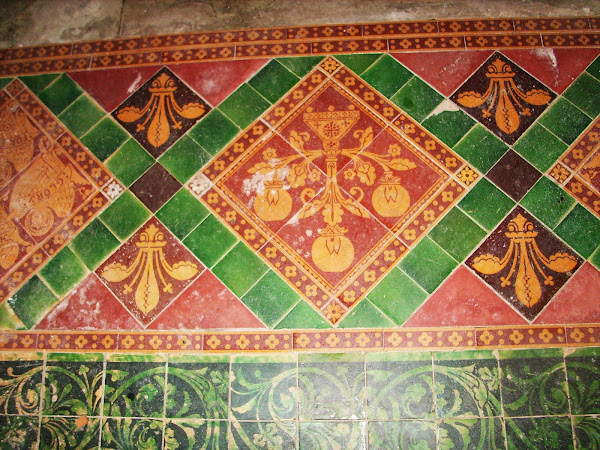
The floor of the chancel was probably laid with stone slabs and embellished in places with decorative tiles, four of which have been recovered. The four tiles depict motifs of a fleur-de-lys, the arms of the Mortimer family (a shield within a shield), a white rosette, and the arms of the de Clare family . Two other tiles, one depicting a curly-tailed, up-winged dragon, are believed to have come from Usk as well and probably date from 1430-1450. According to Mein, the "subsidence effects on what was no doubt designed to be an impressive floor must have been both distressing and dangerous for the Sisters in their daily offices." The floor, at least the part with the tiles, was relaid twice .In addition, wall paintings within the claustral complex were of sufficient note to be referred to in a will.

Image and Shrine of St Mary Magdalene

The image of St. Mary Magdalene was a prime attraction of the community. In 1514 William Baker willed to be buried before an image of "Blessed Mary of the Priory." Sir Hugh David ap John gave rents to maintain the lamp burning day and night before the Blessed Sacrament, and Richard Plantagenet and Lady Elizabeth de Clare provided for the wax and oil necessary for the church's illumination.

Here, even at the very time of terrible turmoil to Catholics in 1536, a man came to make a petition to implore the help of the Saint.Around the time of the Destruction of the Monasteries, a pilgrim from Gwent left this poem to implore the help of St Mary Magdalene with money problems. This is still a common request from pilgrims, for help with bills etc.

Mair fadlen mawr yw d' wrthie [~ wyrthiau]
moes dy gyngor i mine
beth a na [~ wna] tylawd am yscidie [~ esgidiau]
ag am ddillad a 'i kvddie

O Mary Magdalen, mighty are your miracles,
lend your counsel unto me!
What's a pauper to do about shoes,
and about clothes and coverings?
em>

Y kreiriwr mae vt gydnabod
drvd yleni bwyd a diod
ag anodd kael y geiniog
mae 'n dda kyfarch i 'r drindod

The pilgrim is well aware
that food and drink are dear this year,
and it's hard to make a penny;
it's good to render greeting to the Holy Trinity.


Mair fadlen priod ifan
myddyges [~ meddyges] duw i hvnan
ti a wddost f 'ymddiddan
oes dim kyngor am arian

Mary Magdalen, young bride of John
physician to God himself,
thou knowest what I have to say:
Do you have any counsel about money?


Know how he feels!

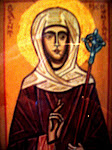
SAINT RADEGUNDE FRIEND OF FORTUNATUS WHO WROTE 'VEXILLA REGIS' FOR HER:

St Radegunde was Princess of Thuringia. Queen of France. She was born in 518 in Erfurt, Saxony, daughter of the pagan king Berthachar of Thuringia She was given at age 12 to Clotaire I as a hostage after he conquered her father's army in 531. The girl converted to Christianity
during her captivity, and 540 she was married against her will to Clotaire who then badly mistreated her, partly for being childless. In 555 she finally left him and took the veil from Saint Medard. Deaconess at Noyon, France.

She founded the convent of the Holy Cross, Poiters, France; among the many relics in its chapel was a piece of the True Cross. She placed the house under the Rule of Saint Caesarius of Arles, and lived there her remaining 30 years; it became a center of scholarship. Spiritual student of Saint John of Chinon. Friend of Saint Fortunatus, who composed his hymn Vexilla Regis in her honour. She was very active in the affairs of the Church and civil politics, and gained a reputation as a peacemaker.
Jesus College in Cambridge was originally dedicated to her. She died on the 13th August 587 in Poitiers, France of natural causes; Her relics were burned by Calvinists in 1562 .


__________________________________________________________

ST MARY MAGDALENE-GREAT SAINT OF THE CHURCH

_______________________________


St. Mary Magdelene is called "the Penitent". St. Mary was given the name 'Magdalen' because, though a Jewish girl, she lived in a Gentile town called Magdale, in northern Galilee, and her culture and manners were those of a Gentile. St. Luke records that she was a notorious sinner, and had seven devils removed from her. She was present at Our Lords' Crucifixion, and with Joanna and Mary, the mother of James and Salome, at Jesus' empty tomb. Fourteen years after Our Lord's death, St. Mary was put in a boat by the Jews without sails or oars - along with Sts. Lazarus and Martha, St. Maximin (who baptized her), St. Sidonius ("the man born blind"), her maid Sera, and the body of St. Anne, the mother of the Blessed Virgin. They were sent drifting out to sea and landed on the shores of Southern France, where St. Mary spent the rest of her life as a contemplative in a cave known as Sainte-Baume. She was given the Holy Eucharist daily by angels as her only food, and died when she was 72. St. Mary was transported miraculously, just before she died, to the chapel of St. Maximin, where she received the last sacraments. Her Fest is celebrated on July 22nd.

She was reputedly beautiful and very proud, but after she met Jesus, she felt great sorrow for her sad life. When Jesus went to supper at the home of a rich man named Simon, Mary Magdalene came to weep at His feet. Then with her long beautiful hair, she wiped His feet dry and anointed them with expensive perfume. Some people were surprised that Jesus let such a sinner touch Him, but Our Lord could see into Mary's heart, and He said: "Many sins are forgiven her, because she has loved very much." Then to Mary He said kindly, "Your faith has made you safe; go in peace." From then on, with the other holy women, Mary humbly served Jesus and His Apostles. When Our Lord was crucified, she was there at the foot of His cross, unafraid for herself, and thinking only of His sufferings. No wonder Jesus said of her: "She has loved much." After Jesus' body had been placed in the tomb, Mary went to anoint it with spices early Easter Sunday morning. Not finding the Sacred Body, she began to weep, and seeing someone whom she thought was the gardener, she asked him if he knew where the Body of her beloved Master had been taken. But then the person spoke in a voice she knew so well: "Mary!" It was Jesus, risen from the dead! He had chosen to show Himself first to Mary Magdalen, the repentent sinner.

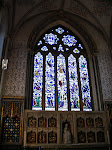
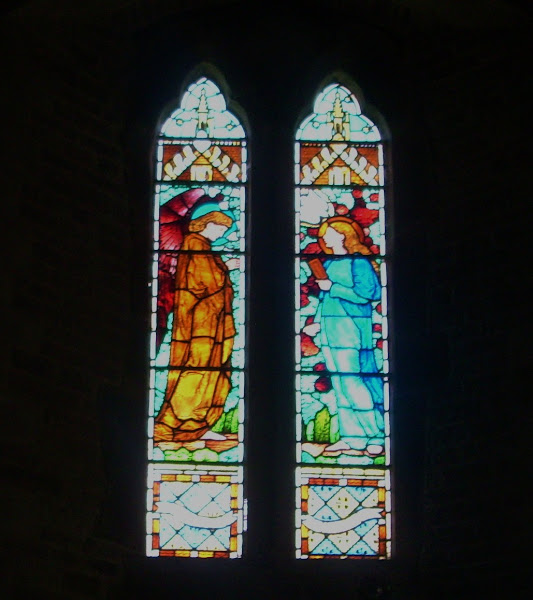
The present window east of the high altar incorporates an accurate representation of the common seal of the nunnery. The seal, an oval in red wax, depicts the Virgin Mary enthroned and holding the Infant Jesus on her left knee. The Lombardic Capital script used in the legend shows that the seal was engraved prior to the mid-14th century. The legend reads: S: SCE: MARIE: ET: CONVENTUS: DE: VSKA (The seal of Saint Mary and the Convent of Usk, (More information from Dr Madeleine Gray, University of Newport)


An Usk 'Ghost Story'....

Ghostly Nuns of Usk Priory

In 1970 a woman visiting Monmouthshire's Usk Priory, one winter saw five ghostly nuns walking from the far end of the house, by the library, towards the church. The original convent at Usk was for five nuns of the Benedictine order. At the suppression of the monasteries the five nuns were pensioned off, having given their allegiance to the king, thereby saving their lives and the probable destruction of the priory.


Catholicism in Mediaeval Wales-Last part of this rare chapter-Part III-J.E.Hirsch-Davies


LAST PART OF CHAPTER ONE:CATHOLICISM IN MEDIAEVAL WALES-please cut and paste into Word as this is a rare article by a Victorian Convert.

Before we proceed to the evidence of later writers and of Mediaeval Welsh literature in general, it will be worth our while to dwell for a moment on the picture of the early Celtic Church , drawn by Gildas in the sixth century. Gildas the author of De Excidio Britannicae, written in a Glamorgan monastery, did not profess to write history. He was a religious and ecclesiastical reformer and he inveighs against rulars and clergy in a savage and merciless spirit. But in spite of the violence of the language , his writings are very important as they contain valuable historical information bearing on the religious condition of the house.

The Work of Gildas

Professor Hugh Williams has dealt very fully and critically with the evidence of Gildas in his ‘Opera Gildas’, and in his’ Christianity in Early Britain’. We cannot do better than quote his estimate of the various historical Quoestiones vexatoe that emerge from the pregnant period in the history of the Celtic Church.Most of the leaders of the nation,spiritual and political, come under Gildas’ unsparing lash- and among them Maelgwyn Gwynedd, the draco insulatis who was in charge of the defences of the country.

Taliesin was chief bard to Maelgwn at his court at the Fortress of Dreganwy, in North Wales. Gildas was himself a monk,and monasticism was already established in the country . In fact, it would seem that it was the religious world outside the monasteries that Gildas criticised so unsparingly.

Now what does he have to say of the Church in his age in Celtic Britain ? What was its Faith? It’s ministry? Its relationship to Rome?

In the words of Mr Willis Bund, was the ‘old Welsh religious system (!)’a kind of foregleam of modern nonconformity?

The historical evidence must decide what the answer has to be , and the evidence is conclusive. Professor Hugh Williams , who was a thorough Protestant writes as follows:

One Church in Britain until 1536, no others. Orthodox Schism in 11th century, but did not affect Britain.

About AD 400 we find that there was in all Christian lands the idea of One Church, called the Catholic Church. Membership of this Church, whether for individuals or for communities, was dependent on the existence of the Faith, and upon general conformity of the existing ecclesiastical order’.

The writer admits that the conception of St Peter, contained in the words already quoted-‘Carae voli Pedyr’ –is found even in Gildas. Passages in the De Excidio show that no other conclusion is possible.

Catholic Celtic Priests were priests in the Catholic doctrine, having their own culture as today.

In his Epistle,eg,Gildas writes in his usual vein of the priests in Britain:

Sacerdotes habet Britannia sed insipientes, sedem Petri Apostoli immundis pedibus usurpantes.

Britain has priests, but they are foolish, usurping the Chair of Peter, the Apostle with unclean feet.

The Priesthood is referred to as the sacerdotalis dignitas, St Peter is designated as Prince of the Apostles- ‘princeps apostulorum beatus Petrus’.
In the Vita Gildae he himself gives an account of his journey to Rome ‘to invoke the merits of the Blessed Apostles Peter and Paul, that, by their intercession, he might obtain from the Lord pardon for his sins.’

Belief in the Primacy of Peter. Celtic priests made frequent visits to both Rome (st Cadoc seven times in the reign of seven popes)and Jerusalem.

A still more convincing and pertinent testimony to the contemporary belief in the primacy of the see of Peter is conveyed in another passage from the Epistle of Gildas ‘’Petro ejusque successorioribus dicit Dominus;et tibi dabo claves regni coelorum’ (The Lord himself designated Peter and his successors with the words 'To you do I give the keys of the Kingdom of Heaven'.

He describes the Holy Eucharist as ‘sacrificial worship’.

In his criticism of the church in Britain,he complains ‘ that they seldom sacrifice (say Mass) and never stand amid the altars with a pure heart.-‘(raro sacrificantes et numquam puro corde inter altaria stantes’).

In connection with the word ‘altaria’ Professor Hugh Williams if of opinion that even in the time of Gildas there were probably , in some at least of the British Churches , several altars-a fact of some significance in relation to the position of Mass in early Celtic Christianity.Gildas calls the altar ‘The Seat of the Heavenly Sacrifice’.

Mass was lengthy and ornate (Stowe Missal and Antiphonary of Bangor are examples)T

here are extant no liturgical books to supply us with information concerning the ceremonials of the Mass in the British Church of that period, but we are told that some idea of its ornate and perhaps lengthy character may be obtained from the Gallic Mass of Saint Germain the Irish Stowe Missal-which was in use before the coming of St Augustine-and the Antiphonary of Bangor.

Ordination-priest's primary function was to say Mass

At their ordination, the hands of the priests were anointed with oil.
‘The hands of priests’ says Gildas,’are blessed so that they may be reminded not to depart from the precepts which the words express in the consecration’.

On this, the editor of Gildas makes the following illuminating comment:-
‘The idea that they were priests as representative of the priesthood of believers finds no countenance in Gildas. The function of the priest, in the words of Missale Francorum of the same age was ‘ut corpus et sanguinem Filii Tui immaculate benedictione transformet’.
It is therefore evident that in Gildas’s time the essential function of the priest was to offer the great sacrifice, the Sacrifice of the Altar.

Everyone prayed for the souls of the departed Brothers and Sisters (maccabees 2)

With regard to the Catholic custom of praying for the dead, there is no need to collect the historical testimonies on this point. The conclusion arrived at by Warren in his valuable work on The Ritual and Liturgy of the Celtic Church covers the whole field with which we are dealing.’ Praying for the dead was as recognised a custom of the ancient Celtic Church as in any other portion of the primitive universal or Catholic Church’.

The antiquity of this custom in Wales is beyond doubt or evil, but what is equally important is that it has survived almost to modern times among the Welsh Peasantry.

The Gwylnos or wake , which has now resolved itself into a prayer meeting, is really a lineal descendant of the Officium Defunctorum-namely , the Placebo and Dirge. The declaration ‘nefoedd iddo’ at the grave on the Sunday following the burial if the Welsh equivalent of ‘Requiescat in Pace’.

As regards Bardic literature, there is a total blank between the sixth century and the eleventh. After the return from Ireland of Gruffydd ap Cynan in the North and in South Wales of Rhys ap Tewder from Britanny, there was a marked revival of bardism, but the intervening period is mute (possibly because of the frequesnt raids by Saxons and then Vikings and frequent burnings of monastery libraries)

Nevertheless, it is important to remember that,while the Welsh records of this period have now disappeared , they still existed in the time of the literary revival in Norman times; for the bards and writers of the new era had undoubtedly access to many old Welsh records.

Nennius -the link

Quotations from the early mediaeval bards in confirmation of this can be found in Sharon Turner’s ‘Vindication of the Ancient British Poems’ to which the reader is referred. Nennius, the author or editor of the Historia Britonum is an important link between te sixth century group of Welsh Bards-Taliesin, Llywarch Hện,Aneurin, Merlin etc- and the Laws of Hywel Dda and the times of Giraldus Cambrensis; and he had undoubtedly access to old British records then extant, for he mentions the antiques libris nostrorum. His date is about AD 800.

Asser of Menevia

It is unfortunate that the learned Asser of Menevia , monk and probably shop of St David’s has in this De rebus gestis Aelfredi left us so little information about the religious condition and customs of his native family.

Early Writers and Bards did have historical records, some not available to us today.

Rhygyfarch

There is no doubt that Rhygyfarch, son of Sulien, Bishop of St David’s and the eleventh century biographer of s David, had at his disposal some authentic records preserved in the cathedral library, which had escaped the ravages of the ferocious sea rovers.

Gerald the Welshman

Giraldus Cambrensis ,hoever, leaves us in no doubt as to the existence at his time of quitea considerable body of ancient Welsh manuscripts.

‘This’ he says ’seems remarkable to me that the Cambrian bards have genealogies, etc….in their ancient and authentic books written in Welsh’.

William of Malmesbury gives similar evidence:’ it is read in the ancient accounts of the actions of the Britons.’

And again ‘These things are from the ancient books of the Britons’.

The reasons why one desires to make clear the point touching the authenticity of the early Welsh records must be obvious. It gives addred weight to the testimony of the literary documents that have survived from the orman period in regard to the early ecclesiastical position of Wales.

The ancient Welsh records have perished for us but they had not perished for the poets and the chroniclers and ecclesiastical writers of the eleventh and twelfth centuries.

Inference they are legends does not disguise their Catholic traits

It is true that legendary matter is mixed up with the meagre records of the lives of the Welsh Saints and romance with thLeaving the facts of Welsh history, but no amount of legend and romance can altogether obscure the main lineaments if the deep rooted realities of the religious life of the Welsh people. This life-the spiritual side of the nation-is necessarily written on too large a scale to be seriously affected by the periodic intrusion of the spirit of romance or other form of literary revivals.

Y Mabinogi is Catholic in Spirit

Leaving aside the scanty remains of the Taliesin and Merlin group of sixth century bards, early Welsh literature naturally takes the form of romance; and in the old Welsh romances, the Mabinogion , the Arthurian stories and the legend of the Holy Grail- we do not expect to find much authentic history as conceived by the prosaic chronicler; but even the old writers of romance could not write their productions in a sort of psychological vacuum. Although they do not supply us with precise historical records, like the Annales Cambriae of Brut y Tywysogion they could not help letting in the persuasive atmosphere of the age in which they lived and wrote; and thus revealing some of the deeper and finer aspects of contemporary history, especially in regard to social customs and religious belief.

This is a point of some importance, for it enables us to take thse old Welsh romances in hand as sources of trustworthy information in regard to the ancient faith of the Cymry. We gather, therefore, from them that the atmosphere of the earlyromances is tha of the Catholic Church, with a pronounced monastic character. In the background we have knight errantry and the institutions of chivalry, though the latter is more characteristic of the later of the earlier forms, and belongs to Norman times.


Some of the Mabinogion probably represent a period of very high antiquity, perhaps pre Roman; but in their final form they are permeated with the spirit of Catholic antiquity, and present all the intimate features of a long established Catholic community.

The Blessed Virgin Mary

A few typical instances of this must suffice. As it has been asserted by some writers on Welsh literature that the Cult of the Blessed Virgin is a product of Norman times, it is instructive to note that Nennius (ninth century) in his Historia Britonum which may be considered as the ‘fons et origo’ of the body of the legend and romance subsequently developed and polished by Geoffrey of Monmouth and others, states that King Arthur , in going to battle, wore the image of the Blessed Virgin on his shield. The original word is ysgwydd (shoulder) but this is a copyist error for ysgwyd, shield(scutum).

In the “Legend of the Holy Grail”,again,the Grail is the natural centre point of all the symbolism of Mass and Sacrament , and the three Grail Keepers represent the Holy Trinity.

Llantwit Major /Llanilltud Fawr

It will be of interest to Welsh people to know that the locus of these wonderful Grail Stories is probably in the neighbourhood of Llantwit Major, which even today has preserved to a great extent the outward marks of its high antiquity and romantic history. In the Grail legend the characters live and move in the odour of Catholic sanctity; they are represented as going daily to Mass before starting on the knightly enterprises of the day. One of the characters declares,for example,’’I am a Knight. One of the Quest for the Holy Grail’. There are many of the Quest labouring in vain, for they are sinners, without inclination to go to Confession. No-one shall see the Holy Grail except it be through the gate that is called Confession’’.

The following are typical quotations:

“When he had confessed and taken his penance, he besought the holy man for the sake of God to give him his Lord’s Body -‘rhoddi iddo Gorph yr Arglwydd’.”

Again, “Peredur (Percival, Parsifal)was delighted to see the people believing in God and Mary”.

Yr Offeren-The Mass

This is a phrase constantly used in the San Greal as well as in later Bardic literature. It was also used in Forms of Bequest. There is also a reference in the San Greal to the Mass of the Blessed Virgin, the term for Mass being ‘offeren’.As words are the symbols of religious beliefs, it is important to notice, as the term ‘offeren’ is sometimes confused with ‘offrwm’ by modern writers in dealing with the history of the Holy Eucharist, that in early Welsh Literature no such confusion is to be found.

Offrwm which is a generic term for ‘offering’ is never confused with ‘offeren’, which is a specific term for the highest offering in the Chritian faith, the Sacrifice of the Mass.

A passage from the San Greal itself illuminates this distinction:

“Yna gwrandaw offeren aoruc ef cyn y fynet, a phawb a aeth yngaredic y offeren yr anrhdedd idaw.”

(He went to hear Mass before going , and all went kindly to offer the honour to Him)

If we now turn to formal historical treatises such as the Bruts, we find he same features, the same empathetic testimony to the belief and devotional practices of Catholicism. The importance of the Mass in the national life is illustrated by such an entry as the following in Brut y Twysogion:

“Gwedy hyny nos wyl Fair y Canwylleu y cant |Esgob Mynyw Efferen yn ystrad Flur, a hono a fu yr Efferen gyntaf a ganawd yn yr Esgobawt”.
“On the Feast of Candlemas, the Bishop of Menevia sang Mass in Strata Florida; that was the first Mass he sang in the diocese.”

This was a very appropriate record, considering that Strata Florida, the Cistercian Abbey at the foot of Plynlimmon, and the ‘Westminster Abbey of Wales’ in olden times, was the home of this particular chronicle.

The moral of an entry of tis kind is very clear. The Welsh Brut only professed to register events of national importance. Such an event was the first occasion of ‘canu offeren’ by a Welsh Bishop in that particular Monastery.


___________________________________________

Sunday, August 30, 2009

Catholicism in Mediaeval Wales-Part II-Catholic words in Welsh


_____________________________________________________________________________________________________________________________
Religious Terminology of the Welsh

Valuable evidence as to the nature of early Welsh religion may be gathered from a brief examination of the religious terminology of the Welsh people.

The late Professor Huw Williams , a great authority on the early British Church, writes:
The Faith in Britain was the Faith of Western Europe generally; its Church had the same organisation of ministers. in which Bishops and presbyters became Sacerdotes , the Lord’s Table, an altar. To these Sacerdotes belong the power of binding and loosing. Behind all was the wonderfully powerful force of Monachism.’

And again:
‘Throughout the west one language universally prevailed in religion. Gildas quotes a Latin Bible, and the literature he read was Latin. Long before Gildas, even St Patrick, the Apostle of Ireland, though a Welshman, wrote in Latin.’‘The native language it would seem, was only used for preaching to the people. The result of this close contact with the Latin world- if one may thus describe the early ecclesiastical situation – was that out religious language has become steeped in Latin’

The following short list of the principal Welsh religious and ecclesiastical terms will illustrate this; and though the list may be dry reading to some of my readers, it is desirable that the point should be made clear before proceeding further.

eglwys ecclesia
offeriad,offrwm, offeren Eucharistic sacrifice
baglawg baculus ecclesiastic entitled to carry a crozier
Periglor Parochus, Parish Priest
Trindod,or trinted Trinitas
Bedydd Baptismus
Senedd Synodus
Clerigwr Clericus
Pregeth Praedicatio
Cardawd Caritas
Gosper vesper
Gras gratia, grace
Crệd credo
Erthygl articulus
Crysfad chrisma (Old Welsh name for Confirmation)
The second Sacrament, says Canon Griffith Roberts in his ‘Grammadog Cymraeg’.’is the Bedydd Esgob a clwir Crysfod.’
Cablyd,Difiau Cablyd capillatio

(The monks were tonsured on this day, Maundy Thursday)

Calan Caledoe

The calong par excellance was January 1st,, but we also have calan mai and calan Gauaf)
Ynyd initium(dydd Mawrth Ynyd= Shrove Tuesday)
Cabidwl Capitulum cathedral chapter
Urdd ordo
Garawys Quadragesima Lent
Segyrffig (now obsolete) sacrificium
Ystwyll Stella (star)Epiphany festum stella
Pgiol vial
Paeol holy water stoup
llện legend
elusen eleemosyna
y fall malus the evil one,
naf numen
pader paternoster
gwers versus
benedith benediction
Merthyr martyr
Llith lectio
Nadolig natalis
Paradwys paradisus
Pechod peccatum
Addoli adoro
Achub occupo
Arawd oratio
Ysbryd spiritus
Plygain pulli cantus;(night song)
gwỹl vigilio
swyno meaning ‘bewitch or charm’
(means makingthe sign of the Cross Signo- to bless
dwfr swyn holy (blessed ) water
sagrafen sacramentum
allor altare
ysymmuno ex-communio
uffern inferna
dofydd domitor, divinity
cappan cope
cappa;cymun communion
cyffes confession
mynach monachus
mynachlog monachi locus
Lloc locus part of Welsh placenames.( A notable use of its use as signifying a monastery is contained in the Black Book of Camarthen.
Ni phercheist ti creiriau,Na lloc na llaneu
You have not respected relics, nor monastery nor churches.
It also survives in the word ‘llech’(sometimes erroneously interpreted in Welsh Place names such as ‘stone’ or ‘slate’) eg Llechgenfarwydd, Llechydwr, Llechgomer, Caellech, Penllech)
Cil, Cill Cella
Columba was called Columncille- thedove of the cell)
Kilmuine St David’s Cell (Kilmynyw)
Disart,disserth from desertum, lonely place, monk’s retreat
Caregl calyx, chalice
cá»™r chorus
clas classus,clausum old cathedral chapter
clos (cognate word) Cloister, close monastery-clausus
syber superbus
Abad I’w glosydd rhwng bedw gelision’.

We could go on indefinitely with the list of Welsh religious terms derived from Latin, but these examples are enough to prove how largely we have borrowed from the parent language of Welsh Christendom. So that, apart from the evidence of Welsh history, we have the clear evidence of language .The Welsh word for ‘religion’ crefydd is a notable instance of this. The word crefydd in pre reformation times meant, with scarcely an exception , not what it means nowadays, the abstract principle of religion, vague enough to incorporate any kind of religious belief, but the definite profession of religion in the monastic sense. It meant the religious life, consecrated and followed under the organised discipline of the Catholic Church. Crefyddwr meant those who were under religious vows. In early Welsh literature crefydd was of the masculine gender, but in modern Welsh it is feminine. In fact it represents in its change of Gender the evolution of religious faith from the dogmatic and definite to the undogmatic and indefinite.

The Puritan,’a good man in the worst sense of the term’ may be said to have changed the meaning with the change in gender.

Crefydd Gwyn e.g. meant The Order of White Monks,-crefydd being the specific term for a religious order.This is the invariable meaning attached to it in our oldest Welsh literature , such as the Welsh Laws,The Chronicles and the San Greal and others.
The old monastic or Catholic connotation of the word passed away with the supression of the Welsh monasteries.

Dr Hartwell Jones, the author of Celtic Britain and the Pilgrim Movement-throws a flood of light on the Catholic Character of early and mediaeval Welsh religion-writes as follows:

It is difficult to conceive that Catholicism at one time permitted Welsh habits of thought ; that its beliefs were jealously cherished; that its theological terminology is woven into the very warp and woof of the Welsh language. Indeed from the third century to the sixteenth, Wales adhered to the old Faith as rigidly as Spain or Italy at the beginning of the nineteenth. This revulsion of national temperament and reversal of a national bias is one of the strangest psychological phenomena of English history’.

After quoting the evidence of foreign writers in the sixteenth century, to the effect that this country was strongly and avowedly Catholic, he goes on:

‘Catholicism appealed to the poetical temperament of the Welsh. Underneath the surface, there lies in the Welsh nature a vein of mysticism which three centuries of Puritanism have not succeeded in eradicating. A love of symbolism also, an eye for the artistic aspects of the Christian religion, a fervid imagination, and an impressionable temperament, would naturally find expression in the Catholic Creed and Catholic ritual; in the stately aspect of the Christian year, the unbroken round of services, the religious acts by which Christian truths were expressed, and in the warm colouring of Catholic ceremonial. Many instances might be cited from modern Welsh literature by the pens of writers who would repudiate any sympathy with Catholic belief or practice, yet betray and instinctive harmony with the Catholic spirit.

A more scientific study of Welsh history, and the renaissance of genuine interest in archaeology and antiquarian lire, have led a new generation of Welsh people to grasp the truth that the heroic period of Welsh history and the golden age of Welsh literature sprang from the heart of the Catholic spirit

And specially prominent in this ancient literature is the spirit of loyalty to the See of Rome, deep even passionate devotion to the Blessed Virgin and the Holy Mass.
And this evidence is not limited to any particular period; it is true not only of mediaeval Wales, but of early Wales as well. Of this early period of Welsh exxlesiastical history, Stephens, in his Literature of the Kymry writes:

“The Church had become powerful in Wales, as well as over the rest of the civilised world. Papal theology possessed and directed the human understanding , and gave its impress to all opinions. We have one striking instance of this in the Awdl Fraith which is evidently an ecclesiastical production of the romance era. This might have been inferred from the tone of the composition, its allusion to the afrilat cyssegredig and its Latinised diction.

He even considers that the immortal Arthur himself, the religious hero, the greater part of whose memorials were found in convents, is partly, at least, a being of monastic creation.

‘The Catholic Church’ he adds,’was now in its glory and at the height of its power ;and now, as at all times, was most studious to conform itself to the improvements of society. It mingled with all things without excluding any; and in Wales, theological modes of thought, feeling and expression were everywhere displayed.

‘The Mabinogi’ of Taliesin is replete with theological expressions.’

He attributes the spirit of the old Welsh romances not to the lay bards, but to the inmates of a monastery:

‘Of the fine and high tones sentiments which breathe through the Mabinogion, we have no traces in the works of the bards;they must therefore have emanated from the clergy.’

This , it may be added, is specifically true of the tales of the San Greal, which was supposed to be the cup out of which our Lord is said to have drunk before his crucifixion, or which contained His blood.

Our earliest Welsh literature, in spite of its mythological background and martial atmosphere is by no means lacking in definite evidence of a Catholic age. Scattered phrases and sporadic allusions, as well as explicit references to Catholic truths, all point steadily in the same direction.

The ‘Book of Taliesin’ e.g. one of the ‘Pedair Cainc y Mabinogi’(4 ancient books of Wales)contains very distinct allusions to the religious beliefs of the age.

The Eucharistic Sacrifice (Holy Communion) is designated as the Urddol Segyrffic, the honoured Sacrifice of the Mass.And the Awdl Fraith the ‘Ode of Varieties’, attributed to Taliesin, the Holy Eucharist as Stephens says is referred to as the afrllad cyssegredig.
‘
Again in ‘Air y Mynydd’, a fantastic imaginative poem of great antiquity, preserved in te Red Book of Hergest, the Holy Communion is mentioned in Connection with Confession which is regarded as an essential principle of the religious life.

The end of alle thing in Confession for the sayke of God, make a full confession.
Again the Blessed Sacrifice is desired by the writer as a shield of salvation against the dread decree of the Day of Judgement-
Rhag gormeil golaldydd brawt’

Llywarch Hện , a sixth century prince and poet, and probable priest as well, writes:

Before I was a fair priest Kyn bum kein vaglawc
I took part and made prayerful compassion Bum kyffer eiryawe
Before I was a fair priest Kyn bum kein vaglawc
I was bold Bum by
I was entertained in the convent house Am kynnwysit yg kyuyrdy
Of Powys, Paradise of Wales Powys Paradwys Cymru

The title in connetion with Llwywarch (hện) refers, in the opinion of Professor High Williams, the author of Opera Gildae, to his ecclesiastical status-senior.

But apart from the external corroboration,the words of the poem itself show that the author was a priest.

In consequence of this ecclesiastical significance of hện , he quotes Pawl Hện , the Welsh name for Paulinus, but it is doubtful if this is a true parallel. Pawl Hện seems to be merely the Welsh form of Paulinus with the Latin terminal lopped off. In fact, there is on the borders of Cardigan (Dyfed) and Camarthen , a church dedicated to Paulinus called Capel Peulin. Paulin or Peulin could easily become Pawl Hện, in which ‘Hện’ is, of course a mere phonetic addition.

In the Book of Taliesin (xvii) we have the following lines:-
There will be no priest ‘Ne byd effeiriat
The wafer bread will not be consecrated Ny bendieco afyrllat
The perverse will not know Ny wybyd anyguat
The seven faculties(=Sacraments) Y seith lafanad’

The primary meaning of llafanad is ‘intellect’ or ‘interllectual faculty’ hence its meaning of faculties in the sense of means of grace, Sacraments.

Anygnat is an early Welsh form of anynad from an and ynad,unreasonable contentious, perverse.

A poemin the Black Book of Carmarthen attributed to Meigant a bard and saint of the sixth century, contains a curious proverbial saying:
Ni chenir bwyeid ar ffro’
Mass is not sung on a retreat

In the Book of Aneurin a sixth century document, we have an interesting collection of phrases , referring to different religious subjects, but which, if taken together, point to a decided Catholic environment. They are taken at random:

The Trinity in Perfect Unity
The shaft, heavy as a crozier of the principal priest (Bishop)
They went to the Llan for penance.
A Llanfawr full of desire for Baptism


In spite of their meagreness, the beliefs and customs of the Catholic Church in early Wales peep out quie clearly between these ancient lines.

The last quotation in particular seems to point to a period of high antiquity, when the country was being gradually from Druidic paganism to the Christian faith.

The process of conversion from Paganism was always expressed in Welsh literature as ‘desire for Baptism’.

The following conception of S Peter at this very early period is a convincing tribute to the antiquity of the Catholic tradition among the Welsh:
I love to praise Peter Caraw voli Pedyr
Who can bring Peace! A vedir tag tew!(Skene)
‘Tag’ seems to be an early form of ‘tanc’ assuming the reading to be a correct transcription- and tew is a form of taw tewi.

Again:
Oret y Duw buw budyeu Pray to the Living God
Am byd ryd radeu for benefits.through the
Drwy eiryawlseinhau (i.e.seintiau) Intercession of the Saints.

The influence of the Latin on early Welsh phraseology is well illustrated by the first word of this verse-‘oret’ from oro.In fact the Latinized diction of the ancient Welsh bards is quite noteworthy.

We have, unfortunately, very few relics of pre-Norman Welsh script to fill up the long gap between the age of Taliesin and Gildas. And the literature that blossomed forth under Norman influence or at least in Norman times. But even the Welsh glosses and verses on the Cambridge ‘Codex of Juveneus’ (ninth century) which probably came from the monastery from Llancarvan, contain englynion of a highly religious character. The text as we have it is sadly imperfect , but evidence is made to the Tindaud, Bedit, and Mab Mair: The Holy Trinity, Baptism and the son of Mary.

If we had the full text ,we should doubtless have ample evidence of the ancient Faith and its liturgical and devotional forms among the old Kymry

Catholicism in Mediaeval Wales-Part I-J.E.Hirsch-Davies

The subject of the religious beliefs of the Welsh people in the Middle Ages is one that has not been adequately presented to the modern Welsh mind. Were it not for the industry and zeal of our antiquarian societies , it is doubtful whether the student of Welsh history would succeed in passing the charmed barrier of the Purital era, which to most Welshmen has been hitherto the terminus a quo of all that is greatest and most fruitful in Welsh History. It has not yet quite dawned upon the ordinary Welsh student that the Puritan era, on the other hand, and for weighty historical reasons , may be quite truly viewed as the terminus ad quem of a golden period of our national history.The deeper we delve into the records of the past, the more we perceive the profound character if the religious change that took place after the Reformation-rapidly in England, but slowly in the principality of Wales.
In the following pages, the main facts bearing on the religious life of the Welsh people in pre-Reformation times are placed before the reader . It is not pretended that these facts are being put on record , for they are already perfectly well known to the historical student.

The writer merely claims that the facts are put in their proper setting. Within the natural limits placed on a modest brochure of this type it is not possible to go into details: in fact one of theproblems that the writer finds himself obliged to solve at every turn it,not what he must put in, but whathemust leave out Welsh mediaeval literature is a very difficult field of research, and it is by no means an easy task to present the results of ones investigations in the form of a summary. This is particularly the case with religious belief , where the evidence is often so elusive and impalpable , so hard to tabulate and classify.

There are documents in Welsh history in which the verbal references to definae religious beliefs and customs are of the scantiest; and yet if we divest ourselves of the legal conceptions of evidence, we often rise from the study of such documents with a most definite conviction of the real character of the religious system that stands behind it and reveals itself through it. It is difficult to know how anyone that is even moderately acquainted with welsh historical records Can fail to arrive at a clear conclusion as to the character of the old religion (y hen fydd) of the Cymry.And yet the following quotation from Mr Willis Bund’s Celtic Church of Wales

Nonconformity comes closer to the old tribal law than anything else. A Welshman, who studies his country’s history sees that there is nothing so near the old Welsh Religious System than Nonconformity.This is one of those strange historical judgements that take one’s breath away. Some of our leading Welsh historians are apparently afflictedwith colour blindness ,for, however real their sympathy for the Protestant Principle, this vision of a primitive non-conformity established around the altars of the Romano British Church , and offering the Sacrifice of the Mass, is not one that has been vouchsafed to them. It is hard to understand in what cryptic sense modern non-conformity can be made to resemble the religion of the old Cymry;but, as the argument has now been put forward with all the apparatus of historical learning the best way to dispose of this primitive anachronism is to produce afresh the evidence of history.

It may be mentioned in passing that the antithesis between the Celtic and the Latin type of Christianity has been greatly over-exaggerated. It is quite legitimate to talk of a Christian type of Christianity and a Latin type , both ancient and modern. Celtic civilisation with its political, social and legal institutions , differed in some important respects from Latin civilisation , and had a character of its own. But these differences, however important in the eyes of a historian , cannot reach a point where they are likely to affect the essential character of Catholicism They are purely external, incidental, subsidiary.

Those internal varieties or aspects of the one great whole, due to the national ethos, do not touch the question of the unity and the Homogeneity of the Catholic Body. The tribal idea of Christianity was in no respect inconsistent with the institutions of the Catholic Church. The Laws of Hywel dda were framed for a tribal of society. But the Catholic Church , with its long, established institutions was the living centre of that society- the soul that dwelt serenely and fruitfully in the tribal body.

A Welshman who studies his country’s history without blinding himself with preconceived notions will look in vain for historical evidence of the idea that early Celtic religion was a kind of Protestantism ‘born out of due time’.

The religious history of the mediaeval period is not so well known to the general public as the earlier-the age of the Saints; and yet Welsh Mediaeval literature reflects very fully and unambiguously the inner life of the Catholic church and the religious devotions of the Welsh people.

Much of this evidence is contained in our bardic literature so much of which is fortunately preserved in that great corpus of Welsh literature, both poetry and prose- the Myfyrian Archeology.

Welsh Bardic literature from the eleventh to the sixteenth centuries is full to overflowing with the most definite and spontaneous testimony to the religious faith of our forefathers.

Catholic allusians in Welsh Bardic Literature

The Sacrifice of the Mass the invocation of saints. The doctrine of purgatory, auricular confession, penance, fasting, the Blessed Virgin Mary, extreme unction , the supreme authority of the See of Peter- these are the constant and essential elements in the religious as well as the secular poetry of mediaeval Wales.

Dr Rhys Phillips . in his book on The Romantic History of the Monastic Literature of Wales, says that ‘a close examination of the literature of the thirteenth to the sixteenth centuries reveals most of the bards as pious Catholics, working in unison with, and receiving much of their information from, the monks who had generously espoused the Welsh national cause, and suffered for it’.

The scores of poems to ‘Mair’(Mary) , ‘the Virgin’, to the saints, and to the various abbots of contemporary monastic houses,form a library of Roman Catholic poetry, probably unequalled in any country of the same size at that era. The Elegy of St Cunedda is in the Book of Taliesin ; while addresses, odes,or cywyddau to SS Beuno, Brigid, Cadoc, Cawrdaf, Collen, Curig, Cynhafel, Cyntog, David, Dwynwen, Einion, Gwenfrewi, Illtud, Mair Magdalen, Margared, Mihangel-next to Mair in popularity- Teilo and others, have been copied and recopied into a large number of manuscript collections.

Welsh literature, in fact,owes its noblest and earliest achievements to the old Welsh monasteries. This fact is at last becoming increasingly evident to the student of Celtic literature, but for the sake of those who are not students in this particular branch, this must be emphasised afresh , for it is very closely connected with the subject of this treatise.

The literary activity of the Welsh monasteries covers the whole period from Gildas to the dawn of the Tudor period.

Welsh Laws of Hywel Dda

It is true that the courts of the Welsh princes were to some extent centres of literary life. This is evident from the testimony pf the Welsh Laws of Hywel Dda. But this qualification must be added: that the literary interest was probably confined to the two departments of (1) bardic lore of a somewhat restricted and professional kind and (2) genealogical records.

Welsh Monasteries as Centres of Culture

The monasteries were undoubtedly the principal centres and courses of culture. The Celtic literature that influenced Europe came from the inmates of the monastery.

The very earliest writings that have survived, such as the De Excidio Brittanicae of Gildas, which is in a sense our first Welsh history, and Nennius’ Historia Britonum both hail from some monastery in Glamorgan.

It is unfortunate that the early devotional literature of the Cymru survive in such attenuated form. We would gladly exchange a whole library of the ponderous and dreary Genevan theology for a few copies of a Welsh Missal.

These were, of course, the first objects of attack by the iconoclastic bigots of the Dissolution period.

Not only did the monasteries produce a very considerable portion of our early literature such as the ‘Lives of the Saints’ the ‘Romances’ and the Chronicles, but they also preserved and transcribed old documents which would otherwise have perished.

Writers such as Gerald the Welshman (Giraldus Cambrensis) Caradoc of Llancarfan, and the compiler of the Liber Landavensis,(Book of Llandaf) had access to ancient records, which they adapted to suit new literary and historical theories, or to meet new ecclesiastical circumstances.

The basal document of all Welsh history is the Annales Cambriae . This is supposed have been compiled by St David’s monastery, a conclusion which is drawn with some confidence from the strong local colouring of some of the entries contained in it. From the Scriptorium of Llandewi-Brevi- memorable for the great council with which the name of St David is connected-came the valuable Llyfr Ancr-The book of the Anchorite.

Camarthen Priory

Perhaps the most interesting literary document in connection with Welsh history os the Black Book of Camarthen the oldest extant manuscript in the Welsh language. It was written in the twelth century by a Welsh Augustinian monk in the Priory of Camarthen.
From the same corner of Wales emanated the famous Black Book of St David’s.

Margam Abbey

Margam Abbey is well known for its Annales de Margam a chronicle that covers the period AD 1147-1232.

Many of the treasures of this old abbey are preserved in the British Museum, still unpublished. These include a twelfth century copy of the Domesday Book, the Gesta Regum and the Novella Historia of William of Malmesbury, and the History by Geoffrey of Monmouth.

The Margam Collection of charters and deeds contain probably the most complete original series in existence relating to one monastic establishment. It was at this famous abbey that the Red Book of Hergest was first heard of, which contains so many exquisite old Welsh romances. It was from this source that Lady Charlotte Guest translated the Mabinogion.

Llandaff Cathedral

The mother church of the diocese, Llandaff, rejoices in being the source of the gospel of Teilo , cometimes called the Book of Chad ;also of the LiberLlandavensis which is one of the most valuable ecclesiastical documents in Welsh history.p 12.

It was compiled early in the twelfth century, but it contains very much older material of unequal value.

Neath Abbey

Neath Abbey, one of the first Cistercian houses in Wales, has lost nearly all its literary treasures. But in the fifteenth century the monks had a copy of a manuscript called the Grail. This was said to be the great San Greal, the romance of the Holy Grail.To this abbey is also attributed the Welsh version of the Parvum Offerium Beata Mariae.

The editor of the Welsh historical Manuscripts Report is of the opinion that the Book ofTaliesin one of the Four Ancient Books of Wales came originally from Neath.

Strata Florida

Strata Florida, the Westminster Abbey of Wales in the Middle Ages, was famous for its learning. It was here that Brut y Tywysogion,the Chronicle of the Princes, was compiled. It appears that the monks of Strata Florida compared notes at regular intervals with the chroniclers of the Abbey of Aberconway, so as to ensure a correct account of historical events. ACodex of the Annales Cambriae is also attributed to these monks, as well as parts of the Red Book of Hergest.

Valle Crucis-near Ruabon

Valle Crucis is perhaps the most picturesque of all the ruined abbeys of Wales. It was known for its generous patronage of men of letters. Its praises have been sung by the most prominent bards of the Middle Ages, such as Gutto’r Glyn and Guttyn Owain,whose history and bardic compositions are closely associated with the annals of Valle Crucis. Here lie the mortal remains of Iolo Goch, the Bard of Owain Glyndwr: and Iolo’s hymns were chanted in the monastery choir. It appears that a White Book once belonged to this abbey, but is now lost or burned.

Strata Marcella

Strata Marcella, Ystrad Marchell, A Cistercian house in Powys is supposed to have been the source of the thirteenth century Life of Gruffydd ap Cynan.

There in the British Museum is a fine collection of Welsh poetry, of which Dr Gwenogfryn Evans writes that ‘judging by the orthography, its original was written in the thirteenth century, inferentially at Strata Marcella, by the scribe who wrote the Book of Aneurin’.
The Dream of Rhonbury is supposed to have been, in its present form, written at this abbey; also the Mabinogion of the White Book of Rhydderch.

The Black Book of Basingwerk is an echo of the literary activity of the abbey of Basing. This is a copy of the Brut of Caradog by Gutyn Owain who brought the record down to his own day.

And so we could go on indefinitely; but this brief list of some of the principal monasteries of old Wales, and their literary labours, is enough to convince the reader that Welsh literature owes an enormous debt to the monastic houses, and that it was generously fostered by the Church.