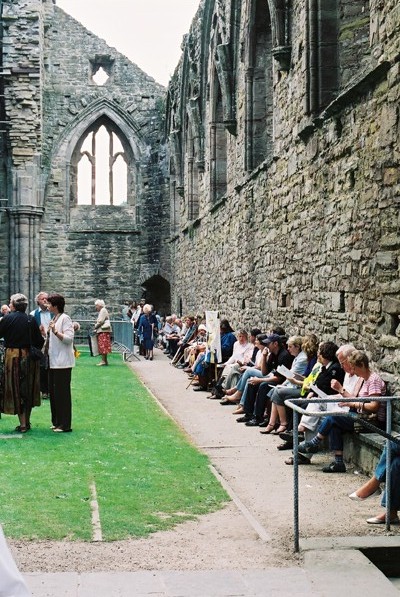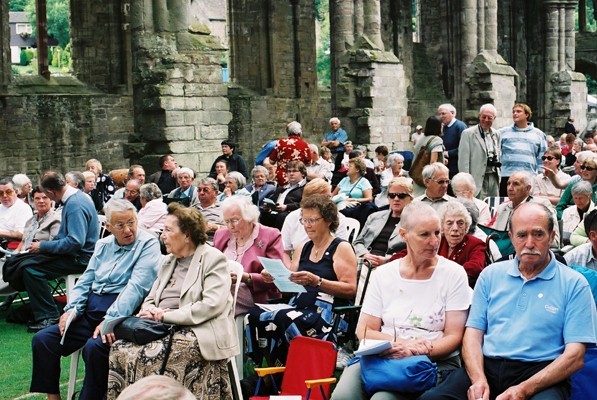


































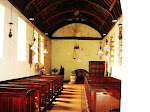

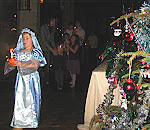






 Last night,i n spite of a very damp evening, nearly a thousand people turned up to Belmont Abbey for the famous May procession to honour Mary, the human mother of Our Lord, Jesus Christ. People met at Hedley Lodge, for an
evening meal or tea and cake and then assembled at nine o'clock at the gates of the Abbey. People turned up in coaches, cars, minibuses and everywhere was packed. At the gates, people bought Lourdes candles and paper cups in which to shield them from the wind.
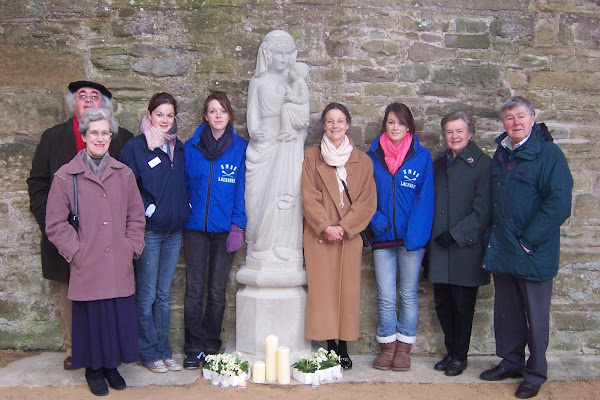
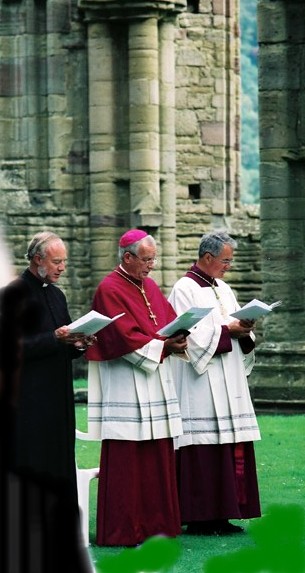
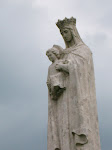
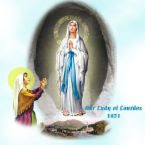
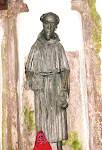
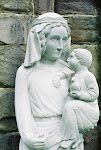
 Abbot Paul Stoneham welcomed all the pilgrims , who had come from as far as Swansea, and also from Bromyard in Herefordshire and all joined in a rousing series of hymns thanking Mary for her 'Yes' to God's plan which overturned Eve's disobedience in the Garden of Eden. We were graced with the presence of the Lord Archbishop of Cardiff, whose birthday it was and who joined in the hymns with equal fervour to the Welsh, who were in good voice. The processional statue of Our Lady was borne aloft, decked with many different sorts of flowers, roses, carnations lilies many other varieties and was illumined. We walked around the huge garden, and recited the Glorious Mystery of the Rosary. In fact this carrying of the statue and the singing and prayer very much called to mind the Ark of the Covenant, the powerhouse of the ancient Israelites at the beginning of our Plan of Salvation, before whom David danced. Mary was of the House of David, and is often called the 'Tower of David' as one of that line's most glorious creations.
 During a homily in the Abbey Church, Archbishop George gave an inspirational homily,recalling our 'journey' through the garden .He reminded us, that our Salvation had begun in the Garden of Eden. Eve too had been conceived without sin, because God had done this for Adam and Eve but, after Eve's disobedience, another woman,Mary in her immediate obedient 'yes' to the Angel Gabriel had brought the possibility of restoring us to Eden. The story of Salvation, moved to a close in another garden, that of Gethsemene,where Jesus was arrested, before his death on the Cross for our Salvation.
The Angel called Mary 'Blessed' and so we call her Blessed Mary or 'Blessed Mother' and in fact Mary herself says 'All generations shall call me blessed' in her Song of Praise, the Magnificat.
 In watching the procession move around, I was mindful of the Ark being carried by the Israelites.
It was made of gold and was Ancient Israel's symbol of the Presence of God, as it contained
The Ten Commmandments of the Law of Moses,
The Rod of Aaron, the High Priest
An Urn containing the Manna from Heaven ,
which the ancient Israelites had been dropped from Heaven to physically eat in the desert to stay alive, when God saved them from starvation. Jeremiah had hidden the Ark from the invading Babylonians and said that the Ark would come back when the Tabernacle, which had been OVERSHADOWED by the Glory Cloud (Holy Spirit) it when it was set up would once again come down.
 When King David brought the Ark to his new centre, Jerusalem, David greeted it and said "Who am I that the Ark of the Covenant should come unto me?" and then leapt in front of it with joy. (Compare Mary's cousin's greeting (Elizabeth) 'Who am I, that the Mother of my Lord should come unto me?', and the baby 'leapt' in her womb.
In the book of Revelation (means Apocalypsis-Unveiling) Chapter 11 John saw the Temple open and the Ark of the Covenant. The scene then reveals the Woman clothed with the sun and twelve stars around her head, 12 Apostles, 12 Tribes-His Body on earth crowning Mary. The Woman was in Childbirth and giving birth to God's Son and the Beast was waiting to eat her child, but it was taken back to heaven. The image of the crowning with stars is also similar to inside the Holies in the Temple where the Ark was kept, there was a curtain that depicted the sun, the moon, stars to show God's temple was above the earthly Temple , which had been like a dim image in a mirror of the heavenly temple.
 Mary made her long visit, (as probably a 15 year old girl,) from Nazareth (a town named after 'Nezzar'-'Shoot, 'A shoot shall spring forth out of the stem of Jesse' (Isaiah)to the town in Judea where Elizabeth lived. The Ark of the Covenant had also made its journey from the North of Judea to Jerusalem, which is in Judea.
The Shikenar Glory Cloud,(Holy Spirit) has now again descended and OVERSHADOWED the NEW ARK, as Archbishop George reminded us, which is one of Mary's titles-The Ark of the New Covenant.
It OVERSHADOWED the Blessed Virgin Mary when she consented to do God's will and enthusiastically obeyed God's call, and made possible for us to have with us the Lord Jesus Christ. The word overshadowed only ocurrs in Greek on these two occasions in the Bible. God needs our co-operation to be present on earth and she is our most wonderful example of a saint, living out god's Life in her.. We venerate her as a unique human saint, alive in heaven with her Son.
 The Queens of the House of David, were never the consorts or wives, always the Mothers of the present King (Solomon with Bathsheba), who are recorded in the House of David, along with the Kings. This Queen-Mother was called the 'Gabirah' and this is how early Jewish Christians would have understood the role of Mary, mother of the King. At the Wedding at Cana she said to Jesus, that the people needed wine and then 'Do whatever He tells you' to the servants .Little mortal human Mary, chosen by God for this important plan of Salvation loved God totally.
. Mediaeval writers called her the 'Spotless Rose' (from Isaiah) set to Music by Herbert Howells, this is a beautiful hymn.
Little human Mary was the NEW ARK.
Because Mary held in her womb and heart - JESUS, the Lord's anointed, as
1) The Word of God, the Wisdom of Christ
2)The True High Priest and Victim (he inaugurated the Lord's Supper and died for our sins on the Cross-once and for all.The Fourth Cup of Consummation of the Passover, was taken in the form of a bitter wine held on a sponge, after which he said 'It is accomplished'-(fulfilled'- You will be my People and I will be your God )
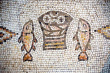
3) The Eucharist,the Thanksgiving Meal. Jesus was born in BETH-LEHEM (Town of BREAD) which was David's City. He is our physical food and is with us to the End of Time.He was laid in a feeding trough- a 'manger' (Fr 'to eat').
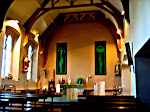
Inside the Abbey the statue was set up behind the altar, and lit up, just like the golden Ark, and everyone sang Hymns of Thanks and Praise to God for his gift of Mary providing a man's body for God in her Son. This Mystery of the Incarnation was observed in ancient poetry and texts of the ancient Welsh people, who called Jesus 'Mary's Son'.
Thank you Mary! for doing what you did!
After Archbishop George had preached, all turned to face the statue and give thanks in a hymn.At the end of the hymn 'Bring Flowers of the Fairest!' thousands of rose petals descended on the Statue representing Mary (New Ark).This was a wonderful moment. The Old Pagan practice of the Queen of the May had been turned to a ceremony of Thanks, decking Blessed Mary with beautiful flowers and thanking her for her obedience, which has had a wonderful blessing for us all for the last 2,000 years.
Throughout the Veneration, the candles had been kept burning and the whole Abbey church shimmered.From everyone, a thank you for your words 'Ecce ancilla Domini'-behold the Handmaid of the Lord, Let it be done to me, according to your Word'. The little handmaid's words to us 'Do whatever he tells you....from the Book of John ask us to be obedient too....can we be as obedient as she is? We can only try.
At the end of the devotion, we all left and Archbishop George greeted us all singly and went to the refectory for refreshments, after which I understand, the faithful sang 'Happy Birthday to You' to Archbishop George.
In spite of the dampish weather , we left with sounds of the hymns in our ears. We had a SUPERB Organist who played Widor's Toccata at the Recessional and accompanied all the inside hymns fervently and with great 'hwyl' and verve-which added a great deal to the fantastic singing, the scent of the many flowers, the images of the hundreds and hundreds of glowing candles and the smiles on all the faces, the Sisters of Charity, the many priests nuns and other brothers and sisters who took part, all these were in our hearts and ears. I really felt little Mary was there amongst us joining in the fun and pointing us, as she always does to her son, our God and her God'.
Do whatever he tells you.......
Thanks from all the Pilgrims for the Faith and Catechesis through popular piety and in other ways,and an excellent retreat programme, to Abbot Paul and all the monks of Belmont for their service and care.