








































Monday, June 9, 2008
Yesterday's Blog....
My computer crashed yesterday in the middle of the uploads. I have now sorted it out and revised it. Please click on the pictures to see them enlarged.The photos of the church interior are in the 'My Visit section after the first bit about Old British monasticism!!!Apologies if you were puzzled, something from a genealogy site seems to have come up and repeated info! Vista!!!!


Sunday, June 8, 2008
St Cadoc's Church, Trevethin and St Tatheus with St Cadoc and Anna of Gwent
At the outset, it is very difficult indeed to authoritatively give what can be relied upon as absolute fact in this period of British history. The fact that there was little written down-except by Gildas and most facts and tales were handed on from father to son and thankfully written down and preserved for us in the eleventh and twelfth centuries is something for which we should be grateful. These stories were written down with the eyes of faith. It does not make them less true, because people have embroidered the wondrous elements throughout the years. However, there are problems with genealogy and whilst we are sure of figures like Anna of Gwent (and Oxley!) there are problems with Meuthu-St Tathyws, known as 'The Hermit'. We know for certain that Cadoc received his theological training at Caerwent, but there is nothing to say he could not have been baptised by Meurthu or Tryddyn. When Tatheus meets Gwynlliw, Cadoc's father,Cadoc is already a child (according to the Life of St Tatheus, and as this appears to be an introduction, I do not believe he can have been the priest who baptised Cadoc.
I am not a trained historian, but an enthusiast for bringing to life our Christian life in Gwent.I can only give you the story from the evidence and sources I have seen. Please tell your friends to visit the site and tell the stories to their children, perhaps something of this Age of Saints will touch them and plant a seed,to help them reverence the holy ground of their forefathers.
Christ is not history. Christ is here and now and forever, and replanting the roots, may help to lead people back to his door and his Way.
The model photo of an old British style monastery is by Dr Deborah Vess.You can just see Trevethin like this.Dr Vess has a beautiful site on 'Celtic Monasteries'.
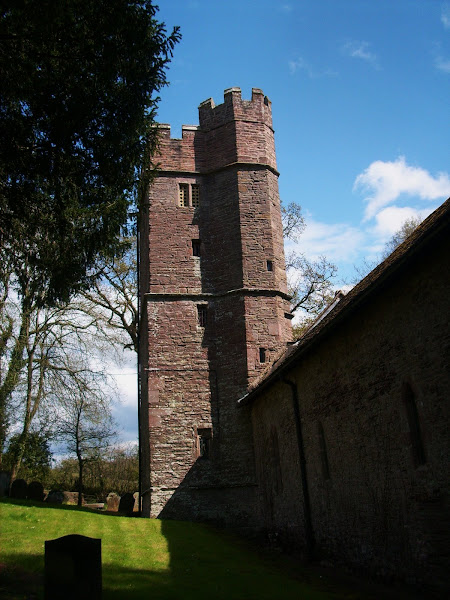
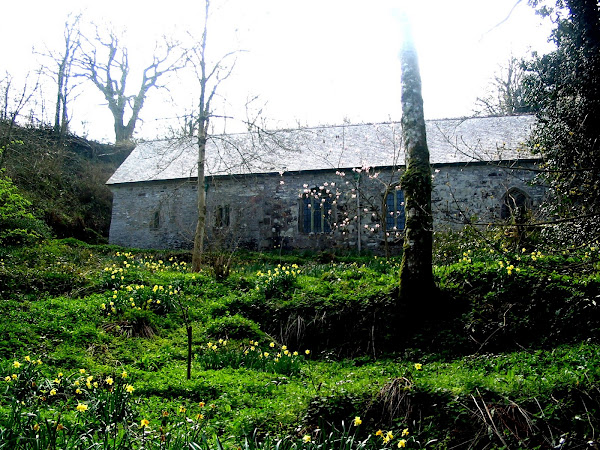
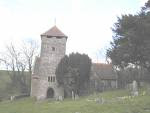
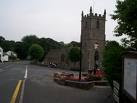
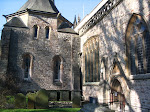
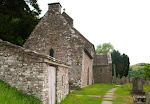
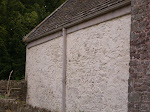
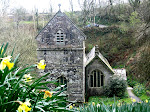
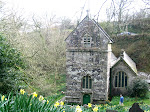
St Cadocs 13th century tower, with curved wall in front
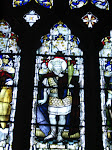
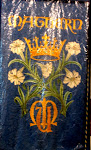
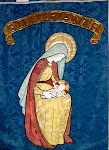
Arms of Saint Cadoc
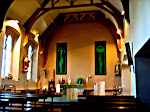
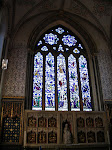
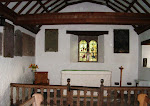
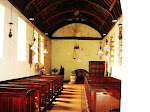
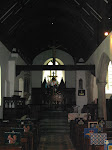
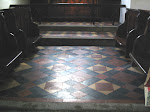
Nave looking through to sanctuary
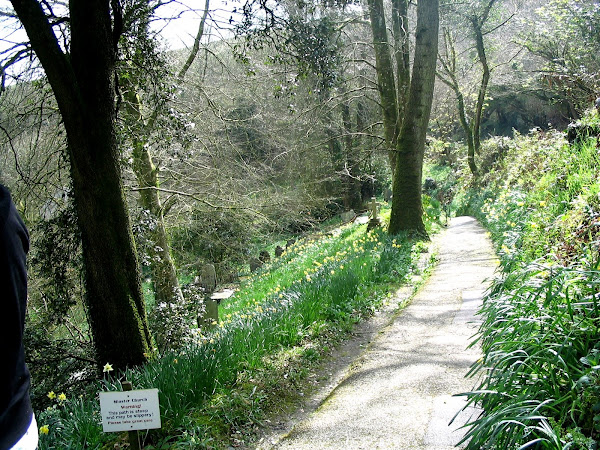
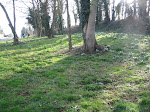
Graveyard


There are so many old monastery sites in Gwent, it is difficult to visit them all, but I am always pleased to be able to get inside the churches that now remain on the site. To look upon the Ecclesiastical Map of Monmouthshire by Dr David Williams at the Gwent Record Office, is to be proud of the Christian settlements in these places at a time, most people call 'Dark Ages'. Yet their witness, their light shone, even in the darkest of times The Martyrdom of so many saints bears witness to the savagery of the times, the civil wars between some of the chiefs and petty kings.
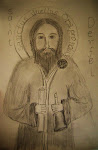
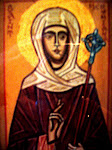
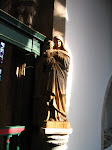
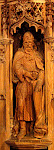
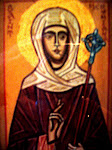
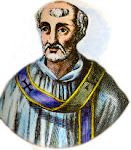
Saint Tathyws
According to Sabine Baring Gould, Tryddin was the son of the Blessed Saint Anna of Gwent and her second husband Amon Ddu, a chieftain from Ireland. He was overshadowed by his older brother Samson (later St Sampson of Dol). He also had a pet name of Meuthu and in the Lives of the Cambro British Saints, Meuthu/Tryddin was responsible for baptising the infant Cadoc .
Tahyws baptises Cadoc
'He baptised the child,according to the angelic comand,and the exhortation of the Lord 'Love your enemies, do gtood to them that hate you and pray for those whovdespitefully use you so you will besons of my father who is in heaven'.But in the performance of this baptism , divine power deigned to show by a wonderful sign ,how great the boy would be.For when the Man of God Meuthi would baptise the son of Gwynlliw , the servant of the king, named Snaudrentia , being fatigued with their long journey , and in want of water for drink, complained in the hearing of Meuthi, the man of God, alleging that they were obliged daily to carry water on their shoulders from a distance. Meuthi answered them 'Let us all pray to Our Lord Jesus Christ,that he will bestow running water to us, his servants, and to the infant who has been elected to him by his mother's womb'. When prayer was ended a large fountain sprang up , and flowing abundantly effected a river , which, being done, and all persons exalting and praising God, the Blessed Meuthi declared in answer that the 'force of the stream had made joyful the city of God'.
Further when a young woman brought the child to the fountain to be baptised,he leapt from her arms into the fountain, which miracle the divine goodness performed to make know the Grace of the child, according to the saying written in the psalms 'Bless the Lord in his Angels and his Saints'.
The infant Cadoc, was obviously not a baby as he got into the fountain three times, which indicated the favour of the Trinity to the people looking on. The Vita goes on 'he rendered obedience (to the Trinity), the Father Son and Holy Spirit to whom with all his might and effect he rendered obedience,studying to proceed daily from virtue to virtue , that he might deserve to see the God of all godas in Sion.and when the blessed Meuthi saw him leaping in alone,he rejoiced and with a more ready mind baptised him in the holy fountain, and upon the angelic command,gave him the name of Cathmail.'
Tryddin's Family
Amon Ddu was the second husband of the Blessed Anna of Gwent and Tyrddin's older brother was Samson and Tydecho, .Samson's biographer says of the parents:'Moreover, we certainly know that the parents of the same married couple were court officials of the kings of their respective provinces, as indeed we undoubtedly find it so recorded in other amended transactions of the Samson, and moreover in similar works. Also, I have heard on many occasions at the singing of Mass the individual names of both parents read out at the altar of Samson, among the names of those by whom the offering was made
St Anna and Amwn and the brothers went on to found the monasteries they had promised to. Anna had decided that all her children were to work for the Kingdom of God.'But now that they had started on the journey his mother, they say, spoke her thoughts privately to him and said, ‘The monasteries which, at thy suggestion, are to be founded and the churches which are to be built, not only do I desire, but lovingly embrace, and inasmuch as the time of the intended promise concerning thee draws nigh, we hope, with God’s help, our churches are to be consecrated by thee.’
Then he, as if modestly smiling and assenting ‘some time’ with his hand, dismissed her with his blessing and left in company with his friends, who were going back by a way other than that by which they had come. And he never ceased to urge those novices by warning and exhortation, and explained sweetly and spiritually the parables of the Old and New Testaments.We learn how the early Christian missionaries and saints penetrated deep into the mountains to spread the Word of Christ and the teachings of the Apostles.(As in Acts 2 v 42)Those remained faithful to the teaching of the Apostles , to the brotherhood to the breaking of the Bread and to the prayers.(St Luke) So there was a feeling of Community of Goods here and spirit and the Apostolic Authority.
Building A Monastic Settlement in Old British Style
When the monks or holy women-like Tegfedd and Tecla embarked on their White Martyrdom and left home and family to where God would take them, they had infinite trust in God. Monasteries were places of spiritual combat. Prayer and Fasting being the main weapons and also the body of Christ equipped with the Grace of the Sacraments and strengthened by the Holy Mass, the Lord Jesus himself in form of Bread and Wine.
Life is A Pilgrimage-the Old British Way
Life itself is a pilgrimage. A pilgrimage is a physical journey which is a metaphor for a spiritual journey; the conversion it represents is a never-ending one. This pilgrim reminds us that reaching the physical goal of a pilgrimage is not necessarily reaching the end of your own spiritual pilgrimage.
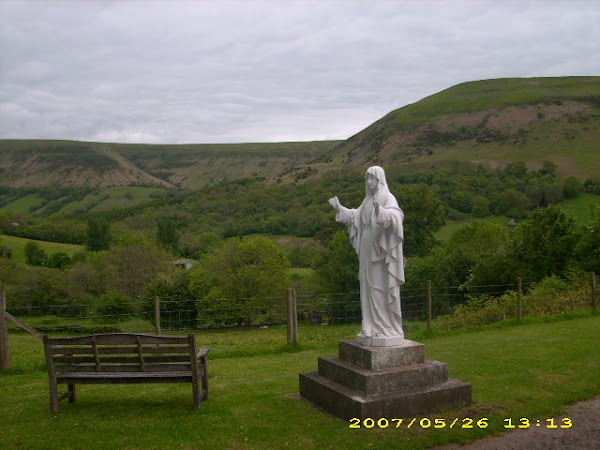
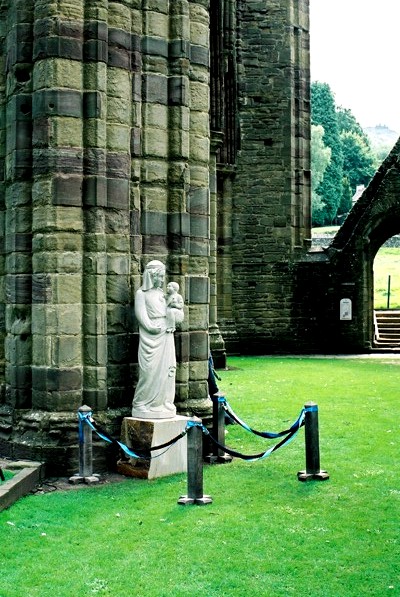
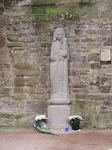
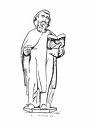
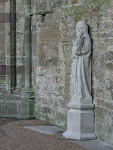
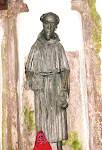
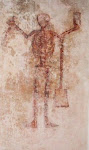
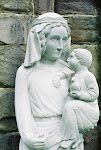
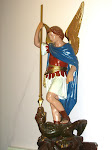
The journey within, the growing more Christ like is a difficult task. As one enters more deeply into the inner journey and become closer to God, you will face monsters, trials and tribulations and come closer to the true meaning of life -- to live in the spiritual green desert and to be face to face with God. One who has achieved such a transformation dies to the past and to all but the eternal present, living in harmony with the Divine. In this statue, we are reminded of the heart of the monastic tradition: one must die in order truly to live on the pilgrimage of life.
We are all pilgrims in this world, and the British saints and their journeys remind us that each place we are in calls us to be transformed, while each journey we make takes us deeper into that one special place where we are most at home. Although it seems that the Celtic saints wandered in an aimless way, they believed that in the end their goal would be found -- finding their place of resurrection, that place where they would cross from this world to the next.
In British style monasticism, the notion of boundaries becomes all important, and the architecture of the monastery was designed to mark off the boundaries between this world and the next. Thus, a physical location itself, a place, could mark out for one a spiritual journey or transformation. Just as the continuous wandering of the saints was literally a physical journey of movement symbolizing the immobile stability of the journey within, a physical place was metaphorically a spiritual journey. Celtic monasteries were built on holy ground.
Pont y pwl or Poul (Pontypool) north of Newport
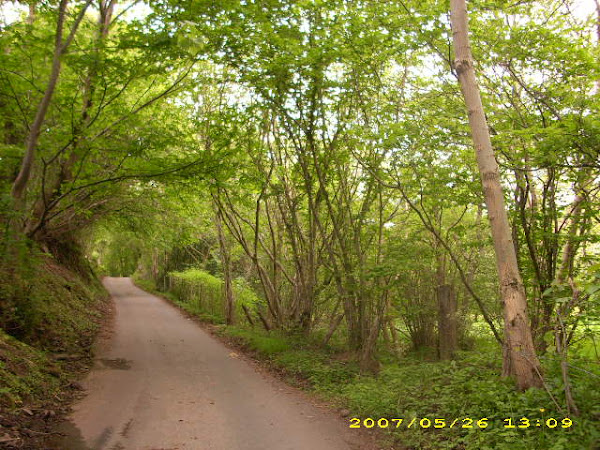
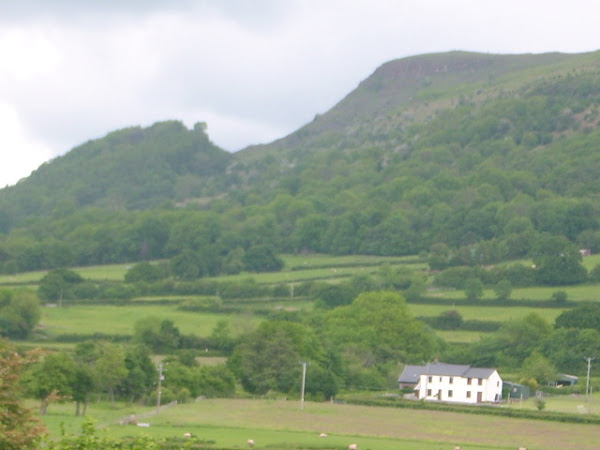
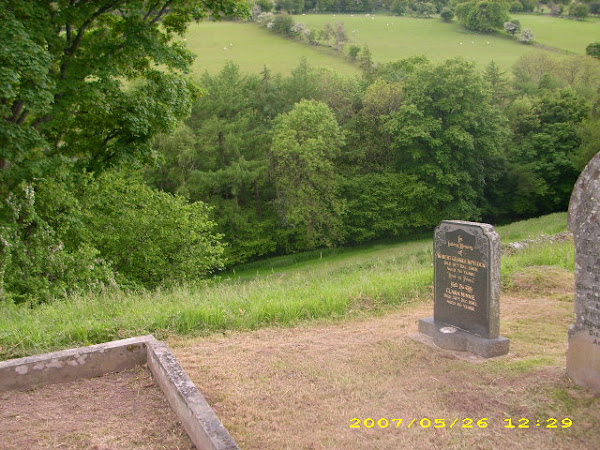
If you visit Pontypool and take the mountain road leading to the lower slopes of the Mynydd Maen, you eventually come to an extremely large, circular churchyard, a sort of large island on the hillside. Paths ran across it. in fact there are many Celtic style grave monuments in this lovely churchyard. When I visited the trees and ground were fragrant. It is so rewarding seeing such a brilliant churchyard(as churchyards go that is) At the top of the hill a 13th century tower stands up proudly witnessing to the centuries past and that and the rest of the church standing for the eternal values of the Church.

Building a British Monastic Settlement
We learn how the early Christian missionaries and saints penetrated deep into the mountains to spread the Word of Christ and the teachings of the Apostles.(As in Acts 2 v 42)The Bishops appointed by the Apostles remained faithful to the teaching of the Apostles , to the brotherhood to the breaking of the Bread and to the prayers.(St Luke) So there was a feeling of Community of Goods here and spirit and the Apostolic Authority. It was Peter who made the decision that non Jewish Christians did not need to be circumcised. Even Paul (Acts 15)presents his plans to Peter in Jerusalem before acting on them. All recognised his authority. Furthermore he chose further delegates to go to the non Jewish churches in person These were Judas and Silas who were charged with the Apostolic message-and ‘Apostolo’ means ‘One who is sent’. It was a discipline which found a heart in the lands of the pre Saxon Britons in the monastic settlements.
On their many missionary journeys, their pilgrimage was not just for their own sake but also the sake of openly and fearlessly proclaiming the teaching of the Apostles and Holy Scripture.Gospel. Sometimes they were accompanied by small bands of followers. Monasteries were places of spiritual combat. Prayer and Fasting being the main weapons and also the body of Christ equipped with the Grace of the Sacraments and strengthened by the Holy Mass, the Lord Jesus himself in form of Bread and Wine.
Founding a Monastery-The Ritual
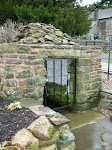
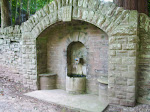
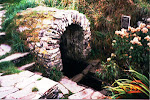
When the monks found a site, their first task was a lot of gardening. They had to clear the site of all brushwood and weeds and stones and also needed to be exorcised and spiritually cleansed-important in case demons were lurking there after devilish practices. Seven weeks of prayer and fasting accomplished this (as Sundays were not included) Many of the monasteries also needed to re-consecrate the ancient wells for baptism .
Buildings
Certainly at first there were no big stone buildings, just a cluster of mud and wattle huts around a church, generally built of wood with a roof made of rushes. This of course, made them particularly vulnerable to fire. The enclosed small settlement-in the case of Trevethin, quite a large one,would be called a llan or holy place. Small handbells were rung to call the monks into church and services were said, and sung to the accompaniment of harps and –in Latin-the language used by the Church throughout Europe.

 _
_
There is an interesting chapter on these Celtic bells in More Mysterious Wales by Chris Barber (0-7153-8736-7 p 179)He quotes St Bede:
When the bell begins to toll, Lord have mercy on the Soul!
He writes 'During the Middle Ages, the bell relics of the Celtic Christian Church founders were highly revered, but unfortunately very few of these bells have survived' Gerald the Welshman made a comment about belief in the bells
...but the laity and clergy in Ireland and Scotland and Wales , held in such veneration certain portable bells , that they were more afraid of swearing falsely by them than by the gospels, because of some hidden or miraculous power with which they were gifted; and by the vengeance of the saint, to whom they were particularly pleasing, their despisers and transgressors were severely punished'.
These small handbells were often given as gifts-such as the bell given to St Teilo, for example.The monks spent a great deal of time growing food or their own survival, so farming was a big part of their daily task.Other tasks they undertook were woodwork, metalwork and weaving, everything they could do to meet the needs of the community. Teachers and scholars gave instruction in the Holy Scriptures, which the Church had compiled, geometry, grammar, bardic literature and all aspects of philosophy-rhetoric, logic etc.
The Venerable St Bede
Bede, writing later on in the tenth century gives us more information. He tells us, when the founder with his followers arrived at their ground they were to make holy,
they would remain there in constant prayer for forty days and nights. They would eat only a small amount after sunset and on Sundays when a small piece of bread, one egg and a little water would be consumed. At the end of that period, the place became the property of the holy man and was called henceforth after his name.
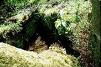
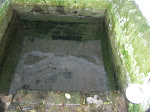
The place literally became holy ground, sanctified by prayer and sacrifice of the holy men. The churches were situated-as at Trevethin, near wells or mountain streams (the Afon Lwyd runs by there down into the valley and while I believe this translates as Lloyd’s stream, in fact it used to be called the ‘crushing stones’ river-or Tor faen.) The wells were later used for baptisteries and regarded as holy, in some cases, being regarded as God working his healing power through the water, as well as providing the water for the holy Sacrament of Baptism. There is a great deal of water imagery connected with the Christian faith as a result.
Food and Drink
Even on Sundays they only received bread, a hen’s egg and a little milk. The monks prayed constantly wrestling with the forces of evil . They prayed constantly to God and his saints, especially asking the Archangel Michael to pray with them for spiritual regeneration and cleansing from evil.
Everyday Life
.Life then settled into a routine of prayer, manual labour and study. There would be a noviatiate (students)and a constant stream of poor people and other visitors, begging for food and shelter. I have mentioned before in my post on Pater Ishow of Nant Mair, that the monks practised footwashing, but if a guest accepted this he would be staying for the night. If he did not, he only wanted a meal.
These students (Ignatius of Antioch studied with St John for example) show us what the early church was like, undeniably, the reason why Cadoc made seven trips to Rome during the reign of seven popes! The ancient British saints kept in close contact with what was happening there, and the progress of the whole church. We have seen how King Meurig was named after the Roman Saint Maurice (or San Moritz) for example, and Tewdrig and Tewdwr named after Saint Theodore shows a strong identity with the church as a whole.
St Martin of Tours
Showing love to strangers was important, especially giving food to the needy, shelter to the dispossessed and clothing the naked. The cult of St Martin of Tours who in freezing cold tore his cloak in half to give half to a beggar, is also told of St Cuthbert, of whom a strange tale is told, that he looked after a frozen youth, rubbing his feet and immersing them in warm water until the eeling came back. When he returned with food there was no sign of him, and no footprints in the snow. There was the teaching, ‘stay awake as you will never know when your Lord will come’ and also ‘Show your love to strangers , for thereby some have entertained angels unawares’.
The Psalms, The Liturgy of the Hours and The Mass, The Sacraments

The students were expected to know all the psalms by heart. On their frequent trips to other monasteries, they would recite the psalms as they walked, so that they learnt them quickly. Often they would be tested and would need to repeat it back, and the prior would recite it with them if they faltered. They would certainly learn the meaning of the Latin and a Liturgy of the Hours , already in circulation. The principal teacher of the monastery would teach as he walked along with his students.
We have seen Baptism as the washing clean from sin, the water and Holy Spirit being the active energy for this. St Paul baptised whole households. He referred to Baptism as ‘the new circumcision (carried out at 8 days in the Jewish faith) Babies were always baptised, especially at a time of high infant mortality. Their parents and godparents having the duty of training them in catechesis, so that at the right time, they could complete the initiation process by themselves affirming themselves as warriors for Christ as adults, being anointed by the Bishop-appointed in a line down from the Apostles.
Reconciliation with God, Penance, Confession
Penance, we have discussed too, and confession. How in the early church people could be asked to do penance only once if they had done a terrible and mortal sin-like murder or adultery for example. They would stand outside the church in sackcloth and ashes and only be received back into ‘The Mystical Body of Christ '(Eucharist or Holy Communion) when they had expressed enough remorse and only at the Easter Vigil with new initiates. Later the practice of individual confession was accepted after the Brythonic Celtic fashion into the mainstream of the church through the beautiful old British idea of the ‘soul-friend’ which had existed in the culture of the Celtic peoples before Christianity, but was so completely in tune with Christian practice. A soul friend (or soul mate we might say today) is so completely spiritually in tune with another, that they tell each other their spirtual burdens and using Christ’s promise through Peter of forgiving sins, did this for each other. The holy Irish monks in particular, and David, Teilo and Padarn who preached in Jerusalem itself were so successful at evangelisation and introduced this concept, so that by the twelfth century it was adopted by the whole church.
Matrimony
Amongst the Christian rulers of South Wales this was adopted readily enough, but not by all as Gildas tells us. He names many of the Chieftains of the British as ‘Tyrants’ except for Ambrosius, of Roman extraction and brother of Uther. He nearly has apoplexy about the behaviour of Guorthogern ( Vortigern) who, in order to retain power, invited pagan warlike Saxons into Britain, but had many ‘wives’ and then ‘married’ the daughter of Hengist, finally bedding and having children by his own daughter! Not all of the chieftains went to these lengths, but they were certainly not Christian in fact (apart from Ambrosius and later, perhaps Arthur, who carried an image of the Virgin Mary on his shoulders as he began his battles). Most of the chiefs were criticised for their multiple wives and their cruelty and wickedness by Gildas, particularly to the poor and vulnerable. The British chieftains supported their monasteries as an insurance policy it seems, as they did not let Christian scruples cramp their style to Gildas disgust!.
Holy Orders
Presbyters or priests were ordained by their bishop by the laying on of hands, after much study-in later times at the great theological colleges which sprang up under Dubricius at Caerleon, under Tatheus at Caerwent and Illtyd at Llancarfan. They were always consecrated on the feast of St Peter’s Chair in more or less the same way as today. Bishops often studied and were consecrated at Rome or Jerusalem, where they would hear all the latest news. We know from the Book of Kells there was great skill in some places in the making of Gospel books and their decoration. We will have a look at some of this later on. Unfortunately only the book of Kells seems to have survived, possibly because the books were not burned by Saxons and Danes and Iona and Dublin seemed safer places to house them. Almost all the written material from St David’s was burnt in Viking raids.
Death Rites-‘Extreme Unction’
The anointing of a dying person, giving them Christ in the form of Holy Comunion and anointing as a Christian soul, to speed them on their journey to the heavenly kingdom is still in force today, but combined in a ministry to strengthen the sick, acknowledging that in God’s mercy and sovereignty, recovery is always possible
Burials
Christian souls were always buried whole, facing East towards Jerusalem, where they would see the Holy City when they arose at the Judgement. Cremation was the more usual form of Druid rites. Often the bodies of very holy saints , would be disinterred after a number of years and the bones divided as relics and shared out among the devotees of the saints for their churches. They would be buried in the altar of every new church or kept for veneration. I have talked about relics before in great detail both on the podcast and below in the post on relics.
All these sacraments (outward signs of inner spiritual grace) showed an age of faith , with many saints undergoing martyrdom, though sadly not as many as today.
The great Yellow Plague that came over the whole island of Britain wiped out whole communities. It is believed in Gwent that only Meurig survived from the sons of Tewdrig for example.Sadly this was also the case of some of the monastic settlements.
We have looked at some other Gwent monastic settlements, Llangwm Isaf, Llangwm Uchaf, Llanarth,Llandegfedd, Mamhilad, Llanoronwy, Bedwellty and they all, throughout the whole of Britain roughly held to this pattern.There are still some to visit and some holy men of South Wales to talk about.
My Visit

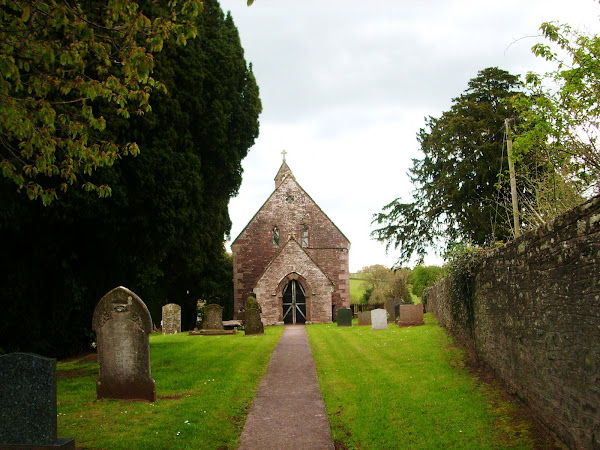
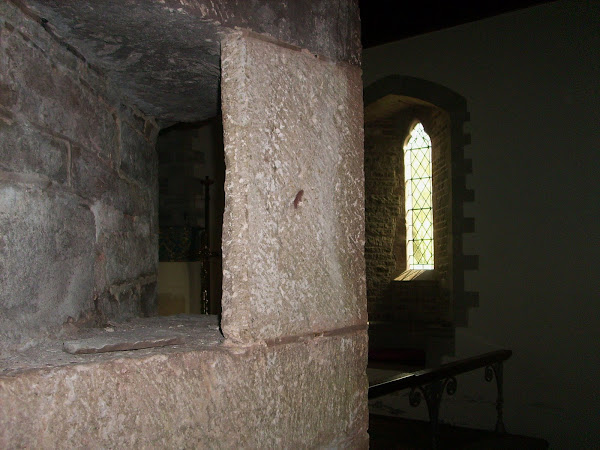
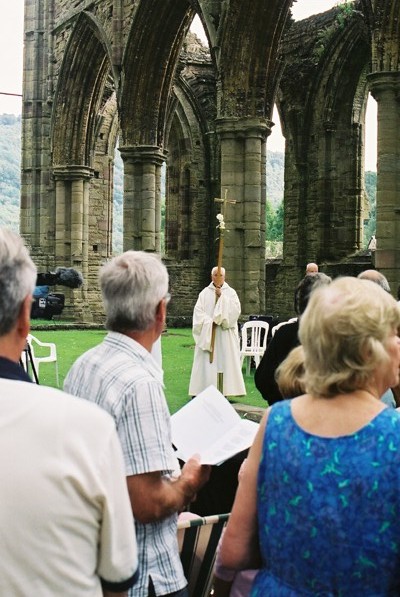
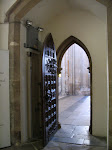
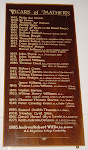
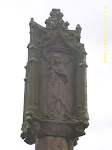
Visiting Trevethin on a bright June day in 2008, what was noticeable was that the wall around the ancient ‘llan’ enclosure is still there, and still hallowed after all these centuries. The place where I stood, is still holy. A large preaching cross stood outside the church building, although I am unsure of its age. There is evidence on the outside that it was still in use until the age of the Conquest, but the church rebuilt in the thirteenth century, incorporating a tower. So by the end of Saxon times, it may have been a small stone church, but in disrepair, possibly being built up under the auspices of Usk or Abergavenny Benedictines.The first known reference to the Church was in the Norwich taxation of 1254 when it was valued at 40shillings. The Church at that time was a chapel, as I said, serviced from Llanover with priests.It did not have its own vicar until 1843 when it had become an Anglican church and the home for the first incumbent later became the Masons Arms public house over the road. In 1866 Trevethin became a separate parish . By 1846 it was being rebuilt and the mediaeval tower raised by 8 feet and a large window added, as well as space for extra seats.
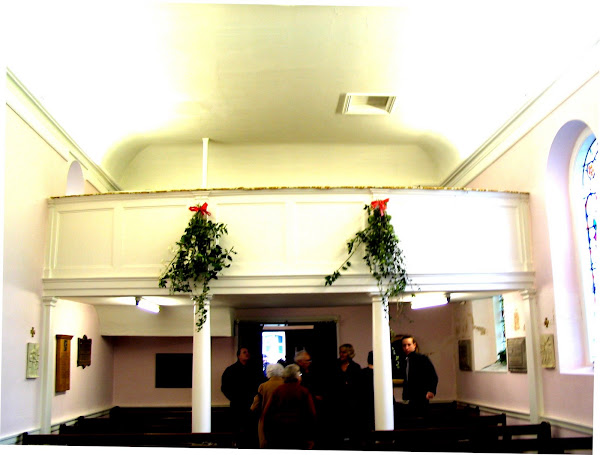
Certainly when I entered the church, it seems to be spacious and some renovation work is being carried on to the floors. I was surprised to see the size of the Church. This was the most ancient parish of Trevethin, which encompassed most of Pontypool at one time. (see map).
The Window of the Sanctuary

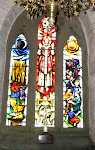
Looking down to the altar, I could certainly see that the church seemed to show the life of the surrounding people and its sufferings. The large altar window depicting a terrible tragedy in the history of the town. Capel Hanbury Leigh sunk the Glyn Pits in the early 1840’s to a depth of 190 yards The pits used steam powered winding engines.Four men were died as a result of explosion here on June 1st, 1864. The cause was attributed to a length of timber left propping open an air-door by the young door-boy. The dead were; Henry Vaux, who died instantly, John Stephens, John Thomas and William Hill died later of their injuries. Another two were killed by a roof fall later the same year. An underground explosion occurred here in January 1890 claiming the lives of five miners. The ensuing fires were so fierce that the mine had to be flooded. The bodies of the five miners were never recovered. They were James, Spear, a married man of Pontnewynydd (41), Frederick Turner,(39) an unmarried man from Tranch,David Lloyd (29) a married man of Nightingale,Arthur Mills (18) of Chapel Lane, Pontypool, and Henry Price (18) of Bell Inn Pontypool.
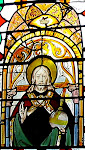
Whilst the damage was being repaired, many of the men went to work at the nearby Llanerch colliery, where just nine days later 176 men and boys were killed in another explosion, some of the victims being Glyn miners. The beauty of the window is a fitting memorial to their lives and contrasts with the manner of their terrible deaths, keeping them safe in the memory of the holy space if the church. Also in the Sanctuary is the little window depicting Christ as the Lamb of God, whose promise has united heaven and earth for believers.
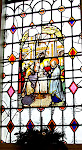
The beautiful stained glass shows Christ ministering to figures in distress and in the tracery you can see angels with musical instruments and a crown of immortality.
The Hanbury Family Pew (left of the sanctuary)
The Hanbury Family
 __
__
The Hanbury family of Pontypool traces its descent from Richard the third son of John Hanbury (fl. temp. Edw. IV) of Hanbury in Worcestershire. Richard Hanbury (d. c. 1608), the great-grandson of the Richard above, was an ironmaster in Staffordshire and in about 1570 started similar works at Monkswood and Pontymoel in Monmouthshire. The Pontypool forge passed to his half-brother, also called Richard Hanbury (1548-1613. His son John Hanbury (c. 1574-1658) was a royalist and compounded for his estates in 1649.

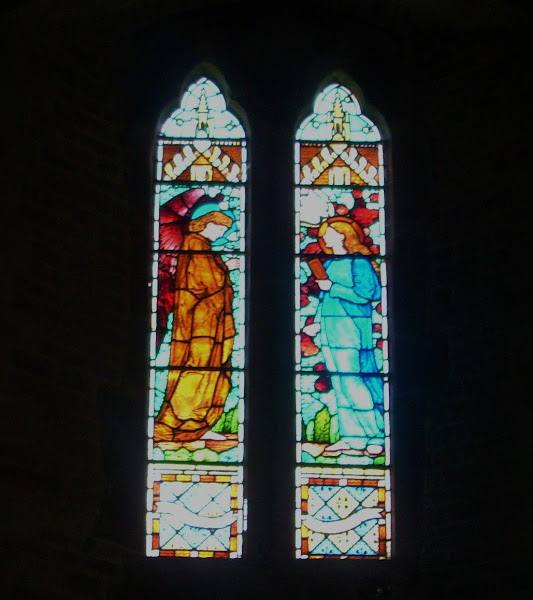
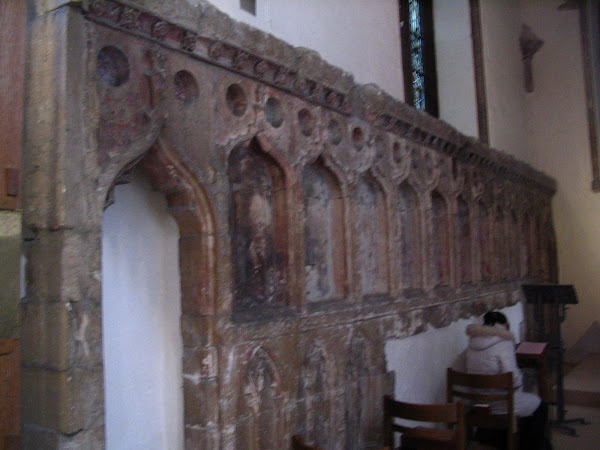
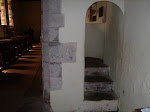
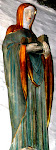
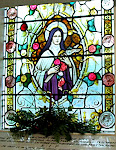
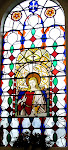
The Hanbury pew is accessible via a few steps , and underneath is a vault where many of the the Hanbury family are buried. Dominating them are two exquisitely lovely stained glass windows. Four windows in all identifying the kindness of the female members of the Hanbury family with the female saints of the church . These are very lovely, and I was much taken with them.
There are two marble busts, the larger is of John Hanbury who died in 1734 and introduced the manufacture of tinplate. He moved to Pontypool and enclosed 158 acres to create a park and mansion which was later sold to the Church to build a Convent School, taught by the Daughters of the Holy Spirit, nuns who had come from Saint Brieux in Britanny and created convents all over Gwent with the help of Lady Augusta Hall, a prominent Catholic, who lived at Llanover . This school, the story of which I shall tell later, is now the St Alban’s Catholic School.
Eagle Lectern
This has been beautifully carved by a parishioner, and behind the pulpitum is a window showing John the Baptist, which was a gift from the architect who restored the church for the Church in Wales in 1846.
Elizabeth Catherine Williams
She played the organ here for forty eight years and the window in the belfry shows King David with his harp and St Cecilia at the organ.
The Stations of the Cross Via Dolorosa

This is a devotion usually undertaken during Lent, at a time of sorrow for sins. We follow each step of Jesus’ walk to his crucifixion through the streets of Jerusalem and beyond. To pray these only requires you to meditate on each step, but you can say ‘We adore you O Christ and we praise thee.Lord by your Cross and Resurrection you have redeemed the world. After each station, say an Our Father, Hail Mary and Glory be. ‘These stations of the Cross are beautiful, traditionally carved and all around the church.
The Font
The nineteenth century font is near the doorway (represents the entrance into the life of the Church) and a baptistery concealed underneath!
War Memorial Chapel
 -
-
Beautiful decorated in this Chapel to the right of the Chancel where the Monmouthshire Regiment have their memorials. This was formed in 1923 from the former Organ chamber. It is separated from the church by a wooden screen , where the men from the parish, who died in two world wars can be found. The west window dates back to the sixteenth century and was formerly in the Sanctuary over the altar table. The centre of the window shows the Nativity , Crucifixion and Resurrection of the Lord Jesus, keeping it in the mind of worshippers-such things were powerful visual aids.
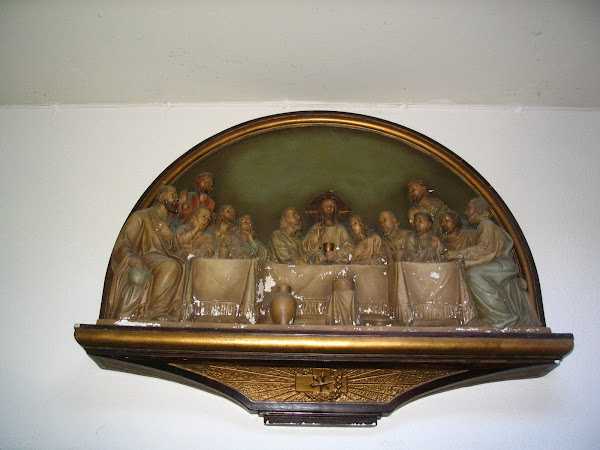
On the sides, there is an image showing the institution of the Eucharist-(the Breaking of the Bread-the Lord’s Supper) and on the other, the scene on top of the mountain, where Jesus lit up like a fibreoptic lamp and was glorified in front of his trusted apostles talking to Moses and Elijah, prompting Peter to say ‘You are the Christ, the Son of the Living God’. This scene is called the ‘Transfiguration’ and to be found in the Bible. It would remind people that Christ was God as well as man.

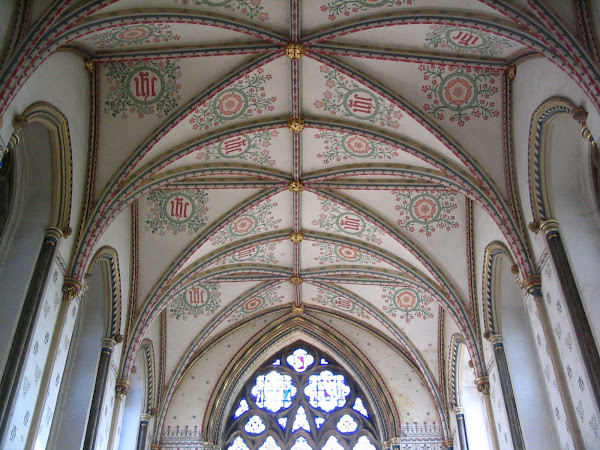
In the other window St David and St Cadoc are shown on either side of Christ.The Monmouthshire Coat of Arms and badge of the battalion can be seen on either side of the lights. The memorial has an exquisite Reredos or back panel to the altar table and a sacred vine emblem runs along the top and this represents Jesus. The back of the altar (Reredos) includes three plaques with the letters IHS (Jesus Hominum Salvator-Jesus the Saviour of Man) There are four angels holding the tools of the Wounds of Christ.Over the panels are also written the words: Gwell Angau Na Gwarth. (Better death than Dishonour)
 _
_
A Prayer from Early Britain
JESU, THOU SON OF MARY
Jesu, Thou Son of Mary
Have mercy upon us,
Amen.
Jesu, Thou Son of Mary,
Make peace with us,
Amen.
Oh, with us and for us
Where we shall longest be,
Amen.
Be about the morning of our course,
Be about the closing of our life,
Amen.
Be at the dawning of our life,
And oh! at the dark'ning of our day,
Amen.
Be for us and with us,
Merciful God of all,
Amen.
The St Cadoc Dedication
Meuthu and the Holy St Anna may have originally founded the settlement. However as I wrote in my post about Mamhilad ( a church I could not get into) the body of Cadoc was brought to Mamhilad after Llancarfan was in danger of being ransacked by Saxons. The original dedication of Mamhilad monastery was to St Illtyd who had either taught there, or monks trained by him had founded it.

The Vita Cadoci says:
After the departure of the most gracious Cadoc from transitory to eternal things, a certain very powerful Saxon noble , named Eilaf came into the country of Glamorgan with a very arge company of attendants , for the purposes of plundering and destroying ; and the clergy of the celebrated Cadoc having heard an account of his impiety, fled from Llancarfan with the coffin of the holy man , and other relics bearing the means for their protection, until they came to the place Mammeliat and there they hid themselves. And when they had been there a short time a multitude of the Saxon and Viking robbers came to them, who beholding the coffin sought to take it with them.’There was a miracle as the man who tried to strike a pinnacle from the reliquary fell down dead!(trans W.J.Rees Life of St Cadoc 37) The rest of the story is told in the post about Mamhilad in the earlier post.
There is no evidence that Cadoc’s coffin ever left Mamhilad from his ‘Vita’(Life) and although various theories have been put forward, here is one more. Mamhilad may or may not have been the final resting place of Cadoc, but the settlement is much larger at Trevethin. And there is a Holy Well on the route they would have chosen. Perhaps.... his body was taken here, and that is the name given to the Church forever after. No one knows for certain, but it is possible that the relics or body of Cadoc rests quietly up here under the trees at Trevethin. There is always a reason why churches were dedicated to certain saints, and I am sure that St Tathyws who baptised him would not mind! There is indeed some mystery about where Cadoc was buried, but I think either Mamhilad or Trevethin must be the place. There is no evidence of the coffin being moved after arriving at Mamhilad. St Cadoc was a 'Red Martyr', killed by Saxons for the faith and should be commemorated more, having founded so many Christian settlements in Gwent.
A new book ‘Cadoc’ is available for sale from Amazon UK
Thanks
I would like to thank Canon Pippin so much for showing me around this beautiful church,at short notice told me about its work and allowing me to take the photographs.

The Wisdom of St Cadoc
Cadoc was known as 'The Wise'
Without knowledge, no God.
No man is the son of knowledge if he is not also the son of poetry.
The best of attitudes is humility;
the best of occupations, work;
the best of sentiments, pity;
the best of cares, justice;
the best of pains, that which a man takes to make peace;
the best of sorrows, sorrow for sin;
the best of characters, generosity.
Truth is the elder daughter of God.
No man loves poetry without
loving the light,
nor light without truth,
nor truth without loving God.
The best of patriots is the man who tills the soil.
No man is pious who is not cheerful.
There is no king like him who is king of himself.
Loving is Heaven; hatred is Hell.
Conscience is the eye of God in the soul of man
The best of all is that Canon Pippin and the men and women of Trevethin , every year do what Cadoc and his monks did-they feed the hungry clothe the naked and look after the sick in Africa by raising £5 or £6 thousand pounds a year to help the less fortunate in Africa.!
 ____________________________
The LEgend of the Trevethin Bell
The bell pictured above is not the Trevethin bell-just a picture of such a bell.
In the middle Ages, there used to be a Church bell, here at Trevethin with amazing power. It was a gift to the church by Llewellyn ap Iowerth, Lord of Caerleon (who aslo helped to found the Cistercian monastery at Llantarnam)
One day, a child climbed into the belfry to see the bell, but was struck dead by it. The people of the church were so appalled by this that they took the bell down and buried it in the churchyard.
Chris Barber, who recounts the story , adds, 'Ever since that day, if a child in the parish is accidentally killed, the Bell of St Cadoc's can be heard tolling mournfully beneath the ground!
Request your prayers and rosaries :
Lastly,your prayers are requested for Pat my friend who died last week, and for Mary in her time of trial.God Bless them both.
I am not a trained historian, but an enthusiast for bringing to life our Christian life in Gwent.I can only give you the story from the evidence and sources I have seen. Please tell your friends to visit the site and tell the stories to their children, perhaps something of this Age of Saints will touch them and plant a seed,to help them reverence the holy ground of their forefathers.
Christ is not history. Christ is here and now and forever, and replanting the roots, may help to lead people back to his door and his Way.
The model photo of an old British style monastery is by Dr Deborah Vess.You can just see Trevethin like this.Dr Vess has a beautiful site on 'Celtic Monasteries'.
St Cadocs 13th century tower, with curved wall in front
Arms of Saint Cadoc
Nave looking through to sanctuary
Graveyard


There are so many old monastery sites in Gwent, it is difficult to visit them all, but I am always pleased to be able to get inside the churches that now remain on the site. To look upon the Ecclesiastical Map of Monmouthshire by Dr David Williams at the Gwent Record Office, is to be proud of the Christian settlements in these places at a time, most people call 'Dark Ages'. Yet their witness, their light shone, even in the darkest of times The Martyrdom of so many saints bears witness to the savagery of the times, the civil wars between some of the chiefs and petty kings.
Saint Tathyws
According to Sabine Baring Gould, Tryddin was the son of the Blessed Saint Anna of Gwent and her second husband Amon Ddu, a chieftain from Ireland. He was overshadowed by his older brother Samson (later St Sampson of Dol). He also had a pet name of Meuthu and in the Lives of the Cambro British Saints, Meuthu/Tryddin was responsible for baptising the infant Cadoc .
Tahyws baptises Cadoc
'He baptised the child,according to the angelic comand,and the exhortation of the Lord 'Love your enemies, do gtood to them that hate you and pray for those whovdespitefully use you so you will besons of my father who is in heaven'.But in the performance of this baptism , divine power deigned to show by a wonderful sign ,how great the boy would be.For when the Man of God Meuthi would baptise the son of Gwynlliw , the servant of the king, named Snaudrentia , being fatigued with their long journey , and in want of water for drink, complained in the hearing of Meuthi, the man of God, alleging that they were obliged daily to carry water on their shoulders from a distance. Meuthi answered them 'Let us all pray to Our Lord Jesus Christ,that he will bestow running water to us, his servants, and to the infant who has been elected to him by his mother's womb'. When prayer was ended a large fountain sprang up , and flowing abundantly effected a river , which, being done, and all persons exalting and praising God, the Blessed Meuthi declared in answer that the 'force of the stream had made joyful the city of God'.
Further when a young woman brought the child to the fountain to be baptised,he leapt from her arms into the fountain, which miracle the divine goodness performed to make know the Grace of the child, according to the saying written in the psalms 'Bless the Lord in his Angels and his Saints'.
The infant Cadoc, was obviously not a baby as he got into the fountain three times, which indicated the favour of the Trinity to the people looking on. The Vita goes on 'he rendered obedience (to the Trinity), the Father Son and Holy Spirit to whom with all his might and effect he rendered obedience,studying to proceed daily from virtue to virtue , that he might deserve to see the God of all godas in Sion.and when the blessed Meuthi saw him leaping in alone,he rejoiced and with a more ready mind baptised him in the holy fountain, and upon the angelic command,gave him the name of Cathmail.'
Tryddin's Family
Amon Ddu was the second husband of the Blessed Anna of Gwent and Tyrddin's older brother was Samson and Tydecho, .Samson's biographer says of the parents:'Moreover, we certainly know that the parents of the same married couple were court officials of the kings of their respective provinces, as indeed we undoubtedly find it so recorded in other amended transactions of the Samson, and moreover in similar works. Also, I have heard on many occasions at the singing of Mass the individual names of both parents read out at the altar of Samson, among the names of those by whom the offering was made
St Anna and Amwn and the brothers went on to found the monasteries they had promised to. Anna had decided that all her children were to work for the Kingdom of God.'But now that they had started on the journey his mother, they say, spoke her thoughts privately to him and said, ‘The monasteries which, at thy suggestion, are to be founded and the churches which are to be built, not only do I desire, but lovingly embrace, and inasmuch as the time of the intended promise concerning thee draws nigh, we hope, with God’s help, our churches are to be consecrated by thee.’
Then he, as if modestly smiling and assenting ‘some time’ with his hand, dismissed her with his blessing and left in company with his friends, who were going back by a way other than that by which they had come. And he never ceased to urge those novices by warning and exhortation, and explained sweetly and spiritually the parables of the Old and New Testaments.We learn how the early Christian missionaries and saints penetrated deep into the mountains to spread the Word of Christ and the teachings of the Apostles.(As in Acts 2 v 42)Those remained faithful to the teaching of the Apostles , to the brotherhood to the breaking of the Bread and to the prayers.(St Luke) So there was a feeling of Community of Goods here and spirit and the Apostolic Authority.
Building A Monastic Settlement in Old British Style
When the monks or holy women-like Tegfedd and Tecla embarked on their White Martyrdom and left home and family to where God would take them, they had infinite trust in God. Monasteries were places of spiritual combat. Prayer and Fasting being the main weapons and also the body of Christ equipped with the Grace of the Sacraments and strengthened by the Holy Mass, the Lord Jesus himself in form of Bread and Wine.
Life is A Pilgrimage-the Old British Way
Life itself is a pilgrimage. A pilgrimage is a physical journey which is a metaphor for a spiritual journey; the conversion it represents is a never-ending one. This pilgrim reminds us that reaching the physical goal of a pilgrimage is not necessarily reaching the end of your own spiritual pilgrimage.
The journey within, the growing more Christ like is a difficult task. As one enters more deeply into the inner journey and become closer to God, you will face monsters, trials and tribulations and come closer to the true meaning of life -- to live in the spiritual green desert and to be face to face with God. One who has achieved such a transformation dies to the past and to all but the eternal present, living in harmony with the Divine. In this statue, we are reminded of the heart of the monastic tradition: one must die in order truly to live on the pilgrimage of life.
We are all pilgrims in this world, and the British saints and their journeys remind us that each place we are in calls us to be transformed, while each journey we make takes us deeper into that one special place where we are most at home. Although it seems that the Celtic saints wandered in an aimless way, they believed that in the end their goal would be found -- finding their place of resurrection, that place where they would cross from this world to the next.
In British style monasticism, the notion of boundaries becomes all important, and the architecture of the monastery was designed to mark off the boundaries between this world and the next. Thus, a physical location itself, a place, could mark out for one a spiritual journey or transformation. Just as the continuous wandering of the saints was literally a physical journey of movement symbolizing the immobile stability of the journey within, a physical place was metaphorically a spiritual journey. Celtic monasteries were built on holy ground.
Pont y pwl or Poul (Pontypool) north of Newport
If you visit Pontypool and take the mountain road leading to the lower slopes of the Mynydd Maen, you eventually come to an extremely large, circular churchyard, a sort of large island on the hillside. Paths ran across it. in fact there are many Celtic style grave monuments in this lovely churchyard. When I visited the trees and ground were fragrant. It is so rewarding seeing such a brilliant churchyard(as churchyards go that is) At the top of the hill a 13th century tower stands up proudly witnessing to the centuries past and that and the rest of the church standing for the eternal values of the Church.

Building a British Monastic Settlement
We learn how the early Christian missionaries and saints penetrated deep into the mountains to spread the Word of Christ and the teachings of the Apostles.(As in Acts 2 v 42)The Bishops appointed by the Apostles remained faithful to the teaching of the Apostles , to the brotherhood to the breaking of the Bread and to the prayers.(St Luke) So there was a feeling of Community of Goods here and spirit and the Apostolic Authority. It was Peter who made the decision that non Jewish Christians did not need to be circumcised. Even Paul (Acts 15)presents his plans to Peter in Jerusalem before acting on them. All recognised his authority. Furthermore he chose further delegates to go to the non Jewish churches in person These were Judas and Silas who were charged with the Apostolic message-and ‘Apostolo’ means ‘One who is sent’. It was a discipline which found a heart in the lands of the pre Saxon Britons in the monastic settlements.
On their many missionary journeys, their pilgrimage was not just for their own sake but also the sake of openly and fearlessly proclaiming the teaching of the Apostles and Holy Scripture.Gospel. Sometimes they were accompanied by small bands of followers. Monasteries were places of spiritual combat. Prayer and Fasting being the main weapons and also the body of Christ equipped with the Grace of the Sacraments and strengthened by the Holy Mass, the Lord Jesus himself in form of Bread and Wine.
Founding a Monastery-The Ritual
When the monks found a site, their first task was a lot of gardening. They had to clear the site of all brushwood and weeds and stones and also needed to be exorcised and spiritually cleansed-important in case demons were lurking there after devilish practices. Seven weeks of prayer and fasting accomplished this (as Sundays were not included) Many of the monasteries also needed to re-consecrate the ancient wells for baptism .
Buildings
Certainly at first there were no big stone buildings, just a cluster of mud and wattle huts around a church, generally built of wood with a roof made of rushes. This of course, made them particularly vulnerable to fire. The enclosed small settlement-in the case of Trevethin, quite a large one,would be called a llan or holy place. Small handbells were rung to call the monks into church and services were said, and sung to the accompaniment of harps and –in Latin-the language used by the Church throughout Europe.

 _
_There is an interesting chapter on these Celtic bells in More Mysterious Wales by Chris Barber (0-7153-8736-7 p 179)He quotes St Bede:
When the bell begins to toll, Lord have mercy on the Soul!
He writes 'During the Middle Ages, the bell relics of the Celtic Christian Church founders were highly revered, but unfortunately very few of these bells have survived' Gerald the Welshman made a comment about belief in the bells
...but the laity and clergy in Ireland and Scotland and Wales , held in such veneration certain portable bells , that they were more afraid of swearing falsely by them than by the gospels, because of some hidden or miraculous power with which they were gifted; and by the vengeance of the saint, to whom they were particularly pleasing, their despisers and transgressors were severely punished'.
These small handbells were often given as gifts-such as the bell given to St Teilo, for example.The monks spent a great deal of time growing food or their own survival, so farming was a big part of their daily task.Other tasks they undertook were woodwork, metalwork and weaving, everything they could do to meet the needs of the community. Teachers and scholars gave instruction in the Holy Scriptures, which the Church had compiled, geometry, grammar, bardic literature and all aspects of philosophy-rhetoric, logic etc.
The Venerable St Bede
Bede, writing later on in the tenth century gives us more information. He tells us, when the founder with his followers arrived at their ground they were to make holy,
they would remain there in constant prayer for forty days and nights. They would eat only a small amount after sunset and on Sundays when a small piece of bread, one egg and a little water would be consumed. At the end of that period, the place became the property of the holy man and was called henceforth after his name.
The place literally became holy ground, sanctified by prayer and sacrifice of the holy men. The churches were situated-as at Trevethin, near wells or mountain streams (the Afon Lwyd runs by there down into the valley and while I believe this translates as Lloyd’s stream, in fact it used to be called the ‘crushing stones’ river-or Tor faen.) The wells were later used for baptisteries and regarded as holy, in some cases, being regarded as God working his healing power through the water, as well as providing the water for the holy Sacrament of Baptism. There is a great deal of water imagery connected with the Christian faith as a result.
Food and Drink
Even on Sundays they only received bread, a hen’s egg and a little milk. The monks prayed constantly wrestling with the forces of evil . They prayed constantly to God and his saints, especially asking the Archangel Michael to pray with them for spiritual regeneration and cleansing from evil.
Everyday Life
.Life then settled into a routine of prayer, manual labour and study. There would be a noviatiate (students)and a constant stream of poor people and other visitors, begging for food and shelter. I have mentioned before in my post on Pater Ishow of Nant Mair, that the monks practised footwashing, but if a guest accepted this he would be staying for the night. If he did not, he only wanted a meal.
These students (Ignatius of Antioch studied with St John for example) show us what the early church was like, undeniably, the reason why Cadoc made seven trips to Rome during the reign of seven popes! The ancient British saints kept in close contact with what was happening there, and the progress of the whole church. We have seen how King Meurig was named after the Roman Saint Maurice (or San Moritz) for example, and Tewdrig and Tewdwr named after Saint Theodore shows a strong identity with the church as a whole.
St Martin of Tours
Showing love to strangers was important, especially giving food to the needy, shelter to the dispossessed and clothing the naked. The cult of St Martin of Tours who in freezing cold tore his cloak in half to give half to a beggar, is also told of St Cuthbert, of whom a strange tale is told, that he looked after a frozen youth, rubbing his feet and immersing them in warm water until the eeling came back. When he returned with food there was no sign of him, and no footprints in the snow. There was the teaching, ‘stay awake as you will never know when your Lord will come’ and also ‘Show your love to strangers , for thereby some have entertained angels unawares’.
The Psalms, The Liturgy of the Hours and The Mass, The Sacraments

The students were expected to know all the psalms by heart. On their frequent trips to other monasteries, they would recite the psalms as they walked, so that they learnt them quickly. Often they would be tested and would need to repeat it back, and the prior would recite it with them if they faltered. They would certainly learn the meaning of the Latin and a Liturgy of the Hours , already in circulation. The principal teacher of the monastery would teach as he walked along with his students.
We have seen Baptism as the washing clean from sin, the water and Holy Spirit being the active energy for this. St Paul baptised whole households. He referred to Baptism as ‘the new circumcision (carried out at 8 days in the Jewish faith) Babies were always baptised, especially at a time of high infant mortality. Their parents and godparents having the duty of training them in catechesis, so that at the right time, they could complete the initiation process by themselves affirming themselves as warriors for Christ as adults, being anointed by the Bishop-appointed in a line down from the Apostles.
Reconciliation with God, Penance, Confession
Penance, we have discussed too, and confession. How in the early church people could be asked to do penance only once if they had done a terrible and mortal sin-like murder or adultery for example. They would stand outside the church in sackcloth and ashes and only be received back into ‘The Mystical Body of Christ '(Eucharist or Holy Communion) when they had expressed enough remorse and only at the Easter Vigil with new initiates. Later the practice of individual confession was accepted after the Brythonic Celtic fashion into the mainstream of the church through the beautiful old British idea of the ‘soul-friend’ which had existed in the culture of the Celtic peoples before Christianity, but was so completely in tune with Christian practice. A soul friend (or soul mate we might say today) is so completely spiritually in tune with another, that they tell each other their spirtual burdens and using Christ’s promise through Peter of forgiving sins, did this for each other. The holy Irish monks in particular, and David, Teilo and Padarn who preached in Jerusalem itself were so successful at evangelisation and introduced this concept, so that by the twelfth century it was adopted by the whole church.
Matrimony
Amongst the Christian rulers of South Wales this was adopted readily enough, but not by all as Gildas tells us. He names many of the Chieftains of the British as ‘Tyrants’ except for Ambrosius, of Roman extraction and brother of Uther. He nearly has apoplexy about the behaviour of Guorthogern ( Vortigern) who, in order to retain power, invited pagan warlike Saxons into Britain, but had many ‘wives’ and then ‘married’ the daughter of Hengist, finally bedding and having children by his own daughter! Not all of the chieftains went to these lengths, but they were certainly not Christian in fact (apart from Ambrosius and later, perhaps Arthur, who carried an image of the Virgin Mary on his shoulders as he began his battles). Most of the chiefs were criticised for their multiple wives and their cruelty and wickedness by Gildas, particularly to the poor and vulnerable. The British chieftains supported their monasteries as an insurance policy it seems, as they did not let Christian scruples cramp their style to Gildas disgust!.
Holy Orders
Presbyters or priests were ordained by their bishop by the laying on of hands, after much study-in later times at the great theological colleges which sprang up under Dubricius at Caerleon, under Tatheus at Caerwent and Illtyd at Llancarfan. They were always consecrated on the feast of St Peter’s Chair in more or less the same way as today. Bishops often studied and were consecrated at Rome or Jerusalem, where they would hear all the latest news. We know from the Book of Kells there was great skill in some places in the making of Gospel books and their decoration. We will have a look at some of this later on. Unfortunately only the book of Kells seems to have survived, possibly because the books were not burned by Saxons and Danes and Iona and Dublin seemed safer places to house them. Almost all the written material from St David’s was burnt in Viking raids.
Death Rites-‘Extreme Unction’
The anointing of a dying person, giving them Christ in the form of Holy Comunion and anointing as a Christian soul, to speed them on their journey to the heavenly kingdom is still in force today, but combined in a ministry to strengthen the sick, acknowledging that in God’s mercy and sovereignty, recovery is always possible
Burials
Christian souls were always buried whole, facing East towards Jerusalem, where they would see the Holy City when they arose at the Judgement. Cremation was the more usual form of Druid rites. Often the bodies of very holy saints , would be disinterred after a number of years and the bones divided as relics and shared out among the devotees of the saints for their churches. They would be buried in the altar of every new church or kept for veneration. I have talked about relics before in great detail both on the podcast and below in the post on relics.
All these sacraments (outward signs of inner spiritual grace) showed an age of faith , with many saints undergoing martyrdom, though sadly not as many as today.
The great Yellow Plague that came over the whole island of Britain wiped out whole communities. It is believed in Gwent that only Meurig survived from the sons of Tewdrig for example.Sadly this was also the case of some of the monastic settlements.
We have looked at some other Gwent monastic settlements, Llangwm Isaf, Llangwm Uchaf, Llanarth,Llandegfedd, Mamhilad, Llanoronwy, Bedwellty and they all, throughout the whole of Britain roughly held to this pattern.There are still some to visit and some holy men of South Wales to talk about.
My Visit
Visiting Trevethin on a bright June day in 2008, what was noticeable was that the wall around the ancient ‘llan’ enclosure is still there, and still hallowed after all these centuries. The place where I stood, is still holy. A large preaching cross stood outside the church building, although I am unsure of its age. There is evidence on the outside that it was still in use until the age of the Conquest, but the church rebuilt in the thirteenth century, incorporating a tower. So by the end of Saxon times, it may have been a small stone church, but in disrepair, possibly being built up under the auspices of Usk or Abergavenny Benedictines.The first known reference to the Church was in the Norwich taxation of 1254 when it was valued at 40shillings. The Church at that time was a chapel, as I said, serviced from Llanover with priests.It did not have its own vicar until 1843 when it had become an Anglican church and the home for the first incumbent later became the Masons Arms public house over the road. In 1866 Trevethin became a separate parish . By 1846 it was being rebuilt and the mediaeval tower raised by 8 feet and a large window added, as well as space for extra seats.
Certainly when I entered the church, it seems to be spacious and some renovation work is being carried on to the floors. I was surprised to see the size of the Church. This was the most ancient parish of Trevethin, which encompassed most of Pontypool at one time. (see map).
The Window of the Sanctuary
Looking down to the altar, I could certainly see that the church seemed to show the life of the surrounding people and its sufferings. The large altar window depicting a terrible tragedy in the history of the town. Capel Hanbury Leigh sunk the Glyn Pits in the early 1840’s to a depth of 190 yards The pits used steam powered winding engines.Four men were died as a result of explosion here on June 1st, 1864. The cause was attributed to a length of timber left propping open an air-door by the young door-boy. The dead were; Henry Vaux, who died instantly, John Stephens, John Thomas and William Hill died later of their injuries. Another two were killed by a roof fall later the same year. An underground explosion occurred here in January 1890 claiming the lives of five miners. The ensuing fires were so fierce that the mine had to be flooded. The bodies of the five miners were never recovered. They were James, Spear, a married man of Pontnewynydd (41), Frederick Turner,(39) an unmarried man from Tranch,David Lloyd (29) a married man of Nightingale,Arthur Mills (18) of Chapel Lane, Pontypool, and Henry Price (18) of Bell Inn Pontypool.
Whilst the damage was being repaired, many of the men went to work at the nearby Llanerch colliery, where just nine days later 176 men and boys were killed in another explosion, some of the victims being Glyn miners. The beauty of the window is a fitting memorial to their lives and contrasts with the manner of their terrible deaths, keeping them safe in the memory of the holy space if the church. Also in the Sanctuary is the little window depicting Christ as the Lamb of God, whose promise has united heaven and earth for believers.
The beautiful stained glass shows Christ ministering to figures in distress and in the tracery you can see angels with musical instruments and a crown of immortality.
The Hanbury Family Pew (left of the sanctuary)
The Hanbury Family
 __
__The Hanbury family of Pontypool traces its descent from Richard the third son of John Hanbury (fl. temp. Edw. IV) of Hanbury in Worcestershire. Richard Hanbury (d. c. 1608), the great-grandson of the Richard above, was an ironmaster in Staffordshire and in about 1570 started similar works at Monkswood and Pontymoel in Monmouthshire. The Pontypool forge passed to his half-brother, also called Richard Hanbury (1548-1613. His son John Hanbury (c. 1574-1658) was a royalist and compounded for his estates in 1649.

The Hanbury pew is accessible via a few steps , and underneath is a vault where many of the the Hanbury family are buried. Dominating them are two exquisitely lovely stained glass windows. Four windows in all identifying the kindness of the female members of the Hanbury family with the female saints of the church . These are very lovely, and I was much taken with them.
There are two marble busts, the larger is of John Hanbury who died in 1734 and introduced the manufacture of tinplate. He moved to Pontypool and enclosed 158 acres to create a park and mansion which was later sold to the Church to build a Convent School, taught by the Daughters of the Holy Spirit, nuns who had come from Saint Brieux in Britanny and created convents all over Gwent with the help of Lady Augusta Hall, a prominent Catholic, who lived at Llanover . This school, the story of which I shall tell later, is now the St Alban’s Catholic School.
Eagle Lectern
This has been beautifully carved by a parishioner, and behind the pulpitum is a window showing John the Baptist, which was a gift from the architect who restored the church for the Church in Wales in 1846.
Elizabeth Catherine Williams
She played the organ here for forty eight years and the window in the belfry shows King David with his harp and St Cecilia at the organ.
The Stations of the Cross Via Dolorosa
This is a devotion usually undertaken during Lent, at a time of sorrow for sins. We follow each step of Jesus’ walk to his crucifixion through the streets of Jerusalem and beyond. To pray these only requires you to meditate on each step, but you can say ‘We adore you O Christ and we praise thee.Lord by your Cross and Resurrection you have redeemed the world. After each station, say an Our Father, Hail Mary and Glory be. ‘These stations of the Cross are beautiful, traditionally carved and all around the church.
The Font
The nineteenth century font is near the doorway (represents the entrance into the life of the Church) and a baptistery concealed underneath!
War Memorial Chapel
 -
-Beautiful decorated in this Chapel to the right of the Chancel where the Monmouthshire Regiment have their memorials. This was formed in 1923 from the former Organ chamber. It is separated from the church by a wooden screen , where the men from the parish, who died in two world wars can be found. The west window dates back to the sixteenth century and was formerly in the Sanctuary over the altar table. The centre of the window shows the Nativity , Crucifixion and Resurrection of the Lord Jesus, keeping it in the mind of worshippers-such things were powerful visual aids.
On the sides, there is an image showing the institution of the Eucharist-(the Breaking of the Bread-the Lord’s Supper) and on the other, the scene on top of the mountain, where Jesus lit up like a fibreoptic lamp and was glorified in front of his trusted apostles talking to Moses and Elijah, prompting Peter to say ‘You are the Christ, the Son of the Living God’. This scene is called the ‘Transfiguration’ and to be found in the Bible. It would remind people that Christ was God as well as man.

In the other window St David and St Cadoc are shown on either side of Christ.The Monmouthshire Coat of Arms and badge of the battalion can be seen on either side of the lights. The memorial has an exquisite Reredos or back panel to the altar table and a sacred vine emblem runs along the top and this represents Jesus. The back of the altar (Reredos) includes three plaques with the letters IHS (Jesus Hominum Salvator-Jesus the Saviour of Man) There are four angels holding the tools of the Wounds of Christ.Over the panels are also written the words: Gwell Angau Na Gwarth. (Better death than Dishonour)
 _
_A Prayer from Early Britain
JESU, THOU SON OF MARY
Jesu, Thou Son of Mary
Have mercy upon us,
Amen.
Jesu, Thou Son of Mary,
Make peace with us,
Amen.
Oh, with us and for us
Where we shall longest be,
Amen.
Be about the morning of our course,
Be about the closing of our life,
Amen.
Be at the dawning of our life,
And oh! at the dark'ning of our day,
Amen.
Be for us and with us,
Merciful God of all,
Amen.
The St Cadoc Dedication
Meuthu and the Holy St Anna may have originally founded the settlement. However as I wrote in my post about Mamhilad ( a church I could not get into) the body of Cadoc was brought to Mamhilad after Llancarfan was in danger of being ransacked by Saxons. The original dedication of Mamhilad monastery was to St Illtyd who had either taught there, or monks trained by him had founded it.

The Vita Cadoci says:
After the departure of the most gracious Cadoc from transitory to eternal things, a certain very powerful Saxon noble , named Eilaf came into the country of Glamorgan with a very arge company of attendants , for the purposes of plundering and destroying ; and the clergy of the celebrated Cadoc having heard an account of his impiety, fled from Llancarfan with the coffin of the holy man , and other relics bearing the means for their protection, until they came to the place Mammeliat and there they hid themselves. And when they had been there a short time a multitude of the Saxon and Viking robbers came to them, who beholding the coffin sought to take it with them.’There was a miracle as the man who tried to strike a pinnacle from the reliquary fell down dead!(trans W.J.Rees Life of St Cadoc 37) The rest of the story is told in the post about Mamhilad in the earlier post.
There is no evidence that Cadoc’s coffin ever left Mamhilad from his ‘Vita’(Life) and although various theories have been put forward, here is one more. Mamhilad may or may not have been the final resting place of Cadoc, but the settlement is much larger at Trevethin. And there is a Holy Well on the route they would have chosen. Perhaps.... his body was taken here, and that is the name given to the Church forever after. No one knows for certain, but it is possible that the relics or body of Cadoc rests quietly up here under the trees at Trevethin. There is always a reason why churches were dedicated to certain saints, and I am sure that St Tathyws who baptised him would not mind! There is indeed some mystery about where Cadoc was buried, but I think either Mamhilad or Trevethin must be the place. There is no evidence of the coffin being moved after arriving at Mamhilad. St Cadoc was a 'Red Martyr', killed by Saxons for the faith and should be commemorated more, having founded so many Christian settlements in Gwent.
A new book ‘Cadoc’ is available for sale from Amazon UK
Thanks
I would like to thank Canon Pippin so much for showing me around this beautiful church,at short notice told me about its work and allowing me to take the photographs.

The Wisdom of St Cadoc
Cadoc was known as 'The Wise'
Without knowledge, no God.
No man is the son of knowledge if he is not also the son of poetry.
The best of attitudes is humility;
the best of occupations, work;
the best of sentiments, pity;
the best of cares, justice;
the best of pains, that which a man takes to make peace;
the best of sorrows, sorrow for sin;
the best of characters, generosity.
Truth is the elder daughter of God.
No man loves poetry without
loving the light,
nor light without truth,
nor truth without loving God.
The best of patriots is the man who tills the soil.
No man is pious who is not cheerful.
There is no king like him who is king of himself.
Loving is Heaven; hatred is Hell.
Conscience is the eye of God in the soul of man
The best of all is that Canon Pippin and the men and women of Trevethin , every year do what Cadoc and his monks did-they feed the hungry clothe the naked and look after the sick in Africa by raising £5 or £6 thousand pounds a year to help the less fortunate in Africa.!
 ____________________________
The LEgend of the Trevethin Bell
The bell pictured above is not the Trevethin bell-just a picture of such a bell.
In the middle Ages, there used to be a Church bell, here at Trevethin with amazing power. It was a gift to the church by Llewellyn ap Iowerth, Lord of Caerleon (who aslo helped to found the Cistercian monastery at Llantarnam)
One day, a child climbed into the belfry to see the bell, but was struck dead by it. The people of the church were so appalled by this that they took the bell down and buried it in the churchyard.
Chris Barber, who recounts the story , adds, 'Ever since that day, if a child in the parish is accidentally killed, the Bell of St Cadoc's can be heard tolling mournfully beneath the ground!
Request your prayers and rosaries :
Lastly,your prayers are requested for Pat my friend who died last week, and for Mary in her time of trial.God Bless them both.
Monday, June 2, 2008
Another Bridgend Suicide...sad news
Requiescat in Pace...
A father-to-be who was found hanged in a village near Bridgend is believed to be the 20th young suicide victim
Christopher Jones, 23, was found by his father in the family’s garage at 11pm on Sunday night and he died the following day in hospital.
Mr Jones, was known by his childhood nickname of Whiskers.
And what is this Evil dragon stalking Bridgend? Please pray for his soul and the 19 others-mostly teenagers who have been compelled to end their lives since January. A powerful evil, so please pray for the town and his family as well and hard.
A father-to-be who was found hanged in a village near Bridgend is believed to be the 20th young suicide victim
Christopher Jones, 23, was found by his father in the family’s garage at 11pm on Sunday night and he died the following day in hospital.
Mr Jones, was known by his childhood nickname of Whiskers.
And what is this Evil dragon stalking Bridgend? Please pray for his soul and the 19 others-mostly teenagers who have been compelled to end their lives since January. A powerful evil, so please pray for the town and his family as well and hard.
Sunday, June 1, 2008
Now look at this-A Miracle in Italy-READ THIS-AMAZING!

I came across this recently and wanted to post it here. The post about the Penrhys pilgrimage is below if you want that. But this miracle is truly AMAZING....
Ancient Anxanum,(Lanciano in Italy) has contained for over twelve centuries the first and greatest Eucharistic Miracle of the Catholic Church. This wondrous Event took place in the 8th century A.D. in the little Church of St. Legontian, as a divine response to a monk's,living under the rule of St Basil ,uncertainty about doubt about Jesus' Real Presence in the Bread and Wine of the Eucharist.
During Holy Mass, after the two-fold consecration, the host was changed into live Flesh and the wine was changed into live Blood, which coagulated into five globules, irregular and differing in shape and size.
The Host-Flesh, as can be very distinctly observed today, has the same dimensions as the large host used today in the Catholic Latin church; it is light brown and appears rose-colored when lighted from the back.
a href=">/https://blogger.googleusercontent.com/img/b/R29vZ2xl/AVvXsEhHnLf7y2p5ck7QzfLXwzmpGZgsJgc9cfaZhorEJIh_OVVLVMb9Txl3L2J-mj0DI-t_hwqpWfBAKIbwEnECVhFQjIDvHCTZPqG6DJy87nsK8jSSrq_HEoGiMTTSWctOuLCyOCA2CR3vFpFr/s1600-h/Lanciano+heart+2.jpg">

The Blood is coagulated and has an earthy color resembling the yellow of ochre.
Various ecclesiastical investigation ("Recognitions") were conducted since 1574.
In 1970-'71 and taken up again partly in 1981 there took place a scientific investigation by the most illustrious scientist Prof. Odoardo Linoli, eminent Professor in Anatomy and Pathological Histology and in Chemistry and Clinical Microscopy. He was assisted by Prof. Ruggero Bertelli of the University of Siena.
The analyses were conducted with absolute and unquestionable scientific precision and they were documented with a series of microscopic photographs.
These analyses sustained the following conclusions:
• The Flesh is real Flesh. The Blood is real Blood.
• The Flesh and the Blood belong to the human species.
• The Flesh consists of the muscular tissue of the heart.
• In the Flesh we see present in section: the myocardium, the endocardium,
the vagus nerve and also the left ventricle of the heart for the large
thickness of the myocardium.
of the myocardium. .
• The Flesh is a "HEART" complete in its essential structure.
• The Flesh and the Blood have the same blood-type: AB (Blood-type identical
to that which Prof. Baima Bollone uncovered in the Holy Shroud of Turin).
• In the Blood there were found proteins in the same normal proportions
(percentage-wise) as are found in the sero-proteic make-up of the fresh
normal blood.
• In the Blood there were also found these minerals: chlorides, phosphorus,
magnesium, potassium, sodium and calcium.
• The preservation of the Flesh and of the Blood, which were left in their
natural state for twelve centuries and exposed to the action of atmospheric
and biological agents, remains an extraordinary phenomenon.
See my posts about Corpus Christi below.......26 May 2008
Saturday, May 31, 2008
Pilgrimage 2008 to Penrhys on the Feast of the Visitation of the Blessed Virgin Mary
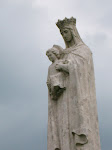
Our Lady of Penrhys looks over the mountains and hills of Wales.This shrine was Mediaeval, and an old British shrine, with healing properties. It used to belong to and be serviced with priests by the monks of Llantarnam Abbey. Nuns now reside in the Abbey (The Sisters of St Joseph of Annecy) and they were represented in the pilgrimage, plus sisters of Mother Theresa's Missionaries of Charities. This Pilgrimage is a very old and ancient one.


We set off
We set off at nine in the morning and drove down the m50 towards Abergavenny. The sun streamed down and the trees on wither side of the motorway were fully green with allsorts of blossoms. We reached Abergavenny Priory by eleven and had a cup of tea in the Angel.We picked up our son at the station and then set of down the Heads of the Valleys Road towards Merthyr. At the turn off to Aberdare, we started off steeply up the mountain road and very quickly were right at the top of the mountains, going around very tight bends.There is something very exhilarating about being on top of a mountain-it is like being on top of the world!
Arrival at Penrhys
Eventually reached the very top, when we got to Penrhys we took our seats. We were quite early so we did have a picnic and then got ready for the afternoon. And what a wonderful afternoon it was. Residents of Penrhys put up several large marquees and sold various things to offset costs. There was tea, there were cakes and sandwiches for tea afterwards. The Intention of the Pilgrimage
To ask Our Lady of Penrhys for the return home of fallen away and lapsed Catholics.As the pilgrimage has been renewed, so may the faith of all her children to ome Home.
The Joyful Mysteries of the Rosary
Laurence O’Leary was the organiser. Speaking to him afterwards, it seemed he was asked by the Holy Virgin whilst on pilgrimage to Medugorje to reinstate the pilgrimage to Penrhys, so that pilgrims return and give her honour.He introduced Theresa and all the pilgrims-about 500 recited the Joyful Mysteries of the Rosary. I have to say it was a rare treat. As the afternoon wore on , the voices echoed around the valley and as Laurence asked-‘Did you see all the angels around her?’ The atmosphere was so silent you could hear a pin drop. The silence and concentration of the Faithful was really charged with prayer.
A Prayer to the Holy and Undivided Trinity for the Consecration of Wales
A Prayer for the Consecration of Wales to the Immaculate Heart of Mary at Penrhys was recited by all present and addressed to the most Holy and Blessed Trinity. Most Holy Trinity,Our Father in Heaven, who chose Mary as the fairest of your daughters , Holy Spirit who chose Mary as your Spouse,God the Son who chose Mary as your Mother, in union with Mary, we adore your majesty and acknowledge your supreme, eternal authority. Most Holy Trinity, we place Wales in the hands of the Immaculate Heart of Mary in order that she present our country of Wales to you. Through her, we wish to thank you for our faith in this land, through the intercession of Mary, grant us peace in our families and peace in the world. Protect the family life of the nation. Guard the precious gift of religious vocations and protect our priests through the intercession of our Mother. Have mercy on the unborn, sick, elderly and disabled, the poor, the tempted, upon sinners, and all who are in need. Mary, Immaculate Virgin, our Mother, Our Lady of Penrhys , we invoke you and give you our country and ourselves to your Immaculate Heart.
The Procession
Some of the pictures above show the lines forming to walk up the mountain to form the Blessed Sacrament Procession. They are not empty seats! There were none! The Procession came down the Hill from the building of the Arts Centre to the singing of Faith of Our Fathers.
Faith of our fathers, living still,
In spite of dungeon fire and sword
O how our hearts beat high with joy!
Whene’er we hear that glorious Word!
Faith of Our Fathers! Holy Faith!
We will be true to thee till death!
The canopy was held over Bishop Daniel and the priests as they arrived proceeded by deacons and altar servers and knelt before the statue, and table which was dripping with flowers and candlesticks and candles and in the centre the Monstrance containing the Body of Our Lord Jesus Christ.The Faithful sang the O Salutaris and Tantum Ergo. There followed the Litany of the Blessed Virgin Mary and the Holy Name.
The Homily
(Catch it on P The Homily by Bishop Daniel concerned the Faith and the responsibility of all to evangelise fearlessly and openly and witness to the faith. It was moving and the whole homily can be heard on the Podcast of the Pilgrimage of Our Lady of Penrhys.If you have not got iTunes you can click on the link in the blog.Otherwise just type maryinmonmouth into the iTunes store window and it will come into your computer. There followed the prayer of St Michael, Archangel for Wales and this prayer:
Almighty God Who in Thine infinite goodness Has sent Thine only begotten Son into the world To open once more the gates of heaven And to teach us how to know, love and serve thee Have mercy upon Thy people who live in Wales. Grant to them the precious gift of Faith And unite them in the one true Church Founded by Thine own dear Son, that, Acknowledging her authority and obeying her voice They may serve Thee, love Thee and worship Thee As Thou desirest in this world And obtain for themselves Everlasting happiness In the world to come Through the same Christ our Lord. Amen
Bishop:Our Lady, help of Christians
Faithful:Pray for us
Bishop:St David
Faithful:Pray for us
Bishop:St Winefride
Faithful:Pray for us.
The long Recessional Hymn was the
Our Lady of Penrhys Hymn Tune:Lourdes
 ________________________________________________ Here are some of the verses….
1.All glory to God for this wonderful place Which stands as a witness of mercy and Grace Ave, Ave, Ave Maria
2.For here in the Rhondda,here stands the blest shrine Which tells us of Jesus, the gift most divine.Ave..
3.For here in the valley a statue once stood Of Mary and Jesus concealed in a wood.Ave
4.And here with the monks they illumined the shrine In honour of Jesus the Saviour divine.Ave….
5.With candles and flowers the people would come To honour Our Lady and her greater Son Ave
6.And people would gather to see Christ displayed In the arms of his Mother in glory arrayed. Ave
7.With love and affection held close to her breast A kiss for her Saviour, she rocked him to rest. Ave..
8.And there as a gift for the suppliants sweet A spring of clear water flowed forth near her feet. Ave
9.And pilgrims who drank from the water were healed As Christ’s sovereign power was revealed Ave…
10.From Gwynedd and Powys, from Dyfed and Gwent The pilgrims would come and requests would be sent Ave….
11.And signs of God’s mercy and healings bestowed Were witnessed by those on the pilgrimage road Ave..
12.But then came a new king and sadly twas learned The statue was taken to England and burned Ave..
13.And here where the honour of Jesus was kept The people of Wales now with misery wept. Ave…
14.And ruin and darkness came over the place And of Mair on Penrhys with longing to pray Ave..
15.And there on the mountain with water still flowed A witness to all of the blessings of God Ave….
16.The centuries turned and the water flowed on With a message of hope until Wales was reborn Ave….
To God the All Sovereign, and Son, with due praise And Spirit of Holiness ,worship we raise. Ave…


 _________________________________________________________________
Scallops, staffs, books and Rosaries
On sale at the shrine were rosaries made by the ‘Crafty Pilgrims’ there were beautiful scallop shells, and pilgrims staffs .
Water Wood and Fire
The book has the Penrhys tour as its theme, and water being the Holy Well, the Wood being the oak tree in which the carving of the Holy Virgin appeared to have been carved, and fire when it was dragged at midnight to London and burnt. The book has been written and produced by children from the local schools. (Dwr, coed a Thân )The art and the poetry is very moving.My favourite is a poem by Liam Brabon and concerns the symbol of the scallop shell-the St James of Compostella pilgrims’ shell, now universally accepted as an emblem for a pilgrim.
http:/www.penrhys.com, email: penrhys@penrhyspartnership.co.uk 01443 755008 <
A href="https://blogger.googleusercontent.com/img/b/R29vZ2xl/AVvXsEgnlp2jZHXexdFrAFDz3StdTqL3VEOOpxXB7sN7LJJMnInYWLHpG7euASfuB2jABUSLptKIbLy038FCdZiTYIUTjnxSzoW1a9n1gb-alo3ghzf2MSHSanm1d-uN7F_BRo_XW-AQ5C7Dtp7w/s1600-h/Our+Lady+of+Penrhys+2008+038.JPG">


If you would like a copy of ‘Water wood and Fire’. 18 of the poems are in Welsh, and about 28 in English. All the money raised from the book goes to improve local facilities for the pilgrims and improve the local area so that the pilgrimage can grow. At the end of the final hymns, small children were commissioned by elderly people to clamber down to the well and fill plastic bottles with the holy water from the well. They enthusiastically scuttled up and down the bank with the plastic bottles. There is a good size car park right next to the pilgrimage site.Penrhys is reached from Ferndale.
Prayer for Priests
Please pray for a priest for the people of Ferndale and Penrhys. Somewhere out there is a priest who will come to look after the church and pilgrimage. Please pray for someone to come and provide a local priest. Hope you enjoy the pictures. My podcast has some great interviews with the pilgrims and the pilgrimage leader Laurence O’Leary.
The Welsh Parishes Pilgrimage will be repeated next year on the last Sunday in May 09


We set off
We set off at nine in the morning and drove down the m50 towards Abergavenny. The sun streamed down and the trees on wither side of the motorway were fully green with allsorts of blossoms. We reached Abergavenny Priory by eleven and had a cup of tea in the Angel.We picked up our son at the station and then set of down the Heads of the Valleys Road towards Merthyr. At the turn off to Aberdare, we started off steeply up the mountain road and very quickly were right at the top of the mountains, going around very tight bends.There is something very exhilarating about being on top of a mountain-it is like being on top of the world!
Arrival at Penrhys
Eventually reached the very top, when we got to Penrhys we took our seats. We were quite early so we did have a picnic and then got ready for the afternoon. And what a wonderful afternoon it was. Residents of Penrhys put up several large marquees and sold various things to offset costs. There was tea, there were cakes and sandwiches for tea afterwards. The Intention of the Pilgrimage
To ask Our Lady of Penrhys for the return home of fallen away and lapsed Catholics.As the pilgrimage has been renewed, so may the faith of all her children to ome Home.
The Joyful Mysteries of the Rosary
Laurence O’Leary was the organiser. Speaking to him afterwards, it seemed he was asked by the Holy Virgin whilst on pilgrimage to Medugorje to reinstate the pilgrimage to Penrhys, so that pilgrims return and give her honour.He introduced Theresa and all the pilgrims-about 500 recited the Joyful Mysteries of the Rosary. I have to say it was a rare treat. As the afternoon wore on , the voices echoed around the valley and as Laurence asked-‘Did you see all the angels around her?’ The atmosphere was so silent you could hear a pin drop. The silence and concentration of the Faithful was really charged with prayer.
A Prayer to the Holy and Undivided Trinity for the Consecration of Wales
A Prayer for the Consecration of Wales to the Immaculate Heart of Mary at Penrhys was recited by all present and addressed to the most Holy and Blessed Trinity. Most Holy Trinity,Our Father in Heaven, who chose Mary as the fairest of your daughters , Holy Spirit who chose Mary as your Spouse,God the Son who chose Mary as your Mother, in union with Mary, we adore your majesty and acknowledge your supreme, eternal authority. Most Holy Trinity, we place Wales in the hands of the Immaculate Heart of Mary in order that she present our country of Wales to you. Through her, we wish to thank you for our faith in this land, through the intercession of Mary, grant us peace in our families and peace in the world. Protect the family life of the nation. Guard the precious gift of religious vocations and protect our priests through the intercession of our Mother. Have mercy on the unborn, sick, elderly and disabled, the poor, the tempted, upon sinners, and all who are in need. Mary, Immaculate Virgin, our Mother, Our Lady of Penrhys , we invoke you and give you our country and ourselves to your Immaculate Heart.
The Procession
Some of the pictures above show the lines forming to walk up the mountain to form the Blessed Sacrament Procession. They are not empty seats! There were none! The Procession came down the Hill from the building of the Arts Centre to the singing of Faith of Our Fathers.
Faith of our fathers, living still,
In spite of dungeon fire and sword
O how our hearts beat high with joy!
Whene’er we hear that glorious Word!
Faith of Our Fathers! Holy Faith!
We will be true to thee till death!
The canopy was held over Bishop Daniel and the priests as they arrived proceeded by deacons and altar servers and knelt before the statue, and table which was dripping with flowers and candlesticks and candles and in the centre the Monstrance containing the Body of Our Lord Jesus Christ.The Faithful sang the O Salutaris and Tantum Ergo. There followed the Litany of the Blessed Virgin Mary and the Holy Name.
The Homily
(Catch it on P The Homily by Bishop Daniel concerned the Faith and the responsibility of all to evangelise fearlessly and openly and witness to the faith. It was moving and the whole homily can be heard on the Podcast of the Pilgrimage of Our Lady of Penrhys.If you have not got iTunes you can click on the link in the blog.Otherwise just type maryinmonmouth into the iTunes store window and it will come into your computer. There followed the prayer of St Michael, Archangel for Wales and this prayer:
Almighty God Who in Thine infinite goodness Has sent Thine only begotten Son into the world To open once more the gates of heaven And to teach us how to know, love and serve thee Have mercy upon Thy people who live in Wales. Grant to them the precious gift of Faith And unite them in the one true Church Founded by Thine own dear Son, that, Acknowledging her authority and obeying her voice They may serve Thee, love Thee and worship Thee As Thou desirest in this world And obtain for themselves Everlasting happiness In the world to come Through the same Christ our Lord. Amen
Bishop:Our Lady, help of Christians
Faithful:Pray for us
Bishop:St David
Faithful:Pray for us
Bishop:St Winefride
Faithful:Pray for us.
The long Recessional Hymn was the
Our Lady of Penrhys Hymn Tune:Lourdes
 ________________________________________________ Here are some of the verses….
1.All glory to God for this wonderful place Which stands as a witness of mercy and Grace Ave, Ave, Ave Maria
2.For here in the Rhondda,here stands the blest shrine Which tells us of Jesus, the gift most divine.Ave..
3.For here in the valley a statue once stood Of Mary and Jesus concealed in a wood.Ave
4.And here with the monks they illumined the shrine In honour of Jesus the Saviour divine.Ave….
5.With candles and flowers the people would come To honour Our Lady and her greater Son Ave
6.And people would gather to see Christ displayed In the arms of his Mother in glory arrayed. Ave
7.With love and affection held close to her breast A kiss for her Saviour, she rocked him to rest. Ave..
8.And there as a gift for the suppliants sweet A spring of clear water flowed forth near her feet. Ave
9.And pilgrims who drank from the water were healed As Christ’s sovereign power was revealed Ave…
10.From Gwynedd and Powys, from Dyfed and Gwent The pilgrims would come and requests would be sent Ave….
11.And signs of God’s mercy and healings bestowed Were witnessed by those on the pilgrimage road Ave..
12.But then came a new king and sadly twas learned The statue was taken to England and burned Ave..
13.And here where the honour of Jesus was kept The people of Wales now with misery wept. Ave…
14.And ruin and darkness came over the place And of Mair on Penrhys with longing to pray Ave..
15.And there on the mountain with water still flowed A witness to all of the blessings of God Ave….
16.The centuries turned and the water flowed on With a message of hope until Wales was reborn Ave….
To God the All Sovereign, and Son, with due praise And Spirit of Holiness ,worship we raise. Ave…


 _________________________________________________________________
Scallops, staffs, books and Rosaries
On sale at the shrine were rosaries made by the ‘Crafty Pilgrims’ there were beautiful scallop shells, and pilgrims staffs .
Water Wood and Fire
The book has the Penrhys tour as its theme, and water being the Holy Well, the Wood being the oak tree in which the carving of the Holy Virgin appeared to have been carved, and fire when it was dragged at midnight to London and burnt. The book has been written and produced by children from the local schools. (Dwr, coed a Thân )The art and the poetry is very moving.My favourite is a poem by Liam Brabon and concerns the symbol of the scallop shell-the St James of Compostella pilgrims’ shell, now universally accepted as an emblem for a pilgrim.
http:/www.penrhys.com, email: penrhys@penrhyspartnership.co.uk 01443 755008 <
A href="https://blogger.googleusercontent.com/img/b/R29vZ2xl/AVvXsEgnlp2jZHXexdFrAFDz3StdTqL3VEOOpxXB7sN7LJJMnInYWLHpG7euASfuB2jABUSLptKIbLy038FCdZiTYIUTjnxSzoW1a9n1gb-alo3ghzf2MSHSanm1d-uN7F_BRo_XW-AQ5C7Dtp7w/s1600-h/Our+Lady+of+Penrhys+2008+038.JPG">


If you would like a copy of ‘Water wood and Fire’. 18 of the poems are in Welsh, and about 28 in English. All the money raised from the book goes to improve local facilities for the pilgrims and improve the local area so that the pilgrimage can grow. At the end of the final hymns, small children were commissioned by elderly people to clamber down to the well and fill plastic bottles with the holy water from the well. They enthusiastically scuttled up and down the bank with the plastic bottles. There is a good size car park right next to the pilgrimage site.Penrhys is reached from Ferndale.
Prayer for Priests
Please pray for a priest for the people of Ferndale and Penrhys. Somewhere out there is a priest who will come to look after the church and pilgrimage. Please pray for someone to come and provide a local priest. Hope you enjoy the pictures. My podcast has some great interviews with the pilgrims and the pilgrimage leader Laurence O’Leary.
The Welsh Parishes Pilgrimage will be repeated next year on the last Sunday in May 09
Friday, May 30, 2008
Llanarth Monastery and St Teilo-Llangarth


Tis was another Church which was closed, although there was a telephone number on the blog. I am using Celia Nash's excellent paper on Llanarth, which I got from the Catholic Chapel on Christmas Day. I will write more about that when I reach the sixteenth century. It seems the Celtic subject is so diverse it is like an open bucket, and you keep finding more and more evidence for our Catholic heritage. I arrived at Llanarth (St Teilo's Church)on an afternoon in early April and a man was working in the garden. Sadly I could not go in. The Man who was tending the graves, showed me the Catholic part of the cemetary, which housed the magnificent monuments of the Herbert family, which were quite stunning, and very lovingly tended. The Herbert family remained true to the Catholic Faith during all the times of the persecution, but more of that later.
My friend in the graveyard also told me with great joy of remembrance how he had gone to Lady Llanover's Christmas Party one year as a child and his face beamed when he recalled she had given him a large beautifully painted train set! Lady Augusta Hall, or Lady Llanover was an important figure in the reestablishment of the Catholic Church after the end of the persecution and restoration of the Church in 1851.She singlehandedly helped to bring dispossessed nuns over from Britanny to found new convents and Catholic Schools in Monmouth, Usk, Abergavenny, Pontypool, and Brecon and saw they had everything they needed. But again, more of that later.
Lets get back to this wonderful clas church and monastery and its story-it being a most important settlement in mid Gwent in the 6th century.
I am quoting from Celia Nash's work here."The name Llanarth could be taken to mean 'The Church on the ridge of the hill' but is more likely to indicate there was a sizeable monastic settlement here with a garth or cloister."And this is a pattern we have seen at Beddwellty, Caerwent, St Woolos (Gwynlliw's)and many other such settlements in Gwent in the sixth century. Celia goes on "The earliest mention of it is in the Liber Landavensis (The Book of Llandaff) wich tells us that King Iddon, son of Ynyr Gwent, for the exchange of the eternal kingdom, sacrificed one of his mansions, Llangarth and all its territories to Archbishop Teilo (without any earthly payment)to God and to the Church of Llandaff. St Teilo was Archbishop of Llandaff between 512 and 566. So there was a clas monastery here in the sixth century" and on the site of St Teilo's church.
What is there now is of course a Norman church, but if you look back at the arcives you will see loads of information about Teilo and Llandaff, and the other country retreat of the Bishops of Llandaff at Mathern (Tewdrig's Church of Martyrdom)We have met King Iddon before too. Ynyr Gwent his Father was killed in battle and his mother Queen Materiana (Madryn) of Gwent and brother Ceidio set of from Gwent on a White Martyrdom and ended up in a small 'island' a part of Boscastle called Minster and evangelised Tintagel and Boscastle, currently ruled from Tintagel by Gorlais and his wife Ygraine. The churches at Tintagel and Minster, Boscastle were both dedicated to St Materiana and there were Saxon and Norman buildings on both areas, the buildings remain until today.Iddon, King of Gwent as Arthur did after him (although we believe he was a petty king of Ercing but not a 'High King' but great military leader (see below)
It is impossible to tell whether Teilo himself came to this area to evangelise it, even though the land was given to him and to God and his Church, but it came from Roman Soldiers, from Glastonbury even earlier and Roman soldiers certainly controlled the ford across the Usk near here, which still has the Roman name Gobion.There are so many Christian settlements around here-the 'clas' churches with their resident priest (the word 'Llan' by this time meaning a church and priest. Llantilio Crosenny nearby also shows a link with St Teilo (Tilio) and Llandewi Rhydderch -(Clan dow-ee ruth-rch)perhaps St David had a house there.Llanfair Kilgeddin (definately worth a visit)and Llanfihangel Ystern Llwyn-all show the particular relationship with Our Lady and St Michael.Locally the church is overlooked by the majestic Holy Mountain-the Skirrid, with the ruin of the little Church above dedicated to St Michael, God's greatest protective Angel (mentioned in the book of Revelations)
Celia writes the following:"The Welsh Chronicles tell us that St Teilo, the Bishop of Llandaff was staying at his summer palace in Llanarth when King Iddon (pron Ithon--th as in the))came to ask his help to prevent the Saxons invading his realm."St Teilo thereupon ascended to the top of the mountain of Cresiny (Skirryd)and there stood, with outstretched arms, beseeching Amighty God to give the victory to the harassed Christians; and in consequence of St Teilo's powerful intercession, the Saxons were driven back accross the Wye'.
After his death, his name weas given to the Church on the hill at Llanarth. It is still dedicated to St Teilo and the property of the Diocese of Llandaff".(Anglican)
Entering the churchyard of St Teilos up on the hill, you can see that people are caring for it. IT is round and curved as you would expect. The holy well (at the bottom of the pictures) is a way off and nearer the site of Llanarth Court.It was recently renovated by the Herbert Family, who were descendants of the Earls of Worcester who owned Ragland Castle and held out for the Faith until the fall of Ragland Castle in the Civil War with Oliver Cromwell. It is easy to imagine that this whole village would have been cells and houses surrounding the church,containing the monks and priests, lay people and farmers and cooks who kept it all going. I have written in detail below about the hospitality of these clas churches so won't again. They all seemed to be high up, affording them a certain degree of protection.
I hope to be able to get into the church at some stage.
Thursday, May 29, 2008
**SATURDAY's PILGRIMAGE TO PENRHYS**ITINERY 31st May 2008
Our Lady of Penrhys by Photographer MAL DURBIN

________________________________________________________
Our Lady of Penrhys, in 1538, was thrown from a window in Saint Pauls, London, and destroyed.Mary, Mother of Mercy, was the banner Arthur carried into battle.
When Rhys, the last king, or "Prince" of Wales died,his memory was honoured in association with Penrhys.(Penrhys means: "Rhys's head" The statue of Mary, at Penrhys,became the greatest site of pilgrimage in Wales.Many of the pilgrims were aware that the hopes and dreams of Wales could be brought here.
The Holy Well of Penrhys, up to 1538, was overlooked by the beautiful gilded figure of Our Lady.
Gwilym Tew, poet, says that:
"It was crowned, had ruddy cheeks,
the Holy Infant in the arms
and a precious stone in the bosom".
Gwilym Tew noted that
"there were human marks
upon the face of Our Lady of Penrhys."
Possibly marks upon the gilded face appeared as tear marks
At this time Bishop Latimer wrote to Thomas Cromwell suggesting the destruction of a number of Shrines of Our Lady, believing them to be a focus of idolatry, and thus 'the devil's instrument'. The statue at Penrhys at this time was obviously an important one as it, alongside others such as the one at Walsingham and Ipswich, was mentioned by name in this letter
On 23rd of August, 1538, the then Chancellor, Thomas Cromwell,instructed William Herbert "to remove the famous effigy as secretly as might be to prevent a local uprising".This was done. The figure itself was said to have been hurled through the west window at Saint Pauls by Bishop Latimer.He recommended afterwards that the figure, of wood, be "burned".
The original statue at Penrhys was said to be 'indescribably beautiful', and contained 'Mary nursing Jesus for a kiss'. Much smaller that the statue that currently resides at Penrhys it was thought to have originally been placed in an alcove at the small well chapel.
What a fabulous photograph this is and what a talented photographer! Superb evocative and emotional view of this statue.Anyway:-
Here are the Details for anyone from South Wales or elsewhere to go tomorrow.
History:
Legends tell that the original statue was a gift from heaven, which miraculously appeared in the branches of an oak tree at the site. The statue, it is said, resisted all attempts to move it from the tree so that, 'eight oxen could not have drawn the Image of Penrhys from its place in the tree'.
The statue only allowed itself to be moved when a shrine and chapel were built to house it. The original statue survived at Penrhys until the 1500's, and Henry Viii's dissolution of the monasteries.
Thus it is said the statue was removed from the shrine secretly at the dead of night to prevent any local unrest. From here it said the statue was removed to Thomas Cromwell's home in London, and after being thrown from the West window of St. Paul's by Bishop Latimer, it along with many other images of Mary was burned publicly.
When Ferndale church was built a Miss M.M. Davies of Llantrisant procured for the church a replica of the original statue, carved in oak standing in a tree trunk.
The statue that currently stands on the hillside at Penrhys was erected in 1953, and blessed by Archbishop McGrath on the 2nd July that year. The statue was carved out of Portland stone and designed, using the many description of the original statue contained in medieval welsh poetry, to resemble the original as closely as possible.
ITINERY FOR SATURDAY's PILGRIMAGE2nd annual combined parishes pilgrimage
1pm They hope you will be seated by then. If you are late bring your
own collapsible chair.
2pm Rosary of the most Blessed Virgin Mary
2.30 (approx)Procession of the Blessed Sacrament from the nearby Penrhys Arts Centre
to the Shrine.
3.15 Benediction
3.35 Homily
Penrhys Hymn and Hymns to Our Lady
All Hallows Choir are providing the Music
Toilet facilities at the Canolfan Rees Arts Centre.
Refreshments
Our Lady of Penrhys Pilgrimage Goods (new)available in a new marquee erected by the residents of Penrhys.
LOCATION IS SOUTH OF THE VILLAGE OF FERNDALE IN THE RHONDDA VALLEY,in the district called Pen Rhys.

________________________________________________________
Our Lady of Penrhys, in 1538, was thrown from a window in Saint Pauls, London, and destroyed.Mary, Mother of Mercy, was the banner Arthur carried into battle.
When Rhys, the last king, or "Prince" of Wales died,his memory was honoured in association with Penrhys.(Penrhys means: "Rhys's head" The statue of Mary, at Penrhys,became the greatest site of pilgrimage in Wales.Many of the pilgrims were aware that the hopes and dreams of Wales could be brought here.
The Holy Well of Penrhys, up to 1538, was overlooked by the beautiful gilded figure of Our Lady.
Gwilym Tew, poet, says that:
"It was crowned, had ruddy cheeks,
the Holy Infant in the arms
and a precious stone in the bosom".
Gwilym Tew noted that
"there were human marks
upon the face of Our Lady of Penrhys."
Possibly marks upon the gilded face appeared as tear marks
At this time Bishop Latimer wrote to Thomas Cromwell suggesting the destruction of a number of Shrines of Our Lady, believing them to be a focus of idolatry, and thus 'the devil's instrument'. The statue at Penrhys at this time was obviously an important one as it, alongside others such as the one at Walsingham and Ipswich, was mentioned by name in this letter
On 23rd of August, 1538, the then Chancellor, Thomas Cromwell,instructed William Herbert "to remove the famous effigy as secretly as might be to prevent a local uprising".This was done. The figure itself was said to have been hurled through the west window at Saint Pauls by Bishop Latimer.He recommended afterwards that the figure, of wood, be "burned".
The original statue at Penrhys was said to be 'indescribably beautiful', and contained 'Mary nursing Jesus for a kiss'. Much smaller that the statue that currently resides at Penrhys it was thought to have originally been placed in an alcove at the small well chapel.
What a fabulous photograph this is and what a talented photographer! Superb evocative and emotional view of this statue.Anyway:-
Here are the Details for anyone from South Wales or elsewhere to go tomorrow.
History:
Legends tell that the original statue was a gift from heaven, which miraculously appeared in the branches of an oak tree at the site. The statue, it is said, resisted all attempts to move it from the tree so that, 'eight oxen could not have drawn the Image of Penrhys from its place in the tree'.
The statue only allowed itself to be moved when a shrine and chapel were built to house it. The original statue survived at Penrhys until the 1500's, and Henry Viii's dissolution of the monasteries.
Thus it is said the statue was removed from the shrine secretly at the dead of night to prevent any local unrest. From here it said the statue was removed to Thomas Cromwell's home in London, and after being thrown from the West window of St. Paul's by Bishop Latimer, it along with many other images of Mary was burned publicly.
When Ferndale church was built a Miss M.M. Davies of Llantrisant procured for the church a replica of the original statue, carved in oak standing in a tree trunk.
The statue that currently stands on the hillside at Penrhys was erected in 1953, and blessed by Archbishop McGrath on the 2nd July that year. The statue was carved out of Portland stone and designed, using the many description of the original statue contained in medieval welsh poetry, to resemble the original as closely as possible.
ITINERY FOR SATURDAY's PILGRIMAGE2nd annual combined parishes pilgrimage
1pm They hope you will be seated by then. If you are late bring your
own collapsible chair.
2pm Rosary of the most Blessed Virgin Mary
2.30 (approx)Procession of the Blessed Sacrament from the nearby Penrhys Arts Centre
to the Shrine.
3.15 Benediction
3.35 Homily
Penrhys Hymn and Hymns to Our Lady
All Hallows Choir are providing the Music
Toilet facilities at the Canolfan Rees Arts Centre.
Refreshments
Our Lady of Penrhys Pilgrimage Goods (new)available in a new marquee erected by the residents of Penrhys.
LOCATION IS SOUTH OF THE VILLAGE OF FERNDALE IN THE RHONDDA VALLEY,in the district called Pen Rhys.
Subscribe to:
Posts (Atom)