



































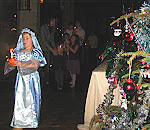






This may interest some of you, the Nidus Choirs, Children and Adults singing O Holy Night. The song is available on iTunes. I am singing the solo, just out of interest. The blog will be returning shortly. We have had to take my mother, who has Alzheimers on a Christmas Trip to Germany, her homeland where she has not been for ten years and prior to that the time has been taken up by trips down to Wales to promote and sell the CD 'Christmas in Wales'. The Album is available via download from iTunes or you can buy it at
http://www.niduschildrenschoir.co.uk and it is all badly needed funds for their forthcoming competitions, which always cost a lot of money.
http://www.youtube.com/watch?feature=player_embedded&v=oeLa_8r2ZF4
Showing posts with label Cwmbran. Show all posts
Showing posts with label Cwmbran. Show all posts
Wednesday, December 28, 2011
Monday, May 3, 2010
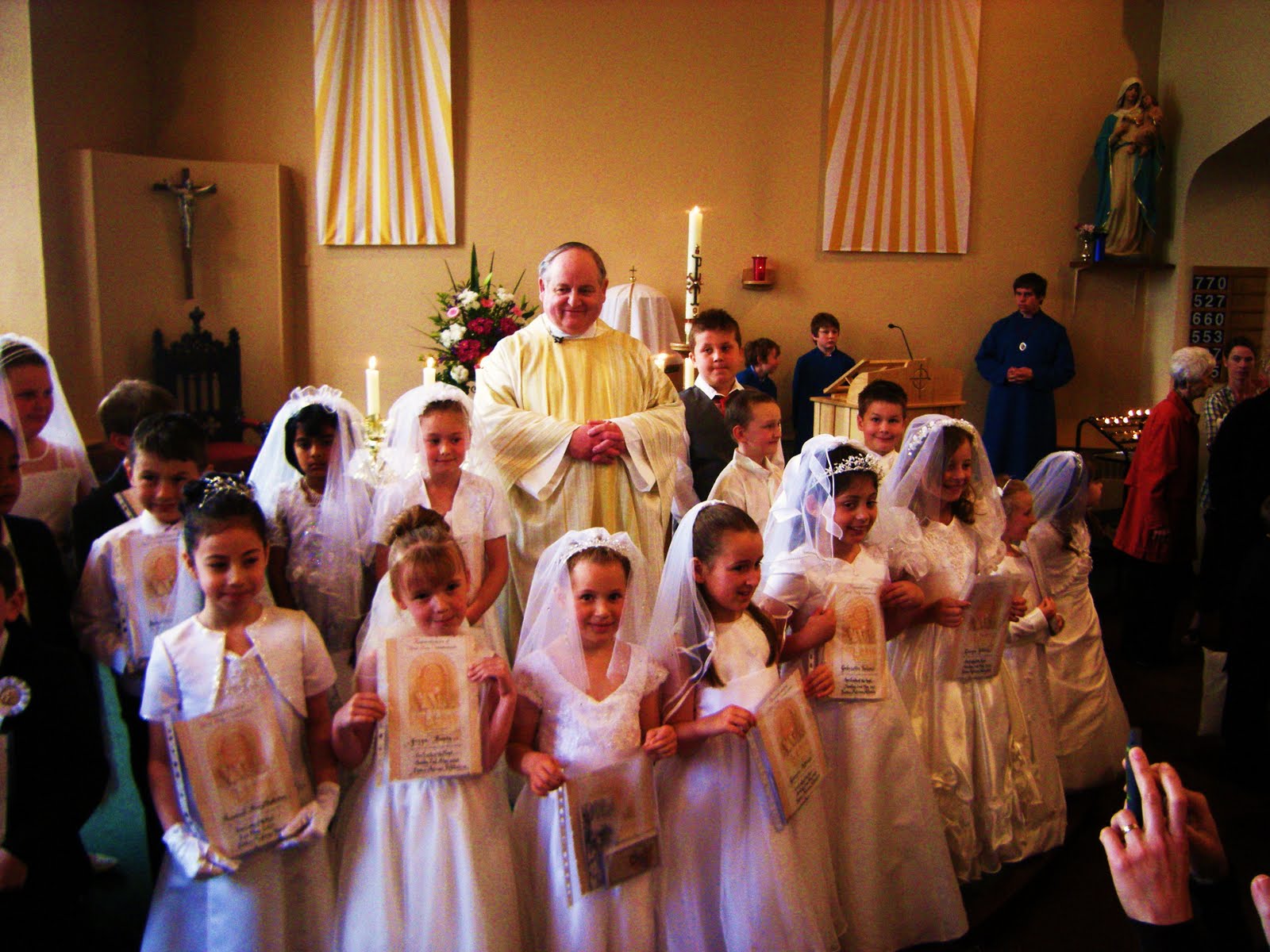
FIRST COMMUNION AT OUR LADY OF THE ANGELS CWMBRAN



 _____________________________________________________________________________________
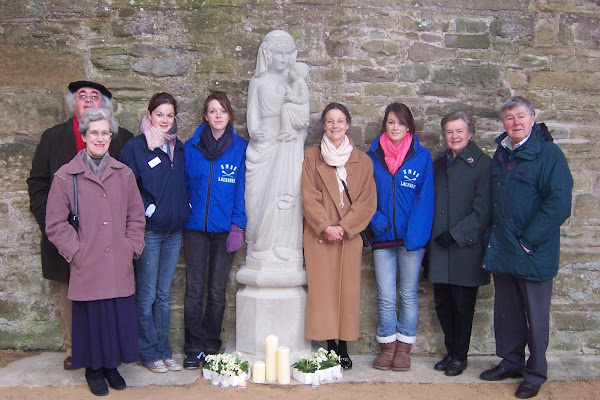
Father Adrian Wiltshire celebrated Mass yesterday for a large number of first Communicants at Our Lady of the Angels Catholic Church in Cwmbran. Father Wiltshire explained to the boys and girls that this was the most important Communion for the Children but that every Communion they made from now on would be an important Communion, coming into the presence of Christ. He gave a wonderful homily onthe importance of Faithfulness in the world today. Afterwards the children went to celebrations with their families as the church congregation clapped and applauded as they received their missals and their certificates. It was a very happy occasion indeed and sadly , as there was not enough room in Church, which was filled to the rafters, some had to watch from outside-but all got to communicate.
Wonderful occasion and the children will lead the Church in the procession at Llantarnam Abbey in June.


Sunday, January 25, 2009
The Llan of St Non , Saxon Monastery of Diuma,then Our Lady and St Michael and All Angels, Llantarnam
.JPG)
.JPG)
.JPG)
.JPG)
.JPG)
.JPG)
.JPG)
.JPG)
.JPG)


 _____________________________________________________________________________
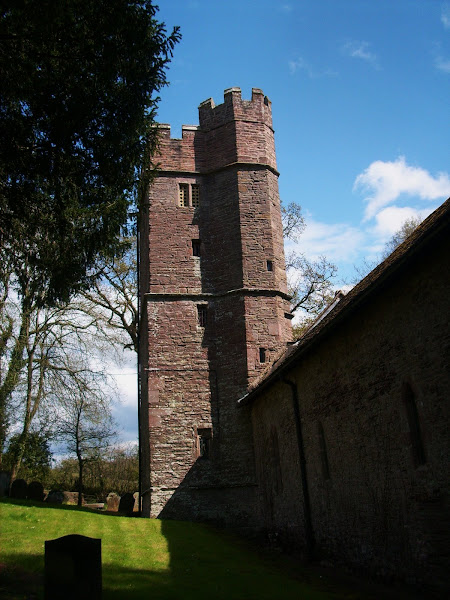
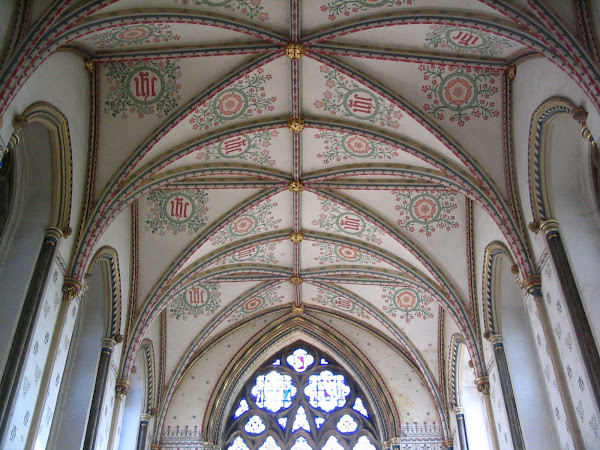
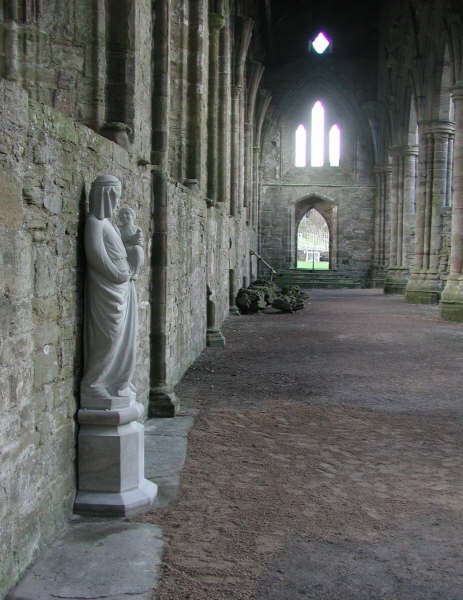
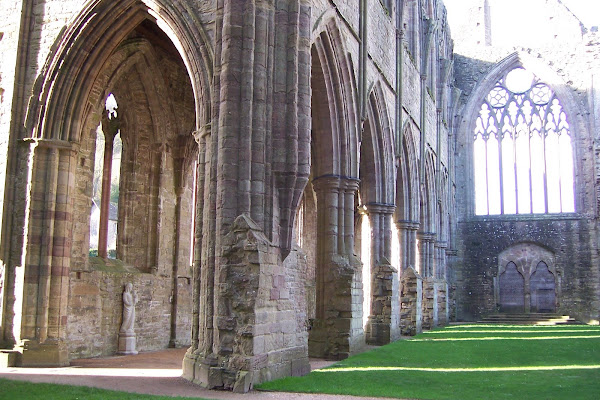
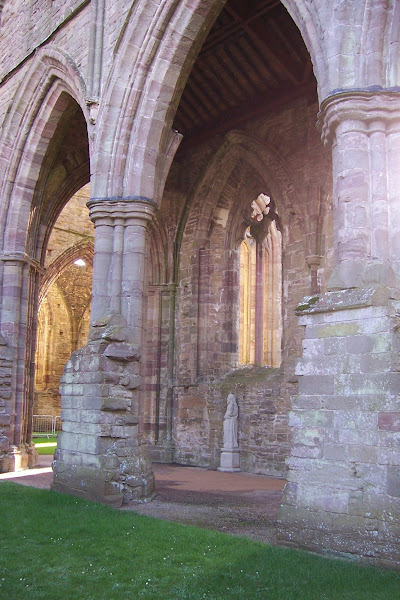
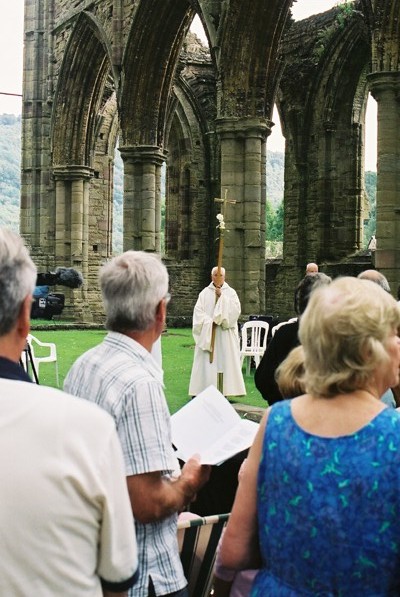
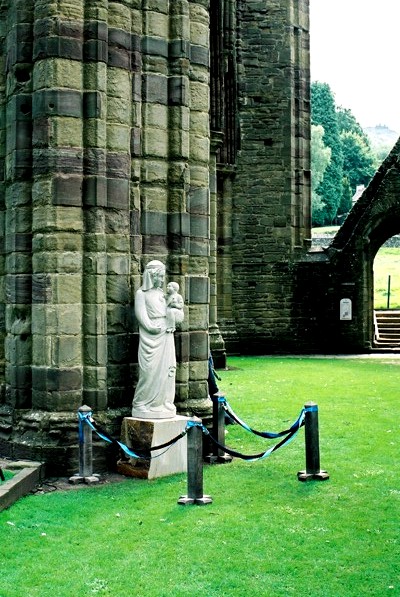
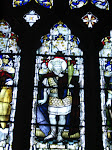
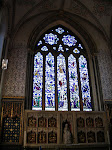
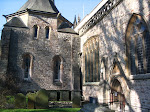
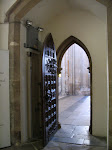
Above,photos of the remains of the old Cistercian Abbey to Our Lady and St Michael, partly concealed in the undergrowth. Also photographs from the present church, within the octave of Christmas.
Today I have made another visit to an ancient Llan and Church of Llantarnam.
During restoration work in 1921, in this Mediaeval church, the remains of an earlier Celtic Church were discovered, a Celtic church built long before the next door Abbey was founded. During the Norman times after 1066 –and 1091 saw South Wales fall,) this church was altered or replaced (since the Welsh were fiercely defending Gwent)with a wall so thick , that like so many of the Crusader churches in the Holy Land, it could have served for purposes of defence as well as a place where the Holy Mass and the Liturgy of the Hours could be sung.
Links to the old Welsh Tale
Idris Davies, who prepared the excellent guide book advances another theory.The story of Teyrnon is related in the early British story of Pwll , Prince of Dyfed in the Mabinogion. He was a man of resounding moral stature and Lord of Lower Gwent Iscoed.. The Glen in which the church stands may have originally been named after him, even though Nant Teyrnon was in Gwynllwg.Terynon, in battle was like a roar of the tidal waters (Severn Bore) in Battle.So at its earliest times Nant Teyrnon became Llantarnam. However, it is possible that the same important site was used as a holy place by St Non and subsequently by the Irish St Diuma.
Founder of the Cistercian Abbey of Our Lady and St Michael, Llantarnam
Sir Hywel ap Iowerth founded the original next door Abbey at Llantarnam, with a Cistercian Order, and the Abbot ofMargam referred to it in 1244 as ‘Vallium’ (Our Lady of the Valley’ very apt as theproperty extended along the river valleys of central Gwent.
Early names give the dedication to St Diuma
The Next door was called the ‘Abbey of Dewma’ and the Bishop of Hereford’s register for 1449 calls the monastery ‘Dewma’ . The Peniarth manuscript of ‘Plwye Dewma’ in the sixteenth century .In an ode to Sir William Morgan (a Catholic layman who bought the land at Llantarnam) , the poet Dafydd Benwyn refers to it as ‘mynachlog Ydeyma’ Frederick van der Meer in ‘Atlas de l’ordre Cistercian’ has as an entry for the Welsh Abbey , ‘Llantarnam filiation de Clairvaux….Pays de Galles , Co Monmouthshire,d Llandaff ND ET ST DEWMA.’
Saint Diuma-Irish Saint from Iona!
The fact that the Welsh people called the Abbey ‘Dewma’s Monastery’ means the question arises. Interestingly there is no Welsh saint called Dewma, but there is an Irishman . The Venerable Bede confirms that St Diuma was a missionary saint of Irish origin, sent to Iona to preach among the pagan Saxons in Mercia , and that in 655 , he was made Bishop of Lichfield. His connections with South Wales are not established , but the mutual influence of Iona and Glastonbury was such, that perhaps Diuma established a monastic llan here before travelling on to Glastonbury.
The Importance of Caerleon
The Key town in this is nearby Caerleon-City of Legions. This was the link with the British Kings too, Caractacus, Ynyr Gwent, Iddon, Woolos, Cadoc (also a Saint) Morgan Hen, Griffydd and others. Other wise , Joseph of Arimathea came here as an honoured guest, and to trade for tin under the Emperor Vespasian, and later, when sent by St Philip with his family as missionaries and refugees after the Crucifixion of Our Lord.. The guide book suggests, as this was so very old, it may have been a first mud and wattles daughter Church of Glastonbury . Together with London and York, they founded the first three Bishoprics after the Council of Nicea in325 (Mansi vol 11 467 to 477.)
Saint Non and her son, Blessed St David of Wales
Llantarnam may actually have been older even than St Diuma. St David , blessed Sacred Saint of Wales, originally had a hermitage at Llanthony, (still in existence as part of the parish church) was called to defend the Arian heresy of Pelagius at Llandewi Brefi and had reluctantly gone there and been acclaimed the new Bishop.He was ordained in Jerusalem as Archbishop along with Teilo and Padarn,as Bishops then returned to Caerleon after working in Jerusalem for a while for the Patriarch. David’s new home at Caerleon was difficult for him, but it is highly likely his mother, Saint Non established an original small llan here which was abandoned when David moved his whole church organisation to Menevia , in Pembrokedshire, where he was born. LLAN-TOR-NON (The Church on the Hill of Saint Non) . StNon was educated at Porth Mawr , (which Latinised becomes Magna Porta), the name of the extensive manor next to the Abbey Estate .It is possible when her son came to Caerleon she moved to a small llan near her former school.
British Bishops made pilgrimages to Rome and Jerusalem and attended the Council of Nicea, Basle, Arles, Pisa, Constance and Sienna.St Cadoc made 7 pilgrimages to Rome!
It is significant that St Dubricius and then St David, with the Bishops of London and York attended the Councils at Pisa, Basle Constance and Sienna . It may be because of St Joseph of Arimathea’s success in heralding the Gospel of Christ to the Britons. The Church was later in the power of the Saxon King INA when the Saxons had overrun Gwent and was then taken over by the Saxon Missionaries of St Augustine when he had completed the Christianisation of the Saxons. The present name of St Michael and All Angels is a Norman one, as it is a favourite Norman dedication.So it is interesting that the persisting dedication to both Church and Monastery was to St Diuma.
St Non’s Well
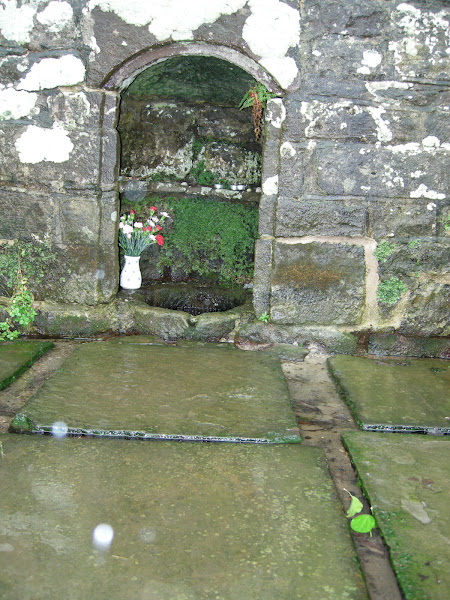
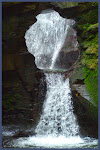
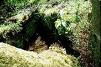
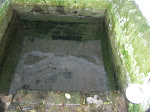
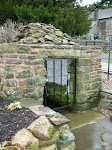
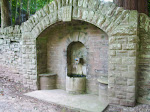
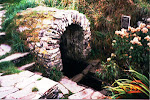
I understand there is a well here at the site of St Non and later Saint Diuma in Saxon times. I have not yet seen this nor the Norman Crypt-but will do so soon, hopefully. I recently attended a wedding here and there was not time.
I will go into more detail about Llantarnam Abbey later on , when I visit the Cistercian Abbey sites in Gwent and Glwyssing.(South Hereford)
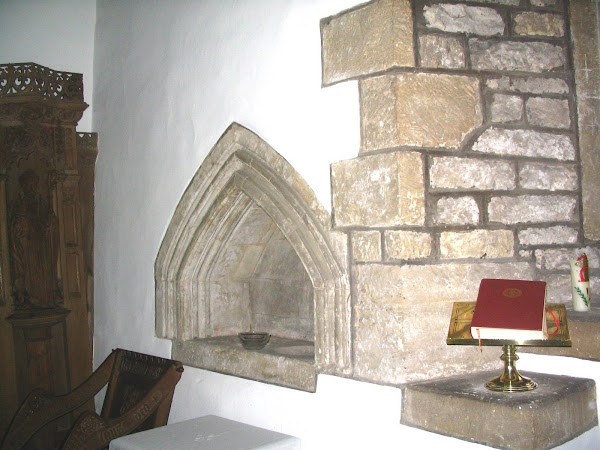
Easter Sepulchre
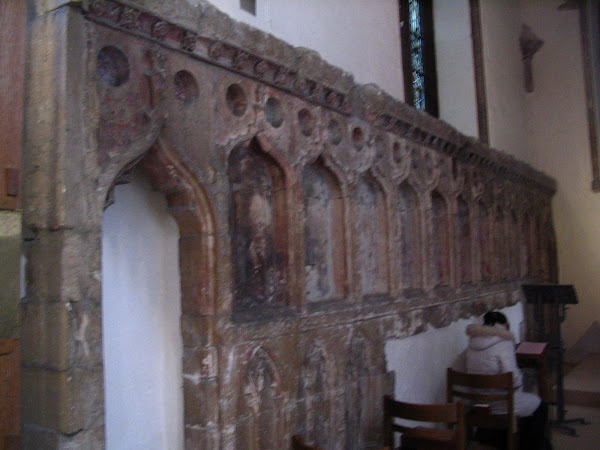
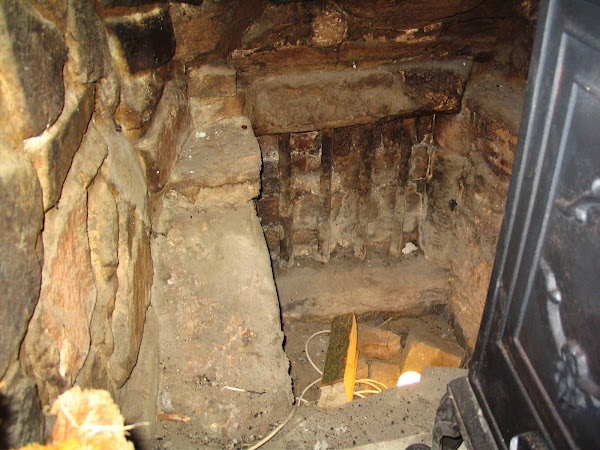
The Church has an existing Easter Sepulchre, not destroyed at the Reformation, possibly overlooked as it was used for a different purpose.
Monday, July 7, 2008
Cwmbran Children's Choir (Nidus) Off to the World Choir Olympics in Graz Austria
Well I am not posting this week because we are off to the world choir games with a choir. Leaving Wales at 1.20 am tomorrow(!!!!) and then arriving at Dover at 7 then through Germany where we will stay th night, arriving in Graz, Austria at 1pm.(hopefully) The procession and opening ceremony at 3, Friendship concert at 7 and then we compete at 7 on Friday.I actually am looking forward to taking part.Odds are not good with 75 choirs (many From Russia) taking part and only 4 qualifying formedals, but lets enjoy it. See you soon.
Ev
Ev
Saturday, April 26, 2008
A Heavenly Interlude-St Tegfedd's Church.Llandegfedd


____________________________________________________________________________________
Visit to St Tegfedd’s Church
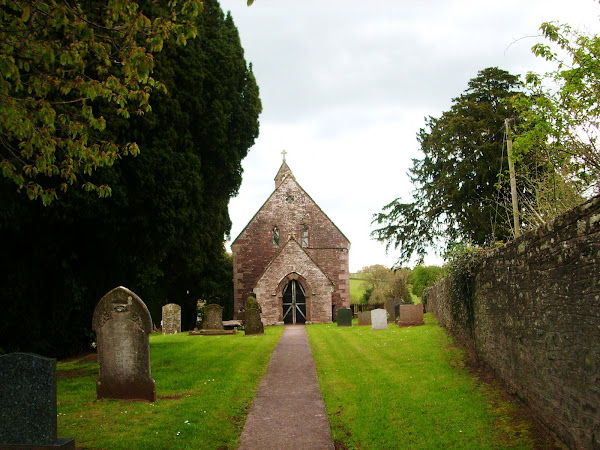
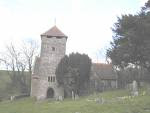
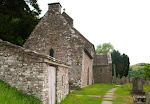
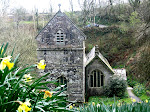
This week I drove out from the foothills of Cwmbran past the Crematorium and out towards Llandegveth to see for myself the spot where St Tegfedd (pronounced Tayg-veth-with the th pronounced as the th in ‘the’. This is the soft Welsh ‘edd’ sound. This road, which also leads to Llangibby (Llancybi) goes through some stunning countryside, with rolling hills on either side. Since we were just coming into the month of May, the fields and trees were supporting that heady mix of yellow green new born leaves and wild flowers in the hedgerows. It really was beautiful and the sun shone hot, even though there was a breeze. Finally after the road took a ‘dip’ I turned off to the village, again a lovely smallish road turning down towards a lower settlement at the foot of a hill. I turned left and drove up it and there, almost at the top was the little church.
What struck me immediately was its character. The church was in three sections, porch, nave and chancel and yet nestling there in the sun, it really seemed somehow delicate and feminine, smallish and cosy. I don’f feel I am being fanciful here.
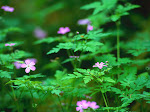
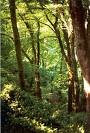
The circular churchyard , identifying it as a place of early Welsh worship, which would have originally included accommodation on the site was now a peaceful churchyard and the whole was surrounded with many varieties of wild flowers. I spotted celandines, campoins, buttercups, stichworts dandelions ,bluebells and wild hyacinths and there were many many more.It was almost as if St Tegfedd was their champion, where so many flowers have been lost from the hedgerows.
The church leaflet claims Samson of Dol as a brother to Tegfedd, but what we do know is that shw was the wife of Cedeg, son of Cunedda Wledig and the mother of S Teilo. The tradition of her martyrdom has been handed down from generation to generation, but one of the biggest cases for the truth of this legend is in fact the name of the site, originally Merthyr Tegfedd (Martyr Tegfedd) and then Llan-degfedd (the T changes to a d when it is joined to Llan or ‘thlan’-although that is approximate-listen to the podcast and you will hear.The church yard also contains a number of ancient trees containing a riot of birds all proclaiming to each other that a visitor had come.
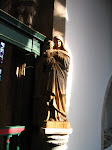
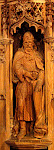
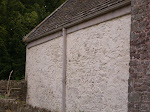
In the very ancient porch, after entering the gate, there were two items of interest .There was a wind-hole on each side looking out to the fields and also on each side of the door was the head of a monk or priest from earliest times, with a Roman tonsure . The pictures show that the faces are quite worn, possibly as they were outside the first stone mediaeval church on the site. Tegfedd’s church would have been of wood or mud and wattles more likely but may have been also built of stone, that is the chancel-sanctuary area.
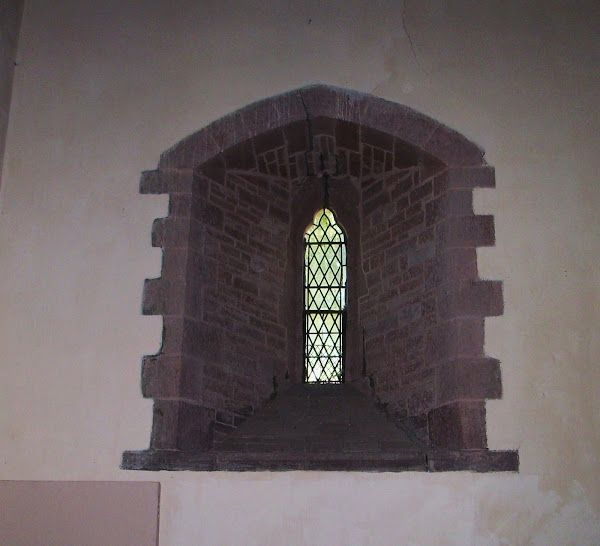
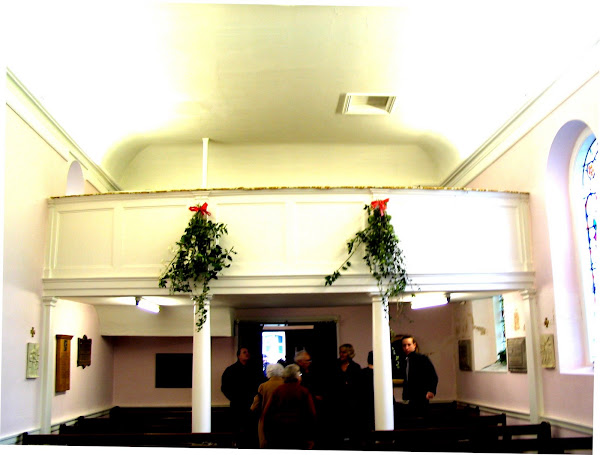
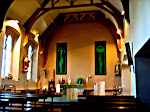
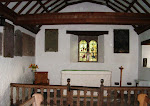
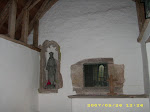
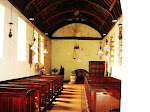
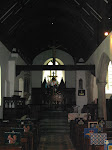
The church was very pretty inside. The original date on the guide sheet is in the thirteenth century for the present church,which has been the parish church of the village for eight hundred years, the first four hundred years would have seen the Mass sung, the Angelus rung at midday and at 6pm. The evidence of the monks heads may also suggest it may have been a small priory, built in this remote area to administer the area as well as for divine Service. In the sixteenth century it passed into Anglican hands, where it has remained ever since, although the small piscine remains for cleansing the mass articles. It is clear many things had been changed. The small perpendicular windholes on the left hand side of the church have been glazed as you would expect.and also. They are just tall and wide enough to shoot an arrow with a longbow, reminding us that in mediaeval times, such churches were also defences against attack from unfriendly sources, often the only fortress for the village. On the right hand side, during Tudor times, resumably after the church had changed hands, the windows had been enlarged as Tudor style windows to let in more light, which was effective.
The lectern had come from a nearby church and stood before a large Norman (restored) arch which led into the chancel. It is likely the chancel (and sanctuary) would originally have been the first stone chapel and Martyrum in pre-Norman times. We know Harold Godwinson entered and took over Gwent just before he had to fight for his crown at Hastings, so the first stone church may have been built over the site by the Christianised Saxons, but possibly also the local British to commemorate their Martyr.
On the sides of the Norman arch are lists of benefactors who had donated money to the church to keep it going throughout the later part of its life. They are also tales not just of money for the fabric of the church, but gifts of money from local landowners to feed widows and orphans and testified to the faith of these people, carrying on , as it were in the wake of St Tegfedd’s work.Onememorial recors a benefactor who gave ‘one pound a year unto ye poor he have in this parish-behold his grave’ and so the benefactor sought a sort of immortality in the place he had loved- and there is plenty to love here.
In the sanctuary area is an old chest. This would have been used probably for the sacramentals of the church, in particular perhaps the cross used originally for the veneration of the cross on Good Friday, which was often given a special box-or it may have stored the documents of the church. It was very old looking. The small desk on which the Holy Scripture lay started life at Caerleon . moved to Llandewi fach )Little St David’s Church) and now stays there and the window behind the reredos in a Tudor style, though I believe of later date also came from here.
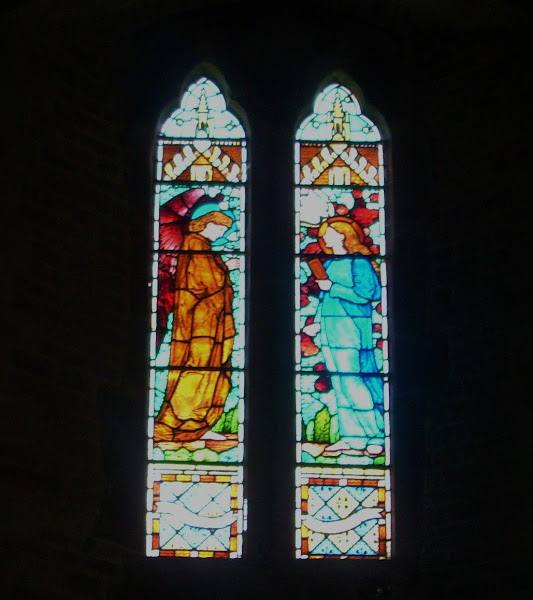
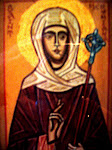
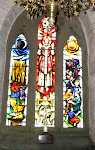
I have saved the best to last although there was a disappointment that there was no Icon or representation to commemorate St Tegfedd actually in the church. Possibly the accounts being to sketchy for the Anglican church, but feel this should have been there. Clearly there was much evidence of strict Protestantism here as the Crucifix had been removed from above the altar area and a plain but beautifully polished brass cross placed on the table in front of the window, which was covered by a lace cloth and bright brass candlesticks on either side of it. The window was beautiful, containing , amongst others am image of St George. As you come into the church, it is most arresting as you look down the nave. ON each side of the large altar table were two ancient wood chairs. The area itself was far more ancient than what it contained and I have alredy mentioned the piscina. The nave was full of the wooden box pews from the 18th century onwards I would think and two ropes hanging at the back led to the bell turret, which houses two handsome large and slightly greening bells. I cold not read the inscription. The lady churchwarden was very helpful letting me in and showing me round and I was very grateful to her. She told me what the church meant to her and how she would fight to keep it open to her last breath and of the fund raising drive, where they had appealed for money from the many new people who had come to the village, which they used as a dormitory village for the surrounding big towns. They had been generous with donations but like everywhere a small group of people kept the worship alive and needed to work hard to raise the money for the fabric. They also had their own priest that they were very grateful for.
We had a lovely conversation. She talked about ‘The Bible Code’ that she was reading and I told her about Benedict XVI’s message of positivity and hope and perhaps some of you would like to go and visit here and leave a little something for it. As I left a number of people on horses were trotting down the road to the shop surrounded by other people walking and a number of small pet dogs. In the sunshine, it was marvellous and vibrant and I could see why St Tegfedd had been drawn to this place. In fact I was very peaceful and calm when I left to drive back to Cwmbran. Over the hill is the famous reservoir, to which St Tedgfedd has also given her name, where there is boating, a picnic site and some large car parks and lovely walks around. This is definitely worth a visit!The place you can get the key is written next to the door.
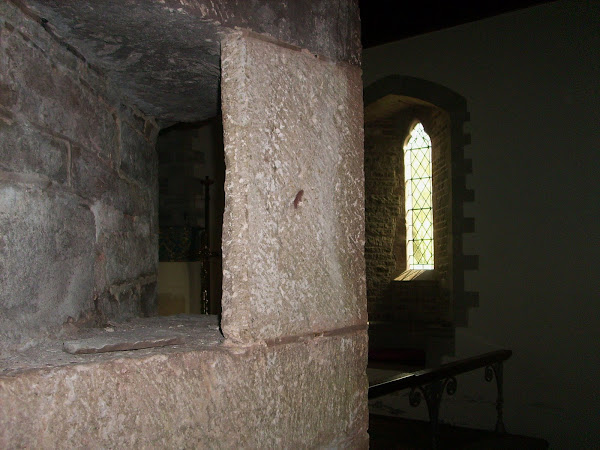
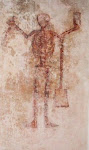
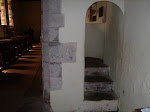
During some rebuilding work, a recess was found hidden in a wall. This probably acted as an Easter Sepulchre during the Easter Ceremonies. Diane Brook thinks the recess was probably originally the place of honour given to the holy Saint, Killed by Saxons. It has nothing to do with a large bone found elsewhere in the church. Of course it may be, that at the reformation, when such relics were destroyed, someone put this bone in there as a joke...which would have been pretty horrible.
Subscribe to:
Posts (Atom)