



Showing posts with label Caerleon. Show all posts

Friday, July 4, 2008

St Julius Julianus of Caerleon, Update


I cannot post very much today, but am just putting in an update of an exciting find.
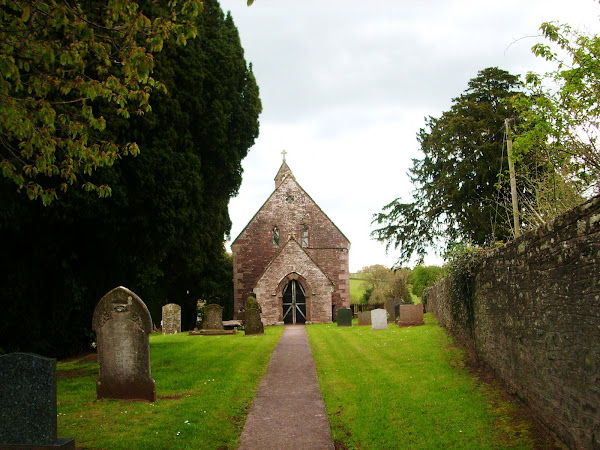
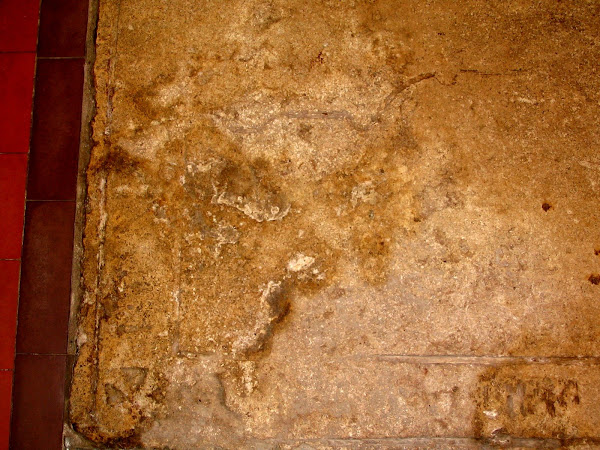
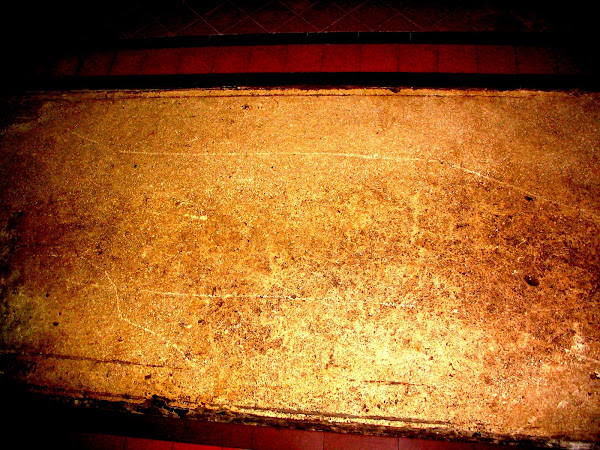
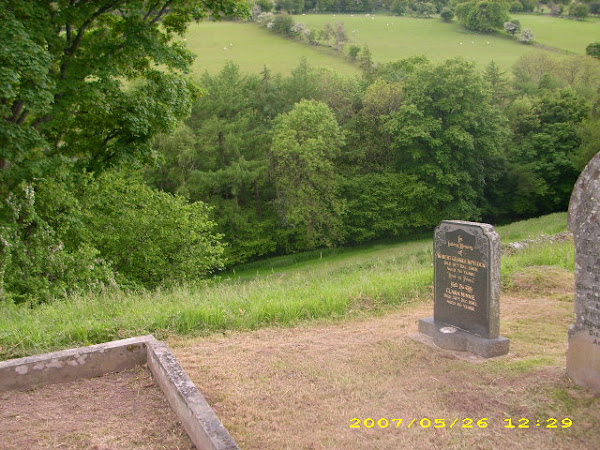
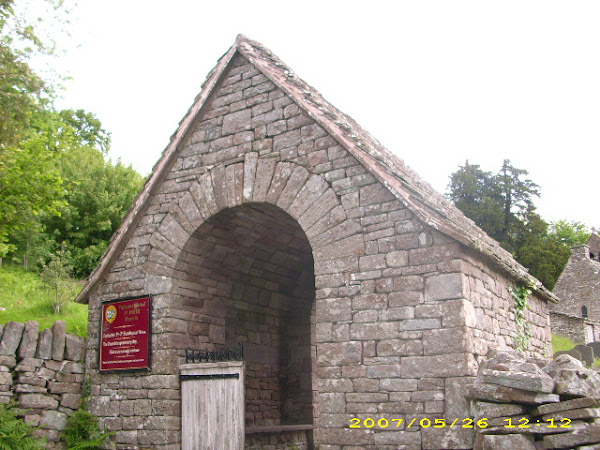
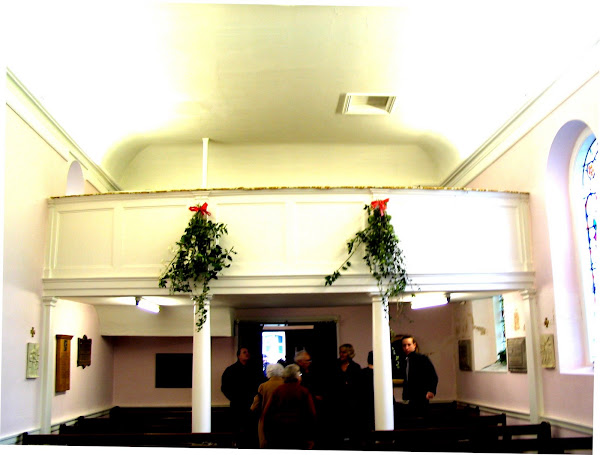
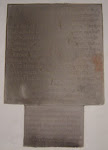
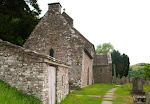
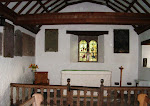
I have written to various people and so I am waiting for feedback. I recently dicovered the Jullianus tombstone inside Tredunnock Church. Tredunnock is a village, north of Caerleon but on the banks of the Usk. This stone has only recently been authenticated by the National Museum of Wales.

The Martyrdoms

At some stage during the Roman period in Gwent there was a massacre of Christians at Caerleon. Bede has it in the early fourth century, but historians believe it would have been earlier as persecutions of Christians in Britannia under the Emperor Diocletian did not happen, according to more recent scholars.

SS Julius and Aaron (associated with StAlban)

Julius and Aaron, two Roman soldiers or ex soldiers were at a mass in Caerleon-somewhere-and usually in someone's home in those days, and news was brought that they were to be arrested. Julius and Aaron quickly spirited away the bishop,Amphilabus, a native British bishop, believing it was he whom the Soldiers sought. They sent him to a friend Alban, over in Verulamium (later called St Albans). However all were arrested. Most Christians were put to the sword, when there was not enough space in the prison (300 seems to be the number, but we can't be sure of anything at this period). The legend of Julius and Aaron was they were each given a sword and given a head start before being hunted and mowed down by the soldiers. The spot where Julius fell was said to be in St Julians wood near the River Usk, obviously thickly wooded then, with only the remnants of the wood now . The place where Julius fell became a Martyrum or martyr's chapel (Merthyr in Welsh) and a church built. In later times it reputedly became a convent,where the anciful Geoffrey had Gwenhwyfar, Arthurs adulterous wife go.This somehow was wrecked, possibly because of Viking raids as they raided Gwent in the tenth century and river churches were very prone to being looted.George Herbert seems to have built a mansion on the spot in the sixteenth century.It's possible, even in its ruined state, that locals felt the site to be holy, the site of the red martyrdom of a Saint. George Herbert moved in and then this mansion too became ruined and remained into my own childhood, St Julius Chapel being incorporated as a stable or some such building. In late 1997 as the government went into creating new houses,it was demolished and the holy site now lies under blocks of gated luxury flats.

The whole area is known as St Julians with almost all churches in the area being named after the martyr. However, did Julius' body remain there, or was it the site of the martyrom that was hallowed.

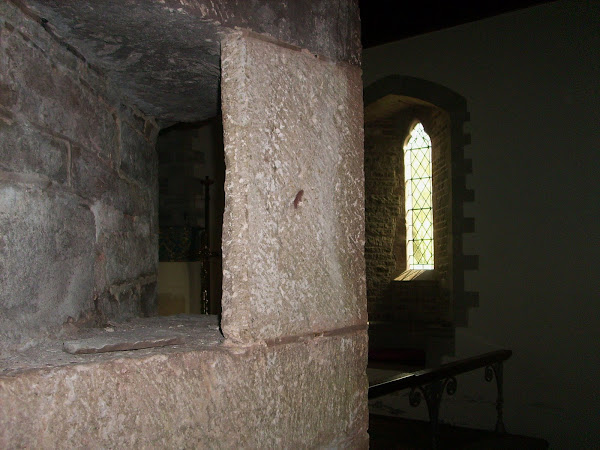
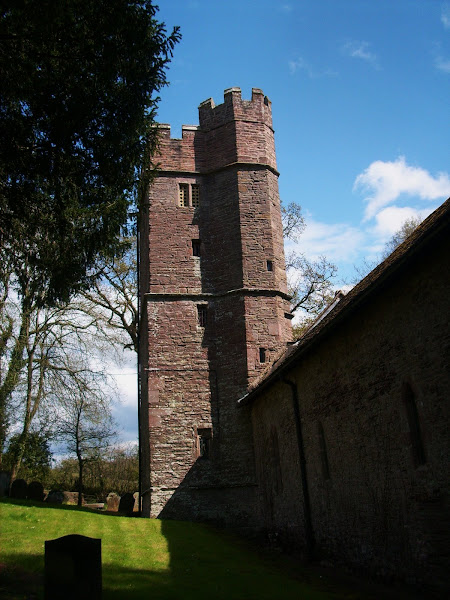
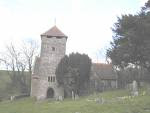
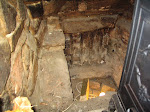
However, Tredunnock liss north of Caerleon is at the top of the Usk tidal range. A stone is displayed in the church. It was erected by hos wife. Although it says 'To the gods below' on the top, we learn this was Julius Julianus of the Second Augustan legion,, that he was 40 years old and the stone inscribed at the behest of his eife. It was buried whole, in the Christian manner, facing East, was the only such burial of honour. Tredunnock was originally a much smaller chapel. The tomb was found during the time of Henry and Edward, as local officals tried to build a nave to the church to make it suitable for more people. The finder was anxious to play down the find, especially as the new church of Henry VIII was trying to play down relics and prayer for the dead at that time. It was not in his interest to make widely known the finding of the body of a major Rom an Saint. Professor Salway in his book on Roman Britain remarks (not speaking about St Julians in particular)that this must have been a persecution earlier than 303AD whic is Bede's aproximate date.

Now I am not a history scholar, and so cannot be definitive, but it looks to me that this could be an exciting find. Fred Hando mentioned it in 'Journeys in Gwent' and saw it in 1951, but we understand it had been inside the church since the beginning of the twentieth century, but only recently authenticated. So was the body left buried under the sanctuary of the Church, where his loving wife placed it.

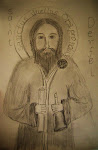
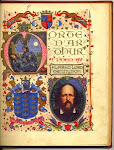
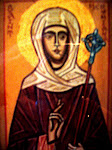
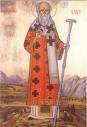
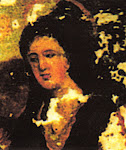
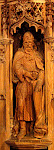
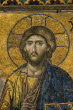
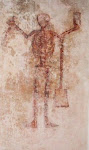
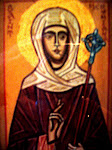
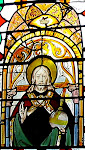
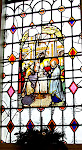
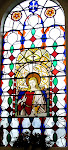
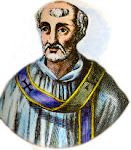
The picture of St Julius is found in St David's Cathedral in Menevia (St David's West Wales) It was impossible to photograph well as it was covered with glass and high up and needed to be done more professionally. SS Julius and Aaron were protomartyrs of Britain, the first to die for the faith in Britannia and in Gwent. At the side of the picture you can see what the Martyrum, the original little chapel set over the place were his blood was spilled , which now lies on or near the block of flats in Haisbro Avenue. There is an Anglican Church nearby which incorporates some of the stones, and I'll publish details of that later, and two Catholic Churches are named for Julius, Aaron and Alban. st Aaron's Church lies just East of Caerleon in the Llanhennock Road. A recent dig has deiscovered a Roman Cemetary around a chapel site, I believe. The area is called 'St Aarons' and a nearby field 'Cae Aeron' or Aaron's field. The dig was carried out by members of the Gwent and Glamorgan archeological society.

I am waiting to hear any further news and will post some pictures anon.

Wednesday, June 18, 2008

Apologies to All!

Hello Everyone! I have hit a very busy few days at the moment because of training people for exams, and this week particularly has been busy. I was in London on Monday and in Wales last night and am really tired this morning. I shall probably paste something a bit more substantial tomorrow when I have time off in the morning!
So I'll be back soon. In the meantime, those interested in St Cadoc, can you have a look at the link on the LHS to Llangattock Lingoed.

St Julius Julianus of Caerleon Inscribed Stone Developments

I have heard back from the Gwent Record Office re-the person who can help me with the location of the bones of St Julian at Tredunnock , where the inscribed tombstone is situated.More interesting the pathway from the river to theChurch is called Via Juliana so we may find something here.Again, it needs time and a visit. Still only in the last phase of the exams.

There are various places I would love to visit, but the middle of a fuel crisis is not the time. If anyone reading has photos of any of these places I would be grateful. I am hoping to make a pilgrimage to St Winefride's Well soon and praying for help with my leg, but want all strikes etc. to be over.

Madeleine McCann

It seems that Gerry and Kate are in Strassbourg (Twinned with Leicester) to talk to politicians about the Europe Wide Amber Alert System for missing children. I hope they are successful and that they find Madeleine very soon.In spite of all searches there is no body and that can only be good.
Bridgend Suicides

It seems a friend of one of the ast victims has died mysteriously on holiday by falling off a balcony. I wonder whether it is time to have some sort of exorcism. This can't be right that so many have died, seemingly people who have not been depressed or have any reason to do this terrible thing.

My Son the Eco Warrior

My son is driving me mad. He has gone made recycling etc and I have stuff all over the place. He comes in and tells us off if we have not put the rubbish in the correct baskets and then sifts through everything. I must add I have been recycling for yonks with separate bins for the paper and for plastics and tins. I now have a smelly bin for waste food etc at the back. Actually I could cope if he did not talk ALL the time about global warming, which both alarms and bores me. Unfortunately there comes a time when you are past caring!

Now he has started doing washing with eco washing powder!!!He has got fabric conditioner though. My delicious Heinz Baked beans are now Organisc beans with the taste taken out.My husband and myself feel we are being taken over. Luckily he is nice and kind and still at 16 goes to Mass, so I hope it is a phase. What I would like is that he would do all the recycling but not talk about it all the time. Perhaps it was a mistake to get him to do GCSE Geography.......................

Monday, March 24, 2008

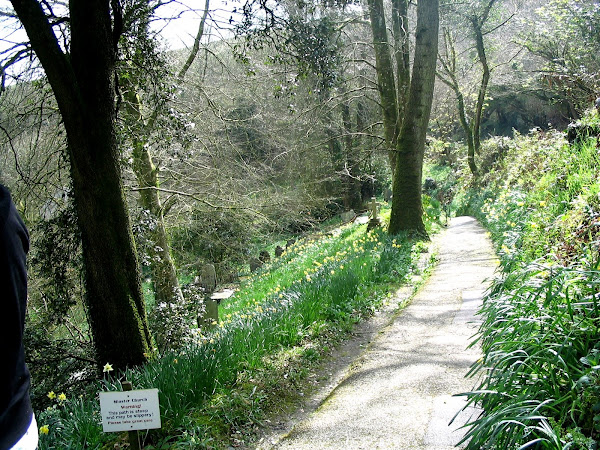
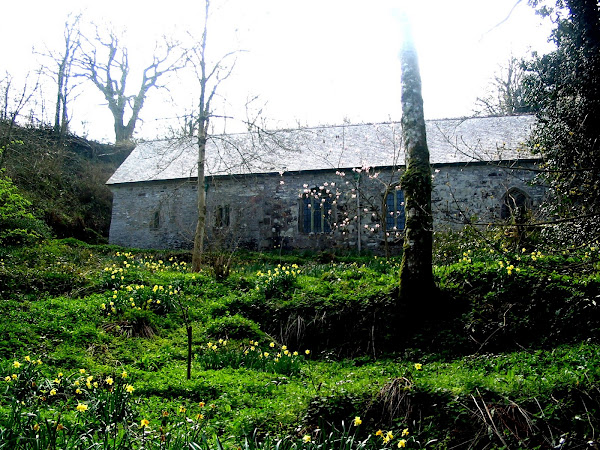
Home again! Back to the grind from the lovely land of Cornwall

Due to school terms being so peculiar this year, we sadly had to come back today and arrived on the m5 on our holiday so that our son could go back to school tomorrow. The weather had been variable and downright icy at times, but it was mainly the wind and generally was not too bad.I managed to find a Church of St Cadoc in a Cornish Book of Saints and found the following information about St Cadoc, son of Gwynlliw and Gwkadys mantioned below and supporting the contention there was a cell of St Cadocs on the site of the present Parish (Anglican ) church at Caerleon. This was originally a basilica and Temple of Jupiter.

Enya Kennerly writes:

The life of Saint Cadoc or Cadog has come down to us in a legendary form. The historians agree however that he was a real person, the son of Gwynllyw, a Welsh prince, and of Gwladus, the daughter of Brychan of Talgarth. He lived a hermit's life, as befitted a Celtic monk, but later started missionary work, preaching in a large area in Wales and Brittany. E. G. Bowen has pointed out that the word saint in the Celtic areas really meant a hermit or monk, not necessarily a saintly one. So, we do not know any facts about Cadoc's character. He founded the monastery of Llancarfan in Glamorganshire, which became the centre of satellite houses or cells. It was usual in Wales of that period that founders of religious communities were sons of princeling or chieftain families and that this kind of foundation stayed in the hands of the same families for quite long periods, the leadership becoming hereditary.

"The family of Llancarfan", as J. Conway Davies calls it, exerted its influence in Glamorgan and Gwent in both religious and political matters. The members of the family had special relations with the chief Welsh lords of Glamorgan. One of these was Iorwerth ab Owen, lord of Caerleon, who married Angharad, daughter of bishop Uthryd of Llandaff (1140-48) who most probably belonged to the Llancarfan family. This relationship may have led to the founding of the Abbey of Caerleon and here we may also have the basic reason for the building of a memorial church to Cadog in Caerleon-even if a cell had existed already in the lifetime of the saint, six hundred years before.'

Nevertheless archeological evidence for this Abbey is problemmatical. Cadoc was a very potent Saint and made seven pilgrimages to Rome and also to Jerusalem. It is possible St Julius Julanus Church was based on the South side of the river and St Aarons on the Llanhennock road where it comes into Caerleon. However, it is possible that this small chapel of St Cadoc becme the centre ofthe ancient monastery of Caerleon as there is speculation that Gwynlliw and Gwlady's base was in this magnificent Roman city, and there was a big church in Caerleon at the time when Dubricius/Dyfrig was senior bishop. Nevertheless, this is something for a detailed study, but interesting to find St Cadoc sites in Cornwall!!

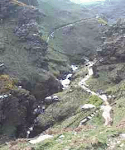
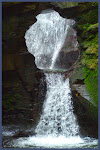
Tomorrow I will write about St Nectan. His waterfall has recently been reopened where he is buried and he is another of these Celtic hermits. The waterfall, though a climb is very much worth while.