Showing posts with label Deerhurst Gloucestershire. Show all posts

Thursday, January 15, 2009

THE BENEDICTINE PRIORY AT CHEPSTOW 2-A Lookalike!


____________________________________________________________________________
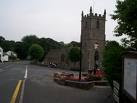
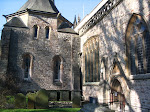
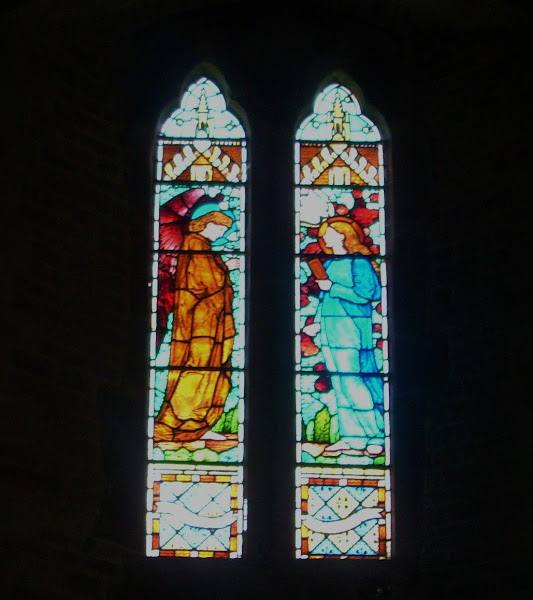
Today we will look at this priory Church,of St Mary de Crypt built by the Augustinians of Llanthony Secunda Abbey as their base in the city of Gloucester. They built up the priory church by extending the Norman Church of the Blessed Mary. These monks were from the second Abbey built near Gloucester Dock, who themselves had moved, following waves of attacks by Welsh rebels!I will blog about Llanthony Abbey separately, as it, too is part of the Norman Story.Whilst a great deal of the Norman remains in Chepstow Priory remain, interesting here is the priory building attached to the Priory Church. This church is later than Chepstow, and the interior style Early English rather than Norman. The tower is centrally placed , as Chepstow's originally was.Also, on the photo above, you can clearly see the priory accommodation in the fourteenth century building with the special window crest. I believe the Chepstow building to have been similar and perhaps L shaped.

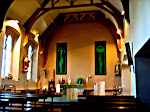
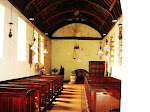
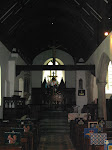
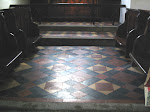
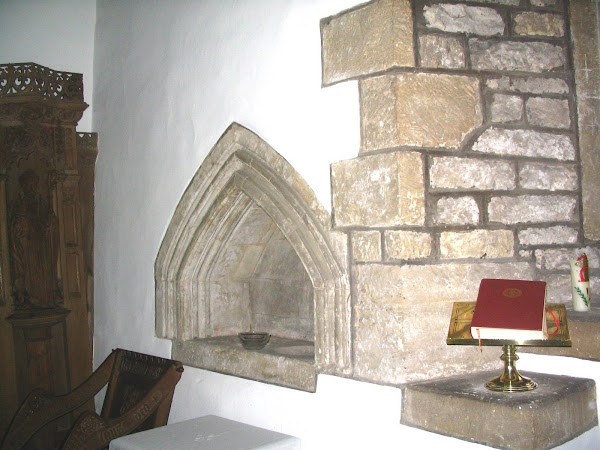
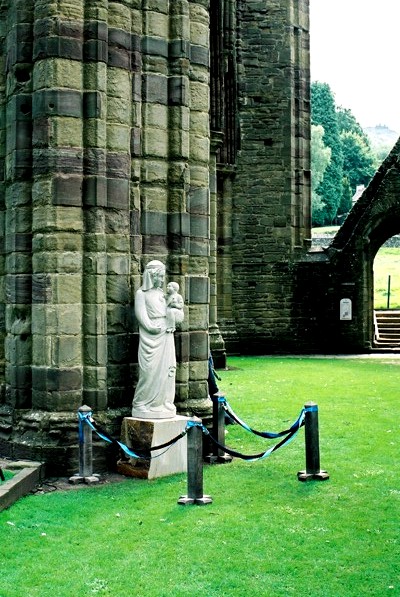
The interior of the Church is more Gothic than the Chepstow building. The Chapel in the transept remains. Formerly dedicated to Our Lady, it would have had a statue, flowers and candles, and open for everyday devotions. The Central aisle leads all the way up to the altar and what would have been the sanctuary. There in the Chancel on the right hand side is the sedillia or sacred priest's seats and the piscina, where the chalice was washed.

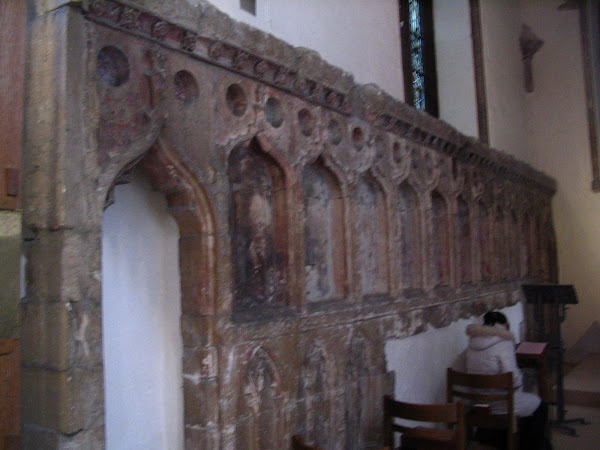
The Left hand aisle, which probably contained the Easter Sepulchre, where the consecrated host was held from Holy Thursday until the Easter Vigil. The Church is lighter and slightly smaller than Chepstow, but the St Mary de Crypt, fairly typical of the Priory building of the time (very similar to the restored Monmouth Priory)could have looked quite similar to this.The Chepstow building branching down from the South transept to the road which goes over te old bridge, the Priory accommodation spreading up along the contours of the road.

The centre had a courtyard, containing a well. The Priory also had a brewery, orchards to the north and contained a room for the priest. It must have been an equally large affair as St Mary de Crypt in Gloucester. This area of Gloucester also contains the remains of Greyfriars and the whole building of Blackfriars, the Dominicans early building, which is in fine order.

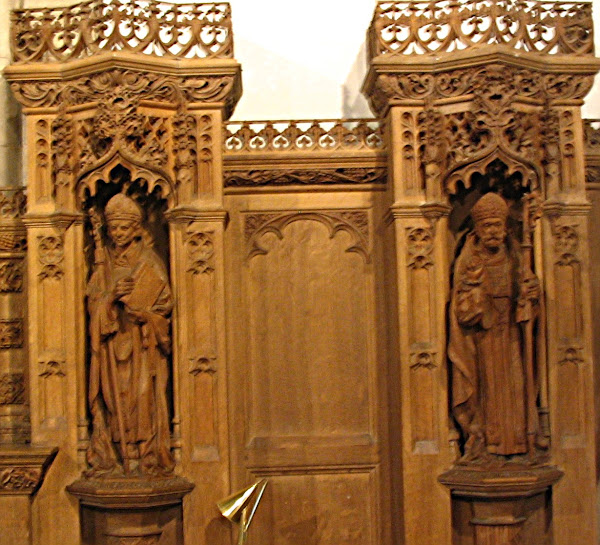
The fifteenth century nave contains an early renaissance style pulpit.When the Anglicans took it, it became the Crypt Grammar School and later Robert Raikes founded the 'Sunday School Movement' which spread all over the country. Unfortunately the administrators of St Mary's took the statue of Our Lady out and put a picture of Robert Raikes in there and this has now been called the 'Robert Raikes Chapel'. Many details are still extant from the old priory such as the steps leading to the dormitories. In all this is a fascinating church and even the head of one of the abbots of Llantony lies high near a pillar on the left hand side of the nave. Amazingly the pulpitum of the Lady Chapel has been restored and is pristine.The Easter Sepulchre area now contains a large organ, and the bells are rung regularly. The Priory interior is in a poor state of repair and closed to the pulic at present. When you look at this Priory Church, however, think of Chepstow.


Monday, January 12, 2009

The Mediaeval Priory of Striguil/Chepstow and the life of the Monks


__________________________________________________________


Later Middle Ages-Effect of the Wars with France


As with many Benedictine Priories, and priories, the nave of the church was always used by the townspeople as their parish church and the Parish Priest had is own room in the priory, and was treated as one of the monks. During the 12th and 13th centuries, these were sent from the Abbey at Cormeilles, although I understand some local men were recruited as novices.
R.C.Shoesmith, who headed the excavations at the Priory in 1973-74 said that it is doubtful that the number of Benedictines at Chepstow ever went above 12 monks (the number of the Apostles) and a Prior. The problem lay in the difficulties between France and England in the Middle Ages and the frequent wars.After the loss of the French territories y King John in 1204, relationships between the Norman French abbeys became difficult , the number decreased. In 13790 there were only four monks and the prior left.

Another Problem-Taxation

y the mid 13th century French or 'alien' priories and monasteries were eing taxed y oth the Papacy and also the Throne, which made these small priories very short of money. St Peters was falling down and needed to be rebuilt, which was a priority by the 15th century. In 1291 Chepstow/Striguil Priory had an estate of 126 hectares (311 and a half acres) with a value of £35 .19s.11d everything included.

The Black Death

The Priory and townspeople of Chepstow all suffered from the viscious swathe of the Black Death. Rents were non-existent as people died, rents were not forthcoming and monks themselves fell victim to the plague as they went about their duties trying to administrate and care for the sick. Financially, therefore, it became weakened, as did so many other monks in similar places.

Edward I

Edward I seized the lands and rents of the alien priories, and appointed commissioners to collect the revenue and provide some maintenance for the foreign monks. Also in certain cases, the foreign monks were kept within their priory under a sort of house arrent.During the Hundred Years' War there were several orders given to seize the Priory no action was taken. In Edwards time however, the the value of the revenue and rent was £45.6S.8D.between 1360 and 1369 the taxes went back to normal but when war broke out again, things got worse. None of this did anything for the prosperity of the Priory as money was salted away everywhere and in 1387 until the Prior paid a fine for custody incurred since the egining of the war.

1396-1388 No Prior or Monks-Parish Priest in reseidence

In 1398, the Abot and monks of Cormeilles granted it to Sir Benedict Cely on several conditions which included the maintenance of three monks from Cormeilles at Chepstow.In 1399, Parliament appreiated that due to the expulsion of priors and misconduct of some commissioners at the various alien priories, the buildings had become broken down and granting hopsitality to visitors and giving alms to the poor had had to cease, as the monks themselves were very poor.To change this, English men were allowed to enter as novices again and, in the case of Chepstow, the Priory was returned to Simon of Bristol (descendent of Roger de Bretuil-son of FitzOsbern) in 1400, provided he paid the yearly fee to the Abbey of Cormeilles (apport)to the King.

Further Financial Trouble

But the temporary respite was not enough.In 1414, the Priory was attached to the English Benedictines at Bermondsey Abbey, in whose care it remained. With England and Normandy rapidly going their separate way, this was a sensible arrangement and for the rest of Catholic life at the Abbey, it remained with Bermondsey.The Priory lands themselves if you take the road to the Left of the Priory Car Park , extended straight up from the priory to the town Wall, which I imagine is now the main road , then extending southwards to the river, up to the bend following on from the road where the car park is, up to the end and down to the river. There was arable land, an orchard , sheep and cows, also rents from various town houses.Nevertheless, the Priory struggled on financially. The monks also served the Chapelwithin the castle,where the Earls of Worcester had their residence. The Earl and Countess' effigy has remained undisturbed in the Priory Church in spite of the efforts of the people sent by Edward's Regent and Elizabeth as well as Cromwell.It is very interesting to see them in their colour form.

__________________________________________________________

Henry VIII and the destruction of the monasteries

Henry VIII wanted a divorce from his wife of 35 years, the daughter of the King and !Queen of Spain , known now as Blessed Catherine of England.Cast off after a succession of mistresses, including the sister of Anne Boleyn, he cast off Catherine ostensibly because he claimed he could not marry his brother's wife because otherwise 'Children they shall have none'. This was clearly not true as they had a child, Mary, also declared illegitimate. The Queen argued desperately with parliament and suffered a whole series of Cranmer's sermons but was banished , and there were reports she was later poisoned, though I have no source for this claim, told to me bya historian. Mary bravely resisted all attempts to change her faith. Henry then went through a form of marriage with Anne Boleyn after the Pope had refused to grant an annulment-as he clearly had no authority to do. Henry had also asked to be cleared of 'affinity' with Mary Boleyn (he had had relations with her, and she became pregnant and was also cast off both by Anne and Henry) The result of this was that Henry, strapped for cash seized all church lands in England, destroyed the monasteries and banished the monks. Very few got pensions and with a swathe the social services they rendered to those around them, such as the 'dole' disappeared. The issue of the care of the poor was never settled, even with the Elizabethan poor laws and the Victorian solution was the workhouse.The King made himself Head of the Church, but never found real happiness and there is a report, that on his deathbed he prayed to our Lady of Walsingham for forgiveness.More of all this later. For some of her banishment, Catherine was at Sudeley and there embroidered the famous tablecloth, for Winchcombe Priory (now St Peter's Parish Church)

Chepstow and the Reormation

Henry sent around agents 'visiting' the various Abbeys Monasteries and Priories and often these agents themselves were able to buy the poorer properties at a knock down price. The Abbey houses were often rebuilt and converted for the large houses of the aristocracy and they later were to enclose the lands and banish the peasants, whose houses cluttered the land.There also followedterrible laws against Catholics.The Priory at Chepstow was destroyed in 1536. The monastic end was destroyed, leaving the nave as the parish church with the tower. The Priory buildings (accommodation area)were destroyed 'which the said Lord King will have ordered to be demolished and removed'. The demolition took place, because as the expert Shoesmith tells us that there was a report in the early 17th century, the greater part of the prory had been demolished, with the remained converted to a parish church.(1607)

The Priory was leased to the Goldsmith of London Morgan Wolfe, citizen of London, but not the church and priory itself.

The Norman Church had been designed on a grand scale, a choir, choir aisles, a crossing with transepts and a central tower, with a long nave and North and south aisles.In the Victorian times, the monastic end had been rebuilt as a high altar . 1841, the nave aisles were removed, and the Eastern End , crossing and transepts will be rebuilt.Shoesmith says the size of the windows of the tower 'giving some slight impression of the aspirations of the Norman founder and the builders.

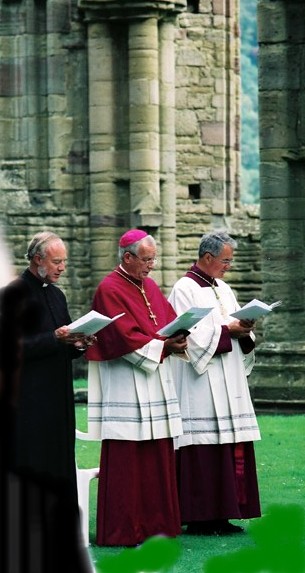
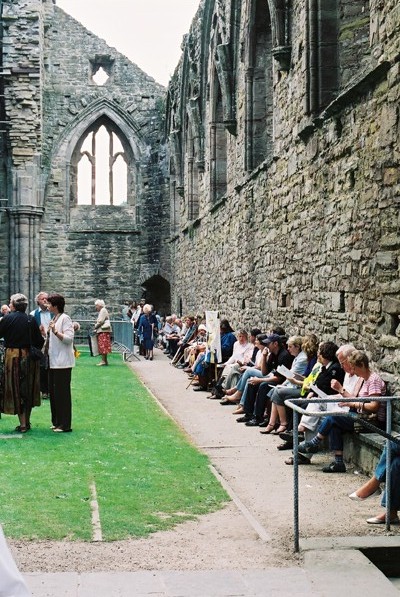
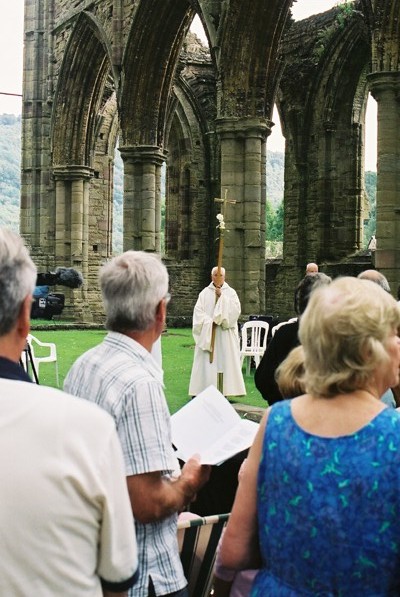
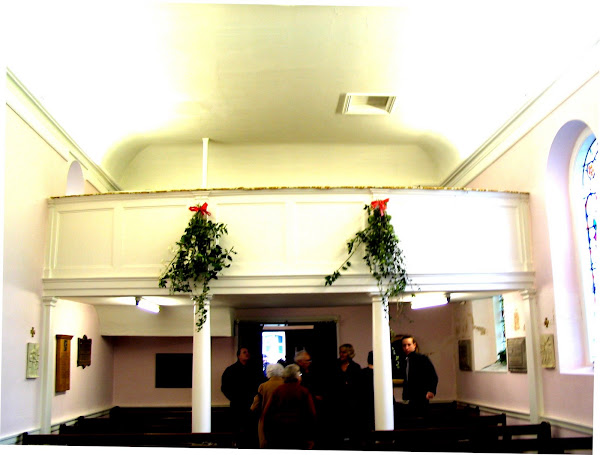
On my visit, I was amazed at the size of the chuch and its antiquity,and feel it is one of Wales best kept secrets. The Priory is open most days for viewing and there are many artefacs, like the Millenium tapestry above. Also golden angels. The piscina of the original Abbey church still remains, although the sink has been blocked up, ut there is an element of huge grandeur. The Church is well used by the people of Chepstow and a Mass was recently held there by a French group of pilgrims to Tintern Abbey. Concerts have also taken place there. Everyone in the area should visit this wonderful Abbey Church and the kindly wardens, who keep it open for prayer and viewing by anyone.

Later this week I will post some pictures of the Gloucester Church of St Mary de Crypt, which although Old English in Style, has a Priory building similar to many priories of the period, and whose tower remains in situ in the middle. St Mary de Crypt has recently had a rebuilt stone pulpitum.

Saturday, December 20, 2008

On the Fourth Advent Sunday! 21st December 08


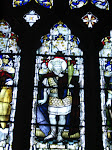
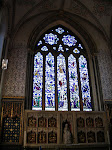
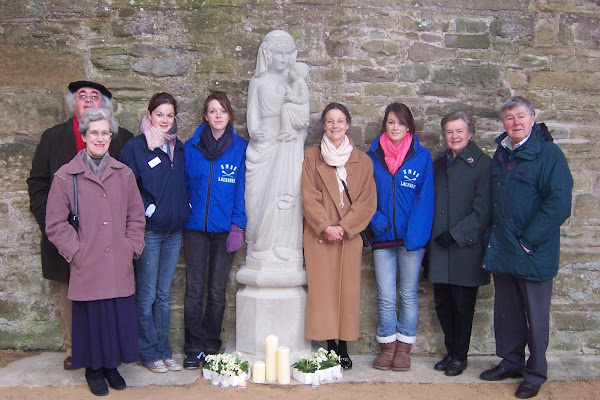
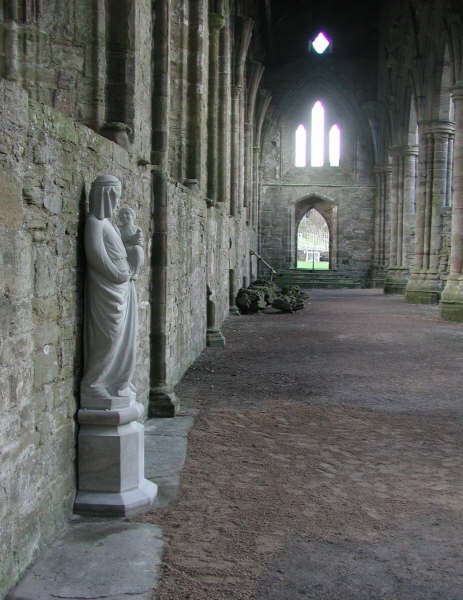
Modern Celtic Woman Rendition of the Wexford Carol, by Maev from Wales! I have, in the last two weeks posted three podcast programmes on Mary in Monmouth, which should bring us to the end of our current study of the Story of Christianity in Britain up until the end of the first Millennium. Of course there are ommissions and as I can get into see places-even Celtic places I have not been able to reach yet, I will do a little flashback, but am concentrating next year on the Religious Houses of Gwent, most of them now Anglican Parish Churches, except for the Cistercian Abbeys like Tintern and Llantarnam, which is DG still used as an Abbey by the Sisters of St Joseph of Annecy. The events have moved fast, a new and beautiful Statue plus the news that an Indulgence under all the usual conditions (confession, Mass etc) is still in force for those who visit the shrine. A great Grace is that Cadw the government body looking after the abbey is making a house available as a Pilgrim Centre. In St Michael's in Newport and ur Lady and St Michaels in Abergavenny, we have the news that the Tridentine Mass is once again being offered thanks to the Pope's 'Moto Proprio'and that it seems there has been an upsurge in new vocations to the Priesthood. Am perturbed that very few churches are offering Midnight Masses at Midnight. They seem to have slipped to 9pm which is too early for us, so we may pay a visit to the Anglicans this year and go to Mass in the Morning at St Mary's in Newport, the Church where I was married and our son was baptised. I think I have covered most of the materials from the podcasts on the blogs before, but they also contain some surprises! I am sending a special Christmas Edition of the Mary in Monmouth Podcast on Christmas Eve itself and hope you will download via iTunes or listen at this link http://maryinmonmouthshire.libsyn.com/rss or simply type it in at the iTunes store! These are all images of the former St Peter's Abbey, (Benedictine) Gloucester not Gloucester Anglican Cathedral. The recordings of the Victorian Medley and 'O Nata Lux de Lumine' were made here in the North Transept above the choir.Interesting was a stained glass window pane with an image of Pope Clement on it!At St Neot's I saw a stained glass pane of Pope Urban. Resonet in Laudibus (14thCentury German Christmas Hymn) Resonet in Laudibus 14th Century German Carol Resonet in laudibus, (Resound in Praise) cum jucundis plausibus,(With jocund shouts) Ecclesiam cum fidelibus (Who appears with the Faithful of the Church) apparuit quem genuit Maria.(to the Holy One born of Mary) Christus natus hodie, (Christ is born today) ex Maria virgine, (From the Virgin Mary) sine virile semine: (Without the seed of Man) apparuit quem genuit Maria. (He appeared who was born of Mary) Pueri, concinite, (Boys, celebrate) nato regi psallite, (Sing psalms to the King) voce pia dicite: (Speak with a pious voice) apparuit quem genuit Maria (.to him who appeared born of Mary) Sion, lauda Dominum, (Zion, Praise the Lord!) salvatorem hominum, (The Saviour of Mankind) purgatorem criminum (The Criminal of Purgatory) apparuit quem genuit Maria. (Who appeared, born of the Virgin Mary) Sunt impleta quae praedixit Gabriel,(As it was explained by the Angel Gabriel) Eia, Eia, (Lullay Lullay) Virgo Deum genuit (The Virgin bore God) quem divina voluit clementia.(Whose divinity wishes clemency) Hodie apparuit, (Today he appears) apparuit in Israel, (He appears in Israel) ex Maria virgine: (Out of the Virgin Mary) est natus Rex. The King is born)

Thursday, October 2, 2008

GWYNLLW's CHURCH IN NEWPORT-now ST WOOLOS CATHEDRAL


_____________________________________________________________________________

GWYNLLIW and HIS VISION - ORigin of St Woolos

CONVERSION OF A PIRATE!

When Dyfrig/Dubricius was Bishop of Caerleon, Glywys-(Glaoo-iss), a local British chieftain governed one of the districts of Gwent. When he died, his land was divided between his sons, but only one Gwynlliw Farfog (The Bearded) was able to fight off marauders and keep the kingdom intact. He exceeded all his brothers in nobility and prowess in battle and was such a worthy prince, and ruled so well that peace ws established throughout the district all his life. He was based in Caerleon, which was still a magnificent city.

After a while, Gwynlliw (Gwinn-thloo)wanted to marry, and found a bride in the beautiful princess Gwladys born at Gwynllwgat Bochriwcarn in Gelligaer, around 497,daughter of a neighbouring prince. Their marriage was happy and they had a noble son, Cadoc, who was a very holy and good person to whom the Church (and hospital)at Caerleon was entrusted in a dedication. he Church was built on the site of a Temple of Jupiter in the centre of the city. Cadoc (baptised "Cadfael" by St. Tathyw)begged his father to think of his immortal soul At a young age Cadoc had been sent away to be educated by this Irish saint (Tathyw) at his monastery in Caerwent. For Gwynlliw had killed many people to achieve his peace

. The saintly Gwladys and Cadoc prayed that Gwynlliw would repent of his sins and turn to God. Fred Hando writes the fierce Welshman revelled in his adventures and scorned the prayers of his saintly wife and son’

Near the mouth of the Usk (Wsg) in a creek called Pill Gwenlliw ,he kept a long fast boat and it was his custom to go out into the Bristol channel with his men and attack passing ships, killing the crews and stealing the cargoes.
One night, so tradition has it, he was visited by his Guardian angel, who told him to leave his worldly possessions.

VISION OF THE WHITE BULL and THE FOUNDATION OF THE CHURCH OF THE BLESSED VIRGIN MARY (Llanfair)


The angel instructed him that on the hill by the banks of the river, he would discover a white ox with a black spot between its horns. The land where he found the ox would be uncultivated and there he must live and labour. Gwynlliw and his wife went out , and discovering the ox on the side of an ancient hill fort, where the angel had told him , he built a cell on the hillside overlooking the sea, and the site of modern Newport. There he also erected a Chapel for prayer and meditation dedicated to the Mother of God, whom he thought should intercede for him with God, because his sins had been many and he thought Mary would plead for him.

GWYNLLIW PASSES TO THE NEXT LIFE

Finally he was became very ill and when he knew he was dying, sent for Cadoc ,his son and Dyfrig (St Dubritius) the Archbishop, who came to comfort him in his last hours. Dyfrig heard his confession and gave him the last Holy Communion (Viaticum)so he would die with Christ. He was buried at a spot which was situated immediately above the entrance to the present tunnel which penetrates Stow Hill. So Gwynlliw is buried underneath the present St Woollos Cathedral (dedicated to Gwynlliw) and the present beautiful Catholic Church of St Mary is also sited nearby and has a stained glass window dedicated to Gwynlliw as well as David .Gwynlliw was regarded as a Saint, because he was a reformed sinner and had devoted his life to Christ.He had been obedient to God’s message by the angel and, like Mary, had been obedient to God’s Will and had done what God had commanded.

ORIGINAL CHURCH BUILDING

The original Cathedral was built of ‘boards and rods’ and was built in the sixth century .This was known as ‘mud and wattle’. The little Chapel to St Mary (Llanfair) nestles between the tower of the cathedral and the nave of St Woolos (St Gwynllw). The sixth century building was replaced by a stone chapel, part of which probably survives in the stone of the walls. Fred Hando says ‘From the ancient chapel the view of the Norman nave is magnificent , seen through a semi-circular arch .This arch was never an exterior doorway and is itself unique , in that its detached pillars have a Roman character and may have been brought from Caerleon.

St PETER's ABBEY, GLOUCESTER

Two steps lead down to the nave. St Gwynlliw’s has, from earliest times had a close connection with St Peter’s Abbey and now Cathedral at Gloucester.and it may be that Benedictine monks from Gloucester raised the first beautiful arcades in the Newport Cathedral. Of one thing I am certain, no man who has ever attended service in summer under those grand old arches will ever forget them

THE LEPER WINDOW

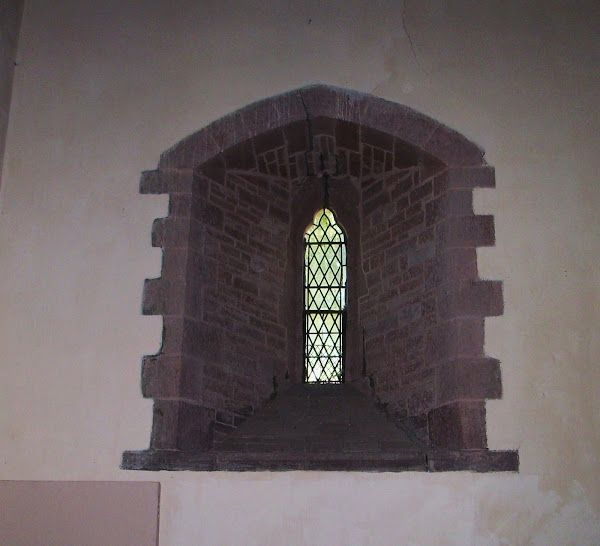
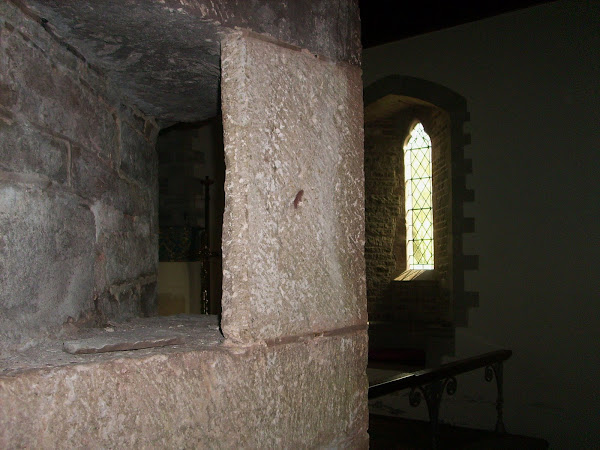
Fred Hando also mentions that from the rising floor of a chancel is an ancient window, still called the Leper Window so that through the open window, lepers could take part in the Masses and Prayers of the Hours. Lepers were, however sadly forbidden entrance to churchyards and this was a ‘sacring’ window and the sanctus (holy) bell was rung at the consecration of the host, at the hours and at the Angelus so that all the people working in the fields would stop and pray facing towards their church.

ST WOOLOS AND HAROLD GODWINSON

The ancient church of Our Lady and St Gwynlliw on the hill served as a beacon for King Harold and his Saxon brothers, his mother sister and daughter had viewed it during the twelve long months refuge on the Holmes. William the Conqueror and William Rufus had looked on the church: outside the walls the solders of Rufus had camped and then knelt inside. Henry II had travelled past on at least two occasions.

GWYNLLIW SITES AROUND NEWPORT

Gwynlliw was named after his kingdom From this name comes, as I have said ‘Pill Gwenlly’(Pill), Wentloog (Gwynlliwg-gwinn-thloog) (The area around the ‘Lighthouse’ Peterstone and Church of St Brides)Wentwood (Coed Gwynlliw) ‘Gwynlliw’s wood’(situated to the left of the A48 if you are travelling to Chepstow. There is ‘Netherwent’ as in St Bride’s Netherwent-Lower Gwent. Even the Royal Gwent Hospital is named for St Gwynlliw. The legacy of Gwynlliw is all around and he recently gave his name to the Welsh medium secondary school in Pontypool.

The County called Monmouthshire was created because it was attached to the Oxford court circuit (assizes)in the time of Henry VIII, who was also trying to 'extirpate 'Wales '. It should me mentioned again, that large tracts of Gwent were owned and colonised by Saxons (English ) before the Norman invasion of William the Conqueror as seen in the deeds of the monasteries who, in turn took their lands. The charters of Bassaleg names –Kenered, Wilfrid, Kadmor, bear testimony that there were established Saxons wielding power in the twelfth century, since Harold Godwinson’s Saxons had conquered most of lower Gwent by the time of the Battle of Hastings.

We shall return to St Woolos again, as it contains many treasures from later times, but it was a monk of St Peter’s Abbey in Gloucester who wrote down the details of the Life of Gwynlliw, and we must be grateful for that.

Harold Godwinson attended Mass here.

Gwynlliw married the glorious Gwladys of Brecon, one of the holiest families in Wales , decended from the family of Joseph of Arimathea. His son, Cadoc was one of the three Grail Guardians and one of the greatest monastics and saints of Wales.His children , Maches (martyred) Cynydir and many others I have written about here. St David probably visited here on the way to see Dyfrig/Dubricius at Caerleon.

This hill saw Gwynlliw’s ‘bull’ vision, where he had to build his church of Our Lady.

It was from here the Angelus prayer would be rung by morning and evening to people working in the fields from earliest times, and to tis building they would turn in their prayer.

Here existed a long standing llan, an early monastery , founded by Gwynlliw and tended for hundreds of years by successive monks and clergy. Here Mass would be offered and St Woolos part of a network of such ‘llans ‘ where the early holy saints of Wales moved around and on route to Rome and Jerusalem. Cadoc made 7 separate journeys to Rome during the time of 7 Popes.

Gwnlliw’s bones became holy relics and a shrine emerged in Mediaeval times, where many implored the help of the Soldier Saint for help with their prayers, where they left flowers and votive offerings and candles.

SHRINE OF TE RELICS OF GWYNLLIW STILL AT ST WOOLOS

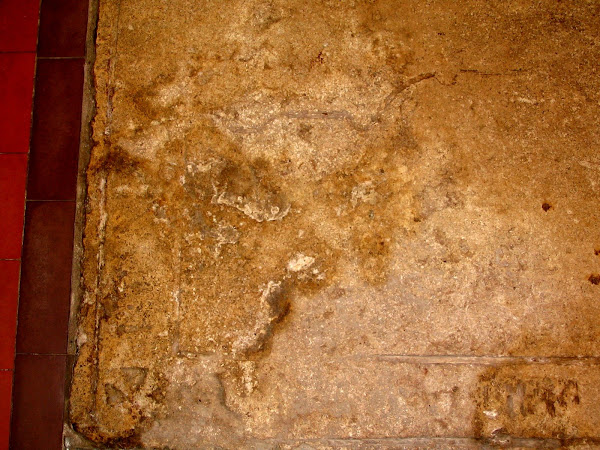
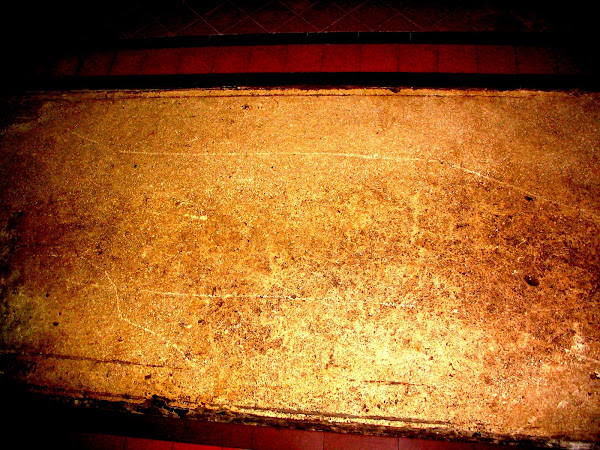
All this was, of course smashed up during the sixteenth century, but it seems the relics of Gwynlliw were thankfully kept and buried under the floor of the nave (see picture above)

ST GWYNLLIW's WELSH SECONDARY SCHOOL

This is a Welsh medium school in Pontypool.

Today the podcast ‘Praystation Portable’ carries all the morning and evening prayers right into your iPod, as well as the Rosary. Good to sit up at St Woolos and pray the Rosary, a meditaion on the life of Christ , or the Liturgy of the Hours. The Benedictines cared for St Woolos until the sixteenth century, and were responsible for the buildings.Interestingly there is a lot of evidence of stone and columns and pillar being brought from Roman Caerleon. A Knight of the Crusades lies buried here. There is much to enjoy and an excellent Guide Book. St Woolos now belongs of course to the Church in Wales. It was extended with stone from Kemys Inferior Church, in the 1960s I think and is very interesting to view.

Wednesday, July 2, 2008

SAXONS!!!!! Earl Odda- Mary is in England!

_____________________________


The chronicler Florence of Worcester described Odda as "a lover of churches, restorer of the poor, defender of widows and orphans, helper of the oppressed, guardian of chastity".___________

God is wonderful in his saints.

Apologies to the Monmouthshire Groupies!I've gone over the border!

Apologies to my Monmouthshire groupies. An insanely busy period of work has halted my rampaging around the Celtic Saints and their foundations. We have covered many topics so far, although I am planning to revisit a few, and Hey! If you have any special requests.....let me know at Maryinmonmouth@googlemail.com. If you would like an article on your Monmouthshire church (dated before 1000 at the moment!) let me know too. I am still going to attempt our beautiful Church at St Woolos, Gwynlliw's foundation.Talk about St Deiniol-at some stage manage to get into Henllys Church,find my files on Rockfield and attend some churches in the North of the COunty and the holidays will be great for that!!
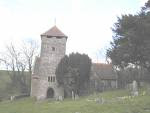
So today I am in England, in Gloucestershire and my visit is to Deerhurst .From Tewkesbury down the A38 south towards Gloucester. About three miles on, turn right on the B4213 and follow signs to Deerhurst, or vice versa if coming from Gloucester.
____________________________

The Chapel-Free to Visit (English Heritage)

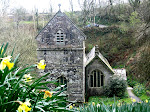
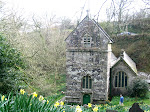
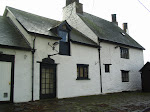
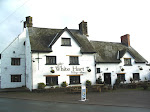
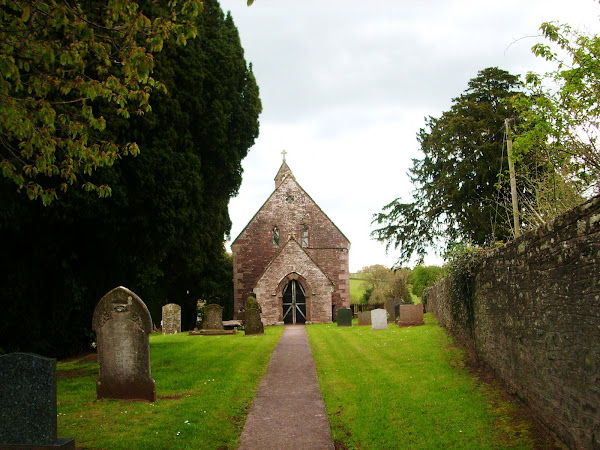
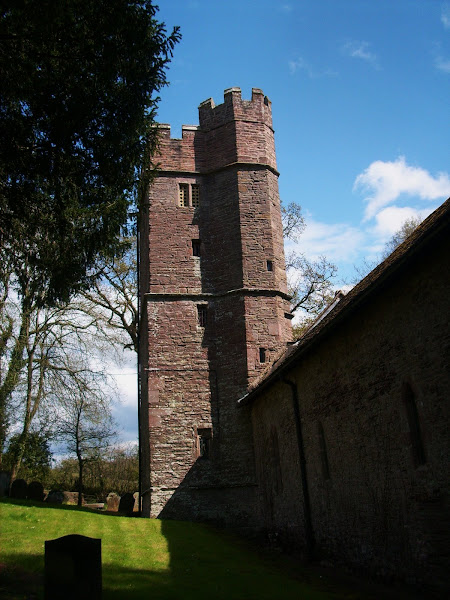
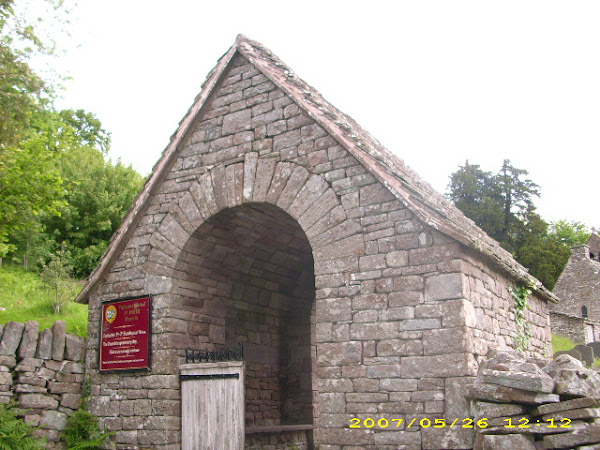
Odda's Chapel is a tiny Saxon chapel now built into a medieval timber-framed farmhouse which obscures the eastern chancel.Quite possibly the timber framed home was the last of the series of palace buildings around Earl Odda.

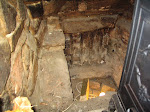
There are only two-cells with characteristic Saxon long and short quoins. It is very plain inside, but retains its original chancel arch and there are a number of Saxon windows.

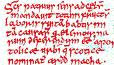
Its importance was only recognised in 1885, despite the fact that an important stone inscription was found nearby some two hundred years before. A copy is on display:

___________________________________

"Earl Odda had this Royal Hall built and dedicated in honour of the Holy Trinity for the soul of his brother, Aelfric, which left the body in this place. Bishop Ealdred dedicated it the second of the Ides of April in the fourteenth year of the reign of Edward, King of the English."
[12th April 1056]


____________________________


Earl Odda-a Kinsman of Edward the Confessor-Last King of Saxon England died 1066

Odda is a well known figure of the period. He was Earl of Hwicce and a captain of the Royal Fleet, not to mention, a kinsman of King Edward the Confessor.

As we can see from the stone, he and his brother, Aelfric, built (or rebuilt) a large palace complex here which included the chapel similar to that excavated at Cheddar (Somerset). Both men are known to have died at Deerhurst and to have been buried in Pershore Abbey.

Earl Odda, also known as Odda of Deerhurst, was an English aristocrat. In 1051, following the exile of Godwin, Earl of Wessex and his sons and the confiscation of their property and earldoms, King Edward the Confessor appointed Odda as earl over a portion of the vacated territory.This was the time when they were in exile at Flat Holme near Monmouthshire. Harold Godwinson was later to return via Porth Iscoed conquering parts of Gwent and worshipping at St Woolos.

This earldom comprised Somerset, Dorset, Devon and Cornwall. Odda was one of the commanders of a fleet which was sent out in 1052 to patrol against any attempt by the exiles to return.

However, Godwin and his sons nevertheless succeeded in reaching England, raising an army and compelling the king to revoke their exile and restore their lands and earldoms to them. Thus Odda was deprived of his earldom within months of receiving it.

_____

Odda himself died at Deerhurst on 31 August 1056, having been ordained a monk by Bishop Aldred of Worcester, and taken the monastic name Aethelwine. He was likewise buried at Pershore. After Odda's death, as he had apparently left no heir, his lands passed to King Edward.As we know, Earl Harold did no better losing Angle-Land to the Frenchman William of Normandy, dying at the Battle of Hastings.

After Odda's death the parish church and its estates were given to the monastery of St-Denis near Paris. Deerhurst became an alien priory, a cell of St-Denis and Odda's own lands were given to Westminster Abbey. Subsequently, after the Norman Conquest, Deerhurst being divided between two distant landlords it lost the importance it had hitherto enjoyed.