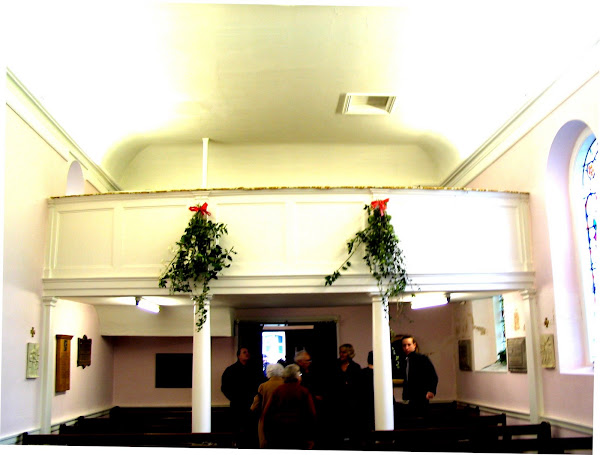
Thursday, November 6, 2008

St KEYNE'S WELL (CEINWEN)


________________________________________________________

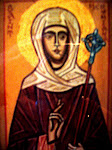
St Keyne was not "a fair lady who went round Cornwall doing good and cast a spell upon a well" as at least one website has written.

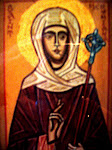
She was a Princess of the Christian family of King Brychan Brycheiniog of Brecon and aunt of St Cadoc who often visited her on the way back from Armorica (Northern France) and walked through Cornwall to return to his various monasteries. Keyne is thus closely linked with Gwent, her sister, Gwladys having married the pirate saint Gwynlliw and hence produced St Cadoc, who eventually became King after his father.The names Cadoc and Keyne are found together in a number of places and there is a langattock in sevral places in Cornwall, including Harlyn Bay.Statements in a mediaeval life of St Keyne, together with the names of places which commemorate here give us an idea of her life.She began by leaving Wales, a consecrated Virgin or nun after the manner of St Tecla and St Winifride and first went to the banks of the Severn where she founded a small settlemtn-possibly on the very site of the St Tecla's monastery in the small piece of land between which there are now the two Severn Bridges.She can be traced to Herefordshire and can be traced to Keynsham and she made numerous missionary journeys and is commemerated in St Martin in Looe and at St Keyne itself between Looe and Liskeard.

Her Well is fascinating

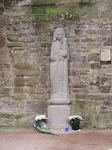
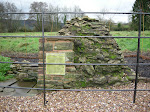
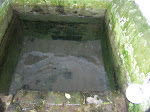
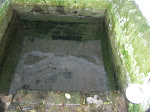
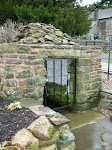
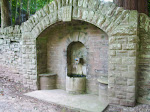
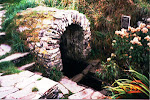
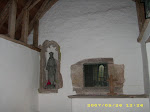
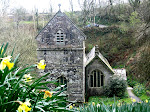
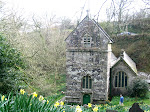
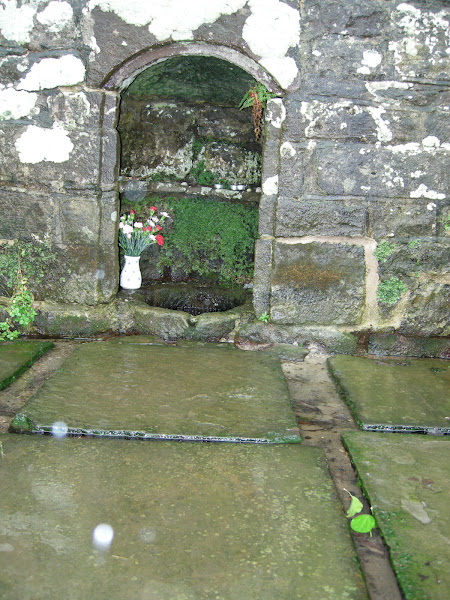
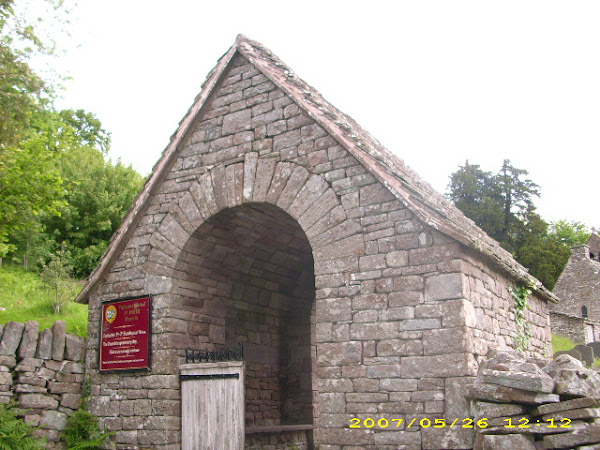
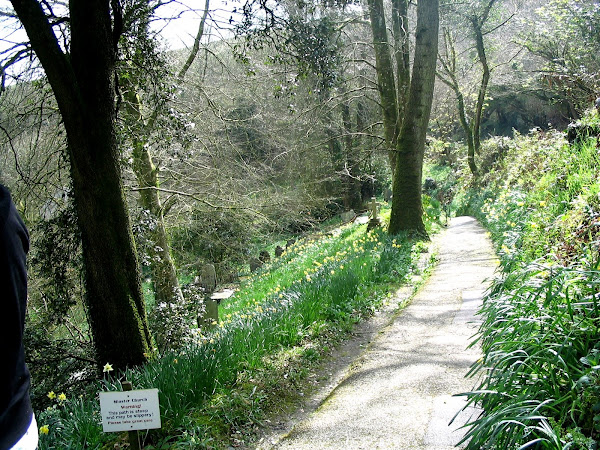
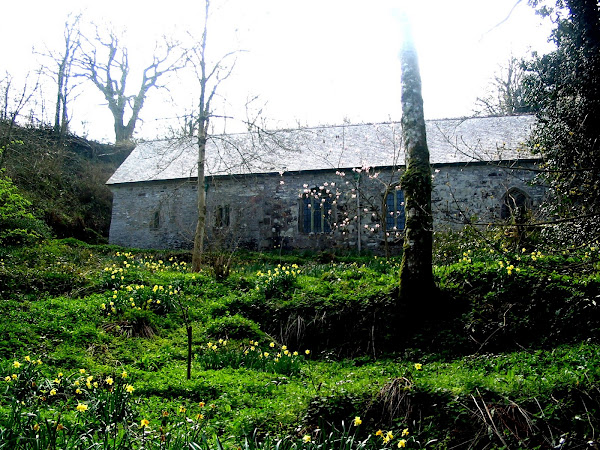
This is abut half a mile from the church on the hill, which was probably the site of the original monastery. The well is in fine condition. It has been restored by a local charity and flowing water runs from the spring into the little pool, which has a traditional cover on it, shaped like a small house.It is often adorned with flowers, remembering this fine woman who spread the news of Jesus Christ at a very dark and dangerous time.Because it is a Holy Well, used for baptisms and no doubt a water source as well, it is almost a magical place and a lot of legends have been made up about her. She is said to have been a kind lady wandering round in COrnwall doing good for people and then casting a spell on the waters, that whoever drinks of it, if it is a newly married couple, one will have mastery of the other.A quaint tale, but the truth is so much more amazing.

A Welsh princess from the Holiest family in Wales, descended from the line of Joseph of Arimathea is a consecrated virgin, travelling with a priest and various other religious to dark parts of Cornwall-as in my blog and podcast about St Materiana of Tintagel. She comes to rest in this part of Cornwall and sanctifies her own monastery doing good works of healing and praying the Divine Office, the prayer of the Church. She is visited by a gread Bishop, Saint Cadoc who made seven trips to Rome in the time of seven Popes and created a beautiful community, where love and care was paramount, and of such goodness, that a thousand years after her passing on to the Lord, she is still remembered with a smile, and people still place flowers on her well. She probably lies in the churchyard of the present church, though her relic may have been destroyed at the 'Reformation.' Isn't that a more amazing story. St Keynes Feast Day is on October 8th!

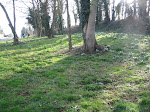
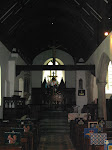
We came upon this prettyplace at the bottom of a hill where she lady's church (though reincarnated in a Norman re-incarnation stood) and almost gasped at it's real atmosphere and beauty. A place of peace and prayer and definately off the beaten track.

Tuesday, November 4, 2008

Well, Well, Well!-St Clether , St Keyne and St Guron Part I


Holy wells were once very important to the Welsh people and that they existed in quite large numbers.Our pagan ancestors regarded wells, springs, lakes and rivers as the abodes of gods. No doubt a range of ceremonies were associated with them and they remained dear to the populace.

In the year 601 Pope Gregory instructed missionaries to destroy the idols of Britain but to purify existing temples. Ancient pagan sites, including wells, gradually came to be associated with the early missionary saints.

Many of the wells were roofed and acquired small chapels with niches for statues of saints but over the centuries the upheavals in the religious life of Britain led to the desecration and destruction of many old shrines and the majority of the old well chapels disappeared, although many remain in remote places in Cornwall, where they are restored and venerated.

Ffynnon Fair Penrhys was a south Wales well belonging to Llantarnam Abbey at the time of the dissolution of the monasteries. In 1538 Thomas Cromwell, vicar-general to King Henry VIII, ordered that the effigy of the Virgin Mary be removed "as secretly as may be" and the "Image and her apparel" were sent to London to be burned. The country folk were not easily swayed by the reformers and intellectuals of London, however, and pilgrimages to holy wells continued.

St Winifred's Well at Holywell


St. Winifred's well at Holywell has survived with associated buildings intact. The well and chapel were granted by the Countess of Chester to the monastery of St. Werburg in 1093. Later, possession reverted to the Welsh lords and in 1240 Dafydd ap Llewelyn granted it to Basingwerk Abbey. Kings Richard I and Edward IV are said to have made pilgrimages there and in 1439 the Countess of Warwick presented her "russet velvet gown" to the chapel (an early example of the present trend in which famous people donate garments for the benefit of favourite charities). Richard III met the cost of maintaining a priest at the well. The present architectural remains resulted from the largesse of Lady Margaret Beaufort, the mother of the future King Henry VII.

It is possible that she prayed there for his success and when he was indeed victorious at the Battle of Bosworth Field in 1485, the Tudor dynasty attained the throne. The Tudors were proud of their Welsh ancestry and the royal connection seems to have accounted for the survival at Holywell. some of the wells retained their ancient associations despite the religious and social upheavals of the centuries. Francis Jones notes the way in which wells often figure in the "Lives" of the saints. The surviving manuscripts date from around 1100 to 1400 and the theme of a saint's battle with dark forces at the site of a well is commonly encountered. Giants, demons (and sometimes women!) slew or were slain by saintly figures and the Lives confirm that even after the many hundreds of years in which Christianity had been the state religion, the wells were still associated with the ancient pagan beliefs of the Celts.

My trips to the three wells we are to discuss, were all undertaken in the last days of October in 2008, and were real treasures. St Clether even had its ancient holy chapel intact as it had been rebuilt by the Normans and kept as a Baptistery.There was a strange experience there too.

BODMIN ST GURON AND ST PETROC

Bodmin is a fine historic town which was mentioned in the Domesday Book. The name Bodmin is thought to derive from the Cornish 'bod' meaning dwelling and 'meneghi' meaning monks.

Bodmin has a long association with religious history being home to Cornwall's largest parish church, dedicated to St Petroc. The church contains an ornate ivory casket which is reputed to have held the bones of the Saint.

WELLS OF BODMIN

St Guron's Well

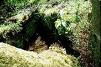
A holy Well, dedicated to St Guron is to be found at the foot of the present St Petroc's Church. St Guron is traditionally held to be the original founder of the llan or monastery there, however the arrival of St Petroc, the Great Evangelist obviously superceded him. What is more interesting is that at St Gurons, two strange heads seem to be looking over the well, and perhaps this could be why St Petroc built his well further up by the Church area (where presumably he built or established his own church in later times. These two heads could be gargoyles, chasing away evil spirits from the Well-they certainly look threatening.


St Petroc's Well is situated in the valley close to the church.

In the churchyard is another Holy Well believed to date from around AD 510. This well is dedicated to St Guron, who is thought to be the original founder of Bodmin, pre-dating St Petroc.

Alternatively, the fact remains Guron may not have been a saint after all. The name 'Goronwy' is an old British Druid name, and it could be a link with Druid religious rites. Petroc maybe built his own well to draw people away from the practice and clearly very successful.As the Druid religion also embraced another World, however, it proved simple to present, as many Druids have said a fulfilment of Druidism. They had human sacrifices and so a Crucified Christ felt very close to them and put an end to all need of such things, especially as Christianity offered everlasting life and the holy springs bubbling up from the ground still a symbol of the new life of Baptism by Water and Spirit.


Saint Petroc established a monastery here in the 6th Century after going on a White Martyrdom from Padstow, where he landed and it is from this ecclesiastical settlement that the town grew. Later in Mediaeval times, it also got a Benedictine Priory and finally the Franciscans arrived in the later Middle Ages. It is possible that St Petrocs was reorganised by the Normans into an Augustinian Monastery, though it could equally well also become a priory administrating for the Norman Overlords.

As we can see, the well of St Petroc, (no doubt the new house is a Mediaeval building) and contains a Christian relief or a young woman praying at the well. The young woman appears to have had her head knocked off in an attack probably by Cromwells men or perhaps a casual vandal. Sadly I could not get into the church of St Petroc, which is said to be the largest in Cornwall.

St George of England, Brychan Brycheiniog's family and that Heavenly Stained Glass

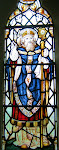
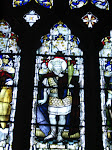
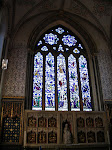
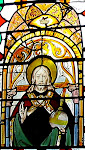
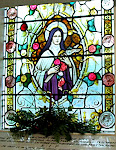
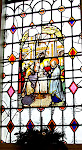
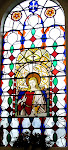
Brychan, with all his children in his lap! and the St George Window in the West Wall showing incidents from his life and Martyrdom.In the final picture there are many such panels, all equally wonderful depicting the laity praying for the intercession of the saints. It seems to the left of the present altar, there may have been a Grave sepulchre, where the crucifix may have been kept during the Holy Week for the Tenebrae services.The Place seems to be in a traditional place for it.


_____________________________________________________

BRYCHAN BRYCHEINIOG

The King of Brecon, one of the holiest 3 families in Wales, decended , according to Welsh annals from the family of Joseph of Arimathea and the family members of the Virgin Mary, who had been granted land at Garthmadrun (now Talgarth) according to Welsh sources.Joseph was a tin merchant and had accompanied the Empoeror Vespasian on his many trips to Britannia. They returned, sent by St Peter, travelling to Gaul with St Philip, who sent them on to Britannia. There was considerable antipathy to the families of anyone connected with Jesus at this time, and so it is likely that they came with Joseph. Interestingly, whilst the holy men desiring hermitage had gone to land given by Archiviragus, brother of Caractacus and King of the Demetiae, known as Ynys Witrin (The Island of Glass) or Glastonbury. Joseph's extended family lived at Talgarth and married into the local royal family(of Irish extraction!), but in the early years the genealogy shows many Jewish names.Parishaw in the Black Mountains for example is from Pater Ishow (Issui in Welsh) Or Father Esau, believed to be from that family.Perhaps Issey, daughter of Brychan was also from the female form of the name, and commemorated at nearby St Issey on the way to Padstow.

Brychan was the father of numerous holy children, although it is felt these may have been grandchildren as well, Amongst these children are many of the Cornish and Welsh Saints. We have seen how St Paul inspired chastity in women and how many Christian women, for the first time saw that they need not marry and could not be forced to-many undergoing hideous tortures for the faith, like St Thekla for example, Paul’s disciple, who was tortured for not marrying a man chosen by her parents.

Many followed her example . St Winifred of Wales is one such example as are the saints all over the church, St Lucy,St Perpetua. Our own St Tecla of Gwent on her tiny island near what is now the old Severn Bridge was another.
Unusual in Brychan’s court, was that he encouraged his children to set up llans all over the district. Under his advisor St Brynach, a priest who had arrived via Ireland from the Holy Land, his children were carefully brought up as Christians.

He had numerous children (many of whom we have already heard of here on this site) In the true manner of Old British saints, however ,they wandered around from place to place (white martyrdom-to where God would lead them) until they found their ‘green martyrdom’sanctified the area of their ‘llan’ and settled there.

Brychan’s children in Cornwall included

ADWEN(Advent) CLETHER,KEW,OUDICEUS(Euddogwy, her brother and nephew of Teilo) ENDELIENTA ,
(St Endellion)ISSEY (St Issey)KERIA (Egloskerry)CEYNA (St Keyne) MABENA, (St Mabyn) MINVER (St Minver)MORWENNA,TEATH, and of course some sons, FINBAR and OUDICEUS.Others we have heard of in Wales are Tydfil, Tegwedd and St Gwladys in Newport. It is wonderful to see this stained glass window paying tribute to this holy King.I have written about Brychan before.

Donors of the Windows

The different windows were donations from local families . Borlase, Martyn, Motton, Callaway and Tubbe families.

Unique Mediaeval St George Window

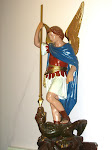
Twelve scenes in the west window of the north aisle describe the life of St. George. They depict the Eastern Church’s recorded martyrdom accounts as a Christian Roman soldier born in Palestine this window is of unique interest as incidents are not found elsewhere nowadays. St George was always shown holding the flag of the Paschal Sacrifice , the red blood on the pure white flag, representing the Lamb of God. In grasping this flag, he was himself taking the Martyrdom for the sake of Christ.The dragon he fought was probably a metaphor for the enemies of Christ. The flag accepted by the Crusaders, who spread a legend of his fighting a dragon as many of then had to as so many of whom died in droves trying to protect the Christian pilgrims to the Holy Places. St George was their inspiration
The Paschal Flag became the English Flag.

It is worth pointing out that St Piran is the patron saint of Cornwall, but had long been administered from England since Norman times and later Wales too became annexed to England and the Welsh language to be 'extirped'

George was born to a Christian noble family during the late third century around AD 275 and AD 285, in Lydia Palestine. His father Geronzio was a Roman army official from Cappodocia and his mother from Palestine. They were both Christians and from noble families of Anici (can not be defeated), so by this the child was raised with Christian beliefs. They decided to call him George meaning "worker of the land".
George offered himself as a soldier to Diocletian, who accepted him as Geronzio had been one of his finest soldiers and by his late 20s, George was a Tribune and stationed at Nicomaedia.

In the year AD 302, Diocletian (influenced by Galerius) issued an edict that every Christian in the army should be arrested and every soldier offer sacrifice to the Roman gods.
George objected and with the courage of his Faith approached the Emperor and tore up the edict. Diocletian was upset, not wanting lose his best Tribune and son of his best official, Geronzio. George loudly renounced the Emperor's edict, and in front his fellow soldiers and Tribunes he claimed himself to be a Christian and declared his worship of Jesus Christ. Diocletian tried to make George change his mind, even offering gifts of land, money and slaves if he made the sacrifice to the Pagan gods. The Emperor made many offers, but George would not accept.
Having made this edict, Diocletian was left with no choice but to have the saint executed for his refusal. Before the execution George gave his wealth to the poor and prepared himself. After many torture sessions,(which included being lacerated on a wheel of swords, he was miraculously resuscitated three times, George was indeed, as shown in the window of St Neot, executed by decapitation before Nicomedia's city wall, on April 23, 303AD, the same year as St Julius and St Aaron)of Caerleon) and St Alban (of Verulamium)died.
. A witness of his suffering convinced Empress Alexandra and Athanasius, a pagan priest, to become Christians as well, and so they joined George in martyrdom. His body was returned to Lydda for burial, where Christians soon came to honour him as a martyr there in Palestine.So not a legend , but a real Martyr and Protector of England.

Back to the St Neot Windows

The guide to the church building states
‘The finest and least restored window, the Creation Window, is at the east end of the south aisle and is full of delightful things representing the Creation (including the newly created bird flying off the tip of His finger), the Fall, Cain and Abel and lastly Noah politely doffing his cap to God as he receives his instructions, while the first window in the south aisle represents the story of the Flood and Noah’

Underneath are the laity imploring ‘Ora Pro nobis’ from kneeling figures dressed in 15th century or so costumes. Only two parish churches in Britain have complete sets of stained glass designed for them –one at Fair ford in Goucester and here at St Neots.The earliest three windows are from 1480 and the last around 1539, which must have been at the date of the taking of church property to form the new ‘Church of England’ by Henry VIII.
It appears the remoteness of the church spared it from the army of Oliver Cromwell who usually destroyed stained glass if they could.

The New Glazing

In 2004, Richard Grylls, the present patron, engaged Arthur Bradley to replace the frosted window at the west end of the church, which obscured the belfry, with a new etched glass screen. The new window contains etchings of a dove, mirroring the dove over the baptismal font, together with fruits of the vine, and wheat from the fields, as well as a porcupine – a symbol from the Grylls family crest, and denoting both plenty and realisation of hopes. A beautiful addition to a fabulous Church.

In the Churchyard

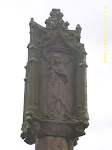
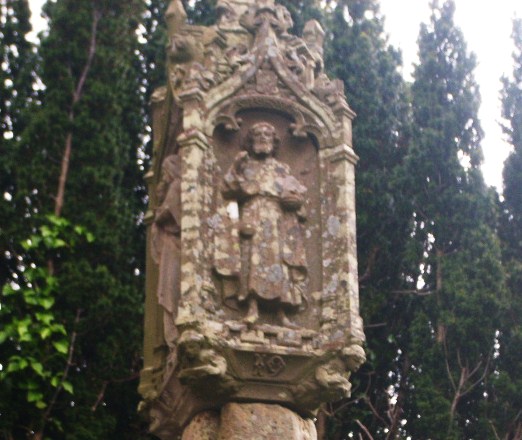
Here in the churchyard was a lantern cross which appears to have had the figure of St Neot on one of the panels and possibly the Blessed Virgin, though truth to tell it shows more signs of weathering than the one I saw at Patrishaw in Gwent, in a lot better state of repair. Nevertheless this cross had been put up again, traditionally a place where visiting preachers or Newsgivers would stand whike addressing the local population.

The Mills as the source of local industry

Travelling along we went past a number of Mills which formed the earliest occupations of the local people-The Trago Mills retail outlet is a development of one of those mills, probably a money spinner in Mediaeval times!


Autumn Colours

The autumn colours were vibrant and startling and trees and woodland inviting in the summy monets but menacing in the dark gloomy moments. St Neots was situated in the area of Warleggan which was evocative of the Poldark TV series.

Return

As we returned to Tintagel, we passed Dozmary Pool, lying undramaticall in the Moor. This was where the legend of the 'arm in white samite'appeared to the earlier 'King Arthur' in Arthurian Legend. I ave written about Arthrwys, the real 'Dux Bellorum' before, but here is where local tradition places the legend. We also passed by the temple Church, home of the Templars until their cruel suppression.Was ever a more unjust punishment, by evil Philip the Fair of France? This Church is dedicated to St Catherine a popular Mediaeval saint, who died broken on a wheel, the rather sick nameing of a corresponing firework 'The Catherine Wheel' on bonfire night.

This A30 is also the site of 'Jamaica Inn', unfortunately nowhere near the sea, but there was also the Daphne du Maurier exhibition and a restaurant and inn with standard food.Frenchman's Creek is not far way and Cornwall was also the Cornish setting for the novel 'Rebecca'.

All in all, a most interesting day.

St Neot and the Wandering Relics Bodmin Moor, Part I

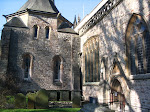
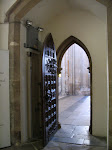
Here you can see some pictures of this beautiful and unique Church. The space for the stoup still remains , where the Faithful crossed themselves with Holy Water, blessed at Easter with the Paschal Candle and would remind them of their own Baptism.
The lantern cross must have been beautiful and on the two faces St Neot and the what may be a Bishop, can be just about seen. The heavy granite building material of the Church can be seen here and the present Vicar has imaginatively had an beautifully engraved window put in the wall between the tower and nave, so that more light can come in and so that we can more easily see the beautiful stained glass, which has to be seen to be believed!

St Neots is on the main road between Bodmin and Liskeard.


-------------------------------------------------------------------


On Monday, we travelled down to Bodmin Moor in bad weather and strong wind, although there were occasional bursts of sunshine. We travelled past interesting small houses, many with carved pumpkins in the front gardens and whether they were Jack o’er lanterns or only for display I did not know.

The road turned off afer Bodmin into the Moor and eventually we came to St Neot, which I was eager to see because of the stained glass window of Brychan Brycheiniog. I walked up to this church, which was amazing ly big and ornate and had three aisles and a North Side Chapel and South aisle chapel, which should have been the Lady Chapel, but had instead another altar there and with a reredos with an image of Jesus saving souls at the Revelation.
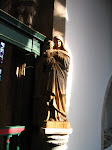
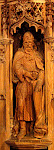
However,in front of this chapel was a small and exquisite wooden carving of the Virgin which I have posted above.

Inside the Church

The central chapel and south aisle of the church were the original building from 1425 when the Church seems to have been built into a manorial church, and an earlier date can be given for the tower. It seems this is another case of Norman reorganisation of the Saxon or old British Church which once stood here, The Normans would have probably rebuilt the church to be staffed by the Benedictines of the priory at Bodmin and the traditional place of accommodation would be in the upper storey of the porch (built 1425) although there was an incumbent priest from 1266. It seems that many religious brothers would spend a number of years out in the parish, returning to the monastery for periods. The local lord of the manor would often endow the church to show his wealth and assure his place in heaven. The best view of the Church is coming up the hill. There is a smallish car park and disabled access and the church well maintained and greatly loved.

The Lost Chapel

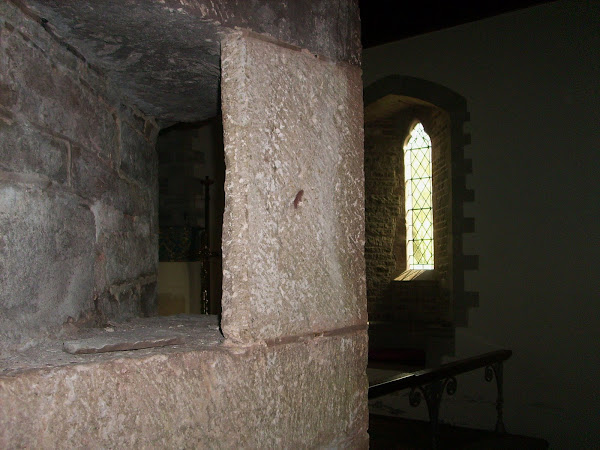
On the north side of the church the seventh arch at the east end is clearly older than the others and lower, and was probably the entrance to a chapel. A squint pierces the wall between the north aisle and the sanctuary . This was probably to allow the occupants of the Chapel to see what went on at the Mass in the Sanctuary.

Saint Gueryr (Aneitus)-the first Founder

However we should really start at the beginning. The original Old British founder of this Llan was Saint Gueryr.remember it would have been a mud and wattles church, and little remains today. It is Asser, the Welsh monk, who in his account of King Alfred the Great tells of the king visiting this shrine and adds that St Neot lies there too.

Neot was a holy and good man who dd the work of the Lord and his church. He was said to have stood upright , of small stature, up to his neck in water reciting all 150 psalms! He was said to have died in 877 approximately and his relics were put in the north wall of the chancel.

Neot’s name (Aneitus)

It has been suggested that the reference to Neot was added later, though it does not mean it was not a fact. There is some discussion about Neot. He was probably a Cornish style saint whose name may also have been found in nearby Menheniot-the Sanctuary of Neot, though the dedication here is to a Saint Lalluwy which name later became Ladislas
St Gueryr may have been an earlier saint altogether. It is ,however, not unusual for the Cornish and Welsh saints to have a Latin name as well, a Church name (eg Dyfrig being known as Dubricius) Latin was and is the language of the whole Church and so it is not unusual.

A relative of King Alfred of Wessex?

There is also a school of thought which makes Neot a relative of King Alfred and it was in a Life of this Neot that the story was told about Alfred burning the cakes! The dates would tie in with this most Christian of kings.

The relics of St Neot travel

He was said to have become a monk of Glastonbury Abbey, who, attached to Bodmin Priory, the local house, lived in what was a hermitage According to this account, some time after his death, the saint appeared to the guardian of the shrine, whom he bade carry his relics elsewhere ; eventually they came to rest in a monastery at what came to be St Neots, originally in Huntingdon near Cambridge.

Another account says the relics were stolen but
the removal of the bones of the saint, in whole, or in part from one place to another , sometimes for safety sometimes at a call to establish a new centre of devotion was a usual enough practice. Alfred had, in any case prayed at the Shrine of Saint Gueryr and was healed of a sickness.

Neot also seems to have been some petty king, who wanted a religious life and abdicated so that his brother was crowned . He became a monk at Glastonbury Abbey and saves a doe from a hunter.


The Legend of the 3 Fish


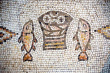
He then found three fish in a well and an angel tells him he may eat one every day , leave 2 and there will be three the next day. Neot orders a fish from his servant Barius who takes two fish from the well, boils one and fries the other . Barius brings the two fish to Neot, who sends him back to throw the two fish back down the well.

Cattle are replaced with stags

Cattle are stolen from Neot’s Community. After prayer stags take their place , then the Robbers return the stolen acattle .

Neot receives the Pope’s Blessing in Rome

Finally Neot receives the Pope’s blessing in Rome. Unusual to see His Holiness in 15th century stained glass in what is now an Anglican Church. Neot’s fest day is July 31st.
All the stories are placed in panels in an elaborate window inside the church. I was amazed when I saw the display of mediaeval glass. With scenes from the Bible and traditional local saints the stories are all told in magnificent colour.

St Neot’s Church Wonderful Stained Glass

The glass dates from the early sixteenth century. Father Robert Tubbe, Priest from 1508 to 1544, was possibly the man behind the present designs. These were restored by John Hedgeland in 1826-28. During this restoration Hedgeland changed parts of windows, and shifted them around, so that it is now impossible to know what they were originally like. The guide to the church tells us, that in twelve of the windows, half of the glass is original.

Pictures in glass of Biblical and British Saints

The Creation window is very fine. All the Saints-Andrew Patrick and many old British saints, including many to Our Blessed Lady, imploring her intercession are found in the church.

Part Two Tomorrow

Sunday, November 2, 2008

St Mary's Under the Wood -LLANFAIR DISCOED


"LLANVAIR-DISCOED, a parish in the upper division of the hundred of Caldicot, county Monmouth, 5 miles S.W. of Chepstow, its nearest town. It is situated near the forest of Wentwood, and on the road to Usk. The parish includes the hamlet of Dinham, and the remains of Dinham Castle, now a ruin overgrown with wood.The church is dedicated to the Blessed Virgin Mary.

'Lamecare'

The village is mentioned in the Domesday Book of 1086 as 'Lamecare'. The name means Mary's (Mair > Fair) church (llan) under (is) the wood (coed). The 'd' at the start of Discoed only appears in more recent versions of the name. The correct Welsh language name is Llanfair Is Coed or Llanfair-iscoed. The wood probably refers to Wentwood.

Llanfair Castle

The village contains a small ruined castle, believed to have been built by the FitzPayn family, as lords of Llanvair Discoed, in the 13th centuryLlanvair Discoed Castle - ST44579241

In the grounds of a house above the church are the overgrown fragments of a castle probably built by Sir Ralph Monthermer in the second half of the 13th century, on the site perhaps used in the 12th century by Marcher Baron Payn Fitz John.

Both the first earls of Hereford and Payn Fitz John had a great deal of wealth and ruled Gwent at a time when the stable rule of the Normans in Wales seemed inevitable.

The ancient castle, appears to have been erected in the earlier part of the 13th century by the noble family of Fitz-Pain, possibly on the site of an older building : the castle was subsequently held by the De Monthermers, and passed from them by marriage to the Montacutes, and afterwards descended to the noble families of Nevile and Pole.

Lady Margaret Pole, widow of Sir Richard Pole

This was the mother of the Blessed Reginald, Cardinal Pole, who had tried with as much diplomacy as possible at such a time, to restore the Catholic hierarchy under Mary I in the face of a noble families grown fat on the lands stolen from the church, and anxious about it ever regaining a foothold in Britain.

The castle was seized by Edward VI and the Protestant supporters of the crown who executed the aged Lady Margaret, wife of Sir Richard Pole,simply for being a Catholic as well as her Plantagenet birth
in 1541, and was sold to Edward Woodward in 1610.

Rhys Kemys

Having reverted to the Crown in the time of James I, the castle was granted in 1610 to Thomas Woodward, who conveyed it to Rhys Kemeys, ancestor of the present owner, Capt. Kemeys-Tynte. Two large round towers, some part of the keep and a small portion of the curtain walls remain.

A Manorial Church

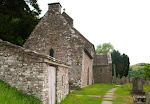
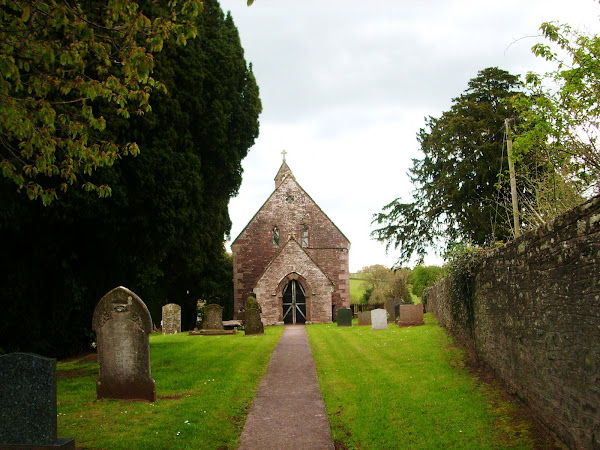
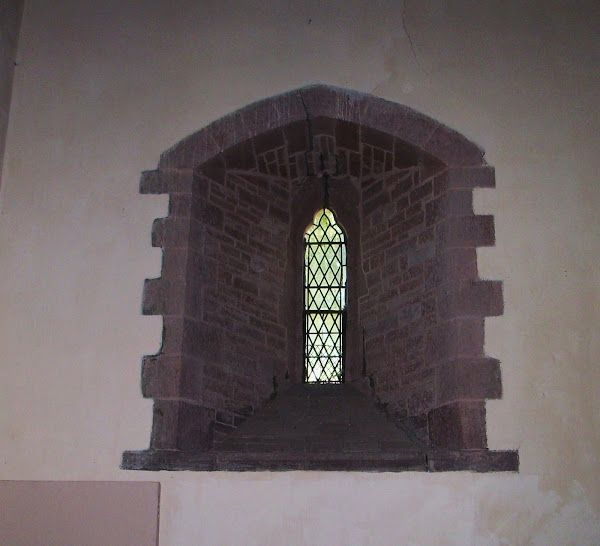
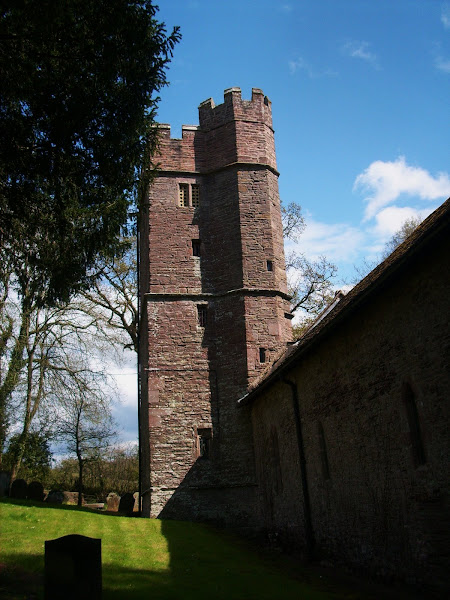
The Church, therefore is a manorial church. The churchyard is square and not a llan.No doubt the numbers went down during the plague. The present church is a simple church with a tower. There is a porch at the side, very ancient with a small windhole.

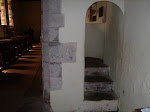
On the other side of the interior of the porch is a humorous slab telling the reader that if they don't come to church on Sunday that the Devil will have you on Monday.
Inside the Church today

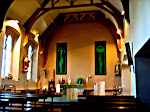
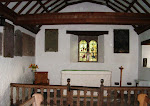
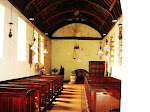
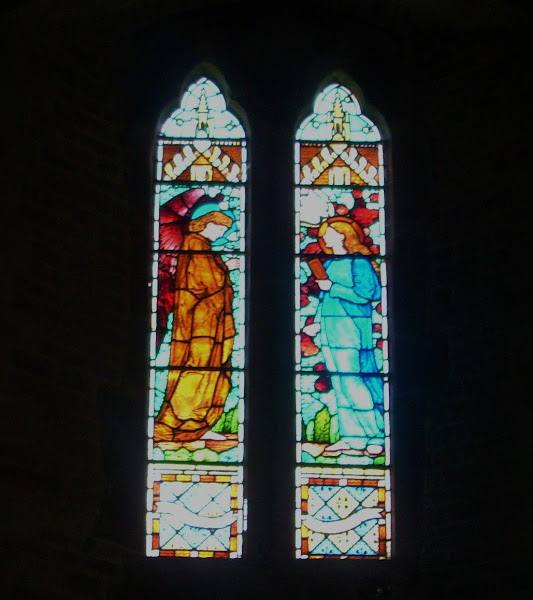
The church s delightful and looks renovated inside, carpeted and very much like a warm room and a Charles rennie Mackingtosh style stained glass window. As a manorial church (the castle would also have had an oratory) but the frisson of excitement is that Lady Margaret Pole would certainly have attended Mass here.She was the last surviving member of the House of Plantagenet.

Martyered: imprisoned in the Tower for two years and then beheaded "by a clumsy novice" 1541 at East Smithfield Green, EnglandBeatified 1886 by Pope Leo XIII

Commemorated May 28


The Story of Blessed Margaret Pole

After her husband's death and that of her brother, Lady Margaret was allowed to receive her husbands estate and became Countess of Salisbury.

There has always been a Catholic Mission at Havant. However, it is only through the dark days of penal times that the story of Havant's Catholic Community starts to come to life. Our story begins with the stubborn refusal of the people in this small corner of Hampshire to give up the old faith with the onset of the Reformation. The Reformation was in its infancy; before the minority of extreme Protestants had seized upon Henry VIII's split with Rome to sweep the church in England into a path that was to take it further away from the old beliefs and practices than Henry had ever wished or intended.

Warblington was a castle within sight of the sea, less than a mile from the centre of Havant.

In 1514 the Manor of Warblington passed into the hands of Margaret Pole who had been granted the title of Countess of Salisbury and permitted to succeed to her brother, Edward Earl of Warwick's estates in Hampshire, Wiltshire and Essex.

Margaret Pole was the last of the surviving members of the Royal House of Plantagenet and, as such, dangerously close to the throne ofEngland. Her father, the Duke of Clarence, had been murdered by his brother Edward IV and her brother had been put to death by Henry VII, probably because King Ferdinand of Spain had refused his daughter, Catherine of Aragon, to marry the Prince of Wales while this Plantagenet Prince lived to challenge the Tudor title to the throne. Margaret was Lady in Waiting to Catherine of Aragon and accompanied her into exile and staunchly supported the cast off queen. Margaret, in common with Cardinal Fisher, and St Thomas More refused to agree to the King taking over from the Pope as Head of the Church in England, because he wanted to marry his mistress. Margaret at the age of 68 was arrested, taken to the tower and 'questioned' After two years she was taken out and executed, at the age of 70 sadly ofr her, "by a clumsy novice" in 1541 at East Smithfield Green, England. She was beatified 1886 by Pope Leo XIII and Commemorated May 28th.Since she was 70 years of age, it wcould only have been spite and hatred which had this old lady executed, because no crime or treason, apart from having letters form the Pope in her castle could ever been attributed to her.

Regnald, Cardinal Pole

Her son, Reginald, Cardinal Pole, often in Rome returned when Mary I came to the throne. He and the Pope warned Mary to go carefully as the public were on her side. The nobles who had grown rich on church lands and the priests who had married were not so happy, but in face, only a handful of bishops including Cranmer, who had a big hand in her mother's depostion and performed the marriage and coronation of Anne Boleyn had to go. Unwisely, she made a Spanish match which was unhappy and broke her heart. When she died, Reginald did not survive long either, the Protestant faction at court deciding he had to go quickly during the regent's rule following her death. Reginald Pole was the last Catholic Archbishop of Canterbury.
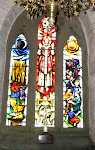
Llanfair Castle was seized by the throne following the persecution and executions and sold to the ancestor of the present owner, himself a descendednt of the old Norman Kemys Family. Whilst Reginald was born at Stourton Castle in Staffordshire, his mother's Margaret's childhood home, but no doubt spent much of his childhood in the woods around Llanfair his father's manor and probably attended Mass here at Llanfair and may have even been Christened in the font here, but there is no firm evidence of this. No doubt Margaret too spent some happy days here as a young woman and mother and it is fun to think of them all at Christmas Mass here before the shadows fell across the land.
The church is delightful, and very cosy. The village is small golden and off the beaten path from the A40 from Chepstow to Langstone.

It was certainly worth a visit, especially because of the magnificent Yew tree in the churchyard.