A site tracing the Catholic life and history of the Ancient Kingdom of Gwent, now known as Monmouthshire,UK from Silurian times. Linked to Mary in Monmouth download free from iTunes Store or RSS feed at end of this blog.Also MaryinMonmouth Group of Face book. Photographs of interesting places. Some Catechesis.Strength of site is in tracing obscure Gwentian saints and martyrs and digging out gems from forgotten sites.Some photographs by Chris Tottle are copyright. Sites in Welsh Marches.
Ready for Ash Wednesday?
Total Pageviews
ST DAVID's CANONISATION 1120AD
WALES WIDE PILGRIMAGE IN 2020 to celebrate a thousand years since his canonisation!-using old pilgrim routes!!!
Come to the Waters....
Whoever drinks the water I will give him will never thirst, indeed the water I give him, will become in him a spring of water, welling up to Eternal Life....John 4:14
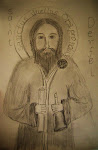
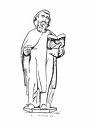
Drawing of St Derfel/Duellus based on similar saints'images
Followers
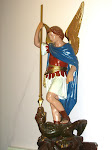
St Michael as a Centaur, fighting on the side of Peter and the Church
Liam Neeson played this int he film
PODCAST IMMINENT OF THE VISIT OF THE RELICS TO CARDIFF
I took recordings of the various Masses and liturgies in the Church as the relics were being received in Cardiff on Tueday and have only lightly edited them. I was doubly glad so many people, who were not able to get in and hear the service of reception and so forth will have the possibility of listening to the Masses for Priests and Vocations, Evangelisation, and personal sanctity, Angelus, Rosary , Litany and Benediction. It was extremely crowded, but I think it captures all the excitement of that day when thousands descended on Cardiff, clapped the little saint for her Christian witness and brought her candles, red roses and many other flowers, incense and beautiful music at the evening Mass.People streamed in until the Cathedral closed at Midnight, and devotions continued all evening, with people praying for conversion of sinners, confessions, praying for priests and praying that all would accept Jesus as their personal friend and Saviour. A Mediaeval style day none will forget. And Bravo to the superb organist!
Dominicans Today buiding a new Friary in US
Procession of Friars
PODCASTS RESUMING SOON AFTER COMPUTER PROBLEMS
I am resuming podcasting later this week or next, because I hade two computer crashes and have had little time to find all the things I need to resume it. I apologise to all the fans of the podcast and all the emails. You can download them from the rss address on this blog, or even via iTunes. Many people like listening on long car journeys! There are some interesting topics coming up.So keep posted.
Dominican Friars
At Chapter
SANCTUS ILTUTUS
St Illtyd , the great Educator
St Ia sculpted by Oberammergau Sculptor
In the Catholic Church. St Ives
Spring in St Ives
The time in Bredon is
Listen free Online to the new podcast!My Pilgrimage to St Winifride's Well
Main road from Abergavenny to Hereford, (or Hereford to Abergavenny if coming the other way!!) Turn off to Llanvihangel Crucorney. Pass Skirrid Inn. Turn LEFT to Llanthony Priory and stay on that road, past priory and up the mountain until you come to Capel y Ffin. Turn Left to monastery, but monastery is in private hands and so you must ask permission to view. On pilgrimage days parking in designated field kindness of Mr and MRs Watkins.
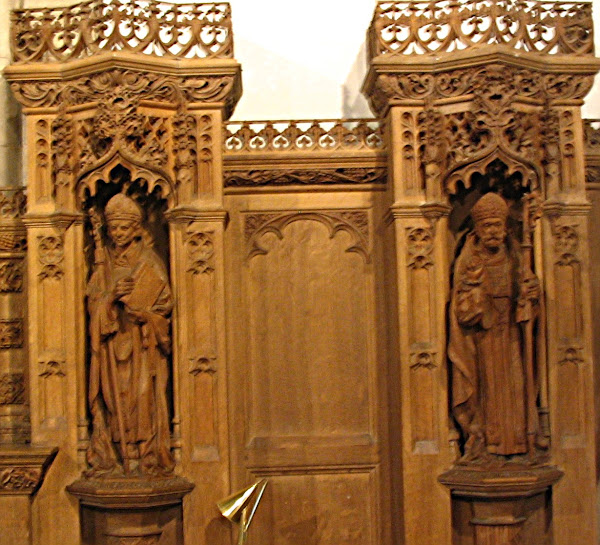
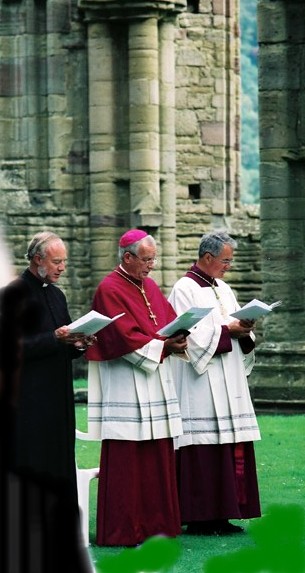
DO YOU KNOW WHY BISHOPS WEAR POINTY HATS CALLED MITRES?
Because they represent the flames which came upon the Apostles when Jesus met them to give them these gifts and the organisation of his Church. There was a great Wind and flames of fire, and we are told they settled on the Heads of the Apostles. When the Apostles appointed their successors, the Bishops they received this headwear to remind them they are the descendents of the Apostles of Christ himself, who founded his church on the rock of Peter.
Veni Sanctus Spiritus
Come Holy Ghost-A Happy Birthday to the Church!
Gwent Links to Arthur or Arthryws recalled in place names
Monks from here built the Priory of St Mary Magdalene in Goldcliff. The local church is still dedicated to this saint. The Church was built there after the Tsunami of 1607 which destroyed what was left of the Priory.
Truth about Relics
Relics have often been a stumbling block for people trying to understand the church. It is no different than keeping a special photo, item or clothing etc from a loved one when they have passed on. Kissing a picture or reverencing it, lighting a candle next to it or putting a poppy by it on remembrance day, just brings them alive again to you, shows them honour and respect. In the case of relics, if you can ask a living person to pray for you, then we can ask the souls who have made it to heaven to pray for us too, Having a small item which has actually touched their body or even a part of that body brings them especially close to them. The Holy Spirit has completely infused their body, So you ask this person to add their prayers to yours up above, and sometimes there are miracles as a result, although it is the prayer to Almighty God that works the miracle if there is to be one and it is his Will.
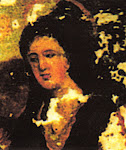
Head of Our Lady from a fresco in the Gunter House, Abergavenny
Secret Masses were said here in times of Persecution 17th century
Hello! The first ten pictures
The first ten pictures are from Llandaff Cathedral or Abbey Church of Our Lady and St Teilo, Then there are some from Mathern Church. Please download the Internet podcast Mary in Monmouth to hear the programmes at maryinmonmouth free from iTunes. This programme is FREE as well. So just type the title Maryinmonmouth into the Store Window and you will find it then subscribe! Automatic after that! Big pictures and feeds and links are at the VERY BOTTOM of the blog! Sorry! Mary
Snowdrops in February
Glorious!
Relic of Teilo's skull-Legend
The tale of this is amazing and will do a podcast
King TEWDRIG Llandaff
Jesse Tree Window in Lady Chapel
beautiful Colours
Lady Chapel from Outside
Beautiful spring day!
Into the Sanctuary
Bigger pictures at the very foot of the blog
Entrance to Lady Chapel
More pictures below-too good to squash!
Pray for the Holy Martyr, Tewdrig
Ora pro nobis peccatoribus
King Tewdrig, Saint and Martyr
Relics are buried under the Chancel
Earliest Catholic Priests and Monks until today
Church became Anglican aruond 1536
Stone of Commemoration to St Tewdrig
Over door at Mathern
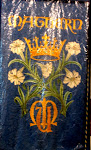
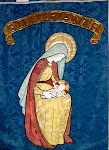
Banner of Mathern Church, with St Tewdrig's crown
Insignia of Blessed Virgin Mary below
That Catholic Show Catechetical & Fun! sqpn shows. You need a YouTube account (free ) to view
Evelyn Nicholson is a professional singer who has sung with all the major opera companies as principal soprano.Evelyn has begun her blog influenced by her father's love of the ancient Kingdom of Gwent and to foster a defence of misconceptions about the Catholic Faith.She is a qualified catechist of the Catholic Faith.
Here is another important Llan named after Saint Tyddwyg, obviously another monk of the sixth century or thereabouts who established this lovely llan here at the side of the Wye. With his friends he would have purged it of evil spirits by praying and fasting overit for thiry days. The church and buildings would be built. There was once again the semicircular Churchyard providing a firm border between the holy terrain of the monks and that of the outside world, oftern. bloodier and moe cruel than today.
Llandydiwg or Dixton
This site is a confirmed ancient Welsh manastery by the eminent writer Diane Brooks.Its renaming after St Peter was probably confirmed after the acoming of the Normans to Britain. They were very interested in Welsh culture, but found some of the saints just twoo obscure. This Church of St Peter at Dixton, because of its fishing, and also that of St Maughams, Dingestow, Wonastow and several others, was given to the Priory of Monmouth and their tithes supported this church. The French Monks who administrated the whole were from St Florent at Saumur in France, and abbey which is still there!
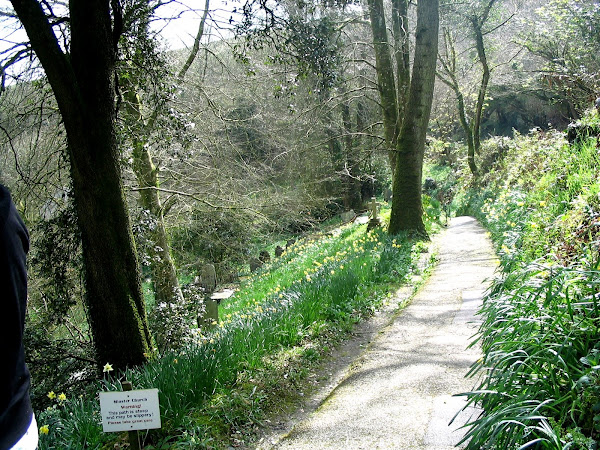
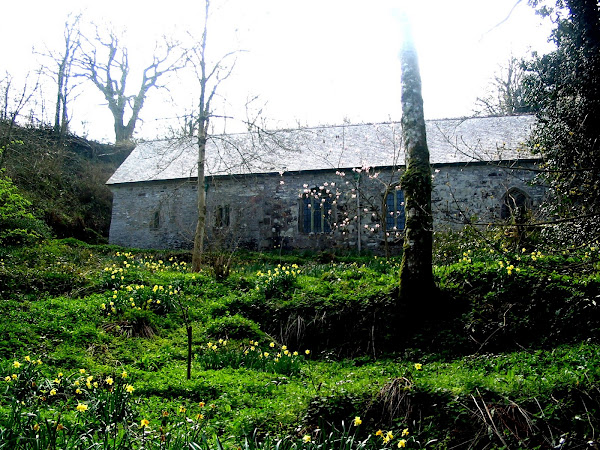
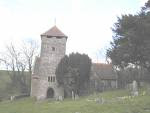
St. Peter's is situated on the banks of the River Wye, just north of Monmouth. This attractive whitewashed building dates back to at least the 12th Century, though was probably a holy site before then. The llan stands to the East of Blestium or Roman Monmouth.
Here in the 7th century A.D. standing in Dixton churchyard and looking at the River Wye below you see you are standing in the llan or religious enclosure of an obscure Welsh holy man, Tyddwg. He gave his name to Dixton. Upstream and across the river is Hadnock, Hodda's oak, a Saxon settlement on the site of a Roman Villa. The river bank on the Hadnock side marks Offa's Dyke, dividing England from Wales.
The herring-bone masonry in the north wall of the nave may be Saxon.
The Church is frequently subject to flooding and brass plates near the chancel arch record the height of the more memorable floods.
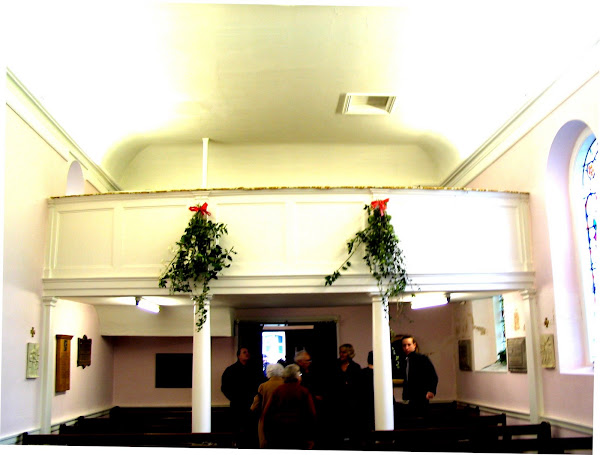
There is a new balcony at the back of the church so that precious items can be out of reach of the water. This has been decorated with a beautiful oak screen.
It was unfortunate I could not gain access to the church, possibly because of security concerns...
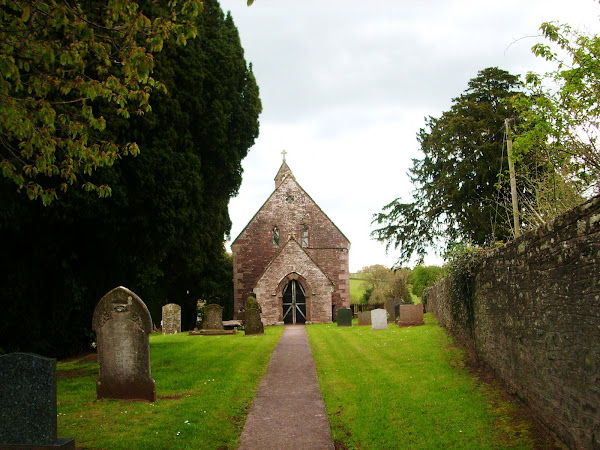
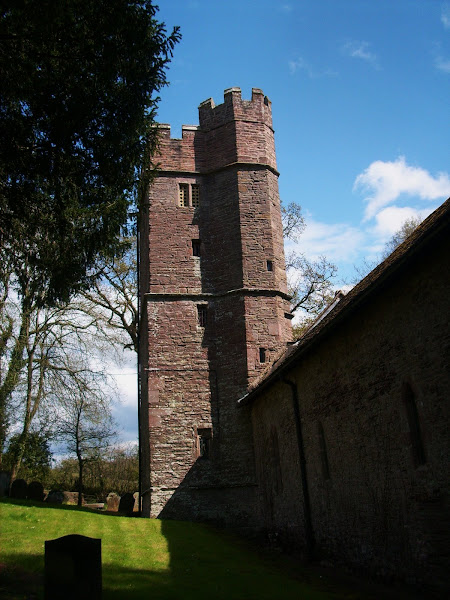
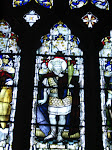
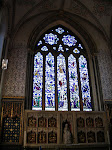
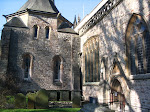
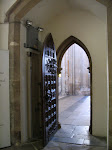
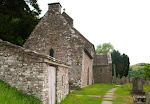
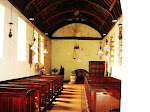
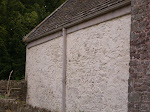
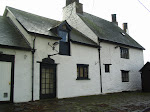
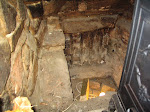
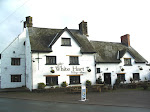
The first two pictures of Trivor Farm (with the secret attic chapel) and Hilston House two recusant centres which sheltered priests and Catholic generally.The others are pictures of the present St Maugham's church and the plaque comemmorating the gift of Charles Rolls (of Rolls Royce fame) who restored the church in the nineteenth century.
SAT MAUGHAMS -A LLAN and early Mediaeval Church
Kelly's directory describes this interesting Church as follows:
'ST. MAUGHANS is a parish on the river Monnow, which bounds the parish on the east and separates Monmouthshire from Herefordshire; it is 5 miles north-north-west from Moiimouth railway station, in the Northern division of the county, hundred and petty sessional division of Skenfrith, union and county court district of Monmouth, Monmouth and Skenfrith highway district, rural deanerv and archdeaconry of Monmouth and diocese of Llandaff. The church of St. Maughan is a small but ancient building of stone in the Early English style, restored in 1866, at the expense of the late J. E. W. Rolls esq. and consists of chancel, nave, south porch and a small western tower with open wooden lantern containing one bell: there are 150 sittings'.
MY VISIT
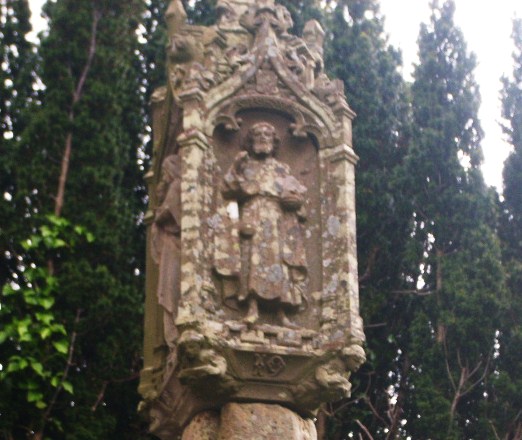
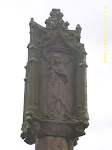
This little church began life as a Catholic Church and when I visited it, I found it , in some ways as being quite mysterious, with many yews and a preaching cross. This church is not far from either Trivor Farm, or from Hilston House, or from Rockfield and Perthir, where the vicar Apostolic , Matthew Pritchard is buried, also in an Anglican Church.
An Early LLAN
The Welsh Name is Llanfocha which I think may have been one of Dubrcius' early monasteries, yet it is dedicated to St Mawgan, or St Meugan, a great early saint whost influence was felt, from Denbigh (North Wales) or to Cornwall, where an RAF airfield still bears his name. The round churchyard enclosure, showing the early deliniation for the Old Welsh of HEaven and Earth. I have covered how the early monks prepared their llans in the post on Trefethin Church as an incident in the Life of Cadoc show the process. Clearing the ground, praying and fasting over it for 40 days and casting out any demons that may be there. The water source is not far away.
To my delight I found it was open.I am not an expert in church architecture, but it seemed the first church (under which a Catholic priest of recusant times is interred) seems to have been an early narrower affair in the Gothic style which the Normans would have built over the original site of the Old Welsh monastery. At some point the mud and wattle buildings would have been created into stone in later tmes and then finally a larger , Norman stone building was built, with a priest installed. The Priest would probably have been a monk attached to The Priory Church of Our Lady and Saint Florent in Monmouthshire, he church and priory there also being built on the site of an old Welsh Llan.
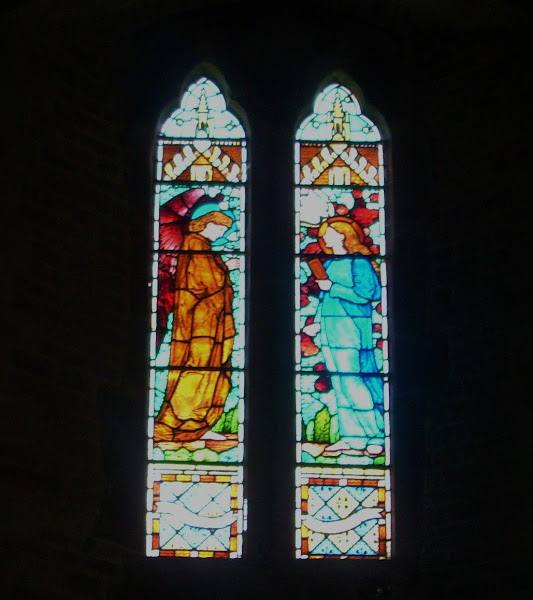
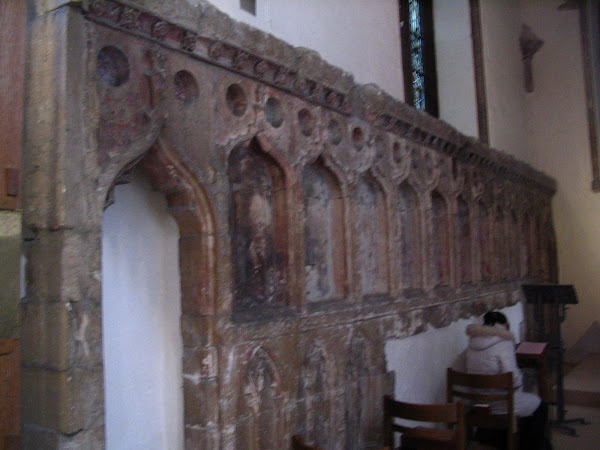
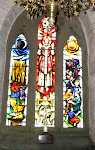
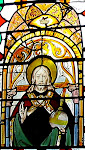
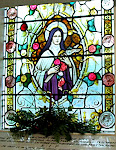
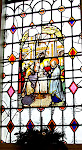
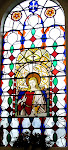
The church seemed to have two naves, half divided into a Sunday School, I think and a wonderful stained glass of the Nativity. I plan to do another visit some time, but many of the 'Catholic' features like the piscina were gone, sadly, although the place had a feeling as if people were still there. I said a quick prayer, but was anxious to explore the circular Churchyard.
A SECOND NAVE
At some stage, perhaps in Tudor times, or possibly later still, I am not sure because there is little information, a second nave was added, which in an odd way seems to take the focus of the church away from the altar. The Church became Anglican under Henry VIII but this circle of Monmouthshire was still largely owned by Catholic gentry who owned the livings of these churches and could decide which Vicar was appointed. The owners of Hilston House , Trivor, Treowen and all the local manors were all Catholic and held Masses covertly at their houses and numbers attending the old churches few. The Vicar of Llantiolo Crossenny gave evidence of the mutitudes going to Thomas Gunter's House in Abergavenny for the Mass when at most forty cane to his church. Church attendance was compulsory then.
LOCATION
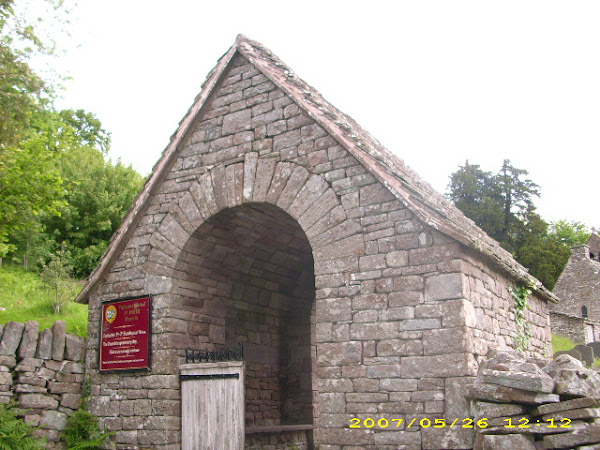
St Maughams lies at a Crossroad, where the Old Roman Road from Monmouth went down over the hills to South Gwent and the fortresses there at Usk and at Caerleon and Caerwent, so it would have been an important Old Welsh Monastery. As new roads were built it lessened in importance and the area around the church itself, being small and rural is as it always was, with a larger settlement at Maypole just up the road. Nearby is also the ancient Holy Well of St Maughams.
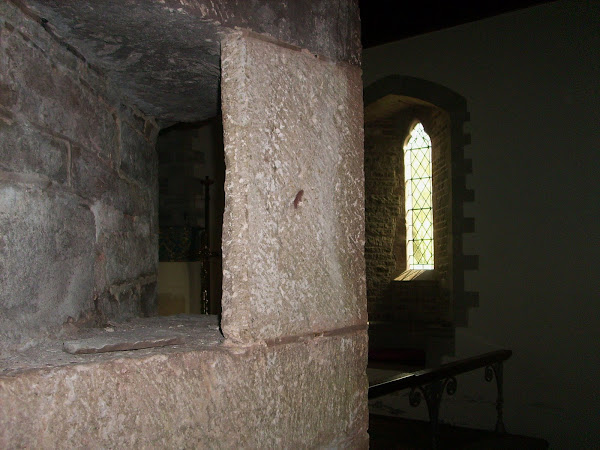
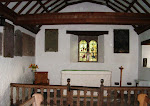
The Church is small and dark and and yet beautifully proportioned and kept. And the Church does have a secret.
IN PENAL TIMES
Trivor Farm up the road had a secret attic Chapel where Father David, Father Philip, Father John and Father Kemble occasionally said Mass. When we chronologically come to this era, I'll post more about it. When a Catholic person died, there was always the distressing thing about where to bury them. There are many such burial grounds in Northern Gwent. The use of the Welsh language kept the secrets much better from the English overlords, but they still had the difficulty. To lok carefully at St Maughams, you can see how many graves in one portion of the churchyard bear the marks IHS and many the Sacred Heart. These are amonst the oldest in the cemetary. When a Catholic died, the vicar often looked the other way. A funeral Mass would be held at Trivor just down the road, then the coffin make its way up the track to he Church. At the Well, there is an imprint for a head and here the bodies were laid out , washed and annointed. The cortege would make its way up the hill to the graveyard, where the burial service was held. Many Catholics were buried like this, here and in other places, at Llanarth, Skenfrith and Rockfield where the living was held by the family at Perthir, which kept Beishop Matthew, and where he incientally spent his boyhood. Many priests are buried at Rockfield as well. Brave men, who risked their lives just to carry out their calling, in terrible times.
CATHOLIC PRIESTS AND LAITY BURIED HERE
Two priests are buried in the Graveyard at St Maughams and I am trying to trace their whereabouts. Under the altar is another. They may not have been martyred like Fathers David, John Roberts, Philip and John Kemble, but they received the call from God at a dreadful time of Calamity for the Catholic people locally and bravely went out on cold dark nights to minister to the sick and dying and minister the Sacraments of the Holy Church.So indeed the Churches in this area do have a great secret. It could have been that the Requiems themselves may have been said in the church at Midnight, when all this went on, but that would have been risky.
If you visit, please say a rosary at Rockfield Cemetary or in the Church, or at St Maughams. If anyone knows the location in the Jesuits records of their names, I would like to know. I do know that it was Bishop Matthew who attested to a miracle at the grave of John Kemble.
ST MAWGAN, Meugan, Maugham, Sancte Maucanne
I hope to do more research on St Mawgan in Cornwall for you, but there is no 'Life' written about him by Benedictine or Cistercian monks. On the other hand his influence was widely felt in Cornwall and up to North Wales and there is a dedication to him near Brecon as well. Since the Brychan Brycheiniog family were the holiest in Wales, this may have been a possibility. Yet there are also links to West Wales.
BRITANNY AND CORNWALL
Two parishes are named after St Mawgan in Cornwall and he may have been one of the roving Welh monks who travelled around especially to escape the yellow fever which had ravaged around the country and killed so many people, wipng out most of Tewdrig's children even. (see the post on Tewdrig)
HOLY ABBOT OF DEMETIA (POWYS-BRECONSHIRE)
Mawgan (possibly even spelt 'Morgan'-a more popular name)was possibly the Holy Abbot of Demetia-now Powys, which is why the parish at Brecon may have been his 'home 'parish) and possibly travelled to Britanny during the yellow fever outbreak) and then been blown back to the British Isles on a 'White Martyrdom' and been blown up on the shores of Cornwall where he ended his days, perhaps.Roscarrock another researcher, believes he was made Bishop of the Isles of Scilly.
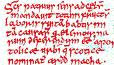
The EXETER LITANY 11th CENTURY
Sancte Maucanne Ora pro nobis
Clearly therefore , he had a huge influence on the development of the Kingdom of God. It is possible he first went to North Wales to establish some houses there, then returned perhaps during the Yellow Fever to Brecon, moved south and dedicated St Maughams and then joined the other saints to go to Britanny , returning via the Scillies to Cornwall.
If you have any extra information about either church or St Mawgan, please let me know at maryinmonmouth@googlemail.com.
Finally more to enjoy here. St Tydfil's Church, Merthyr Tydfil. Hannah and Caitlin sing 'Panis Angelicus'.












































 ___________________________________________________________


.JPG)


.JPG)