









































 ______________________________________________________________________________
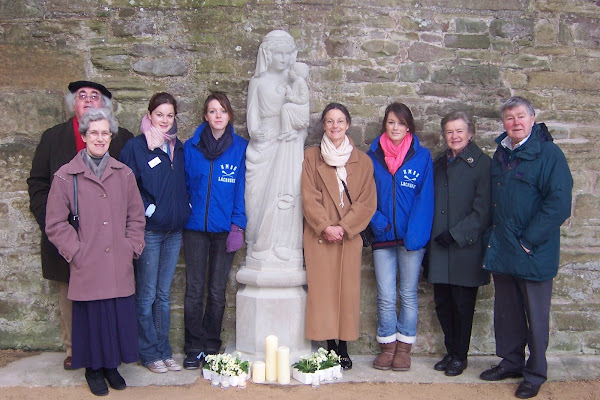
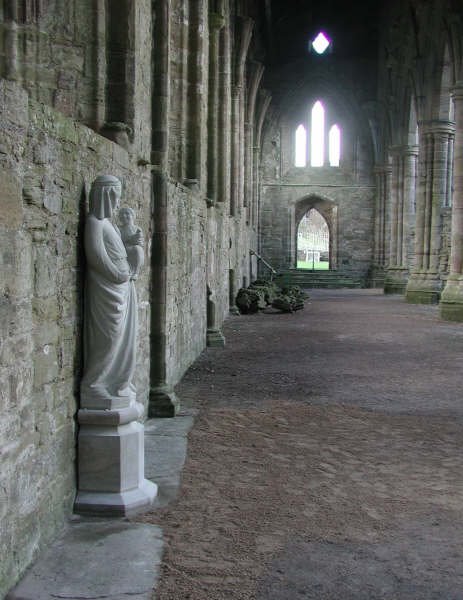
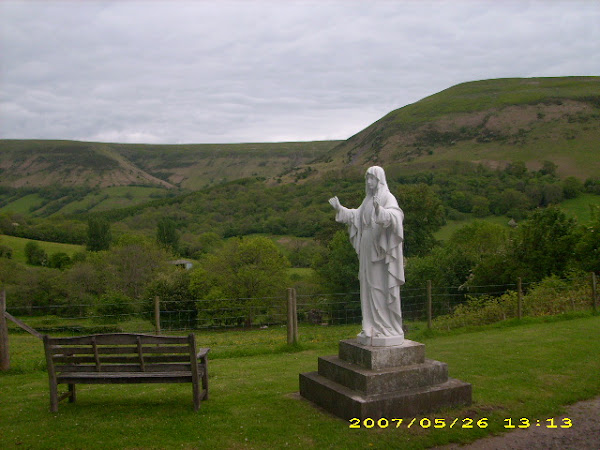
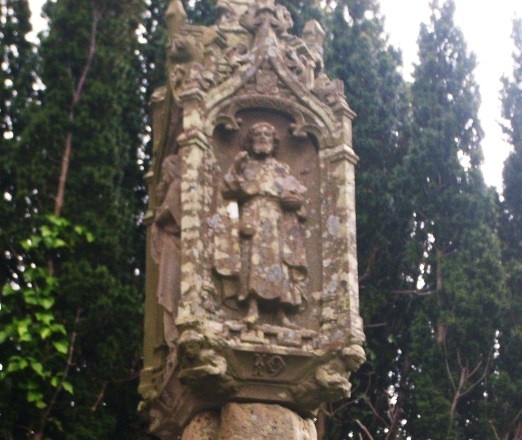
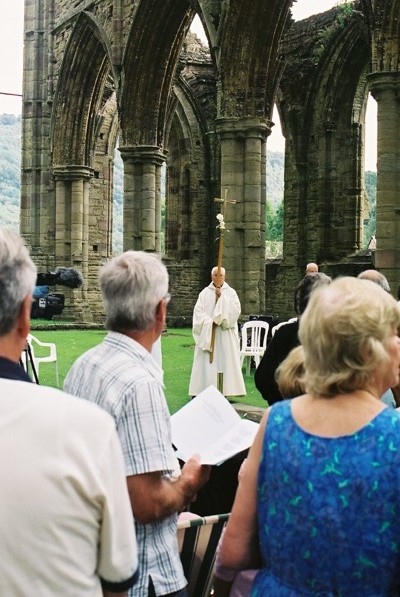
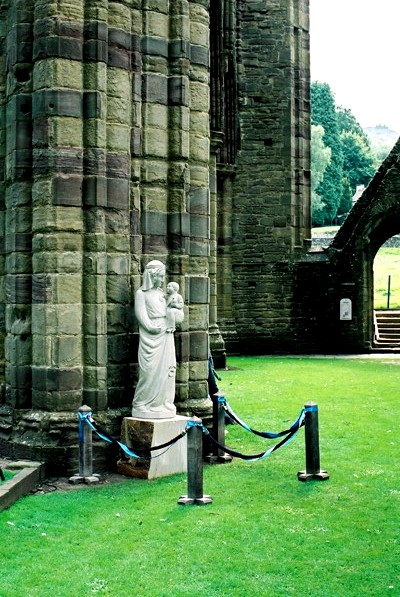
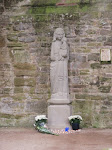
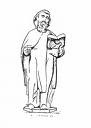
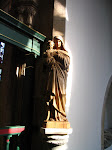
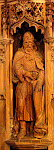
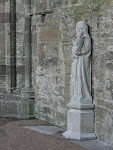
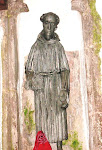
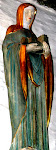
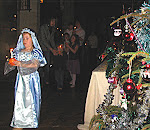
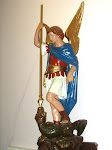
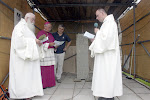
New Statue of St Derfel,by David Lloyd, carved for the 'Ancient Cwmbran annd the Cistercian Project'. Unveiling of the new statue, showing Derfel as a soldier on his Feast Day, April 5th.
Early Life
Derfyl is recorded as being the son of Hywel Mawr ab Emyr Llydaw by Alma Poppea and the brother of Dwyfael (Iolo) or Dwywai (Myv Arch) Arthfael and Hywel Fychan. Arthfael was the original founder of the llan church of St Peter in the Moor or Peterstone, where the lighthouse still stands. Hywel the Elder (Farchog-the Bearded) is buried at Llantwit Major and both Arthfael and Dwyfael,Derfyl’s two brothers were holy men trained at Llanilltyd Fawr or Llantwit Major and later went with their cousin Cadfan to Bardsey Island-‘The Island of 20,000 saints.’
There is also a tradition from Britanny (Armorica or Roman Gaul) of another brother, St TUDWAL , bishop of Treguir, whose mother was Alma Pompea. Arthfael later became a man of great importance of the Church in Brittany.
Note how the Welsh (Romanised Celts were still supporting Roman names-Alma Poppea.)
‘GADARN’ (Cadarn)
Derfel or Derfyl is usually called ‘Cadarn’ or ‘THE MIGHTY’. We see from his upbringing at Llantwit Major, that he was a religious man and was more inclined than his brothers to fight for the right to stem the Saxon influences and invasions. The invading Saxons were pagans and it is possible he went in search of a martyrs crown, and fighting for the cross may have been his direction. Certainly the Welsh kings at that time were fighting among themselves-something which contributed to Arthur’s own death at Camlann.
Arthrwys (Arthur) was not a king but a Dux bellorum as the Romans would have called him, a warlord of noble birth-son of Uther and Welsh legends do speak of him as a foster brother of Kai (Kay) and Bedwyr (Bedivere). It is fashionable to rubbish the Prior Geoffrey of Monmouth for his romanticising this whole period into a King and a lot of mediaeval knights, but to be fair, it is also said by some scholars that Geoffrey must have had recourse to a book, which became lost in the subsequent years of Monmouth Priory’s existence, which was much depleted by the great plague.
Digression to talk about ‘Real’ Arthrys (Arthur)
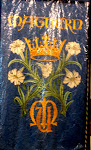
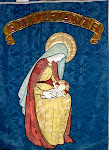
One thing we do know ,though, is that Arthrwys was a Christian and fought against the Saxons at Badon (Mons Badonis) under a banner of the Virgin Mary and her Son, and won, saving those areas for Christianity for at least another fifty years.
The Second thing which has been written about, regarding the role of the Christian Arthrwys and his war band, is the ‘clearing out ‘ of the early Welsh monks at Glastonbury and their Abbot COLLEN up to North Wales, taking with them many of the ancient artefacts, some say the original mysterious Grail, the ‘Royal Blood’ of Jesus of the House of David.
Jesus and Uncle Joseph of Arimathea (Ho Rama Thea) and the Glastonbury Connection
‘And I will give the wicked for his burial, and the rich for his death; for he practised no iniquity, nor craft with his mouth.’(Isaiah 53)
1)Only a male member of Jesus’ family could have claimed Christ’s body.(so it is likely that Joseph was an uncle or family member of Christ's)
2)Only a rich and important person could have come into Pilate’s presence to claim it. Joseph had been to Caerleon (ISCA SILURUM-Usk of the Silures) before on a tin trading mission for the Emperor Vespasian and was a miner. (notice in the Bible it says that the cave, the grave in which Christ was placed was one’ Which he had hewn himself’.(Matthew 27 verse 60)
3)In the wave of persecutions following on Christ’s death, William of Malmesbury says St Peter sent St Philip into Europe with Joseph of Arimathea and the Welsh Triads tell that Archiviragus (Caractacus’ family) gave them land at Garth Madrun (Talgarth) and land for a monastic settlement at Glastonbury.(Ynys Witrin)
The family remained at Talgarth and married into the local nobility, and became part of the family of Brychan, one of the three holiest in Wales (Triads)(after which Brecon was named.)
Llan-gollen
So Collen went to North Wales with the monks and settled on Dinas Bran. Collen established his won church at Llan-gollen. We might ask why the monks were cleared out-was it because they did, in fact have the famous artefact in their possession which they wanted to preserve from the Saxons at all costs? We may never know. It is likely , however, that there was a very good reason, and certainly Teilo, Padarn, and Illtud had the title ‘Guardians of the Grail’in Welsh sources. Was the choice of the fortress Dinas Bran a reason for this removal, apart from one of safety?
In the Welsh records, Arthrwys (Arthur)was betrayed by his nephew Mordred who had the affair with Gwynhafr, his 'white' queen. So there was no romantic French Knight!Fashionable for a Norman prior to add French interest! It was this adulterous relationship which sparked natural hatred between Arthryws and his nephew not all the ‘witchy’ things thrown in to make a good story. Gwynhafr, if Geoffrey is to be believed, ended her days at St Julians in the Monastery which had been built over the site of St Julian Julianus’s monastery. It seems that Derfel would have been one of these unsung heroes of Wales who preserved the faith in these deeds.
The Battle of Camlann
This was Arthrwys’ last battle against his nephew Mordred in which both died. Arthrwys and his band’s status was so high that his memory endures. He appears to have been the only committed Christian Chieftain and his legendary fight against the Saxons was revered by all the Welsh. In fact you could argue he was brought down by heartbreak and the sin of those near to him. Arthrys clearly also had a dedicated little army, inspired by his leadership and only seven of these survived the battle.Derfel was one.
Weltmȕde
This is a German term meaning ‘tired of life’ and after the dying Arthur is carried away by boat to be buried at Glastonbury (it seems at some stage-his wife is removed there later-it seems the Saxons were Christianised by then) Derfyl was heartbroken at the death of his leader and decided to embrace an earlier vocation and return to Llantwit Major for rest and recuperation and some time as a novice .He was probably inspired by that monastery's founder, St Illtud, who himself had been converted to Christianity by Trevethin and Caerleon's Saint Cadoc, who showed him the way of war was not the Christian way. Illtud, a Breton, became a great scholar and founded his monastery at Llan illtud Fawr)
St Derfel comes to Cwmbran and establishes two holy places, 'llans'
After his early training,he quickly received his holy orders and travelled to the Eastern Valley of Gwent to begin his Llan there, living as a hermit and then in a small community.
Saint Dials
In Latin, Derfyl is known as ‘Saint DUELLUS’ and so his first Chapel, now demolished and lying under the present ex police college, near Greenmeadow was one of his very first llans. Going out on the 'mass',the mission to ‘Baptise all men in the name of the Father, Son and Holy Ghost’, and leaving some brothers there at St Dials, he travelled on up to the Mynydd Maen and there they established another holy place, and that place became a place of pilgrimage for centuries and was much larger, perhaps in scope than St Dials.
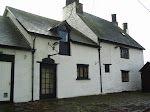
The Chapel was a sort of L shape with surrounding buildings, probably on the site of the present Llanderfel farm , where the brothers toiled to produce food, looked after sheep ,most probably ,the llan down at St Dial’s probably producing other crops, as corn was unlikely to have grown on the Mynydd Maen(The Stone Mountain). The brothers also kept cattle and, indeed there are reports of many people bringing in their cattle for blessing ad healing when they were ill.
The Opus Dei
They must have felt very close to God up there on the mountain, close to heaven. The office of the day was often sung in the chapel-the psalms learnt by heart and often accompanied by the harp. There may have been a book of gospels but Bibles, which the church had compiled a century earlier were not in common use expensive to produce, so religious learned the teachings by heart and able to read and write down the prayers at places like Llantwit Major, which would have had one. This was a common thing with the older bards, whose memories were prodigious.
This is also the case today in monasteries that monks can remember any number of psalms, which they sing day in and day out in praise of God-and in Latin. This was the common language of the Church throughout the world, although Derfel would have talked to the people about God in the ancient British language, and evangelised and explained this.The quality of the monk Gildas' Latin is very fine, much better than St Patrick's, who always found scholarship difficult.
It must have been wonderful in the stillness of a summer evening, hearing the hymns, sung to a harp from the top of the Mynydd Maen (Often called Twm Barllwm)with the sounds of the sheep and cattle in the background, looking way over to the River Severn (Roman River Sabrina-Celtic ‘Hafren’)When animals or people were sick, they consulted Derfel's monks. St Illtud his teacher was a renowned farmer and agriculturalist and also taught farming to his students, something very important for survival.Illtud had a gift for crop growing and animal husbandry, and Derfyl now passed all this on in his ministry to the people of Cwmbran.
Llanderfyl, North Wales
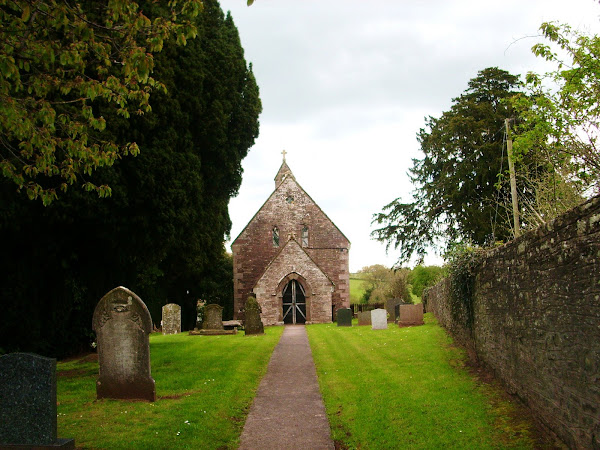
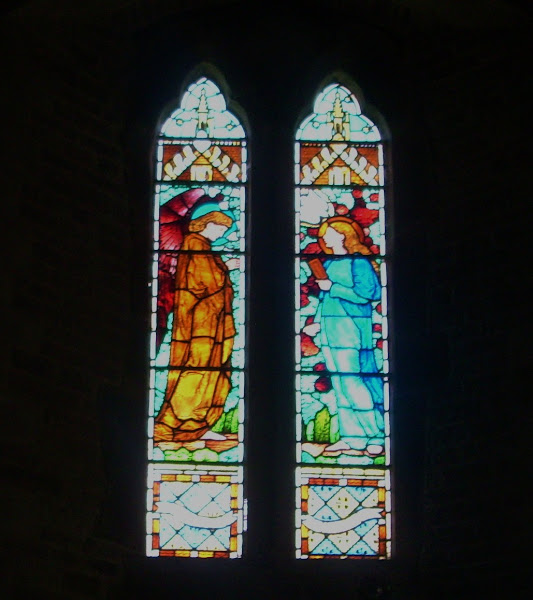
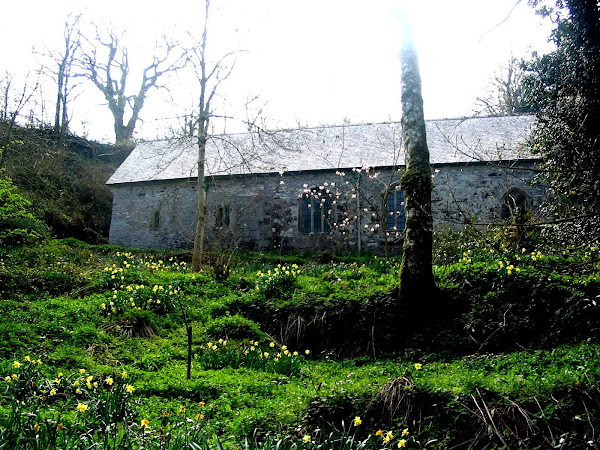
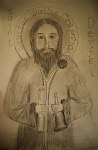
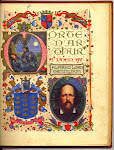
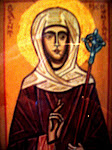
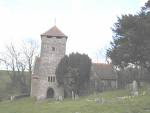
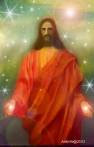
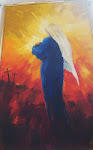
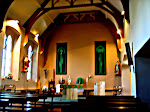
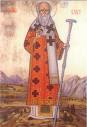
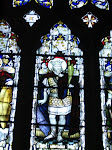
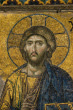
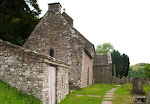
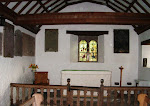
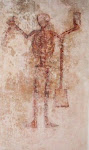
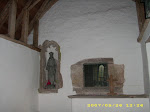
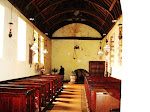
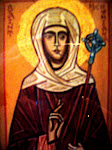
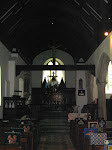
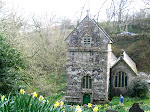
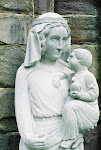
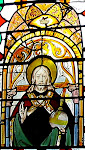
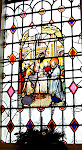
Derfyl’s brothers Dwyfael and Arthfael were both by now on the Isle of Bardsey, and families were very strong in Wales. It is likely then, that some of the brothers moved up from Llanderfel in Cwmbran , with Derfyl to North Wales, near Bala, where they established another llan. Here they did just that and it is from this St Derfyl’s now Anglican Church that you can see the tired and battle weary , broken hearted Derfyl being presented to the Virgin and the Child Jesus as an icon of the Church.(see above)
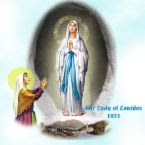
The Meaning of the Imagery of the Virgin
(The Old Testament describes the Ark of the Covenant which represented God as containing
1.The ROD OF AARON, showing the HIGH PRIEST
2. GOD’S WORD in the 10 Commandments tablets.
3) An URN with THE MANNA the physical food which God sent to save the Israelites from Death.
The Ark of the Covenant was destroyed when the Jerusalem Temple was destroyed by the ROMANS as foretold by Jesus. It has never been found. This was because the 'New Ark' had arrived.With the 3 o'clock Crucifixion and death of our Lord, there was thunder and lightning and the 'veil of the temple' was torn in half, symbolising that the barrier had gone between earth and heaven. The Church had been established and Chris's teaching was on the earth to point people to God.
New Ark
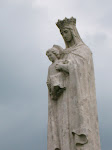
The human girl, Mary was a Vessel of God and carried in her womb, the ‘New Ark of the Covenant’
In her Womb (New Ark) was was contained
1.CHRIST THE HIGH PRIEST
2 THE WORD OF GOD as CHRIST
3 THE EUCHARIST the physical body and blood of Christ, with which he remains on earth until the 'end of Time'.(Matt 28:28 and St John 6:54-58)
Mary and Jesus, therefore are usually portrayed together in works of art. In addition this was the understanding of Mary by all at the time.
Derfyl’s ‘Ceffl’ at Llanderfyl
Like Teilo, Derfyl was portrayed as riding a stag. In the times when anything connected with Mary or the saints was dragged out of churches and destroyed, Derfyl’s statue was dragged out of both Llanderfyl in North Wales and also the statue at Llanderfyl and taken to London to be burned, and fulfilling a rather horrible prophecy. (Post on this coming soon)The Faithful of Cwmbran, and Llanderfyl supported all their ‘llans’ by offerings to God of ‘kyne, oxen and horses’ in return for the service of Derfel and his community-they were not offered to Derfel himself. It seems Derfel became a patron saint of these animals (praying for their health) in this farming community.
Last Days of Derfyl Gadarn
Approaching old age, Derfyl set out again for Bardsey with some brothers and there some Welsh writers have said he was Abbot of Bardsey when he died.(See Fisher/Baring Gould who quote Owen Jones that a place near Blaenau Ffestiniog callsed Llyd Dorfyl was his residence in his military days in that area 'Cymru' 1875, i, p 407)
Summing Up
In the early church of the Romanised Celts, people were named as saints by popular acclaim and the agreement of the Bishop of the diocese. Derfyl fulfilled all the requirements of a saint.It would have been Bishop St Teilo or St Euddogwy (Oudecceus) who declared him a Saint. St David was canonised by Pope Callixtus in the twelfth century for defending the Church's teachings and his day was kept as a principal feast throughout the Church in Europe until Henry VIII.
1.Fought for the Faith under a Christian Lord
2 He helped to safeguard the Christian tradition (and possibly more!) in with Arthryws, Bedwyr and Kai removing Collen and the Glastonbury brothers from danger (and some of those at Garth Madrun-reputedly of the family of Jesus, after Joseph of Arimathea(Ho Rama Thea)who was granted land there)
3 Had studied the Christian heritage and scriptures as taught at Llanilltyd.
4 He embarked on his ‘Green Martyrdoms’ in his missions, establishing his ‘islands’ in the manner of St Augustine of Hippo, and living in the Kingdom in the World, being a ‘Beacon of Light for Christ’ evangelising in a Life of Service to others.
He felt he had to atone for all the killing he had seen and done and hoped to build for a better humanity.
He died, shriven by the holy Church as was the practice at the time on Bardsey Island,the island of 20,000 saints which even today is difficult to visit, and where later a Benedictine Monastery was set up to pray for these saints. (Later torn down)
The Saints of the Valley
He truly is a good patron Saint for Cwmbran, and with our other surrounding patrons, Saint Cadoc (at Trevethin (Llangadog Trefeurthin)and Caerleon ,St Tegfedd of Llandegveth, St Non and St Michael the Archangel patron ofhangel of Llantarnam, one of which we can be proud.
Early Welsh Poem - (I dedicate it to St Derfel)Quoted from 'Celtic Spirituality (Welsh Poems)from 'The Classics of Western Spirituality (Oliver Davies-published by Paulist Press-Wonderful book!)
The first word I say
In the morning when I rise
'May Christ's Cross be my armour about me'
I shall put on the Lord's Protection today
A sneeze I hear
It is not my God;I will not believe in it
I shall arm myself splendidly,
And not believe in superstition, for it is not right.
He ,who created me will give me strength.
My mind is set on a journey.
My intent to put out to sea
A beneficial plan,a gift it will be.
A crow shall raise its wing.
Intending to go to Rome.
A beneficial plan it will be fine.
Saddle the bay mare with white nostrils!
Eager to run, with a rough coat
King of Heaaven, we will need God's aid.
Earth's company is burdensome, and thick the briar's leaves
Bitter the drinking horn of sweet mead.
Lord of Heaven, smooth out the way of my journey.
O Royal Offspring, Victorious Redeemer!¬
Peter Head of Every Nation
St Brigid, bless our journey! (excerpt from a Welsh poem)