













































 _____________________________________________________________________
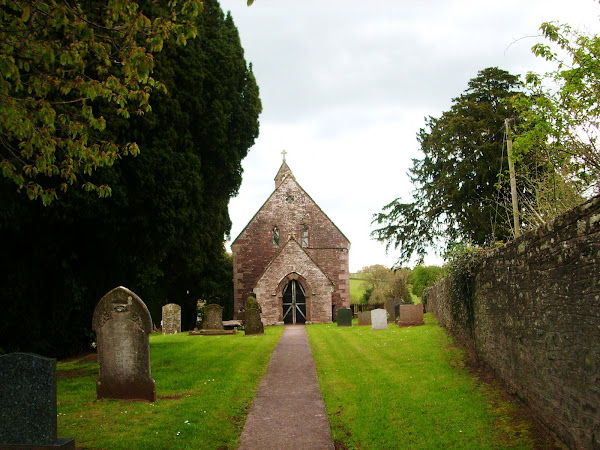
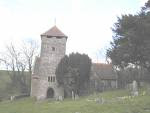
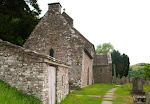
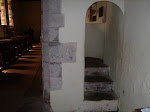
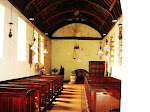
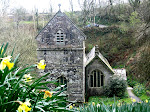
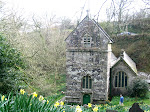
Holywell remains of great interest to Welsh Catholics and British Catholics generally. St Winifride one of the early young virgin saints, remains a Patron Saint of Wales. Holywell, built by Henry VIII's grandmother (the present shrine) remains in Mediaeval glory and has become known as the Lourdes of Birtain, because of the many miracles wrought by the prayers of St Winifride of her people in Wales. Ever since her martyrdom, in fighting off a rape attempt, she has continued to pray for Wales and its people. St Paul tells us nothing can stand in the way of the love of Christ for his people, especially those who love him as did St Winifride who had consecrated her life to his service. Somehow she survived the attempt to cut her head off and lived to become Abbess of the small monastery founded by St Beuno at Gwytherin, pictured in the recent 'Cadfael' episode 'A Morbid Taste for Bones'. The church at Gwytherin was seized at the Reformation by Henry VIII and has now been closed by the Anglican authorities because of a small congregation. This is a rebuild of the earlier church, which needed refurbishment.
There are two main Monmouthshire links with Holywell:
1. St Beuno, who according to one source received his theological training at Caerwent in the college of St Tatheus, as there was at that time no similar college in North Wales He returned there to begin to found his abbeys.
2. During the wrecking of the Monasteries and knockdown sales to wealthy landowners, many precious relics, vestments pyxes etc were taken there for safety, even some relics of St Winifride herself were carefully salted away by devout people, so that there were remains of these things for when the persecution would end. A cross and some vestments of Monmouth Priory were returned when the new Catholic Church was built at Monmouth, the first since the 'reformation'.
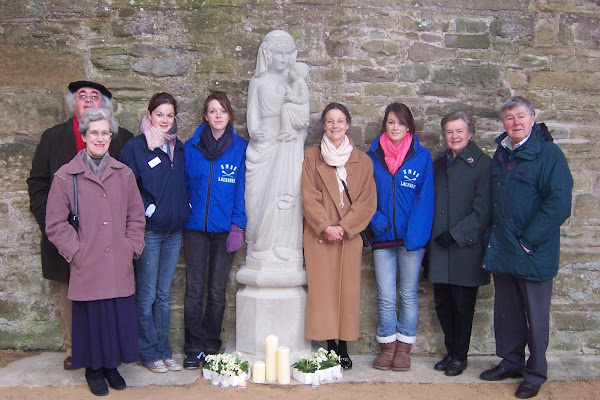
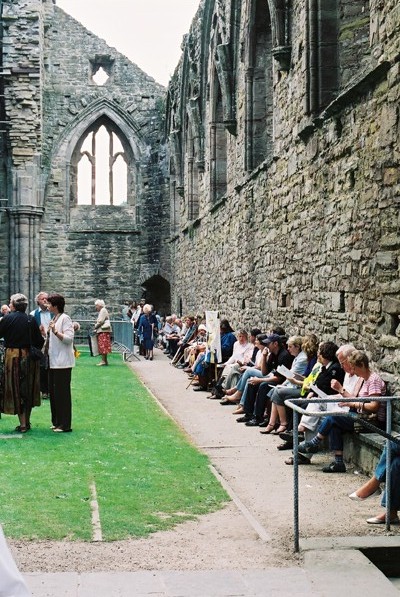
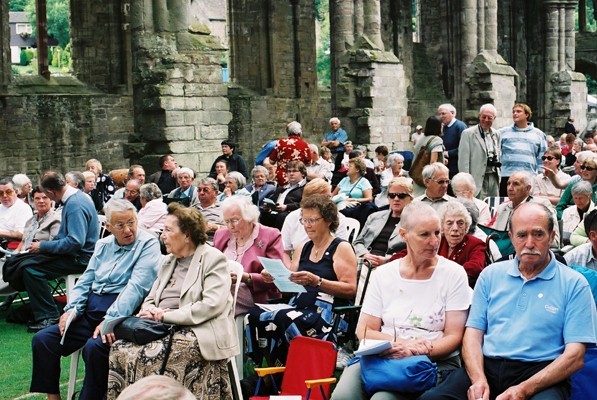
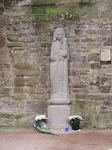
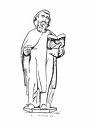
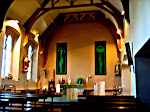
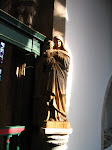
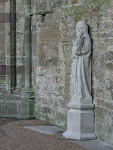
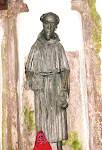
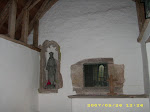
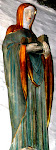
With this in mind, I set off last week to the National Pilgrimage, trying to recapture the essence of a mediaeval pilgrimage. I stayed the night before at the St Winifrid'es Guest house, although thunder and lightning assailed me as I drove up the M5/M6/M54 to Chester and then to Holywell. I had a very friendly greeting. I knew Mother Julia from my time at Maryvale and I was relieved to gt into my bedroom, quite snug but cosy and warm and with a TV! Not the thing for a pilgrimage I know. I was up early and went to Mass at St Winifred's Church right next to the Guest House and it was in the Extraordinary Form. I loved the singing and the reverence of it and it was very restful after a very stressful week. It was a the Feast of St Peter and St Paul , martyrs and apostles and a lovely celebration. Father Salvatore of the vocationist fathers celebrated Mass with the Deacons. To the right of the altar was the statue of St Winifride, beautifully carved representation of the Saint, with flowers and ready to be carried in procession that afternoon. After that I had a bit of a wait but decided not to go anywhere, as I would lose my car space. In a strange way, I found myself surrounded by Irish camper vans and people with big dogs. On chatting to them, I found some of them had travelled over from Ireland to this pilgrimage. The sun was out in glorious golden hue over the whole shrine, but it was so hot that many of the pilgrims had actualy seated themselves off the field in the shadows around the walls for shade- a very sensible thing as I understand from the St John's Ambulance people that many people faint every year in the son. So there were about 300 in the field around the shrine before the procession arrived. The people there were generally those with children. I had thought to bring a chair-my knee needed it. It really was hot, and there seemed to be no discipline as far as the children were concerned.Some of the language was quite 'choice'.
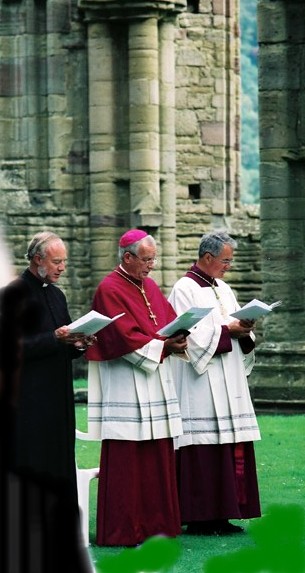
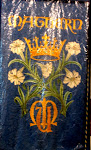
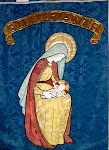
Anyway gradually at about quarter to 3 the procession came down. Leading it the children who had made their first communions this year from the diocese, followed by other notables, Knights of St Gregory, the Bridgettine Nuns, the Vocationist Fathers, Deacons, Bishop Regan and Bishop Salvatore with microphone intoning the rosary and singing the Ave Maria. It was a huge procession with hundreds of people and banners and very impressive.
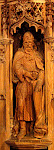
As the people filed in it began to fill up. The wheelchairs in the shade next to the well and other pilgrims also trying to find shady places to sit. I had a good view to start but was obscured by people standing in front of me, so I was constantly moving. The occasion was tremendous, but apart from 'Soul of My Saviour'I did not know the hymns at all, which was a shame as I love singing, but the behaviour of some pilgrims was disappointing -answering mobiles furing the liturgy of the Eucharist was a a big 'no no' and I had the feeling I was in an episode of Ballykissangel when I heard a woman say in a strong Eire accent'Oooh, mother, can't talk now, I'm at the holy well'on her mobile. In fact Bishop Regan was very patient and had to tell people they had to be quiet at the consecration.There was for that moment of consecration a huge and silent and profound stillness that settled on everyone. Then when the priests came out with the consecrated hosts it was suddenly a scramble and rather than lining up in the normal way, crowds of pilrims rushed around the priests rather like fish rushing to their food, but then I thought in a way it was wonderful -very biblical.At the end of Mass, Bishop Regan walked up to the shrine with the relic of St Winifride kept at the church. Stewards from the shrine allowed a few people in at a time and inside you can see pictured the beautiful display of candles , with prayers to God for which pilgrims had requested the Saint also pray. I remember thinking, 'St Winifride will be busy today!' On one wall were large candles with labels requesting help will illnesses , marriages, almost anything bereaved people etc.Flowers adorned the mediaeval statue and the scent of the flowers was quite intoxicating. It was moving to see the mixture of people, a huge contingent from Ireland. They had christened Holywell 'The Lourdes of the British Isles' . All milled together -men with Mohicans and tatoos, women dressed in hot pants and tea shirts ,Knights of St Columba, more well off people and the happy sense of Communion there.
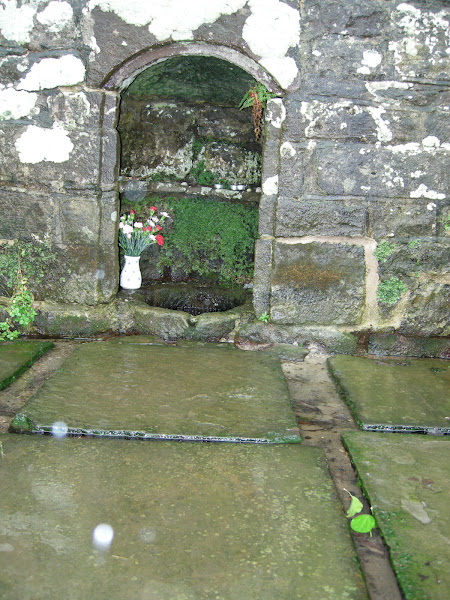
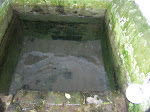
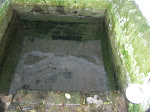
There were, of course, a number of people difficult to control. When people had finished venerating the relic of St Winifride, thereby thanking her for her sacrifice for Christ, the Rite of Bathing began. Father Salvatore tried to keep a lid on this and a number of people queued to walk into the icy water in their full clothes and pray for healing. Many prayed devoutly for healing. I had planned to but did think I had a long drive back to Gloucestershire and no way of drying myself, so I resolved to come back privately and ask Father Salvatore, perhaps before a session of prayers at the shrine.


 _________________________________________________________________________
Poor Father had his work cut out to 'police the pool'. Some children went into the bathing cubicles, came out and jumped into the pool of the well trying to swim, while the pilgrims were walking round praying.. He had to explain to children it was not a swimming pool, which disappointed them, but was not insured as such or was designed for this use.
There were some humerous moments. A lady came up to the small ante room and said 'Confessions?' to a big Irishman standing nearby. He smiled at her and she went in to make her confession only to find a rather bemused St John's Ambulance team inside. The ambulance man was heard to remark as she hurriedly left- 'Come back, I can do you a good confession!' Everyone laughed at his remark, even the lady. Then at one stage a man leapt out and dive bombed right in the middle of the pool, focing a lot of water out of the pool and splashing the pilgrims! Father Salvatore seemed to know him and called him out of the water. I did wonder at one point, whether the pool needed 'bouncers'.However the man seemed to be a bit mentally challenged, and so was sick and I hoped St Winifred would work for him as the people prayed.

_________
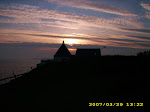
Finally the sun went down over the hills in a glorious red sky. The well lies right in the middle of a group of mountains and as I got back into the car and made my way down, I remembered the procession, the banners, the sound of all those people praying the rosary, the very beautiful Tridentine Mass in the Morning, the holy Bishop Regan, a Welsh speaker, the moment of the consecration, the candles, the flowers and the prayers and the friendship and care of the Bridgettine sisters. The pilgrims who had travelled from Ireland for long hours.Echoing in my head was the Victorian hymn to St winifred. In the nineteenth century when the wells were restored composers dug up all sorts of ancient tunes and texts. Here is one translated by E.Caswell, who I think was an Anglican clergyman. It is from the ancient pilgrims' hymn: VIRGO VERNANS VELUT ROSA
St Winifred
1.More fair than all the Springtime flowers
Embosom'ed in the dales
St Winifred in beauty bloomed
The rose of ancient Wales
2.With every loveliest grace adorn'd
The Lamb's unsullied bride
Apart from all the world she dwelt
Upon the mountain side.
3.Till Caradog with impious love
Her fleeting steps pursued,
And in her sacred maiden blood
His cruel hands imbrued.
4.He straight the debt of vengeance paid
Engulfed with yawning flame;
But God a deed of wonder worked
To her immortal fame.
5.For where the grassy mound received
The Martyr's severed head,
This holy fountain upwards gushed
Of crystal veined with red.
6.Here miracles of might are wrought;
Here all diseases fly;
Here see the blind, and speak the dumb,
Who but in their faith draw nigh.
7. Assist us glorious Winifred
Dear virgin, ever blessed
The passions of our heart appease
And lull each storm to rest.
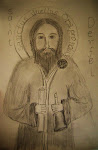
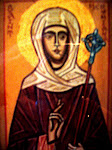
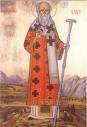
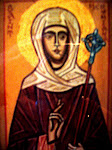
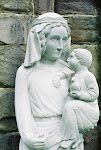
God is glorious in his saints, all saints canonised and not, and in his martyrs. St Winifride is always shown in statues and iconography with the palm of a martyr.